AS9100 Certified Shop Quoting Best Practices
I talk to AS9100 certified shop owners every week. Most of them got their certification to win aerospace work. Some of them are winning it. Most of them are quoting it wrong. They use the same quoting process they used for commercial work, add 20% for "aerospace complexity," and wonder why their margins are thinner than their tolerance bands. AS9100 certified shop quoting best practices are fundamentally different from general manufacturing quoting because the input is different: you are quoting from a technical drawing, not from a purchase order line item.
The moment you received your AS9100 certificate, the game changed. Your customers now send you multi-sheet PDF drawings with GD&T callouts, blanket tolerance standards, surface treatment specifications, and compliance requirements that did not exist in your commercial work. Every one of those specs affects your cost, and missing even one during the quoting process means you absorb the cost after winning the job. This guide covers the quoting practices that separate profitable AS9100 shops from shops that win aerospace jobs and lose money on them.
AS9100 Certified Shop Quoting Best Practices: The Drawing Is the Quote
Practice 1: Read the Entire Drawing Before Opening Your Quoting Spreadsheet
This sounds obvious but most estimators start typing numbers on Sheet 1 and work forward. They miss the surface treatment note on Sheet 7 that adds $3,000 to the outside processing cost. They miss the GD&T callout on Sheet 5 that requires a CMM setup their shop does not have.
Spend the first 15 to 20 minutes on a complete drawing preview. Identify the governing tolerance standard (ISO 2768mk or ASME Y14.5). Count the sheets. Flag every GD&T callout. Note the surface treatment requirements. Check for 3D model references. Look for classified holes on Boeing drawings. We cover the full drawing preview process in how to read aerospace technical drawings.
This preview takes 15 minutes and saves hours of rework when you discover a missed spec after submitting the quote.
Practice 2: Price Every Tolerance, Not Just the Dimensions
In commercial machining, you price the machining time. In aerospace, you price the tolerance. A bore at +/-0.1mm is a standard drilling operation. The same bore at +/-0.01mm requires precision reaming or honing, a different tool, slower feed rate, and possibly a dedicated setup. The dimension is the same. The tolerance makes it 3x more expensive.
For every feature on the drawing, ask: what tolerance governs this dimension? If it has an explicit tolerance, use that. If it does not, look up the blanket tolerance from the governing standard. We cover the size-dependent tolerance table in ISO 2768mk tolerance table for CNC machining and the Boeing-specific system in Boeing PVS drawing interpretation for subcontractors.
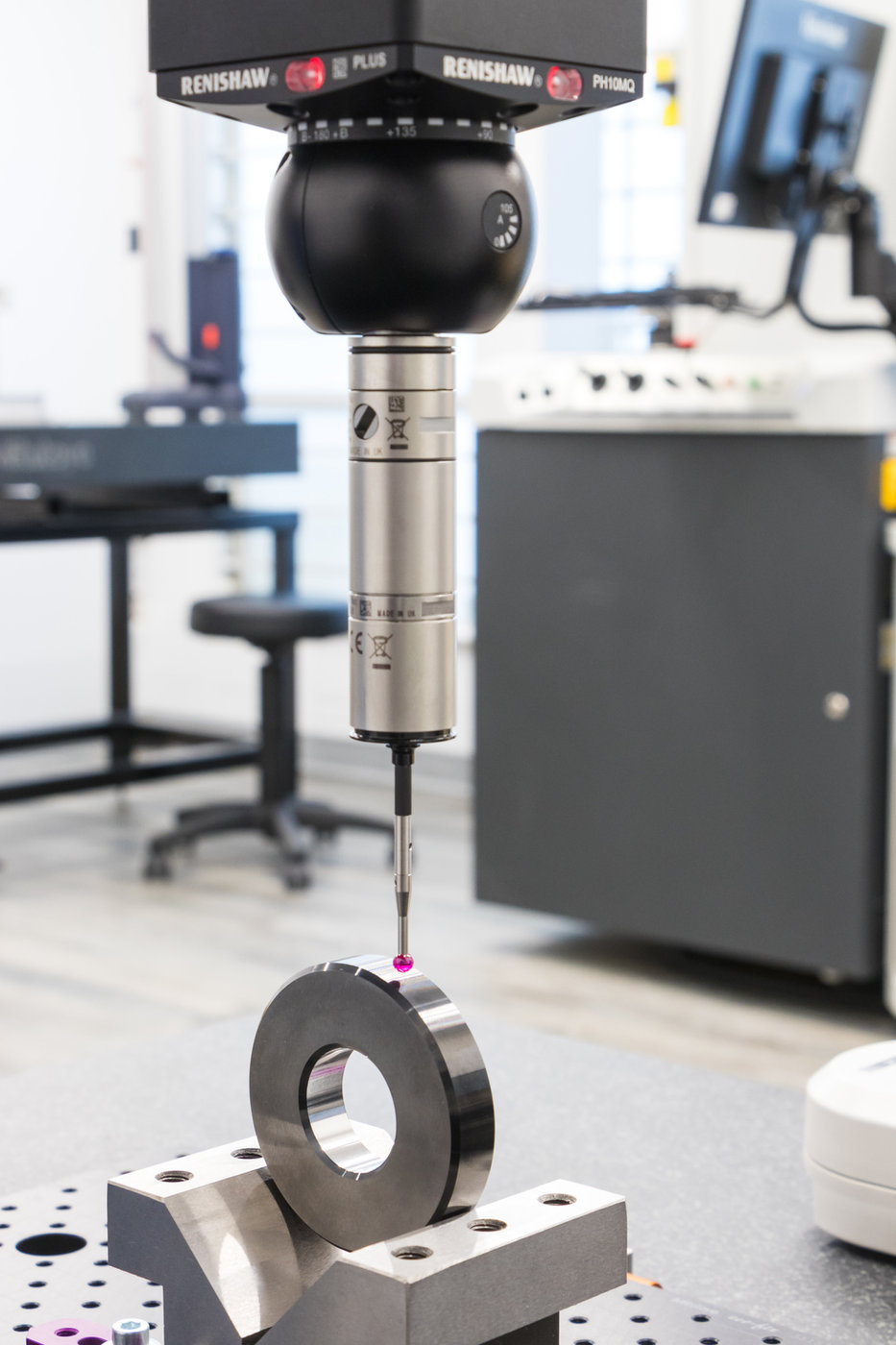
GD&T callouts deserve special attention. A positional tolerance of 0.010 with three datum references means a CMM inspection with full datum qualification. That is 15 to 20 minutes of CMM time per feature. If the drawing has 12 positional callouts, that is 3 to 4 hours of CMM time that you must include in the quote. We cover GD&T inspection time estimation in AS9102 Form 3 GDT callout inspection method guide.
STILL ANALYSING DRAWINGS MANUALLY?
Get 2 Hours back on complex drawings. Let AI balloon and interpret the drawing
Bring your hardest drawing. Watch it become a Form 3 live.
Practice 3: Quote FAI as a Separate Line Item
Most AS9100 shops absorb FAI cost into the unit price. This is a mistake. On a complex part, FAI preparation takes 4 to 8 hours of quality engineering time. CMM inspection takes another 2 to 4 hours. Documentation and submission takes 1 to 2 hours. Total FAI labor: 7 to 14 hours, costing $400 to $1,200 depending on your loaded rates.
If you absorb that into a 50-piece lot, you are adding $8 to $24 per unit to the piece price. On a 200-piece lot, it is $2 to $6. But if the customer only orders 10 pieces, the FAI cost is $40 to $120 per unit, which can wipe out your entire margin.
Quote FAI separately: "First Article Inspection per AS9102: $850." The customer knows FAI costs money. They budget for it. Hiding it makes your piece price look inflated compared to competitors who price FAI separately. We cover the full cost breakdown in AS9102 first article inspection cost estimation for aerospace shops.
Practice 4: Include Outside Processing in Your Lead Time and Cost
Aerospace parts almost always require outside processing: anodize, chemical conversion, heat treatment, NDT (non-destructive testing), plating. Each one adds cost and lead time. Each one requires a certified processor with the right NADCAP accreditation.
Before quoting, check whether you have a qualified vendor for every outside process the drawing requires. If the drawing specifies "Anodize per MIL-A-8625 Type II Class 1" and your anodize vendor only does Class 2, you need a new vendor. That vendor qualification process takes weeks to months.
Include outside processing as explicit line items in your cost estimate. Include the transport time (parts to vendor, wait, parts back) in your lead time. A common quoting mistake is estimating 4 weeks for in-house machining but forgetting the 2 weeks for outside processing, making your lead time 6 weeks instead of 4.
Practice 5: Build a Clarification Question List Before Submitting
Every aerospace drawing has ambiguities. Missing datums, unclear surface finish zones, 3D model references without the model provided, revision discrepancies between the drawing and the purchase order. Identifying these ambiguities and asking the customer before you submit the quote does three things.
First, it protects you. If you assumed a standard anodize when the customer wanted a precision anodize, your quote is wrong by $2,000. Asking first prevents the assumption.
Second, it shows competence. When the OEM receives a clarification list that includes "Please confirm whether Datum B applies at MMC or RFS" and "Drawing references 3D model for surface definition, please provide CATIA file," they know your shop understands the drawing at a technical level. This builds trust.
Third, it gives you time. Most customers extend the quote deadline for shops that send substantive technical questions. They would rather wait 2 extra days for an accurate quote than receive a fast quote full of assumptions.
Practice 6: Track Your Win Rate by Drawing Complexity
Most shops track overall win rate (quotes submitted vs jobs won). Few shops track win rate by drawing complexity. If you win 40% of your simple 1-2 sheet quotes but only 10% of your complex 5-7 sheet quotes, that tells you something: your quoting process breaks down on complex drawings.
The breakdown is almost always in the drawing extraction step. On complex multi-sheet drawings, your estimator misses specs, underestimates machining time on precision features, and submits a quote that is either too high (they added too much contingency for uncertainty) or too low (they missed a costly feature). Either way, you lose.
We cover the full quoting process for complex drawings in how to quote aerospace parts from 2D drawings and the drawing extraction bottleneck in quoting for aerospace subcontractors.
Practice 7: Budget for Partial FAI on Drawing Revisions
Your customer will revise the drawing. Not if, but when. And when they do, you will likely need a partial or full FAI on the revised parts. If your original quote only covered one FAI and the customer issues three revisions over the production life, you have absorbed two additional FAIs.
Include a clause in your quote: "Quote assumes current drawing revision. Drawing revisions requiring partial or full re-qualification will be quoted separately." This sets the expectation that FAI is not a one-time cost. We cover partial vs full FAI requirements in AS9102 partial FAI vs full FAI requirements.
Practice 8: Do Not Quote What You Cannot Inspect
Before committing to a quote, verify that you can inspect every characteristic on the drawing. If the drawing has a profile-of-surface callout with three datums and your CMM travel is 500mm but the part is 600mm, you cannot inspect it without a fixture or outsourced CMM.
If the drawing references ASME Y14.5 and your quality team only knows ISO 1101, there is a training gap. If the drawing requires surface roughness verification and you do not own a profilometer, you need to outsource the measurement or rent the equipment.
Discovering an inspection capability gap after winning the job is expensive and embarrassing. Discovering it during quoting gives you time to plan, price it, or decline the job. We cover the differences between the two major GD&T standards in ISO 2768mk vs ASME Y14.5 tolerance comparison.
The Real Cost of Getting Quoting Wrong
A quality engineer at an OEM-approved aerostructures manufacturer told me that Form 3 preparation alone takes 45 minutes to 1 hour per sheet. On a 7-sheet drawing, that is 5 to 7 hours. If that time was not in your quote, your margin just absorbed $300 to $420 in unplanned quality engineering labor. On a 20-piece lot at $200 per unit, that is a 7 to 10% margin hit from one line item you forgot to include.
A senior aerospace operations leader put it more bluntly: "If I save 40% time but still need the same team, ROI is weak. If I can reduce headcount dependency or double throughput, ROI is strong." The same logic applies to quoting: if your quoting process requires your most experienced person to read every drawing end to end, you have a headcount dependency. When that person is overloaded, quotes get delayed. When they are on vacation, quotes stop.
Mavlon Extracts the Drawing So Your Estimator Can Focus on Pricing
The biggest time sink in AS9100 quoting is not the pricing. It is reading the drawing. Your estimator spends 1 to 3 hours per drawing extracting dimensions, tolerances, GD&T, surface specs, and material requirements before they can start calculating cost. Mavlon does that extraction in seconds.
Upload the drawing. Get every spec extracted, every tolerance sourced, every GD&T callout identified with datum references, and every feasibility flag raised. Your estimator opens a structured summary instead of a raw PDF and goes straight to pricing.
Bring Your Drawing to a Demo to see what your estimator would have extracted in 2 hours, delivered in 30 seconds. First drawing free.