Quoting Custom Equipment Before the Design Exists
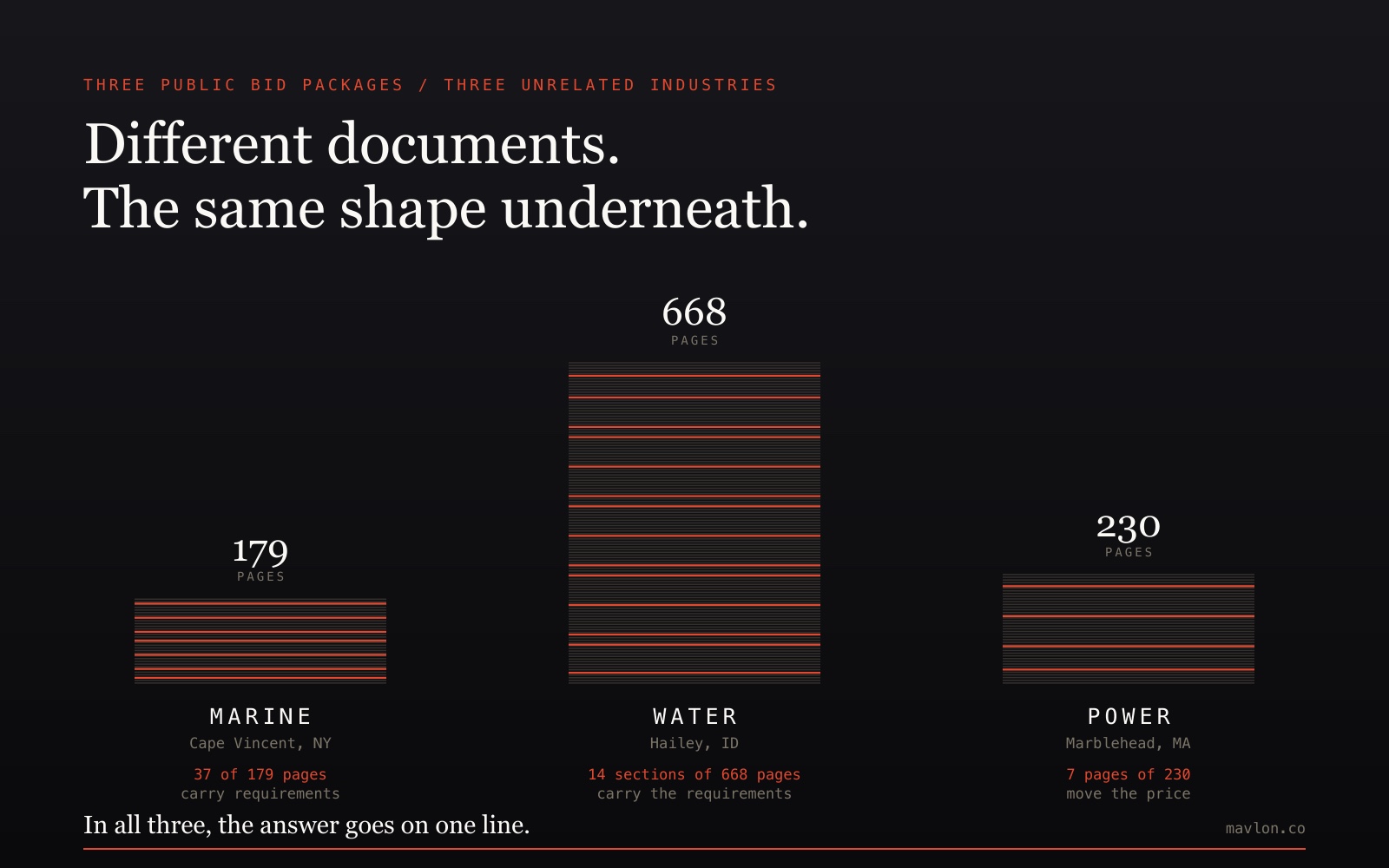
Three real bid packages, three unrelated industries, one shape. The document belongs to somebody else, your product is a minority of it, and the whole answer goes on one line.
I spent this year reading bid packages. Not software documentation, not analyst reports. The actual documents that land on an estimator's desk on a Tuesday with a deadline attached.
I did it because I am building software for this problem, and I do not think you can build for a job you have not sat with. What I did not expect was how little the industry mattered. I went in assuming that quoting custom equipment was a different exercise in marine fabrication than in water treatment than in electrical power, and that each one would need its own way of thinking. That turned out to be wrong in a way I find genuinely useful.
The vocabulary changes completely. The shape of the problem does not change at all.
The three packages
All three are public documents. Anyone can download them and check every number in this page.
| Package | Industry | Total pages | What the bidder actually supplies |
|---|---|---|---|
| Cape Vincent, New York. Waterfront improvements | Marine fabrication | 179 | An aluminium gangway and floating dock work, a modest part of a whole waterfront job |
| Hailey, Idaho. Water reclamation headworks | Water and wastewater equipment | 668 | Treatment equipment described across 14 separate sections |
| Marblehead, Massachusetts. Village Substation | Medium voltage power equipment | 230 | Two metalclad switchgear lineups and a control room |
A dock builder, a screen and pump supplier and a switchgear manufacturer have almost nothing in common. Different materials, different standards, different customers, different factories. Put their bid packages side by side and they are the same document wearing three costumes.
Here is what was true in all three.
One. The document was written by somebody who does not work for you
Not one of these packages was written by the customer. Cape Vincent's was prepared by the town's consulting engineer. Hailey's by the engineer for the water reclamation project. Marblehead's by an outside electrical power engineering firm.
That sounds like a detail. It is the root of everything else.
The engineer who wrote the document does not work for you, is not trying to make your quote easier, and is not being paid to. They are being paid to define what must be delivered and to protect their client. Every feature of the document that makes pricing hard follows from that: requirements scattered wherever they logically belong rather than wherever you need them, quantities on the drawings instead of in the text, and boilerplate carried across from a previous project because it was correct there.
Compare this to any other kind of selling. A catalogue business writes its own price list. A configured product has options its own team defined. Here the specification of what you are selling arrives from outside, already finished, and you do not get to negotiate its structure. You just have to read it.
Two. Your product is a minority of the document
This is the thing that surprises people who have never done it.
On the 668-page Hailey package, 14 separate sections carried requirements that changed the equipment price. On the 230-page Marblehead switchgear package, seven pages genuinely moved the number and the other two hundred and twenty three largely did not. On the 179-page Cape Vincent package, the gangway and dock scope was a modest slice of a much larger waterfront job.
So the estimator's first task is not pricing. It is search. And it is search without an index, because the relevant material is not gathered in one place and is not labelled for you.
The cruel part is that you cannot tell which pages matter until you have read them. A page of general conditions looks identical to a page of general conditions that happens to contain the warranty term, the liquidated damages exposure, or a line saying you are responsible for offloading and rigging at destination. The only way to know a page does not matter is to read it and decide it does not.
Three. The answer is smaller than the question
Two hundred and thirty pages of requirements at Marblehead, and the commercial answer is a single lump sum written on one line of the bid form. No breakdown by cubicle. No schedule of rates. One number.
Most packages in this category work the same way. You compress everything you read, everything you decided, and everything you guessed into one figure, and then you hand it over.
Two consequences follow, and both are expensive.
The first is that there is no line item to argue about later. If you left something out, the omission is inside the number, invisible, and the contract says you supply it anyway. You will usually find out during the job, not during the bid.
The second is subtler and costs the whole industry more. When several bidders answer the same package, their numbers get lined up in a column and compared as if they were answers to the same question. Often they are not. In the switchgear package the specification says to price two spare circuit breakers separately, and the bid form provides one blank line with nowhere to put a separate price. One bidder folds them in, another attaches them on a covering letter. Both read honestly. The tabulation flattens the difference into dollars and nobody can see it. The full walk through that package shows exactly where that happens.
Four. Silence is agreement
Bid forms in this category commonly ask the bidder to declare one of two things: the equipment offered complies with the contract documents, or it deviates and here is the list. Then they add the sentence that makes the whole thing bite. A bidder who declares neither is treated as having offered full compliance.
Read that as an estimator. If you say nothing, you have promised everything.
Every requirement on a page nobody reached is now a requirement you supply, at the price you wrote. This is the real reason reading matters in this business, and it is not because reading is virtuous. It is because the contract is constructed so that unread equals accepted. The same trap wears other clothes elsewhere: a phrase like or approved equal looks like it grants freedom, and the clause that governs it usually sits somewhere else and takes most of it back.
Five. The parts disagree, and reconciling them is your job
In every one of the three packages, the documents contradicted themselves somewhere. Not through carelessness. Through the ordinary process of assembling a specification from proven previous work, where a sentence that was exactly right on the last job lands slightly differently on this one.
At Cape Vincent the specification and the drawings disagreed in seven places, including one line asking for composite decking while another asked for timber. At Marblehead, the same rating appears as 68 kA peak on one page and 68 kA rms on another, in two sections of one document, when the governing standards say the equipment carries one convention or the other and never both.
Nobody flags these for you. There is no errata sheet. The disagreement sits quietly in the package and the first person to notice it is whoever reads carefully enough, which is the person who then gets to decide what to do about it.
And the correct thing to do is almost never to pick one. It is to ask, formally, before the question deadline, with the page references attached. An unresolved requirement is a question with a bracket around it. It is not a number you invented so the spreadsheet would balance.
Why quoting custom equipment resists the usual tools
Put those five together and you can see why the software that works elsewhere does not work here.
| Kind of pricing | Where the number comes from | Why it does not transfer |
|---|---|---|
| Catalogue | The product exists and its cost is known | Nothing here exists yet |
| Configured | A fixed option set with prices attached | The options are written by the customer's engineer, differently every time |
| Cost plus | Measured afterwards | You must commit before any work is funded |
| Takeoff | Counting quantities off drawings | Counting is the easy part; deciding what is in scope is the hard part |
Configure price quote software is genuinely good at its job, and I will say so plainly even though we compete near it. If your product is a catalogue with options, and pricing is a formula over known variables, a configurator will serve you better than we will. It has nothing to say about a 668-page document where the scope has to be discovered before it can be priced. Those are different problems and they need different machines.
Takeoff tools have the same boundary. They are built to measure quantities from drawings, which matters enormously in construction where the quantity is the job. In engineered equipment, the quantity is rarely the difficulty. The difficulty is knowing that the warranty runs from energization rather than acceptance, that the spare breaker has to fit two different cubicle sizes, and that somebody has to travel to site and assemble the thing.
Where the hours actually go
Ask an estimator in this category where a day goes and the answer is consistent: finding things, and deciding what they mean.
The arithmetic is not the bottleneck. Once the scope is genuinely settled, the pricing is comparatively quick, because most firms have decent rates, decent history and a workbook that does the sums. What takes the day is reading several hundred pages to work out what is being asked, chasing the same requirement through three places that state it differently, and making a series of judgement calls that nobody else in the building is qualified to make.
That last point is the one worth dwelling on. The person doing this work is usually senior. They are senior precisely because the job requires judgement. And most of their day is spent on the part of the work that requires no judgement at all, which is locating the material. Every hour spent searching is an hour not spent deciding.
There is a second cost hiding in that arithmetic, and it is the one nobody counts. Reading is also how you find out whether you should be bidding at all. The signals that say walk away are buried in the same pages as everything else: a delivery date your plant cannot hold, a liquidated damages clause priced for somebody larger, a specification written so tightly around a competitor's product that an equal is not really being invited, or a scope boundary that quietly hands you site work you do not do. None of that is visible from the cover sheet. So a firm that bids everything pays to read packages it was never going to win, and a firm that filters early filters on the wrong information, usually on the customer's name and the headline value. The only honest filter is several hours in, which means the bid or no bid decision costs real money whichever way it goes. There is also no feedback loop to correct you. Win or lose, months later, usually without being told why. A price that was quietly too low looks exactly like a price that was right until the job is half built. We wrote separately about why that missing feedback loop is the structural problem, and it is the reason experience in this field accumulates so slowly and leaves so completely when somebody retires.
What has to be true before a number exists
Across the three packages, the same four conditions had to be satisfied before anybody could responsibly write a figure.
- You know exactly what is being bought. Not roughly. Quantities, sizes, ratings, materials, finishes, and the boundary where your scope stops and somebody else's starts. Most of this is on the drawings rather than in the text, because the specification governs capability and the drawings govern how many.
- You know what governs it. The standards named, the testing required, the submittals, the warranty term and when it starts, the schedule obligations, and the commercial exposure if you are late. These live in the front sections that look like paperwork and are not.
- You know what is missing. The requirements the package does not settle, written down as questions with brackets on them, submitted before the question deadline rather than absorbed silently into the price.
- You know what it costs you specifically. Your rates, your plant, your suppliers, your current lead times. This is the only one of the four that is genuinely yours, and it is the one estimators are actually trained for.
Three of those four are reading problems. One is a pricing problem. The industry talks almost exclusively about the fourth.
The commercial terms that quietly set the price
Estimators are trained on the technical sections. The money often moves in the sections that look like paperwork, and in all three packages the same categories showed up.
When the warranty starts, not just how long it runs
Marblehead asks for coverage running 60 months from energization or 66 months from acceptance, whichever ends sooner. Read quickly, that is a five year warranty. Read properly, it is a warranty whose clock may not start when you ship. If the substation energizes a year after your equipment arrives on site, you are carrying an asset in somebody else's yard with your name on the risk. The number you reserve for warranty depends entirely on which of those two dates governs, and the difference is real money on equipment that ships more than a year after the order.
The gap between a firm price and a long delivery
The same package requires the bid price to stay firm for 60 days while stating a desired equipment delivery of 60 weeks after receipt of order. You commit to a figure now, and you buy the materials at whatever they cost much later. Whoever carries that gap has taken a position on the price of copper, steel and electrical components more than a year out, usually without saying so out loud and usually without a hedge behind it.
Work that is not manufacturing
Marblehead's summary of work runs past furnish and deliver into offloading and rigging the equipment onto the owner's foundation, and final assembly at destination. A manufacturer who prices this as equipment leaving the loading dock has omitted crane time, a travelling crew and site assembly. For a shop whose normal business ends at the dock, that is an entire cost category living inside a section that reads like housekeeping.
Evaluation costs you pay before you win anything
The owner may inspect the bidder's factory as part of evaluating bids, including a meeting with the proposed design team. A design review meeting may be held at the vendor's own offices. A detailed manufacturing schedule with thirteen named milestones is due within four weeks of award and reissued monthly. None of these is dramatic on its own. Together they are engineering and management hours that appear on no line item and are recovered only out of the single lump sum.
The pattern generalises. Whenever the front sections of a package feel like boilerplate, that is exactly where to slow down, because boilerplate is where an owner's risk gets transferred to a bidder who did not price it.
What a good question to the engineer looks like
Since every one of these packages contained something the documents did not settle, the ability to ask well is a real commercial skill, and most estimators are never taught it.
A weak question sounds like a complaint, arrives late, and invites a one word answer that helps nobody. A good one does four things at once. It quotes the exact wording. It cites both page references so the engineer can see the conflict without hunting. It states the two readings and what each one implies for the equipment. And it proposes the resolution you believe is correct, so the engineer can agree rather than start from nothing.
Take the momentary current ambiguity in the switchgear package. The weak version is to ask which figure applies. The strong version says: section 26 13 26.21 gives the assembly a rated momentary current of 25 kA rms on page 61, while the breaker in that same section is given a closing and latching capability of 68 kA peak on page 65, and the corresponding line in section 26 13 26.31 reads 68 kA rms on page 91. We read the intent as a closing and latching duty derived from the 25 kA short time rating, and we propose to quote on that basis unless advised otherwise.
That question is answerable in a sentence. It also does something quieter and more valuable: it puts on record, before the bid, that you read the document properly. Engineers remember which bidders asked intelligent questions, and on the next package that memory is worth more than a small price advantage.
The discipline is simply to keep the list as you read, rather than trying to reconstruct it at the end. By the time the package is finished the questions are already written, and the only remaining job is deciding which are worth the engineer's time.
A checklist that works in any of these industries
If you are handing this to somebody new, this is the short version, and it held on all three packages.
- Find the bid form before you read anything else. Count the blanks. The shape of the answer tells you how much room you have, and if the form and the specification disagree about what gets priced separately, you have found your first question.
- Find the deviations clause and read what happens if you stay silent. Decide deliberately whether you are taking exceptions rather than discovering later that you did not.
- Build the scope from the drawings, not the prose. Specification governs capability, drawings govern quantity, and quantity is most of the money.
- Treat near-identical sections as hostile. Where a package carries two similar items, read the second slower than the first, not faster.
- Collect the scope that is not equipment. Rigging, site assembly, travel, factory inspection, schedule reporting, warranty reserve, bonds. Each is small. Together they are the margin.
- Write down every question and send them early. The deadline for questions always falls well before the deadline for bids, and an unresolved requirement priced as a guess is the single most expensive habit in this business.
What software changes, and what it does not
I will be direct about both halves, because the useful half only means something if the other half is stated honestly.
What software can genuinely take off a person: finding every requirement in the document that changes the price, citing each one to the page it came from so it can be checked in seconds rather than trusted, noticing where two parts of the package disagree and putting both in front of a human instead of silently averaging them, and carrying the arithmetic once the scope is settled. That is the bulk of the hours, and none of it is the part that needs judgement.
What it cannot do, and what I will not claim: decide your margin, decide whether you bid at all, resolve a genuine ambiguity in the documents, or know a thing the documents never stated and nobody wrote in a workbook. Those are yours. A system that produces a confident number on a package that cannot responsibly be priced has not solved the problem, it has hidden it. The honest output in that case is a structured refusal: these documents do not settle the following items, here is what we would need, here is a bracket on each.
Why we are building Mavlon
We are building the best reader of bid packages in the world. That is the whole company, stated plainly.
Not a configurator, not a catalogue pricer, not a workflow tool with a quoting tab bolted on. A system whose entire purpose is to take the document set your customer sent, find every requirement that changes the price, cite each one to its page, and put the contradictions in front of the person who is qualified to resolve them.
We made that bet deliberately, and the three packages above are why. The shape of this problem does not change between marine fabrication, water treatment and power equipment. The nouns change. The work does not. That means a machine built for the work, rather than for one industry's nouns, is worth building once and worth building properly.
We hold ourselves to the same standard we ask of the documents. We publish the exam we ask to be tested against, with the pass bar agreed in writing before anything runs, and we publish what we get wrong. If you want to see the method applied to a real document end to end, the 668-page treatment package and the 230-page switchgear package are both written up in full.
Talk to the person who built it
If your team prices work from documents like these, the quickest way to find out whether we are useful is a conversation. Nothing to send, nothing to prepare, no procurement process to open. Just a call with the founder.
Book a demo