AI Quoting Software for Manufacturing: 2026 Buyer Guide
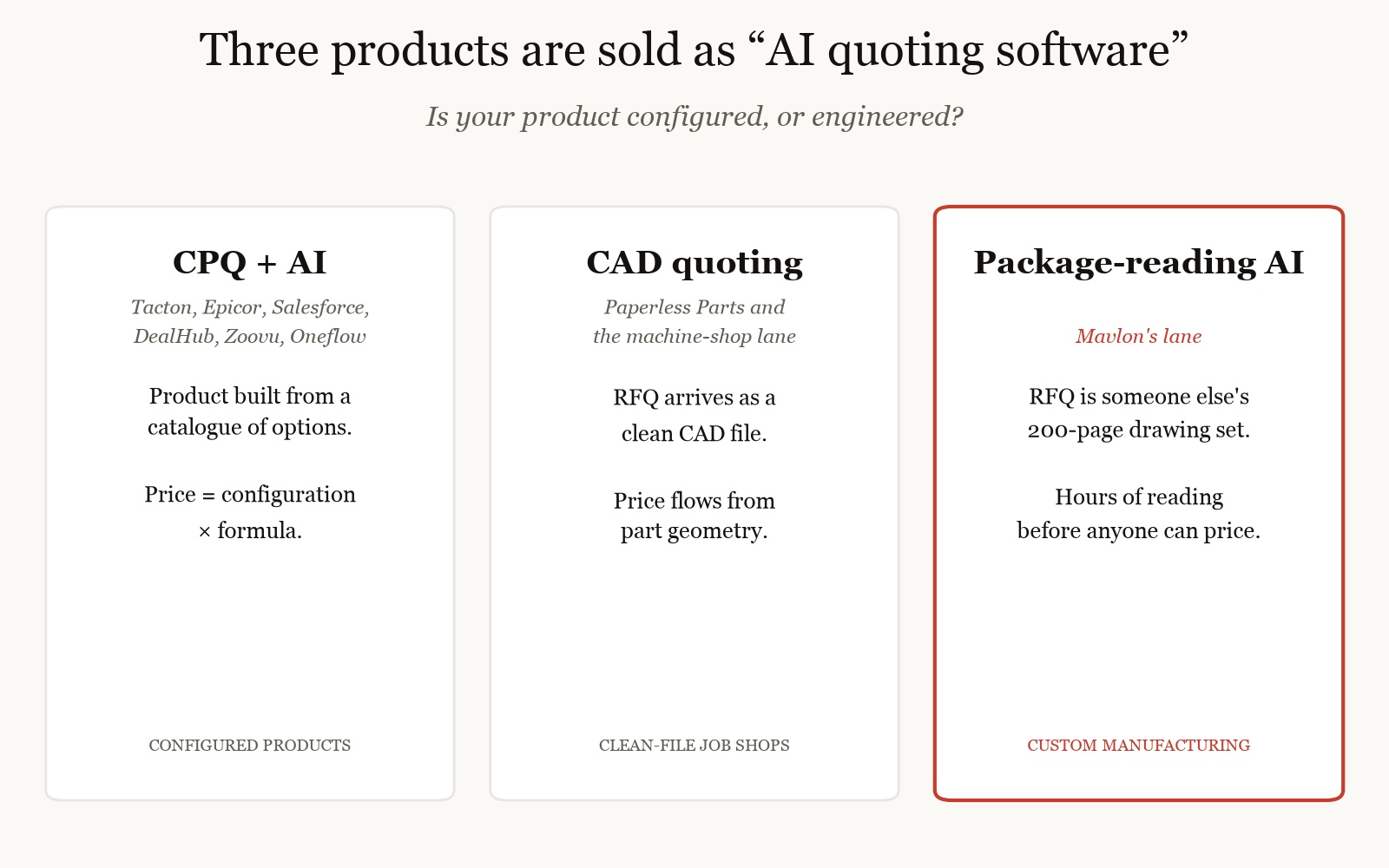
Search for AI quoting software and the first page hands you listicles of CPQ platforms: Tacton, Epicor, Salesforce Revenue Cloud, DealHub, Zoovu, Oneflow, Threekit, Logik.io. All real products, all genuinely useful, and if you manufacture custom equipment from someone else's drawings, quite possibly all wrong for you, because none of them can read the 200-page bid package sitting in your inbox.
This guide exists to untangle that. The phrase "AI quoting software" is currently sold as one category, but it covers three different products solving three different problems, and which one you need comes down to a single question about your business. We will sort the tools into their real lanes, tell you plainly where each lane wins, and then go deep on the lane we know from the inside, including how an agentic quoting engine actually works and where the human estimator stays permanently in charge.
AI quoting tools for manufacturing: three products, one name
Lane 1: CPQ with AI features. Configure, price, quote platforms assume your product already exists as a structured model: a catalogue of options, compatibility rules, and pricing formulas. The salesperson (or the customer) picks options; the system computes the price and generates the document. AI has arrived in this lane as guided selling, recommendation, and document intelligence layered on the configurator. Tacton, Epicor CPQ, Infor CPQ, Salesforce Revenue Cloud, DealHub, Oneflow, Zoovu, Threekit, and Logik.io live here.
Lane 2: CAD and geometry quoting. Built for job shops whose RFQs arrive as clean CAD files. The software reads part geometry, estimates machining or fabrication operations, and prices from the model. Paperless Parts is the best-known name; we compared this lane in detail in our manufacturing quoting software guide.
Lane 3: Bid-package reading AI. Built for manufacturers whose RFQs arrive as another company's documents: a consulting engineer's drawing set, a municipal spec book, an addendum trail. Nothing is structured, nothing is your format, and the expensive work is reading. This is the newest lane, and it is the one Mavlon builds for.
The one-question fit test
Here is the honest division, and we will state it against our own interest first: if your products are formula-based and catalogue-based, the CPQ lane is better than us. If a pump configuration, a window size, or an options sheet fully describes what you sell, a configurator with AI assistance will price it in seconds, enforce your rules, and generate flawless documents at a volume no reading engine matches. Buy the CPQ. The same goes for the geometry lane: clean CAD in, quote out, a solved and well-served problem.
But if you do custom manufacturing, the kind the industry sometimes labels engineer-to-order, where every bid arrives as a multi-page package with its own one-off configuration, where an estimator spends hours reading, analyzing, and part-designing before a single number can exist, then the configurator has nothing to configure. There is no options catalogue for a dock nobody has built yet. The bottleneck is not arithmetic; your spreadsheets and wizards already do the arithmetic in minutes. The bottleneck is the reading, and that is where a bid-package reading engine earns its keep.
| Your situation | Right lane | Representative tools |
|---|---|---|
| Product assembled from a catalogue of options; price = configuration x formula | CPQ with AI | Tacton, Epicor CPQ, Infor CPQ, Salesforce Revenue Cloud, DealHub, Oneflow, Zoovu, Threekit, Logik.io |
| RFQs arrive as clean CAD files; price flows from part geometry | Geometry quoting | Paperless Parts and the machine-shop lane (full comparison) |
| RFQs arrive as third-party drawing sets and spec books; hours of estimator reading per bid | Bid-package reading AI | Mavlon; DIY chat-assistant builds (see below) |
| You want should-cost benchmarks from 3D models, as a buyer | Cost simulation | aPriori, Costimator (a different question entirely) |
One more entry deserves honest treatment because it is what many shops actually try first: building your own quoting assistant on ChatGPT or Claude. It is a rational experiment and it teaches you a lot. It also hits a predictable ceiling: a chat window cannot ingest a large plan set with page-cited extraction, requirements scattered across hundreds of pages fall out of context, the reading varies run to run, and gaps get filled with plausible-sounding guesses instead of flags. We wrote up exactly what breaks when you use ChatGPT on real bid packages; the summary is that it is a pipeline problem, not a prompting problem. For the full build-or-buy treatment, including where the DIY build genuinely wins, see our ChatGPT quoting assistant guide.
The CPQ lane, tool by tool, honestly
Because most readers arriving at this page came from a CPQ listicle, here is our honest one-line read of the names you saw there, from their public positioning. These are competent products in their lane; the only mistake is buying them for the wrong problem.
| Tool | What it is best known for | Fits you when |
|---|---|---|
| Tacton | Deep manufacturing CPQ, strong constraint-based configuration for complex industrial products | Your complex product is still, ultimately, configured from a model |
| Epicor CPQ | Visual, CAD-connected configuration inside the Epicor ecosystem | You run Epicor and sell configurable products with drawings generated from rules |
| Infor CPQ | Configuration tied into Infor ERP environments | Same story, Infor shops |
| Salesforce Revenue Cloud | Quote-to-cash inside the Salesforce estate | Your quoting pain is process and approvals, not reading documents |
| DealHub, Oneflow | Sales-side quote generation, approvals, e-signature, document workflow | Your bottleneck is the selling workflow around a known price |
| Zoovu, Threekit, Logik.io | Guided selling, 3D visual configuration, and configuration intelligence layers | Buyers self-configure your catalogue and need help choosing |
Notice what every row has in common: the product being quoted already exists as structured data before the quote begins. That assumption is the whole lane. It is also exactly what custom-fabrication work does not have, which is why a shop that quotes from consulting engineers' plan sets can implement the best CPQ on this list and find its estimators reading exactly as many pages as before.
How a bid-package reading engine actually works
Everything in this section describes the engine we have built and run, not a concept. We spent this year building it from the ground up and battle-testing it against real filed quotes, and the architecture below is what survived contact with real packages.
The pipeline has three phases: identify, check, price.
Identify. The engine ingests the whole package: plan sets, specification books, addenda, cover emails. Where a PDF carries embedded vector text, that text is treated as ground truth and extracted deterministically, page by page, because it is complete and never hallucinates. Where pages are scans, vision models read them, in overlapping tiles at real resolution, because a full-size drawing sheet squeezed into a vision model's input silently becomes unreadable. Every extracted requirement carries a citation to the exact page it came from. In the product, that principle has a name on the screen: EVERY WORD, AS WRITTEN. A value without a page behind it does not exist.
Check. Real packages disagree with themselves. The specification says one decking material, a drawing note says another; the spec says "see plans" and the plans never print the number; two sheets give the same structure two lengths. The engine's job in this phase is to surface every such conflict rather than quietly pick a side. On a public 179-page municipal package we use as a demonstration, the engine extracted 214 cited statements in under a minute and flagged 7 places where the documents disagreed with each other, including one where two documents specified two different decking materials for the same structure. Any estimator who has been burned by a conflict found after award knows what that list is worth.
Price. The engine drafts the quote in the manufacturer's own pricing logic, their rates, their formulas, their line-item format, never a cost model of ours. This matters enough to repeat: the pricing knowledge is the manufacturer's asset, and the engine's job is to apply it to a correctly-read package, not to replace it. The output is what we internally call a priced argument: what and how much, with the assumptions stated; which decisions belong to the estimator; and where every number came from, traceable back to the page.
Why reading is the hard problem (and arithmetic is not)
A fair question at this point: if the shop's own spreadsheets already do the arithmetic, how hard can the reading really be? Having built the reading engine, here is what the problem actually contains, because this is where AI quoting claims most need grounding.
Half the pages are scans. In the real packages we process, a large share of customer pages carry no digital text at all, and a scanned D-size drawing sheet pushed whole into a vision model lands at an effective resolution where annotations become unreadable and extraction silently returns nothing. The engineering answer is unglamorous: detect the text layer where it exists and treat it as ground truth, and tile the scanned sheets into overlapping regions at real resolution so nothing is read through a keyhole.
Dimensions belong to arrows, not to nearby text. On a crowded drawing, the number 45.00 might be a span, a site coordinate, or the length of the structure two inches away on the sheet. Plain text extraction cannot tell. The engine resolves dimension ownership visually, following leader lines on the actual drawing region, and abstains when the arrow is genuinely ambiguous, because a wrongly-attributed dimension becomes a wrongly-priced structure.
The number you bill is often not printed at all. Real packages say "clear span: see drawing" and the drawing never prints it; the span exists only as coordinates in a working-point table or a gap between two other dimensions plus stated bearings. Estimators reconstruct these in their heads. An engine has to do the same geometry with receipts, and a drawing frequently offers several true lengths for one structure, bearing span, fabricated length, overall length, where choosing the right one to quote is knowledge, not print.
Reading must be repeatable. Ask a general-purpose model to read the same crowded package twice and you can get two different readings; on ambiguous documents the variance is a property of the package itself. The engine's answer is layered determinism: deterministic extraction wherever text exists, cached answers for every resolved question so identical inputs never re-roll, and consensus passes with explicit voting where genuine ambiguity remains, surfaced as flags rather than averaged away.
None of this appears in a demo on a clean two-page RFQ. All of it decides whether the tool survives its first real 200-page package, which is why our evaluation advice below insists on testing with your ugliest bids, not your prettiest.
Where the human stays in charge, permanently
This is the section that matters most if you are evaluating any AI quoting software for custom manufacturing, ours included, because the vendor claims in this category regularly imply a level of autonomy that would be reckless in practice. In custom manufacturing, a large share of quoting decisions depend on human knowledge and judgment that no model holds, and a well-designed engine is built around that fact rather than in denial of it.
Concretely, in the product we run:
- The big calls are surfaced, not made. The draft presents the highest-dollar-impact decisions to the estimator explicitly, each with the evidence for the alternatives and one signed figure per option. When a package genuinely supports two readings, the estimator sees both, priced both ways, and chooses. The screen label is blunt about whose job this is: FOR ESTIMATOR REVIEW.
- Unknowns become questions, never guesses. When a load rating is absent, a dimension is undrawn, or a specification requirement has no stated criteria, the engine files it under an explicit list, Ask the customer, with what is at stake in dollars. Some things exist in nobody's documents: a per-project engineering judgment, a wave-load assumption, a client's tolerance for alternates. Those are human decisions by nature, and pretending otherwise is how AI quoting goes wrong.
- Every line is verifiable in one click. Beside each extracted requirement, the estimator can jump to the evidence: See it on the drawing shows the exact region of the exact sheet, with the wording boxed; the full page is one more click. When the source is a scan, the product says it is a scan instead of pretending to a precision it does not have.
- The estimator edits with a safety net. The draft is editable the way a senior reviews a junior's work, and the product keeps the original: RESET TO AS-GENERATED is always there. The machine's read and the human's judgment stay distinguishable.
- Margin belongs to the human. The engine never decides what a job is worth to your business. It gets the reading right and the arithmetic right; the final number, the risk appetite, and the walk-away call stay where they belong.
Our own view, having built the thing: the estimator is not the component AI replaces, the estimator is the customer. What gets replaced is the first read, the hours of extraction and cross-checking that happen before judgment can even begin. Reading week one becomes reading hour one; the judgment stays yours.
What using it actually looks like, end to end
A concrete walkthrough of the product we run, so the words above stay attached to reality. The estimator uploads the package, everything, drawings, spec book, addenda, the cover email. The run screen tells the truth about state: a queued package says it is queued, not running; cancelling a run stops the work but never deletes the upload. For a full package, reading takes minutes, and the progress shown reflects what the engine actually did, not a narrated guess.
The draft opens as a working document with the whole record behind it. The first pass answers what and how much: the product schedule the engine assembled, each structure with its dimensions, materials, loads, and count, each traceable to its pages, and the priced lines in the shop's own format with rates and assumptions stated openly. A line the shop's logic cannot honestly price, freight to an unfixed destination, say, prints as TBD rather than a hallucinated number, because a real quote says TBD there too.
The second pass is the estimator's queue: the decisions worth their attention ranked by dollar impact, the open questions for the customer with the stakes attached, and the conflicts the documents carry. The third pass is the full record, every extracted statement with its citation, the reasoning laid out, nothing summarized into unverifiability. Review feels like marking up a junior's work: fast where the engine is obviously right, careful where it flagged its own doubt, and always reversible.
What we deliberately did not build
Boundaries are features in this category, so ours are stated plainly. The engine does not do structural design and does not originate engineering method: your engineer designs, reviews, and seals every job, and anything that smells like a design decision is routed to a human as a question. It does not send quotes to anyone; every draft is reviewed by your team, and the decision to submit is a person's. It carries no cost models of ours to quietly override yours. And it does not pretend to certainty it lacks: scans are labeled as scans, unresolved ambiguities stay visibly unresolved, and the estimator can always distinguish what the machine read from what a human decided.
On economics, one honest note, because buyers ask: engines like this run on the strongest available models, and we learned early that trading model quality for per-run cost is a bad bargain, since the cheapest wrong quote is more expensive than every API bill combined. The per-package cost of a serious reading run is a rounding error next to the estimator hours it returns.
What honest evaluation looks like
Whichever lane you land in, evaluate the same way. Ask every vendor, us included, these questions:
- Can I test it on my own past bids, blind? The honest protocol: a set of your filed packages with the quotes held back, the tool prices them cold, and you compare against numbers you already know were right, with the pass threshold agreed in writing before anything runs. A vendor who resists blind testing is telling you something.
- Where do the numbers come from? If the answer involves the vendor's own cost model, ask whose logic wins when it disagrees with your estimator. For custom work, the only defensible answer is: yours.
- What happens on an ambiguous package? The revealing question. The right answer involves flags, questions, and both-ways pricing. The wrong answer is a confident number.
- Can every value be traced to its page? If the tool cannot show your engineer where a number came from, your engineer will re-read the package anyway, and the time savings evaporate.
- What does it refuse to do? Every honest tool has a stated boundary. Ours: the engine does not do structural design, does not stamp drawings, and does not send anything to anyone; your engineer designs and seals, your team reviews every draft, and the final decision on every quote is a person's.
Public data backs up how much this discipline matters. On one public Florida letting we analyzed, six contractors priced an identical 4,000 SF floating dock between $110 and $300 per square foot, a 2.7x spread on the same documents. The spread was not a materials story; it was a reading-confidence story, and the bidder who could price without padding for doubt took the $2.6 million contract. The full breakdown is in our floating dock cost analysis, and it is the clearest public picture we know of what uncertain reading costs.
The bottom line, by shop type
If you sell configured products from a catalogue: buy a CPQ, and buy the AI-assisted tier if guided selling helps your channel. The tools ranking on page one for this category, Tacton, Epicor, Salesforce, DealHub and their peers, are mature and will serve you well; our only advice is the evaluation checklist above.
If you are a job shop with clean CAD inbound: the geometry lane exists for you, and our eight-tool comparison covers it honestly, including where Paperless Parts beats us.
If you are a custom manufacturer whose every RFQ is a fresh multi-page package: you are the shop the CPQ listicles forgot, and the reading engine lane was built for you. We are one vendor in it; test us the same blind way you would test anyone.