Epicor CPQ Alternative for Custom Manufacturing: 2026 Guide
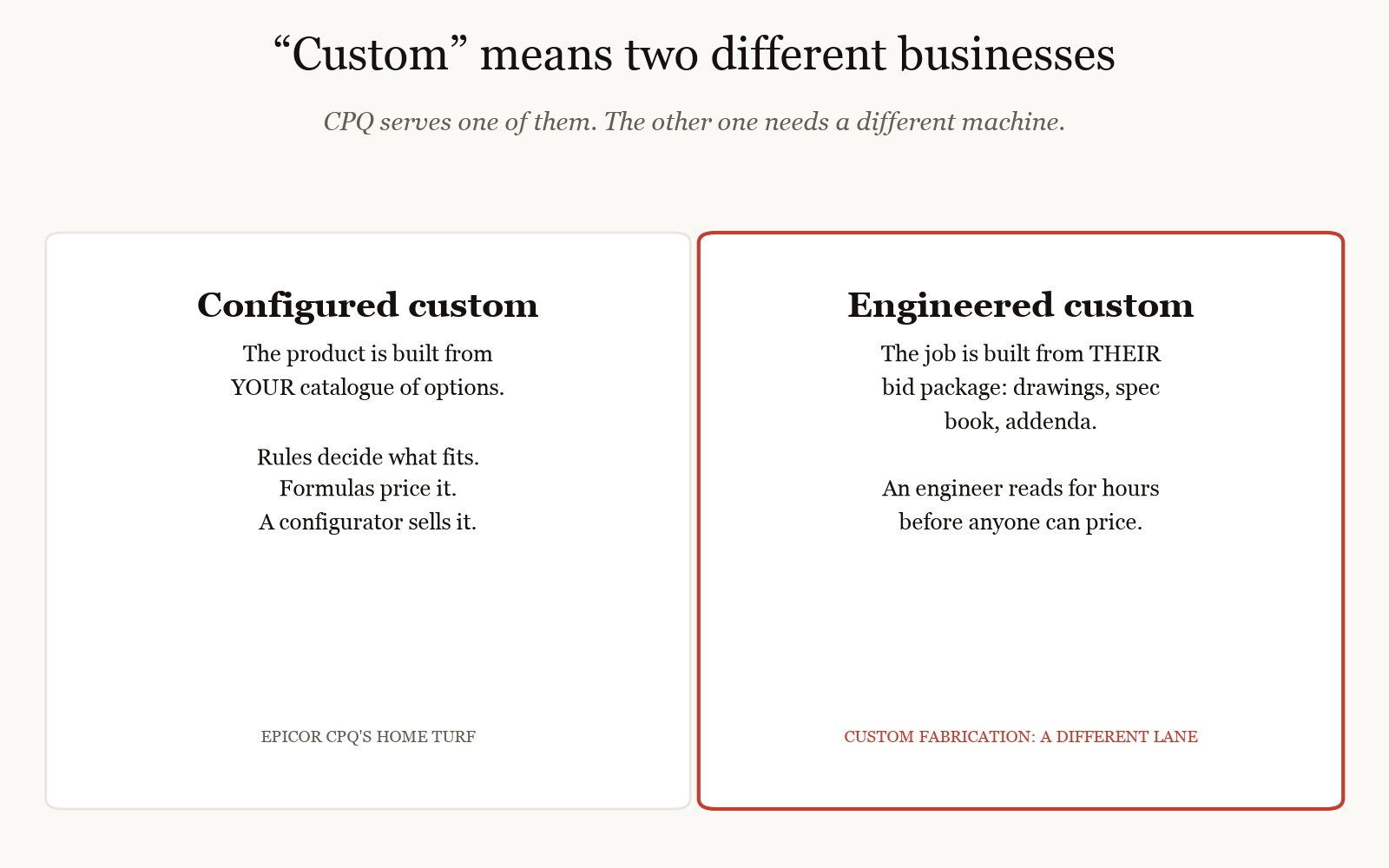
The first time I watched a fabrication shop describe their configurator project going sideways, the diagnosis took one sentence. They quoted structures built to a customer's drawings, a customer's spec book, a customer's addenda, and eight months into the implementation someone finally asked what, exactly, the configurator was supposed to configure. Nobody had an answer, because the honest answer was nothing. The product had no options to model. Every job was somebody else's engineering, arriving by email, waiting to be read.
If you are searching for an Epicor CPQ alternative, some version of that story may be why, and the listicles will not help you see it. G2, Gartner, and Capterra rank Epicor CPQ against other configurators, which answers the question "which different configurator could I buy" and silently assumes a configurator is what you need. Epicor's own marketing describes the product as built for "complex, custom products," their words, and the phrase is doing something worth noticing: custom means two different businesses, and only one of them is CPQ-shaped.
This guide takes both seriously. It covers what Epicor CPQ is genuinely good at, who sensibly shops for a replacement inside the configurator lane and what the real options there are, and then the group the lists ignore: custom manufacturing shops whose quoting problem was never configuration in the first place. The wider category map lives in our buyer guide to AI quoting software; this page is the Epicor decision specifically.
What Epicor CPQ actually is, and where it earns its keep
Epicor CPQ began life as KBMax, a visual configuration platform Epicor acquired in 2021, and the visual DNA is still its signature. Judged on their public materials and customer stories, the product's strengths are real:
- Visual, 3D, and AR configuration. Buyers and dealers assemble the product on screen and see it as they build it, which for dealer networks and web-based selling is not a gimmick; it measurably reduces the "that is not what I ordered" class of error.
- A visual rules engine. Product logic is built in a drag-and-drop environment their materials call Snap, which lets engineers rather than programmers own the rules.
- Design and manufacturing automation. A completed configuration can generate CAD outputs and manufacturing data, connecting the sale to production.
- The Epicor ecosystem. For shops already running Epicor ERP, the family connection is a genuine draw: one vendor, an integration story that starts inside the same company.
Their customer quotes describe quoting processes going from days to minutes, and for the right business shape we find that entirely believable. The right business shape is the operative phrase. Epicor CPQ's "custom product" is one your team has modeled in advance: options defined, rules written, prices formulated, so that each customer-specific variant is assembled from known parts. Their own case studies say it plainly enough, describing companies that "systematize engineering experience" into the configurator. If your engineering experience can be systematized into rules, this machine and its lane-mates are built for you.
Why teams go shopping for an Epicor CPQ alternative
The searches behind this page sort into four stories, and the sorting matters more than any ranking:
- "We are not an Epicor shop." The product runs standalone, but its center of gravity is the Epicor world, and teams on other ERPs often want a configurator that treats their stack as home rather than a foreign country.
- "We came for visual selling and outgrew or under-used it." Visual configuration was the purchase reason, and the daily reality turned out to need deeper constraint logic, or far less machinery, than the platform carries.
- "We inherited it." KBMax-era customers re-evaluating after the acquisition, doing the diligence any ownership change deserves.
- "It never fit." The story from the opening paragraph: shops that bought a configurator for work that arrives as bid packages, where the implementation stalls on the question of what to configure.
The first three stories stay inside the configurator lane, and the next section is for them. The fourth story leaves the lane entirely, and most of this guide's value, if it has any, is in saying that out loud.
How the two customs diverge in daily life
Before the alternatives, make the distinction concrete, because on marketing pages the two businesses are indistinguishable; both say custom, both say complex, both show machinery. Watch a Tuesday morning instead.
In the configured-custom business, a dealer rep opens the configurator at 9 a.m. because a contractor wants a service body for a truck chassis. She picks the chassis model, and the rules silently remove every body that does not fit it. She picks compartments, a crane option, lighting; the price updates as she clicks, a 3D view rotates on screen, and a formatted quote with drawings lands in the contractor's inbox before the coffee is cold. Nobody with an engineering degree touched the transaction, which is precisely the achievement: years of engineering experience were encoded into rules once, so that ten thousand Tuesdays can run without it. Epicor CPQ's customer stories describe exactly this shape, quoting in minutes instead of days, and within this shape those stories deserve belief.
In the engineered-custom business, an estimator opens an email at 9 a.m. from a general contractor bidding a county wastewater project. Attached: a 96-sheet plan set, a specification book organized in CSI divisions, and addendum two, which everyone insists is important. His product appears on perhaps eleven of the sheets, referenced by three spec sections, one of which conflicts with the structural drawings about a load. The words "or approved equal" appear forty times, each one a judgment call about what the engineer-of-record will accept. By 3 p.m. he has a marked-up PDF, a page of handwritten questions, and no price yet, because pricing cannot start until the reading ends. There is no menu anywhere in his day. Nothing repeats from last Tuesday, whose package came from a different engineer with different conventions.
Same word, custom. Two jobs with no overlap: one encodes known engineering into rules and executes cheaply forever; the other confronts unknown engineering fresh in every envelope. Software built for the first Tuesday has no purchase on the second, in either direction; a package-reading engine would be equally useless to the truck-body dealer. The entire discipline of choosing in this market is knowing which Tuesday is yours.
Staying in the lane: the real configurator alternatives
If your product is genuinely configured and the question is which configurator, here is the honest field, from public materials, to check against your own demos rather than substitute for them:
| Platform | Positioning, per public materials | Strongest case |
|---|---|---|
| Tacton | Constraint-based configuration engine, design automation, enterprise manufacturing focus, 25+ years | High product variance where deep constraint solving is the point; we wrote a separate honest guide on Tacton |
| Configure One Cloud | Configurator-first CPQ for mid-market manufacturers | The configurator without enterprise platform weight |
| Threekit | Visual and 3D product experiences, configuration as part of visual commerce | Visual selling is the product's whole point for you |
| DriveWorks | Rules-driven design automation on SolidWorks | The bottleneck is generating drawings and models, not selling |
| Experlogix | CPQ close to Microsoft Dynamics and Salesforce | Your CRM ecosystem leads the decision |
| Infor CPQ / Oracle CPQ / Salesforce | Configurators inside the big ERP and CRM clouds | Ecosystem alignment at enterprise scale |
Lane-one advice in two sentences. Price any move as a product-model rebuild, because the model, every option, rule, and price formula your team encoded, is the actual asset, and re-expressing it in a new platform is a second implementation wearing a migration's name tag. And if the configurator you have is delivering, weigh that rebuild cost against your annoyance honestly; ownership changes and contract friction are thin reasons to re-platform a working machine.
The fourth story: when custom means engineered, not configured
Now the story the alternative lists have no row for. There is a kind of custom manufacturer, the kind legacy software categories filed under engineer-to-order, whose work no option catalogue can describe. Think water treatment equipment houses, marine and dock fabricators, precast producers, structural specialists: shops where the request for quote is a third party's construction bid package. A drawing set that can pass a hundred sheets. A specification book in CSI divisions with "or approved equal" scattered through it. Addenda that change the answer after you started reading. We have taken such packages apart page by page and written about what that reading actually involves; the short version is hours of engineer time per package before pricing judgment even begins.
Put that business inside any configurator and the same failure repeats, vendor-independent: step one of the configurator worldview is "model your product," and this business has no product to model. The product is whatever the customer's engineer already drew. The knowledge that prices it is not a rule set anyone wrote down; it is a senior estimator reading sheet S-301, noticing it disagrees with spec section 05 50 00, and knowing which governs. The configurator project stalls not because the software is weak but because the business was never configuration-shaped, and no Epicor CPQ alternative from the listicles, however good, changes that geometry.
For that shop, the honest replacement is a different machine entirely: software whose input is the customer's documents rather than your product model. Package-reading AI ingests the whole bid package, extracts the requirements with every value cited to its source page, surfaces the conflicts between drawings and spec book instead of resolving them silently, turns gaps into questions for the customer rather than guesses, and drafts the quote in the shop's own pricing logic for the estimator to review, adjust, and own. The estimator's judgment stays exactly where it is; the reading, the part that was eating hours, moves to the machine. Where chat tools hit their ceiling on the same documents is a separate teardown: what actually breaks when ChatGPT reads bid packages, and for teams tempted to build internally, the build-or-buy guide runs that math honestly.
Signals you are in the wrong lane, from shops that were
Lane mismatch rarely announces itself; it accumulates. The signals below come from conversations with shops that bought configurators for engineered work, and any two of them together should end the debate:
- The implementation stalled at product modeling and everyone blames the implementation. Months in, the "define your options" workshop keeps rescheduling because nobody can list options for a product the customer designs.
- The configurator holds three products after a year, the three simplest ones, and the revenue runs through everything it does not hold.
- Every "configured" quote still routes through engineering review anyway, because the model cannot see the customer's documents, so a human re-reads everything the tool supposedly handled.
- Estimators quietly keep quoting in spreadsheets and paste results into the tool afterward for reporting. The workflow of record and the actual workflow have diverged.
- Rule maintenance has a backlog longer than the quote queue, because engineered work generates exceptions faster than anyone can encode them.
- The vendor's success stories all have dealer networks in them and yours has an engineering office.
None of these means the software is bad. Every one of them means the input is wrong: the business runs on documents the tool cannot ingest, and the organization is manually converting engineered reality into configured fiction at the door.
What package-reading looks like on a public document you can check
Claims about reading engines are cheap, so here is the shape of the work on documents anyone can verify. In one public Florida bid letting we took apart line by line, six pre-qualified contractors priced the identical 4,000 square feet of aluminum floating dock from the same drawings and spec on the same day, and their unit prices ran from $110 to $300 per square foot, with the gangway line spreading 4x. Identical documents, professional estimators, a 2.7x disagreement: that spread is what interpretation uncertainty costs in the open market, and the full numbers are in our floating dock cost teardown. Separately, we have run our own engine on a 668-page municipal specification book; it located the fourteen sections governing the equipment being quoted and pulled every requirement with its page number in under two minutes, the day's worth of locating-and-listing an estimator does before judgment can even start.
Those two artifacts, one showing the cost of reading uncertainty and one showing the reading moved to a machine, are the whole category argument. The estimator still rules on every conflict, still owns the price, still applies the judgment that took twenty years to build. What changes is where the hours go: from finding and transcribing requirements to deciding about them. For a shop whose engineers spend two hours reading per package across a few hundred packages a year, that relocation is worth several hundred engineer-hours annually, a number you can compute for your own shop from your own queue before any vendor call.
Plenty of real manufacturers are both things at once: a standard configurable line sold through dealers, and a custom bid-package business run by the engineering office. The mistake is forcing one tool to cover both. The configured line belongs in a configurator, possibly the Epicor CPQ you already run, and nothing in this guide argues otherwise. The bid-package side belongs in a package-reading system. The two do not compete for the same work, they do not share an input, and a shop that routes each stream to its own machine gets both numbers right, while a shop that forces either stream through the other's machine gets one of them wrong at scale. If this is you, the budgeting question is not either-or; it is which stream is currently paying an invisible tax, and on the bid side that tax has a number: engineer reading-hours per package, times packages per year.
The hybrid case also explains a pattern worth naming: some of the loudest configurator disappointment comes from hybrid shops that measured the tool against their whole business instead of the stream it was bought for. The configurator did its half perfectly, the bid side kept hurting, and the pain got billed to the software. Before you leave a platform in that situation, split your quote log into the two streams and attribute the pain honestly; you may discover you need an addition, not a replacement, which is a cheaper and far less disruptive purchase than the migration you were about to scope.
The decision table, honestly
| Your situation | Honest answer |
|---|---|
| Epicor ERP shop, configured products, platform delivering | Stay; the family integration is a real asset |
| Configured products, different ERP, want the configurator nearer your stack | Lane one: Tacton, Configure One Cloud, Experlogix, or your ERP's own CPQ |
| Bought for visual selling; need deeper constraint logic than you are using | Evaluate Tacton's engine specifically; verify with your gnarliest product in pilot |
| Visual selling was the point and remains the point | Stay, or compare Threekit; do not trade the strength you bought |
| Every RFQ is a customer's bid package; engineers read for hours before pricing | Not a configurator problem; package-reading AI lane |
| Standard configured line plus a custom bid-package business | Two machines; configurator for the line, package reading for the bids |
What "AI in CPQ" means, and what it does not
One more source of confusion deserves defusing, because it is the newest one. Every configurator vendor, Epicor included, now describes AI capabilities, and a buyer hearing "AI quoting" can reasonably assume that means the software reads things. Inside the CPQ lane, AI mostly means something else, and something genuinely useful: guided selling that recommends options based on what similar customers chose, pricing intelligence that flags discounts drifting out of band, document generation that drafts the proposal prose, assistants that answer a rep's product questions from the model. All of that operates downstream of the product model, on structured data the configurator already owns. It makes a configured-product sales motion smarter, and in that lane it is real value, not decoration.
What it is not, at any vendor in the configurator lane, is document reading: the ingestion of a third party's ninety-sheet plan set, the extraction of requirements from an unstructured spec book, the reconciliation of addendum two against sheet S-301. That is a different AI discipline with different machinery, page-level citation, conflict surfacing, abstention on ambiguity, built and measured on documents rather than catalogues. The label "AI quoting software" is currently stretched across both, which is how a fabricator ends up on a configurator demo wondering where the drawings go. When you hear the label, ask one clarifying question: AI applied to my catalogue, or AI applied to my customer's documents? The answer sorts every vendor in this market, including us, in one sentence.
The migration ledger, before you sign anything
Whichever direction this guide points you, walk in with the full ledger, because in the configurator lane the sticker price is the smallest line on it. Moving from Epicor CPQ to another configurator means re-expressing your product model, every option, rule, visual asset, and price formula, in the new platform's language; re-cutting the integrations to CRM, ERP, and web storefronts; re-training every seller and dealer who touches quotes; and running both systems in parallel long enough to trust the new one. Teams that have lived it consistently describe a second implementation, not a migration, and the visual rules that made Epicor CPQ approachable do not export to a competitor's engine; they get rebuilt. Which is also the strongest honest argument for staying put when the platform fits: a working product model is an asset with sunk craftsmanship in it, and contract irritation is a weak reason to smash it.
The ledger looks completely different if you are lane-four. A package-reading system replaces nothing: there is no product model to rebuild because you never had one, no configurator to decommission because it never held your real work, and whatever ERP or spreadsheet machinery prices your jobs today keeps doing exactly that, now fed by drafts instead of blank pages. The adoption cost is calibration, teaching the system your pricing logic and document conventions, and the honest way to size that is a pilot on your own past packages with known outcomes, not a contract. Beware only the sunk-cost trap in reverse: shops that forced a configurator onto bid-package work sometimes keep forcing it because the model cost so much to build. The model's cost is spent either way; the mismatch's cost renews annually.
Running the evaluation, whichever lane you are in
Demo choreography is a solved art everywhere, ours included, so the information in an evaluation comes from what you bring and what you insist on watching. The protocol we recommend against every vendor on this page and against ourselves:
- Bring the worst real case, not the brochure case. Configurator lane: your product with the nastiest option interactions you actually sell. Package lane: the bid package your estimators still curse, with its addenda.
- Watch first contact live. Where the demo driver slows down, what gets postponed to a follow-up, which of your questions produce slideware instead of screens.
- In the package lane, score the reading before the pricing. Extractions checked against the documents: found, missed, invented, flagged. A system that guesses confidently is more dangerous than one that abstains visibly.
- Ask to see a refusal. Every trustworthy system has edges it declines to cross: invalid configurations, values it will not invent. No visible edges means you have not seen the system yet, only the demo.
- Reference-check against your business shape, not the vendor's proudest logo. A dealer-network success story says nothing about an engineering office drowning in spec books.
The pilot design that settles it
For the package lane specifically, there is a cleaner instrument than any demo, and we recommend it against ourselves: the blind test on your own history. Pick five past packages you have already quoted, including at least one that went badly, and gather the documents your team had on day one, keeping your filed quotes out of the vendor's reach entirely; a system tested on answers it was handed proves nothing, and it is astonishingly easy to leak the answer by accident. Run the five through the candidate system cold. Then score two things separately, in this order: the reading, what was extracted, missed, invented, or correctly flagged as ambiguous, checked line by line against the documents; and only afterward the pricing, how far from your filed numbers and whether the misses trace to reading errors or to judgment calls that were always going to be human. Insist on seeing the misses, not just the hits; a vendor who will not walk you through what their system got wrong on your documents is showing you a brochure with extra steps. Two afternoons of this beats two months of demo choreography, in every lane, from every vendor, us included.
Where Mavlon stands in this, plainly
Mavlon is the package-reading lane. Our engine reads the customer's whole bid package, cites every extracted value to its page, ranks the decisions worth your estimator's attention by dollar impact, and drafts the quote in your own pricing logic, with the final number staying human. We do not configure products, we do not compete with Epicor CPQ for configured-product work, and if this page has sorted you into the configurator lane, the table above is our honest best effort at who to call instead. If it sorted you into the package lane, the test is cheap and fast: book a 30-minute demo, bring your ugliest package, and judge the reading against your own documents, line by line.
The categories will keep blurring, because every vendor including Epicor now says AI and every vendor including us says custom. The one distinction that will not blur is the input. If the job starts from your catalogue, buy configuration. If it starts from their documents, buy reading. Everything else in this market is detail.