Floating Dock Cost Per Square Foot: What Six Real Bids Reveal
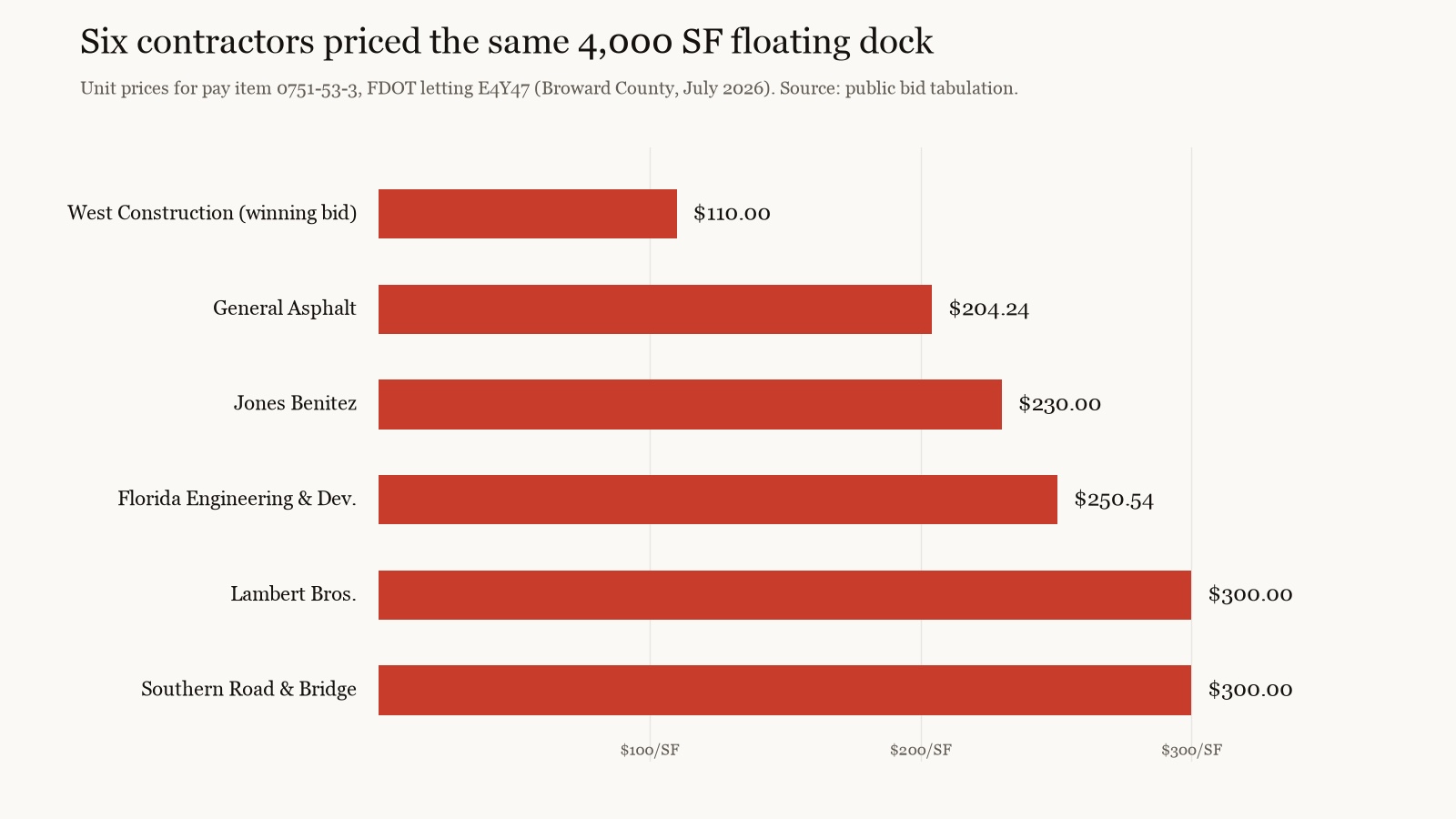
I pulled a public bid tabulation last night and could not stop staring at one line.
Six pre-qualified contractors bid on the same Florida boat ramp program: identical drawings, identical specification, identical 4,000 square feet of aluminum floating dock.
The lowest unit price on that dock line was $110.00 per square foot. The highest was $300.00.
That is the same scope, the same letting day and the same public documents, and a 2.7x spread between professionals who do this for a living.
If you have ever asked what floating dock cost per square foot actually looks like in the real market, this is the most honest answer I can give you. It is not a number, it is a range, and the range is wider than anyone selling you a tidy estimate wants to admit.
We have written before about how AI reads a marina bid package. This article is about what the filed prices themselves reveal.
Everything below comes from one public record: the bid tabulation for FDOT District 4 letting E4Y47, the I-75 Alligator Alley boat ramps program in Broward County, let on July 10, 2026.
Bid tabs are public documents. Every number here can be checked.
Finding this letting took more work than reading it. We downloaded 1,759 itemized bid tabulations covering six years of Florida DOT lettings, and this was the only one carrying a floating dock pay item.
The full story of that hunt, and the map of where dock work actually gets bid, is in the companion piece on how to find marine construction bids.
What follows is everything the one letting we found has to teach, and it turns out to be a lot.
Floating dock cost per square foot: the six real bids
| Bidder | Floating dock, $/SF (4,000 SF) | Extended |
|---|---|---|
| West Construction (winning bid) | $110.00 | $440,000 |
| General Asphalt | $204.24 | $816,960 |
| Jones Benitez | $230.00 | $920,000 |
| Florida Engineering & Development | $250.54 | $1,002,160 |
| Lambert Bros. | $300.00 | $1,200,000 |
| Southern Road & Bridge | $300.00 | $1,200,000 |
Six prices for one scope
The pay item is 0751-53-3, FLOATING DOCK, measured by the square foot.
That gives six numbers for one scope: $110.00, $204.24, $230.00, $250.54, $300.00, $300.00. The median sits around $240 per square foot.
The winner priced the dock at less than half the median, and the two top bidders priced it at nearly three times the winner's rate.
What one line item did to the totals
On a $2.6 million contract, this one line item created a $760,000 gap between the low and high dock price.
The total bids told the same story: $2,575,575 for the winner up to $5,130,758 for the highest, on the identical set of documents.
The contract was won on the dock line
Here is the detail that makes this tab a case study rather than a curiosity.
The letting grouped its items into two sections:
- A Roadway section covered mobilization, maintenance of traffic, approach slabs, riprap, articulating block revetment and bedding stone.
- An Architectural section held the three marine items.
Compare the two lowest bidders section by section:
| Section | West Construction (winner) | Jones Benitez (2nd, +0.9%) |
|---|---|---|
| Roadway section total | $1,968,825 | $1,320,260 |
| Architectural (marine) section total | $606,750 | $1,278,600 |
The cheaper roadway bid still lost
Jones Benitez beat the winner by nearly $650,000 on the roadway work.
West Construction won anyway, by less than one percent overall, because their marine section came in at less than half of everyone else's.
The entire contract turned on who could price a floating dock with confidence.
A quarter of the money decided the award
That is worth sitting with if you fabricate docks or gangways. On a program where the marine scope was barely a quarter of the money, marine pricing still decided the award.
The generalist contractors were competitive everywhere except the one place that required product knowledge they did not have in-house.
Whoever supplied West Construction's dock confidence, whether their own crew or a sharp fabricator's quote, effectively won a $2.6 million contract with it.
The same tab priced gangways and fixed platforms too
| Bidder | Gangway, $/SF (1,370 SF) | Fixed platform, $/SF (800 SF) |
|---|---|---|
| West Construction (winning bid) | $75.00 | $80.00 |
| General Asphalt | $204.24 | $204.24 |
| Jones Benitez | $180.00 | $140.00 |
| Florida Engineering & Development | $151.38 | $78.17 |
| Lambert Bros. | $150.00 | $140.00 |
| Southern Road & Bridge | $300.00 | $275.00 |
A 4x spread on the gangway
Gangways ran $75 to $300 per square foot, which is a 4x spread on the identical 1,370 SF scope.
If you quote gangways for a living, look at that range for a moment. Somewhere between reading the same drawings, four professional estimating teams landed a factor of four apart.
One rate for three different products
And notice General Asphalt's column. The dock is $204.24, the gangway is $204.24 and the fixed platform is $204.24.
Those are three structurally different products at one identical unit rate to the penny. That is not an estimate; that is a plug.
It usually means the marine scope was priced from a single blended subcontractor number, or from no number at all, spread across the lines.
It happens on real bids far more often than buyers imagine, and it is invisible unless you read the tab line by line.
Six bidders, six pricing personalities
Read all eighteen marine numbers together and each bidder's whole approach becomes visible. This is the part of a tabulation nobody quotes, and it is the most instructive.
Lowest or close to it on all three items
West Construction was lowest on the dock and the gangway, and within two dollars of lowest on the platform: $110, $75, $80.
Nobody prices a field of five that tightly across three products by accident. That pattern says real product knowledge, in-house or through a fabricator whose numbers they trusted enough to bid tight.
One rate on all three items
General Asphalt bid $204.24 on all three. The rate is identical to the penny across structurally different products, and it is the plug we keep returning to.
Notably, their plug landed mid-field on the dock but top-half on the gangway and highest-but-one on the platform. A blended rate is always wrong somewhere, and the smaller the item, the wronger it gets.
Each product cheaper as it gets simpler
Jones Benitez priced mid-field with internal logic: $230 dock, $180 gangway, $140 platform, each product cheaper as it gets simpler. That reads like a genuine estimate built without a specialist's cost base.
They finished 0.9 percent behind overall. Their roadway pricing nearly carried them past a superior marine number.
High on the dock, lowest on the platform
Florida Engineering & Development is the most interesting split. They were high on the dock at $250.54, but the lowest bidder of all six on the fixed platform at $78.17.
They understood the simple welded structure and feared the floating one. Flotation, not fabrication, was their uncertainty.
The dock at the ceiling, the rest competitive
Lambert Bros. ($300, $150, $140) priced the dock at the ceiling but the gangway and platform competitively, the mirror image of Florida Engineering's fear.
High on all three items
Southern Road & Bridge sat at or near the top on everything ($300, $300, $275) and finished at 199 percent of the winning total.
That is not a company trying to win; that is a company pricing so it cannot be hurt if it accidentally does.
What the eighteen numbers show together
From one tabulation, you can practically see each estimating room: who had a cost book for docks, who had a sub quote, who had a blended rate, and who had a bad feeling and priced it.
What it cost each bidder in dollars
Percentages hide the money, so here is the marine scope, all three items extended, per bidder:
| Bidder | Marine items total (dock + gangway + platform) |
|---|---|
| West Construction (winner) | $606,750 |
| General Asphalt | $1,260,161 |
| Florida Engineering & Development | $1,272,087 |
| Jones Benitez | $1,278,600 |
| Lambert Bros. | $1,517,500 |
| Southern Road & Bridge | $1,831,000 |
A market consensus, and a winner at less than half of it
The field's marine pricing clustered around $1.26 to $1.28 million three bidders deep. That is what an honest market consensus looks like when nobody has a specialist's cost base.
The winner priced the same scope at less than half the consensus, and the highest bidder at three times the winner.
On 6,170 square feet of aluminum structure, the knowledge gap between the most and least confident bidder was worth $1.22 million.
If you fabricate docks, the six bidders are your market
The same tab has one more reading, for the aluminum fabricators.
Five of the six bidders were not dock builders
Five of the six bidders on this letting were, by their names and their number patterns, general and civil contractors, not dock builders.
Every one of them needed a floating dock price to bid this program, and the quality of the dock price they carried decided their fate. The bidder with the confident marine number took a $2.6 million contract by less than one percent.
Every letting like this one is a sales map
That makes every letting like this one a sales map for a dock fabricator. The five losing bidders now know, publicly and precisely, that their marine pricing cost them a contract.
A fabricator who can hand the next West Construction a fast, tight, assumption-stated dock and gangway quote is not selling a product line; they are selling the winning margin on the whole program.
The lettings themselves tell you which generalists bid this work in your region, how they price it today, and therefore who most needs a better number next time.
Keeping the map current
The bid-watch routine in the companion article is how you keep that map current.
Quoting those partners fast, from their bid package, in your own pricing logic, is exactly the workflow our software exists to speed up.
The fixed platform tells its own story
The smallest marine item, 800 SF of fixed platform, deserves its own paragraph because it breaks the pattern in an honest way.
Where another bidder got under the winner
This is the one line the winner did not own. Florida Engineering & Development priced it at $78.17 against West's $80.00, and it is the only marine item where anyone got under the winner.
A welded aluminum platform on piles is the most conventional structure of the three. It has no flotation, no hinges and no buoyancy calculation.
The tab shows it: four of six bidders landed between $78 and $140, the tightest clustering of the three items.
Two bidders priced policy, not the platform
Then the same two outliers appear anyway: the $204.24 plug, indifferent to the product as always, and Southern's $275 ceiling.
That gives the platform line its lesson. On the scope where uncertainty was lowest, the field converged.
The bidders who still sat high were not pricing this product at all; they were pricing their standing policy.
Spread follows ambiguity, item by item
Spread tracks ambiguity item by item, even inside a single contract.
- The dock, hardest to read, spread 2.7x.
- The platform, easiest to read, spread 3.5x only because of two policy prices. Strip those and it spread 1.8x.
If you ever needed proof that reading confidence, not fabrication difficulty, is what moves public marine pricing, it is sitting in the quietest line of this tab.
The gangway paradox
Look back at the gangway table and notice something odd. Two of the six bidders priced the gangway at exactly the same rate per square foot as the dock, and five of the six priced it at or above the fixed platform. That is odd because a gangway sounds like the simpler product, a ramp between shore and float.
Why a gangway is not the simpler product
It is not simpler. A gangway is a small aluminum truss bridge:
- It spans clear water with no flotation under it.
- It carries handrails down both sides regardless of width.
- It hinges at one end and rolls at the other.
- Its length is dictated not by convenience but by accessibility law, the 1:12 slope rule that our ADA gangway slope calculator exists to check.
Per square foot, a narrow structural span with two rails and code-driven geometry can genuinely cost more than an open deck on floats.
The bidders who priced gangways above docks were not confused; the ones who priced them identically were.
Public bids versus private marina quotes
Anyone pricing a private dock can ask a fair question: do these public numbers apply to my project?
The answer is directionally yes, and absolutely not literally.
Costs that public work carries
Public work carries costs a private residential or marina job may not: bonding, public-owner submittal cycles, prevailing wage where applicable, and the pre-qualification overhead of agency work.
A private quote for comparable scope can legitimately come in under these figures.
What carries over to a private job
What transfers cleanly is the structure of the market, not the level. Three things carry over:
- The spread between a specialist's price and a generalist's carries over.
- So does the plug-number risk when marine scope hides inside a bigger contract.
- So does the premium that ambiguity extracts.
If your private quotes spread 2x between vendors, this letting says that is the industry's normal. The cure is the same in both worlds.
Pin the scope, name the assumptions, and prefer the bidder whose numbers show product knowledge rather than padding.
What lives inside a dock's price per square foot
To compare the six numbers fairly, it helps to know what a unit price on a public letting actually absorbs, because it is more than the dock.
Four things the dock line carries
A bid's floating dock line typically carries four things:
- The fabricated product is the aluminum framing, decking, floats, hardware, and the shop labor to build it. For an aluminum dock this is the largest share, and it moves with the metal market.
- Marine installation covers barge or crane time, divers where needed, connection to piles or anchors, and the schedule risk of working over water. Site access can swing this piece enormously. A dock you can reach from a ramp installs for a fraction of one that needs a barge mobilized from three counties away.
- Engineering and submittals means signed and sealed calculations, shop drawings, and the review cycles a public owner requires.
- Each bidder's allocation choices are in the line too. Overhead and profit do not get their own pay item, so they hide inside unit prices, and different estimators park them in different places. One bidder's dock line may quietly carry money another bidder parked in mobilization.
Why single line items need care
That last point is why comparing single line items across bidders needs care, and why section totals and the overall bid matter alongside the unit price.
It is also why the spread in this tab cannot be explained by allocation alone. Allocation moves a line by tens of dollars per square foot, not by a factor of 2.7.
The metal price behind the number
The metal matters too. An aluminum dock's material share is large enough that the aluminum price era shows up in the bid.
These six numbers are all from one letting on one day, so they are directly comparable. But if you set them beside dock prices from two or three years earlier, remember that the metal market underneath moved substantially between those eras.
Never average dock prices across years without carrying the date along. We keep a letting date on every row of our own dataset for exactly this reason.
Why the same dock gets six different prices
Nothing in the spread is random. Three forces show up when you read enough tabulations.
One: who actually builds the dock
A contractor who fabricates or regularly installs aluminum floating docks knows the material weight, the float count, and the labor hours from experience.
A roadway contractor carrying a marine subcontractor's quote adds the sub's margin plus their own markup plus a cushion for a scope they do not fully control.
The winner here was lowest on the dock and gangway and effectively tied for lowest on the platform. That is the signature of someone who knew their dock costs cold rather than someone who guessed low.
Two: how carefully the package was read
A marine bid package hides its requirements across drawings, specifications, and general notes: live load, freeboard, float construction, decking material, utility clearances.
Miss a requirement and you under-price it; fail to resolve an ambiguity and you price the worst case.
We wrote about the mechanics of this in what five real public packages taught us, and the pattern holds here. The widest unit-price spreads live on exactly the items whose requirements are scattered across the most pages.
Three: the uncertainty premium
When an estimator cannot pin a scope down, the honest options are to ask, to walk, or to price the doubt. On lump-sum-style unit items, doubt is expensive.
The $300 bids are not incompetence; they are what it costs to say "we are not sure, so we are covered."
The spread between $110 and $300 is, in large part, the market price of uncertainty about the same documents.
If you are budgeting a floating dock project
Use ranges, not points. From this letting, an aluminum floating dock on a public program priced between $110 and $300 per square foot installed, with the median bidder near $240.
Three price bands for planning
A useful planning posture has three bands:
- $100 to $150/SF is achievable when a specialist who knows dock costs is bidding and the site is friendly. Treat a number here as a reason to check the bidder's marine track record, not a red flag by itself.
- $200 to $250/SF is the middle of this field. If your engineer's estimate sits here, it will not be embarrassed by the tab.
- $300/SF and up is the uncertainty zone. Bids land here when the package is ambiguous, the site is hard, or the bidder is a generalist pricing someone else's trade.
A 2,000 SF dock run through the bands
To make the bands concrete, run your own project through them. Take a 2,000 SF marina dock:
- Penciled at the specialist band ($110 to $150), it is a $220,000 to $300,000 structure.
- At the field's median, it is roughly $480,000.
- At the uncertainty ceiling, it is $600,000.
It is the same dock with $380,000 of range, and which number you get depends mostly on who you ask and how clean your documents are.
That is the honest way to use floating dock cost per square foot data: not to pick a number, but to know which conversations move you down the range. Those conversations are tightening the spec, resolving the ambiguities, and getting a bidder who knows the product.
One caveat about this data
One caveat I refuse to hide: this is one letting, in one county, in one month.
Site access, water depth, mobilization allocation, and specification requirements move these numbers materially, and unit prices on public tabs absorb overhead in ways that differ bidder to bidder.
Treat the range as a reality check on any estimate you are handed, not as a price list.
As we collect more public lettings, the bands will sharpen. The raw dataset behind this article is the first entry in that series.
What moves a floating dock's cost beyond its size
Square footage sets the scale, but the requirements hiding in the specification move the unit price, sometimes more than size does.
Six requirements to check on any dock quote
When you compare any dock quote against the ranges above, check which of these the project carries:
- Live load matters because a 25 psf residential dock and a 60 psf public marina dock are different structures wearing the same name. Higher live load means more flotation, heavier framing, and more labor per square foot.
- The freeboard specification is the required height of the deck above water, measured to the top of the walking deck, and it drives float selection. A tight freeboard band with a heavy live load can force taller floats or more of them, and the flotation math is checkable in minutes with our free dock float calculator.
- Float construction can be standard poly-tub floats, heavier pontoon designs, or full-float construction, and these carry genuinely different material and labor content. Specifications sometimes force the choice in a single sentence that is easy to miss.
- Decking material can be composite, aluminum, or timber. These differ in material cost and, less obviously, in installation labor, because board width and fastening pattern change the screw count and the hours.
- Utilities and accessories each add real money: water, power pedestals, cleats, fender systems, and pile guides. On this letting, pile guides were their own pay item, and every bidder priced them separately from the dock.
- Access and mobilization are the quiet budget-killer. The same dock costs materially more where marine equipment has to travel far or work in restricted conditions.
How to sanity-check a dock quote against this data
If you are holding a quote right now, here is the five-minute check we would run.
Place the quote on the range
Divide the quoted price by the square footage and place it on the range: below roughly $150, midfield around $200 to $250, or high near $300.
Then ask three questions.
The three questions
- Does the quoter's position match their profile? A dock specialist quoting low is normal. A general contractor quoting below the specialists deserves a scope conversation, because the most common reason a generalist is cheap is a scope they have not seen yet.
- Are the distinct products priced distinctly? Ask for dock, gangway, and platform as separate lines. If structurally different products arrive at one identical rate, you are looking at a plug, exactly like the $204.24 bidder on this letting. A plug means the number was allocated rather than estimated.
- Do the stated assumptions cover the expensive unknowns: live load, freeboard, float type, access? A quote that names its assumptions can be compared and negotiated. A quote without assumptions is a range pretending to be a number, and the tab you have just read shows how wide that range really runs.
If you are the one bidding docks
Read that spread again from the other chair.
A 2.7x range on one item means the market is not pricing the product. It is pricing each bidder's confidence in their own read of the documents.
That has two hard implications.
A full read lets you bid near your true cost
First, the estimator who can read the package fully, resolve what is resolvable, and flag what is genuinely open, gets to bid near their true cost instead of near their fear.
On this tab, that was worth the contract. The winner took a $2.6 million program with a dock price the rest of the field could not touch.
Speed lets you answer more of the right bids
Second, speed matters because volume matters. Shops that quote from third-party plan sets, the way "or approved equal" work always arrives, win by answering more of the right bids, not by padding the few they have time to read.
The hours an estimating team burns extracting requirements from a 180-page package are hours not spent on the next package.
That reading problem, not the arithmetic, is where quoting time actually goes, and it is the problem we build for.
What a tabulation still cannot tell you
Before the method, we should be honest about the limits.
What a tab does not show
A tab shows committed prices, not their anatomy. There are three things you cannot see in it:
- The first is whether West self-performs marine work or carried a fabricator's quote.
- The second is how much of any unit price is material versus labor versus nerve.
- The third is what the scope conversations after award did to the final cost, because change orders live in a different set of documents.
You also cannot see the losing bidders' reasoning, only its output.
How to treat the stories in this article
So treat everything in this article as what it is, the most honest public evidence available about dock pricing.
Treat the causal stories we have told, knowledge here, fear there, a plug in the middle, as the best reading of that evidence rather than testimony.
Where the documents allow a check, we have checked; where they do not, we have said so.
Where these numbers come from, exactly
Here is the method, so you can check us.
The source document
The source is the public bid tabulation for FDOT District 4 letting 04260710, contract E4Y47, opened July 10, 2026, published by the department in its letting archive.
How we transcribed it
We transcribed the three Architectural-section pay items (0751-53-3, 0751-53-4, 0751-53-5) for all six responsive bidders into a structured dataset, one row per bidder per item.
Each row carries the source document, letting date, quantity, unit, unit price, and extended amount.
The section totals quoted above are printed on the tabulation itself. The six-bidder marine totals are the three extended amounts summed per bidder.
The rule we hold to
Nothing here is estimated, modeled, or adjusted, and anyone can pull the same document and verify every figure.
As we transcribe more lettings, county and grant-funded work included, the dataset and the ranges in this article will be updated with the same rule: no number without a public source.
Check the flotation math yourself
This section is a closing gift for the engineers. Two of the numbers every dock bid depends on, float count and freeboard, are pure statics, and you can sanity-check them in a minute.
Two free calculators
We built a free dock float calculator that reports freeboard on the datum specifications actually mean (top of deck, not top of float), and an ADA gangway slope calculator for the 1:12 rule and its exceptions.
Both run on public physics and the published standards, and both are free with no signup.
Honest ranges, not one answer
The floating dock cost per square foot question will never have one answer. But it has honest ranges, public receipts, and patterns that reward whoever reads the documents best.
That is true for this letting, and every tab we open from here will either sharpen the range or teach us something new about the spread. Either way, we will publish it.