Fire Truck Request for Proposal: 84 Pages of Yes or No
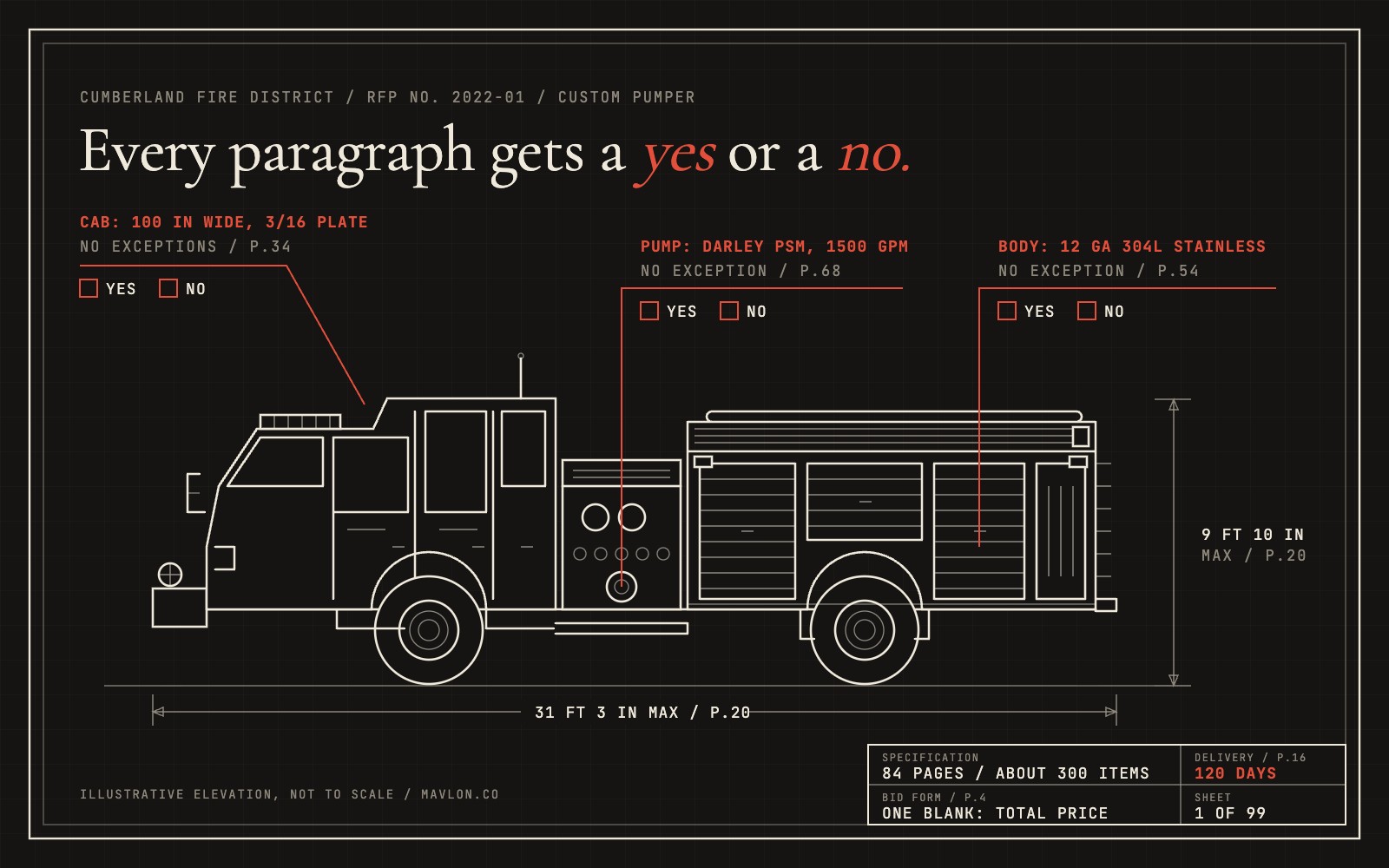
I read a fire truck bid package the way the person answering it has to read it. Every paragraph, in order, with a pen, because in this industry every paragraph gets an answer. A fire truck request for proposal is unusual among the documents we study: the buyer does not just describe what they want and wait for a price. They print a column down the right-hand side of every page, headed YES and NO, and the bidder has to mark one or the other against each paragraph of the specification.
Ninety nine pages. A fire district in Rhode Island buying one custom pumper. Eleven pages of instructions and forms, four pages about the bidder, and eighty four pages of specification with that column running down the side. At the end of it all, one blank for the price.
We have written about what a switchgear bid package asks you to price and about which rules apply to an elevated water tank bid. A fire truck is a very different product, sold to a very different buyer, and the document behaves in the same way. This article is about what is actually inside one, page by page, and what it demands from whoever has to answer it.
In brief
- A public fire truck RFP for one custom pumper runs 99 pages: 11 of forms, 4 that qualify the bidder, and 84 of fire apparatus specifications with a YES and NO box beside every paragraph.
- About 300 headed items have to be answered. Roughly 60 components are named by brand, and exceptions are not allowed on any of them.
- The truck is due 120 days after contract signing. The normal wait was 12 to 18 months.
- The document contradicts itself on warranty length, plumbs the truck for a foam system it never orders, and puts a $10,000 allowance on the last line of the last page.
- Everything goes into one blank: a single total price.
The package
The buyer is the Cumberland Fire District in Cumberland, Rhode Island. The document is RFP No. 2022-01, an invitation for bids dated January 12, 2022, for what the cover calls a Stainless Steel Low Hose-Bed Severe Service Custom Pumper. It is public, like most municipal procurement, so anyone can download it and check every page reference below.
For anyone outside the fire service. A pumper is the standard fire engine: a truck that carries water, hose and a crew, with a large pump in the middle that can draw from a hydrant or a pond and push water out through several hoses at once. Custom means the cab and chassis are purpose built for fire service by the truck builder, rather than a commercial truck chassis with a fire body bolted on. The industry word for the whole vehicle is apparatus, which is why the documents read the way they do.
This one carries a 1,500 gallon per minute pump, a 780 gallon water tank, a 30 gallon foam cell, a 450 horsepower diesel and seats for five. It has to fit the station: no taller than 9 feet 10 inches and no longer than 31 feet 3 inches (page 20). Nobody holds this truck in stock. It is designed for one department and built once.
The 99 pages break into three parts, and the split matters more than it looks:
| Pages | What is there | What the bidder does with it |
|---|---|---|
| 1 to 11 | Cover sheet, checklist, bid form, two certifications, instructions, terms and conditions | Sign, bond, insure, and write one number |
| 12 to 15 | Qualifications and capabilities of the bidder | Pass or be rejected before the truck is looked at |
| 16 to 99 | The specification, with a YES and NO column beside every paragraph | Answer every paragraph, and list every NO on a separate sheet |
One blank, again
Page 4 is the bid form. This is all of it:
One vehicle, one price, written twice. No options schedule, no line for the equipment, no line for training or delivery. If you have read our switchgear piece this will feel familiar: 230 pages there, 99 here, and in both cases the commercial answer is a single figure. I am starting to think this is simply how public buyers purchase anything that is built to order. It keeps the bid tabulation simple. It also means everything the document asks for, on every page, has to find its way into that one number or be refused in writing.
Page 7 says how the number will be judged. The award goes to the lowest responsive and responsible bidder, and in making it the district will consider five things: bid price, the qualifications and capabilities of the bidder, the extent to which the bid meets, deviates from or exceeds the specifications, warranty, and delivery date. So price is first in the list and it is not alone in the list. Hold on to the last item, delivery date. It comes back.
The first test has nothing to do with the truck
Part 4 starts on page 12 with a paragraph in capitals. This section will be evaluated before the apparatus technical specifications, and bids that do not comply with any minimum requirement in it will be deemed non-responsive and rejected without further review of the technical specifications.
Read that as an estimator. You can get all eighty four pages of the truck right and never have them opened.
What Part 4 tests is not the manufacturer's engineering. It is the local organisation that will look after the truck for the next twenty years. Pages 12 to 15 ask for:
- A service facility owned or offered by the bidder that is solely dedicated to emergency vehicles. Facilities that also work on highway department, oil or concrete trucks will not be considered.
- A minimum of fifteen technicians holding EVT certification, the emergency vehicle technician qualification, including at least one certified as a master. Page 13 adds that there shall be no exceptions to this requirement.
- An on-site pump test facility, and status as an authorized parts and service center for three pump makers at once: Hale, Waterous and Darley.
- On-site body fabrication, collision repair and a paint shop with a cross flow booth.
- Over $1,000,000 in parts inventory available at all times.
- A guarantee that future repairs are handled locally, because bids from manufacturers who use third party service people will be immediately rejected.
Then a questionnaire, marked NO EXCEPTIONS: miles from the district to the nearest service facility, number of bays, square feet, years selling the brand, and a question I have not seen in any other category. Has the dealer represented other manufacturers in the past, and if yes, why was the change made?
The lesson for anyone pricing this kind of work is that the quote is not only a price for a product. In this category the bidder is usually a dealer, the product comes from a factory several states away, and the first gate is a test of the dealer's building, people and parts shelves. None of that is in the bill of materials. All of it decides whether the bill of materials gets read.
A fire truck request for proposal is a compliance matrix: 84 pages of yes or no
Page 15 sets the rule that governs everything after it:
And then the sentence that gives the column its teeth: proposals that are found to have deviations without listing them may be rejected.
Other industries call this a compliance matrix: a table of every requirement with the bidder's answer beside it. Usually the bidder builds it for its own use. In fire apparatus specifications the buyer builds it and makes it part of the bid.
In the switchgear package, silence was treated as a promise of full compliance. Here the mechanism is stricter and more tiring. There is no silence. Every paragraph demands a mark, and a YES against a paragraph you do not actually meet is an unlisted deviation, which is grounds for rejection before award and an argument about the contract after it.
I counted what that means in practice. Between page 16 and page 99 there are roughly three hundred headed items, from Bumper Gravel Shield to 25 Year Frame Rail Corrosion Warranty. The word shall appears 1,553 times. Each headed item is several requirements deep. The front axle item alone fixes the make and model, a 20,000 pound rating, the kingpin centers, the cramp angle with its tolerance, the hub material, the spring dimensions and leaf count, and the steering gear model.
Two more rules narrow the room further.
First, page 15 says no exceptions will be allowed relating to gauge, alloy and type of metal, size of compartments and overall design. The body is 12 gauge 304L stainless steel. The cab is extruded aluminum with 3/16 inch plate skins. If your construction method is different, the exceptions sheet is not available to you for that.
Second, page 17:
I went through the specification and listed the brands. There are about sixty. Axles, shock absorbers, steering gear, rear suspension, tires, brake valves, the air dryer, the engine and transmission, the fuel and water separator, the alternator, mirrors, seats, the brackets that hold breathing apparatus in the seat backs, roll-up doors, valves, the pump and its primer, the pressure governor, the multiplex electrical system, warning lights, sirens, the paint system, down to the floor matting in the compartments. On sixty of the choices a truck builder would normally make for itself, the document has already chosen, and says the choice is closed.
The phrase no exception, in one form or another, appears twenty times across seventeen different pages. It is attached to big things, like the cab model and the stainless body, and to small ones. Page 27 requires stainless steel mounting straps for each air tank, quantity four, no exceptions.
This is a harder version of the problem we described in or approved equal. In most construction specifications a named brand comes with at least the appearance of a substitution route. Here the route is closed in a single sentence on page 17, sixty times over.
The specification still has its maker's fingerprints on it
This is the finding that made me want to write the article.
The further I read, the less the specification sounded like a fire department describing what it needs, and the more it sounded like a truck builder's option catalogue with the options switched on. Not because of the brand names. Because of what was left behind.
Page 24, in the middle of the tire pressure indicator requirement:
That is not a requirement. It is an internal engineering note about a part number change, written for whoever maintains a catalogue, and it has traveled into a public bid document with a YES and NO box beside it.
Once I saw one, I found them all the way through:
| Page | What the specification says | What this truck actually is |
|---|---|---|
| 20 | Equipment allowance is in addition to hose and ladders "listed in the shop order" | There is no shop order. It is a bid |
| 25 | Slack adjusters: one brand on RS-24-160 and RS-25-160 axles, another on RS-26-185 and RS-30-185 axles | One axle is specified, the RS-25-160 |
| 37 | A separate access panel "when equipped with an X12 or X15 engine" | The engine is a Cummins L9 |
| 43 | Canopy window sizes for a 44 inch cab and for 58 to 80 inch cabs | One cab length is being bought |
| 48, 49 | Cabinet dimensions for a 94 inch wide cab and for a 100 inch wide cab | Page 34: 100 inch wide cab, no exceptions |
| 59 | Service door arrangement "for side control units" and "for top control units" | The pump panel is side mount |
| 71 | "The Flush option could result in panel scratching. Example 72 or 76" | A caution to a buyer choosing options, not a requirement on a seller |
| 83 | "If equipped with an aerial device", connections on the aerial shall be protected | It is a pumper. There is no aerial ladder |
| 99 | Front axle warranty terms listed by axle family, including a front drive axle | One front axle is specified |
I counted twenty seven conditionals of this kind: if equipped, if applicable, as applicable, when equipped. Each is a fork that belongs to a configurator, left unresolved in a document that asks for a yes or a no.
I do not know which builder's catalogue this text came from and I am not going to guess. It is also worth being clear that nothing here is improper. A department works out what it wants, usually with a dealer it trusts, and the dealer's specification system produces the words. The document is candid about where that leaves everyone else. Page 15 says these specifications reflect the only type of fire apparatus that is acceptable at this time.
That sentence turned out to have a history of its own. I pulled three other public pumper packages to see whether Cumberland was unusual. In Lowndes County, Georgia (bid LC-2022-02, opened November 2021) the exceptions section begins: these specifications are based upon design and performance criteria which have been developed by the fire department as a result of extensive research and careful analysis, and reflect the only type of fire apparatus that is acceptable at this time. In Kingsland, Georgia, in a 101 page specification from 2023, the same sentence appears word for word. Cumberland, about a thousand miles north, has it too, with a handful of words changed.
The two Georgia packages share more than that. Both bar any manufacturer whose parent company has had a performance bond called in the last ten years. Both bar any manufacturer or parent ever fined or convicted of price fixing or bid rigging in any fire apparatus market. Both refuse apparatus with a subcontracted cab, chassis, pump module, electrical system or body. Both require two factory inspection trips for three fire department personnel, with travel, lodging and meals at the bidder's cost. Those clauses are absent from Cumberland, which has its own family of clauses instead: the sole source chassis, the fifteen technicians, the three pump brands.
So there are at least two distinct specification families in four documents, and I would expect a wider sample to find a handful more. Here is what that means if you are the one answering. For the builder whose catalogue produced the text, every paragraph is YES by construction, because the paragraphs are descriptions of its own truck. For every other bidder, each of three hundred items is a small research job: is our frame rail 10 and a quarter by 3 and a half by 3/8? Is our section modulus 16.61? Did our cab pass the roof crush test at exactly 23,561 pounds, the figure on page 17? Where the honest answer is that ours is different and arguably better, that is a NO, an entry on the exceptions sheet, and a judgement by the fire chief, who page 17 makes the one to determine acceptability.
In this category the exceptions sheet is the bid. The price is what you write down after you have decided how many times you are prepared to say no.
One hundred and twenty days
Page 16, under Construction Time:
To put that in context: the trade press, summarising industry association data, puts the normal wait for a new rig between 2011 and 2019 at twelve to eighteen months. In 2022, the year of this bid, demand ran 45 percent above typical supply while production fell 9 percent, and within two years departments were reporting waits of three years and more. This document asks for a custom pumper in four months.
And page 15 has already closed the obvious way out. No substitutes, stock units or alternates are permissible, and no demonstrators, used units or prototypes will be accepted.
I can think of only one situation in which a custom truck to an 84 page specification arrives 120 days after contract signing: it is already being built, or a production slot is already held for it. I do not know that this was the case here, and the document does not say. What I can say is what the paragraph does to everyone pricing the job. Delivery date is one of the five award considerations on page 7. The Construction Time paragraph has a YES and NO box beside it like every other. A builder quoting an honest eighteen months marks NO on a line the buyer has called extremely important, and the bid is marked down before anyone compares prices.
If you take one practical point from this article, take this one: find the delivery clause first. It took me until page 16 to reach it. Everything else in the package is work you may not need to do.
The warranty the document cannot agree with itself about
Page 16 lists the warranties the bidder must submit with the bid. Among them: a lifetime frame warranty, a 20 year frame corrosion warranty, and a ten year cab and fifteen year stainless body structural warranty. It finishes with a warning: warranty forms must be submitted with the bid package, and altered forms will not be accepted and will be grounds for disqualification.
Eighty pages later the specification reaches its own warranty section, and the numbers have moved.
| Warranty | Page 16 asks for | Pages 97 and 98 ask for |
|---|---|---|
| Stainless body, structural | 15 years | 20 years or 100,000 miles |
| Frame corrosion | 20 years | 25 years on the frame rails, 20 years on the galvanized frame components |
| Cab, structural | 10 years | 10 years or 100,000 miles |
| Body paint | 12 years, not prorated | 12 years, not prorated |
| Stainless plumbing | 10 years | 10 years |
My guess is that page 16 was written by a person and pages 97 and 98 came out of the catalogue, and nobody laid the two side by side. It would not matter much, except for three things. Both paragraphs have a YES and NO box. A warranty is a priced promise, and five more years of structural cover on a stainless body is not free to give. And the bidder cannot settle it by editing its form, because an altered form is grounds for disqualification.
This is a small example of the thing we keep finding in every category: the parts of a package disagree with each other, and reconciling them is left to the bidder. We listed it as one of the five constants in quoting custom equipment before the design exists. The only safe move is a written question. Page 9 says questions must arrive at least five days before the bid opening. So this one has to be found in the first two weeks, in a document where the two halves of the conflict sit eighty pages apart.
A foam system nobody ordered
This one is about scope, and it is the kind of gap that produces two honest bids several thousand dollars apart.
Follow the foam through the document. Page 63 specifies a 30 gallon foam tank, built into the water tank. Page 78 specifies a foam tank level gauge on the pump panel. Page 79 says:
And directly below it: the specified foam system shall be plumbed to the first crosslay, the second crosslay and the driver's side front jump line.
So the truck has a foam tank, a foam gauge, a foam manifold, a bracket for a foam pump, and plumbing that carries foam to three discharges. What it does not have, anywhere in 99 pages, is a foam system. Five models from two manufacturers are named as possibilities and none is chosen. The text says the specified foam system, and no system is specified.
The last page of the document lists the items the dealer will supply before delivery. Ladders, suction hose, a deck gun. No foam system.
One bidder reads foam ready and dealer installed, concludes the department will buy the proportioner later, and leaves it out. Another reads the specified foam system shall be plumbed, concludes that a truck with a foam tank is expected to make foam on the day it arrives, picks the middle model and prices it in, along with the NFPA testing that page 79 assigns to whoever installs it. Both readings are defensible. The bid form has one blank. Nothing on the bid tabulation will ever show why the two numbers differ.
The last page
The very last thing in the package, at the bottom of page 99, is a short list headed Dealer Supplied Items. I have learned to read last pages carefully, because things that were remembered late get put there.
Every line is money and all of it goes into the blank on page 4. Two of the lines cannot be priced from the document at all. Lettering as specified has no specification: gold leaf on four doors and a painted name along the body is a very different job from vinyl numbers. And the $10,000 allowance is a sum the bidder has to carry inside a lump sum. The bid form has no allowance line, so a bidder who misses the last line of the last page is simply $10,000 cheaper than one who did not, and looks better for it on opening day.
There are other costs sitting in paragraphs that do not look like costs:
| Page | Requirement | Why it belongs in the number |
|---|---|---|
| 8, 16 | Bid bond of ten percent of the bid price | On a truck of this class, a bond worth tens of thousands of dollars, from an insurer registered in Rhode Island. Page 16: bids without one will not be read |
| 16 | Original certificate of product liability insurance of $25,000,000 or more, naming the district | No photocopies. Someone has to ask the insurer in week one |
| 16 | Delivery under the truck's own power, via the local service facility | A driver, fuel and days on the road from the factory |
| 16 | Training run by a fire officer with at least 20 years of hands-on fireground experience, classroom and practical | A specific person, for a full program. Page 16 calls drop-off deliveries unacceptable |
| 84 | A five year cellular data plan for the truck's telematics system | A subscription, prepaid, inside a capital purchase price |
| 95 | Reflective striping "provided and installed by the dealer/customer" | The slash leaves open who pays for it |
| 95 | Undercoating applied "after customer final inspection" | An inspection visit is implied and never described. The Georgia packages spell out two trips for three people at the bidder's cost |
| 96 | Approval drawings for the pump panel, the dash layout and the general arrangement | Engineering hours before construction starts |
The data plan is my favourite, because it is so easy to miss and so modern. It sits on page 84 under a heading marked no exception, inside a section about a vehicle gateway with four CAN ports. It is five years of a monthly service bill, and it has to be estimated, prepaid and folded into the price of a truck.
Three weeks
The invitation is dated January 12, 2022. Page 9 says bids are due by 3:00 PM on February 2, with the public opening the next afternoon. That is twenty one days. Questions have to be in five days before the opening, which leaves a little over two weeks to find everything worth asking about.
In those three weeks, a bidder who is not the natural fit for this specification has to get through Part 4, mark roughly three hundred items YES or NO with someone who knows the truck well enough to be right, write up every NO with supporting data good enough for a fire chief, spot the warranty conflict and the foam gap in time to ask, secure a bond and an original insurance certificate, assemble its own complete construction specification, down to the grade and thickness of every sheet and extrusion (page 19 requires it), and then price all of it as one number.
The arithmetic is the small part. A builder knows what its truck costs. The time goes into reading, comparing and deciding, and most of it is spent by the most experienced application engineer in the building. We made the general argument in why quoting is hard to automate. A fire truck bid is the purest case of it I have read so far, because the reading has been turned into a form with three hundred boxes.
How to respond to a fire truck RFP: what to check first
If I were answering one of these tomorrow, this is the order I would work in. It is not the order of the document.
- Delivery. Find the construction time clause and the award criteria. If the date is impossible and delivery is scored, decide now whether to bid.
- The bidder gate. Read the qualification section as pass or fail. Technician counts, service distance, authorized service status, references in the region. If one fails, nothing after it matters.
- The closed doors. List every no exception and every named brand. Twenty and sixty in this package. These are the lines where a NO is not a negotiation.
- The construction rules. Material, gauge, alloy, construction method. Page 15 closes these to exceptions as a class, before the specification begins.
- The back of the book. Warranty section, dealer supplied items, allowances. Read them against the front. This is where the 15 and 20 year conflict was, and the $10,000.
- The orphans. Anything plumbed, wired or bracketed for a component that is never itself specified. Here, the foam system.
- The leftovers. Every if equipped and as applicable. Decide which branch applies to this truck and write down what you assumed.
- The services. Training, delivery, inspection visits, manuals, data plans, drawings. None of them is on the truck. All of them are in the price.
- Then the three hundred boxes. With everything above settled, the YES and NO column is a day's work. Without it, the column is where the mistakes get made.
The same document in other clothes
I have now read a switchgear package from a Massachusetts light department, an elevated tank bid, a 668 page wastewater specification, a marina package and a fire truck. The products have nothing in common. The documents have nearly everything in common.
The answer goes in one blank. The document was written by someone who does not work for the bidder, and in this case partly by a competitor's catalogue. It disagrees with itself in at least one place that costs money. It contains scope that is plumbed for and never ordered. It punishes the unread paragraph, there by treating silence as agreement and here by demanding a mark against every line. And the time allowed is three weeks.
The fire service has done one thing the other categories have not. It has made the compliance matrix, the line by line statement of what you will and will not do, part of the bid form itself. Everyone who prices built-to-order work against a customer's specification is doing that exercise whether or not the customer prints the boxes. A fire truck request for proposal just makes the work visible.
One note on standards, since the package leans on one. NFPA 1901, the edition named on page 20, was the governing standard for fire apparatus at the time. From January 2024 it was consolidated with three related standards into NFPA 1900. Packages written since then cite the new number, and a fair amount of boilerplate has not caught up, which is one more thing to check.
What software changes, and what it does not
We build software that reads packages like this one, and the honest description of what that is worth here is narrow and specific.
A machine can read all 99 pages in the time it takes to find a pen. It can pull out every requirement with its page number, list the sixty brands and the twenty closed doors, notice that page 16 and page 98 give different warranty periods for the same body, notice that a foam system is plumbed and never specified, and surface the 120 days on page 16 before anyone has spent a day on the rest. It can draft the three hundred answers against your own standard specification, so that your engineer reviews the list instead of creating it, and it can put the likely NOs at the top.
It cannot decide that an exception is worth taking. It cannot know that the fire chief in the next town accepted your frame rail last year. It cannot decide whether a job with an impossible delivery date is worth a bid bond. Those are the judgements your best people are paid for, and the point of the software is to give them their three weeks back for exactly those.
Talk to us about your packages
If your team answers specifications like this one, line by line, against a deadline, the fastest way to find out whether we are useful is a conversation with the person who built the thing. No forms to fill in, no data to send, no procurement process to start. Just a call.
Book a demo