Elevated Water Storage Tank Bid: Which Rules Actually Apply
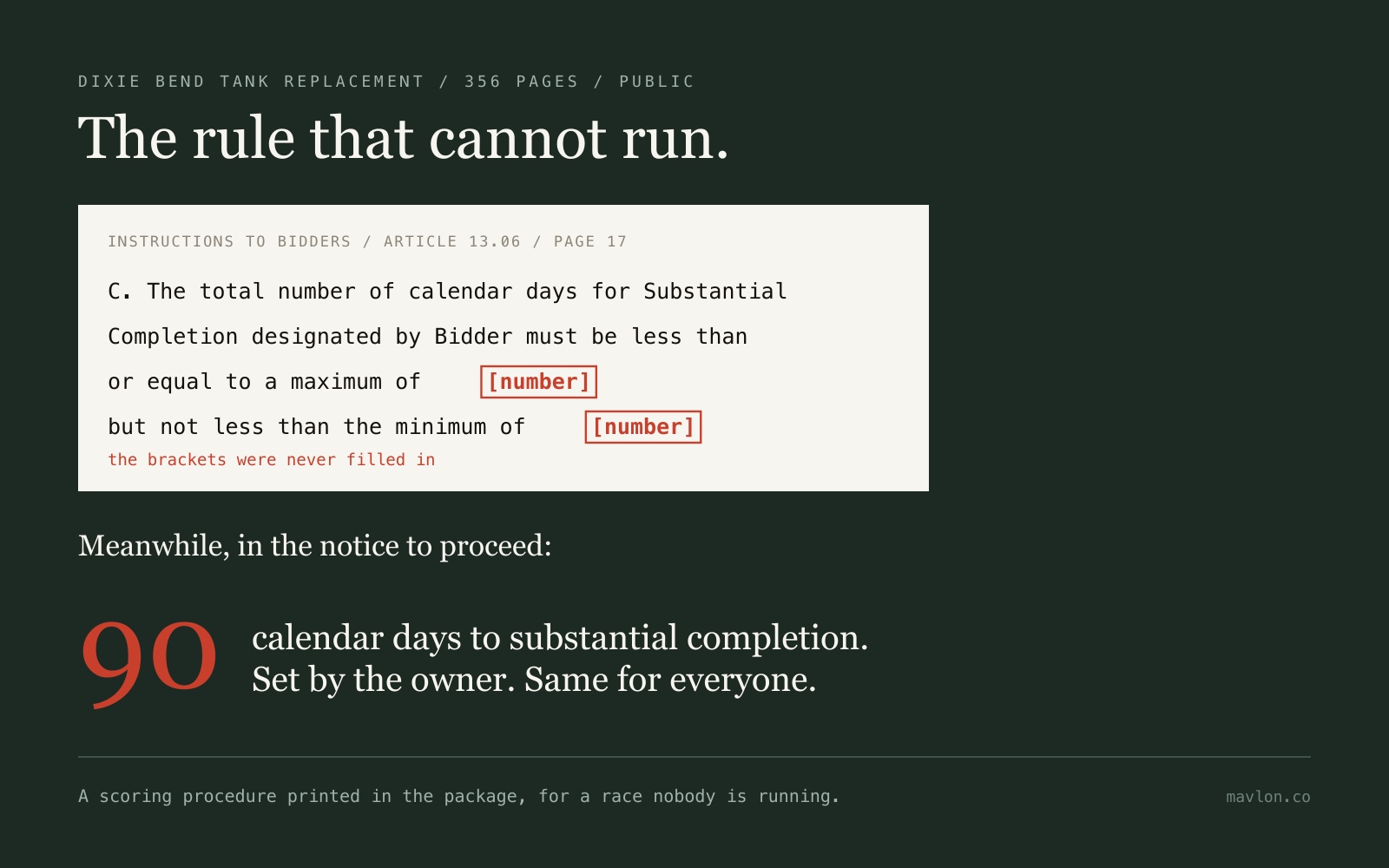
I spent an afternoon reading an elevated water storage tank bid the way a tank fabricator would have to read it, and I found something I have not seen written down anywhere: a rule printed in the package that tells you how you will be scored, which cannot actually run.
Not a contradiction between two numbers. A whole procedure, described across three paragraphs, that has nothing to operate on. If you priced against it you would be optimising for a competition that is not being held.
That turns out to be the most useful thing in the document, because it is not a one-off. It is a property of how these packages get made.
The package
South Eastern Water Association, a water utility in Pulaski County, Kentucky, replacing a tank. The document runs 356 pages and was prepared by their engineer, Kenvirons. It was filed with the state public service commission, which is why anyone can read it.
The thing being bought is a 100,000 gallon elevated water storage tank, plus everything around it. Elevated tanks are engineered and built by a small number of specialist fabricators, which makes this a good example of custom equipment procurement: the buyer describes what they need, the fabricator designs and builds a structure that has never existed before, and the price is committed long before the design is done.
Unlike some packages, this one does not put the whole answer on one line. The base schedule splits the job into eight lump sum items.
| No. | Item description | Unit | Qty |
|---|---|---|---|
| 1 | 100,000 gallon elevated water storage tank | LS | 1 |
| 2 | Earthwork | LS | 1 |
| 3 | Foundation | LS | 1 |
| 4 | Painting | LS | 1 |
| 5 | Yard work including lined channels and site restoration | LS | 1 |
| 6 | Yard piping | LS | 1 |
| 7 | Check valve station | LS | 1 |
| 8 | Tank demolition | LS | 1 |
Eight lines is more generous than one. It also means eight boundaries to interpret. Where does earthwork stop and foundation start. Is the pad under the check valve station earthwork, foundation or yard work. Does site restoration include the ground disturbed by demolishing the old tank, or is that inside item eight. Nobody rules on any of that, and two honest bidders will draw those lines differently.
The rule that is printed but cannot run
Here is the finding. On page 17, in the Instructions to Bidders, Article 13.06 is titled Price-Plus-Time Bids. It reads, in part:
Read the two brackets. They were never filled in.
Then page 19 explains how that would be scored: the lowest bid for comparison is the bid price plus the bidder's chosen number of days multiplied by a daily rate, and the procedure is used only to pick a winner, not to set what you get paid.
Now go to the Bid Form on page 22. Article 4, Time of Completion, says the work will be complete "on or before the dates or within the number of calendar days indicated in the Agreement." There is no blank for a bidder-specified duration. Nowhere on the form to enter the number Article 13.06 insists you must enter.
And the Notice to Proceed on page 51 settles it:
Ninety days, set by the owner, identical for everyone. The schedule is not a competitive variable at all.
So a bidder who reads Article 13.06 carefully and shortens their programme to win on time has optimised for a race that is not being run. A bidder who spots the unfilled brackets knows in ten seconds that the clause is inherited template text.
Why this happens, and why it is not sloppiness
These documents are assembled from standard forms. This one uses the EJCDC family: C-200 for instructions to bidders, C-410 for the bid form, C-520 for the agreement, with federal Rural Development edits layered on top. The engineer starts from a template covering every project shape the form anticipates, then fills in what applies and deletes what does not.
That is good practice. Writing bidding documents from scratch every time would produce far worse ones. But it has a predictable side effect: optional provisions survive into the issued document when nobody remembers to cut them, and a bracketed placeholder is the tell.
Once you know to look, the same pattern appears elsewhere in this package.
A payment clause with nothing to pay on
On the bid form, immediately under that eight-item schedule, the bidder acknowledges that "estimated quantities are not guaranteed, and are solely for the purpose of comparison of Bids, and final payment for all Unit Price Work will be based on actual quantities."
Look back at the schedule. Every item is LS, lump sum, quantity one. There is no unit price work in this project. The clause governs a category the bid schedule does not contain. The agreement carries the same machinery on page 41, including a line for the total of lump sum amount and unit price work with its own unfilled placeholder.
Harmless on its own. But an estimator who reads that sentence and concludes quantities will be re-measured after the fact has misread their own risk, because on a lump sum item, a quantity that turns out larger than assumed is simply theirs.
Milestone damages with no milestones
The agreement sets liquidated damages of $1,000 for each day past Substantial Completion, and the same for each day past final completion. Then it sets a milestone rate, and the amount is another unfilled bracket, for milestones the contract never names.
The borings that officially do not exist
This is the one that would keep me up, and it is not a placeholder problem. It is two operative documents flatly disagreeing about whether something exists.
The Supplementary Conditions, on page 143, do not merely modify the standard subsurface clause. They delete it and replace it:
Now turn to the technical section for the tank, on page 234:
And the next page names who did it, American Engineers, Inc. of Glasgow, Kentucky, and says the results are included at the end of the plans and specifications. The table of contents lists a Geotechnical Exploration Report running twenty two pages. The report is genuinely there, from page 293 onward, with site geology, boring logs, laboratory results, a seismic site class and foundation recommendations.
Why this matters more than a tidiness complaint: that deleted paragraph is the hook on which a contractor's differing site conditions claim normally hangs. The standard mechanism works by identifying reports containing Technical Data that the bidder is entitled to rely on, and then giving a remedy if actual conditions differ materially from that data. Strike the reports and you weaken the basis for relying on anything, while the data sits in the package being read by every bidder pricing the foundation.
The technical section adds its own qualifier on page 235, and this part is ordinary and fair: the owner does not guarantee that materials other than those disclosed by the borings will not be encountered, nor that proportions will not vary, and the contractor may at its own option and expense undertake additional investigation. That is a normal allocation, and a bidder can price it.
What is not ordinary is the geotechnical report's own conclusion. On page 300, under potential historic mining activities, it notes no obvious signs of distress in the existing tank from subsidence, then says the possibility exists that underground mines extended beneath the tank and that local mining for house coal occurred. And then it states plainly that the owner must assume the risk for potential subsidence related settlement of the tank.
So a specific and potentially expensive risk has been assigned to the owner, in writing, inside a report that the supplementary conditions say is not known to exist. A bidder who prices on the strength of that sentence is relying on a document whose contractual standing the package itself has muddied.
The right move here is not to guess and it is not to pad. It is to ask, before the question deadline, whether the geotechnical report is a contract document and whether the subsidence allocation on its page stands. That is a question the engineer can answer in one line by addendum, and until they do, it is the single largest unpriced item in the package.
You are scored on work that may never be built
The second thing worth knowing here has nothing to do with templates, and is entirely deliberate.
The bid form states that the low bid determination is based on the Total Base Bid, and that the Total Base Bid is the base project and Alternate No. 1 added together. Then it adds that if funds remain at the completion of the base project, with the owner's approval, Alternate No. 1 may be added.
Sit with that. You are compared on the sum of both. Only the first is certain to be built.
The strategic consequence is real. Put conservative margin into the alternate, because it is the part you understand least, and that margin counts fully against you in the comparison even though the alternate may never be ordered. Strip the alternate to win the comparison, and you have committed to a price for work that could well arrive later, at whatever material prices exist by then.
The bid security follows the same logic. Article 8 sets it at five percent of the bidder's maximum bid price, "determined by adding the base bid and all alternates." You bond the work that might not happen too.
The window for an equal closes before bids open
One more rule worth reading twice, because the common assumption about it is backwards. Article 10 says the contract as awarded will be on the basis of the materials and equipment specified, "without consideration during the bidding and Contract award process of possible substitute or or-equal items," and that an application for a substitute "may not be made to and will not be considered by Engineer until after the Effective Date of the Contract."
Then it adds that nothing counts as an approved equal unless a written request was submitted and confirmed by addendum before bids went in.
So the sequence is the opposite of what people assume. The freedom to offer an equal exists before the bid, through the question and addendum process, and closes when bidding opens. After award you can ask, but you are already contractually on the hook for the specified item. We wrote at more length about how or approved equal really behaves and when to walk away from a package because of it.
Questions close early too. Article 7 says questions received less than seven days before bid opening may not be answered, and that only responses issued as an addendum are binding. An answer given on the phone is worth nothing.
The clock, and what it costs
Collect the time provisions scattered through the package and a picture forms.
| Provision | Value | Where |
|---|---|---|
| Substantial completion | 90 calendar days from commencement | Notice to proceed, p51 |
| Liquidated damages | $1,000 per day | Agreement, p40 |
| Bid remains open for acceptance | 90 days after opening | Bid form, p22 |
| Bid security | 5% of base plus all alternates | Instructions, p13 |
| Questions deadline | 7 days before opening | Instructions, p13 |
Ninety days to substantially complete an elevated tank, and ninety days during which your price must stay available for acceptance. A fabricator whose honest build and erection plan runs past the fixed duration is not pricing a tank. They are pricing a tank plus a daily penalty, and that either goes into the number or gets accepted as a deliberate risk. What it must not be is unnoticed.
Every pound of steel has to be American
This project is funded through USDA Rural Development, which is why the standard forms carry Rural Development edits. That funding brings an obligation that sits quietly in the front of the package and reaches all the way into the mill order.
The package states that a domestic preference statute applies an American Iron and Steel requirement to the project, and that all iron and steel products used must be produced in the United States. It is not a passing mention. It appears on eighteen pages, and the contract documents include a manufacturer's certification form that has to accompany requests for approval.
For most trades on most jobs, that is a paperwork item. For a tank fabricator it is a sourcing decision that has to be made before the price is written. Plate, structural shapes, fasteners, pipe, fittings, valves and the appurtenances bolted to the tank all fall within scope, and the mills and suppliers you would otherwise pick on price and lead time are now filtered by where the material was actually melted and manufactured.
Two things follow, and both belong in the number rather than in the hope column. Domestic plate at the thickness and grade an elevated tank needs is a narrower market, so both the price and the lead time behave differently to the open market. And every supplier in that chain now has to produce a certificate, which means a supplier who cannot or will not certify is not a candidate, however good their quotation looks.
Notice what this does to the earlier point about the clock. Ninety days to substantial completion, with a domestic-only supply chain feeding it. Those two provisions live in different parts of the document and were almost certainly written by different people, and it is the bidder, not the engineer, who has to hold them in the same thought.
What an elevated water storage tank bid pins down, and what it leaves to you
The technical section is where the tank itself finally appears, and it is worth seeing how the responsibility is actually divided, because it is not what people expect.
The package pins the standard rather than the design. The tank must conform to AWWA D100, the American Water Works Association standard for welded steel tanks for water storage. It must be designed to withstand wind loads produced by a 100 mile per hour wind. Welds are to be inspected radiographically as set out in Section 11.4 of D100, and the contractor must furnish a person experienced in radiographic inspection. Surface preparation for painting follows Steel Structures Painting Council SSPC-SP6 commercial blast cleaning, with a specified profile, and the sealer is called out by equivalence to a named product.
There are accessory requirements too: a balcony of a stated minimum width, a lockable manhole of a stated clear dimension with a rainproof cover, an exhaust manhole, tubular columns braced by tie rods and struts.
| The package fixes | The fabricator decides |
|---|---|
| Capacity, 100,000 gallons | Plate thicknesses and the whole structural design |
| Governing standard, AWWA D100 | Column and bracing configuration within it |
| Wind load, 100 mph | How the load path is actually carried |
| Weld inspection method and extent | Weld procedures, sequence and shop versus field split |
| Surface prep standard and profile | Coating system build, and how it is staged |
| Accessories that must exist | How they are detailed and fabricated |
This split is the heart of why an elevated water storage tank bid is a genuinely engineered quote rather than a catalogue selection. Nobody has told you how much steel is in this tank. They have told you what it must survive and which rulebook governs, and the weight of steel, which is most of the cost, falls out of a design you will not complete until long after the price is submitted.
So the estimator is doing something subtle. They are not measuring a design. They are predicting what their own engineers will arrive at, months from now, under a standard and a wind load, and then pricing that prediction with enough margin to survive being wrong. That is the same act we described in quoting custom equipment before the design exists, and a tank is one of the cleanest illustrations of it in public procurement.
It also explains where the real spread between bidders comes from. Two experienced fabricators will predict different steel weights for the same capacity and the same wind load, because their standard details differ, their shop practices differ, and their judgement about the foundation and the erection sequence differs. Neither is wrong. The spread is the estimating problem made visible.
How to tell a live rule from a dead one
This is the transferable part, and it costs about fifteen minutes on any package.
- Search the document for square brackets. Placeholders like a bare number in brackets, or a blank where an amount should be, mark provisions nobody activated. It is the single fastest signal in the package.
- Make every commercial rule point at something. A scoring rule needs a blank on the bid form. A milestone penalty needs a named milestone. A unit price clause needs unit price items. If the rule has no target, it is not running.
- Let the executed documents win. Instructions to bidders describe intent. The agreement and the notice to proceed are what gets signed. Where they disagree, the signed document governs, and the instructions were the leftovers.
- Read the award rule before you price anything. Base only, or base plus alternates, or price plus time. It determines where margin should sit, and you cannot work that out from the technical sections.
- Find the deadline for questions, first. It is always well before the bid deadline. Every ambiguity you find after it has passed becomes a number you invented rather than a risk somebody resolved.
- When a rule is live and genuinely unclear, ask in writing. Quote the wording, cite both page numbers, state both readings, and propose the one you believe is correct.
None of this is about steel, tanks or water. It is the commercial layer that sits on top of every engineered-equipment package, and it is where a good estimator quietly separates themselves from a fast one. The same instinct applied to a switchgear package we read recently turned up a specification telling bidders to price two spare breakers separately with no line on the bid form to put them on.
What this package shares with every other one
A tank fabricator and a switchgear manufacturer have nothing in common. Different materials, different standards, different customers. Put their bid packages side by side and the shape is identical: a document written by an outside engineer, a small fraction of it actually about your product, a commercial layer that decides how you are judged, and a deadline for questions that falls long before the deadline for the price.
We set out that cross-industry pattern in full in quoting custom equipment before the design exists, using this package and two others from unrelated industries.
Why we are building Mavlon
We are building the best reader of bid packages in the world, and documents like this one are exactly why the job is worth doing properly.
The work that eats an estimator's day is not arithmetic. It is reading several hundred pages to find the twenty that matter, then working out which rules bind and which are leftovers from a template. That is slow, it is unglamorous, and it is completely mechanical right up until the moment it requires judgement.
Our claim is narrow and we make it hard: find every requirement that changes the price, cite each one to the page it came from so it can be checked rather than trusted, and put the contradictions in front of the person qualified to resolve them instead of quietly averaging them. What we will not do is decide your margin, decide whether you bid, or invent a number for a requirement the documents never settled. Those stay yours, and any vendor telling you otherwise is selling something they have not built.
We publish the exam we ask to be tested against, with the pass bar written down before anything runs, including what we have got wrong.
Talk to the person who built it
If your team prices work from documents like this one, the fastest way to find out whether we are useful is a conversation with the founder. Nothing to prepare and nothing to send.
Book a demo