What a Switchgear Bid Package Actually Asks You to Price
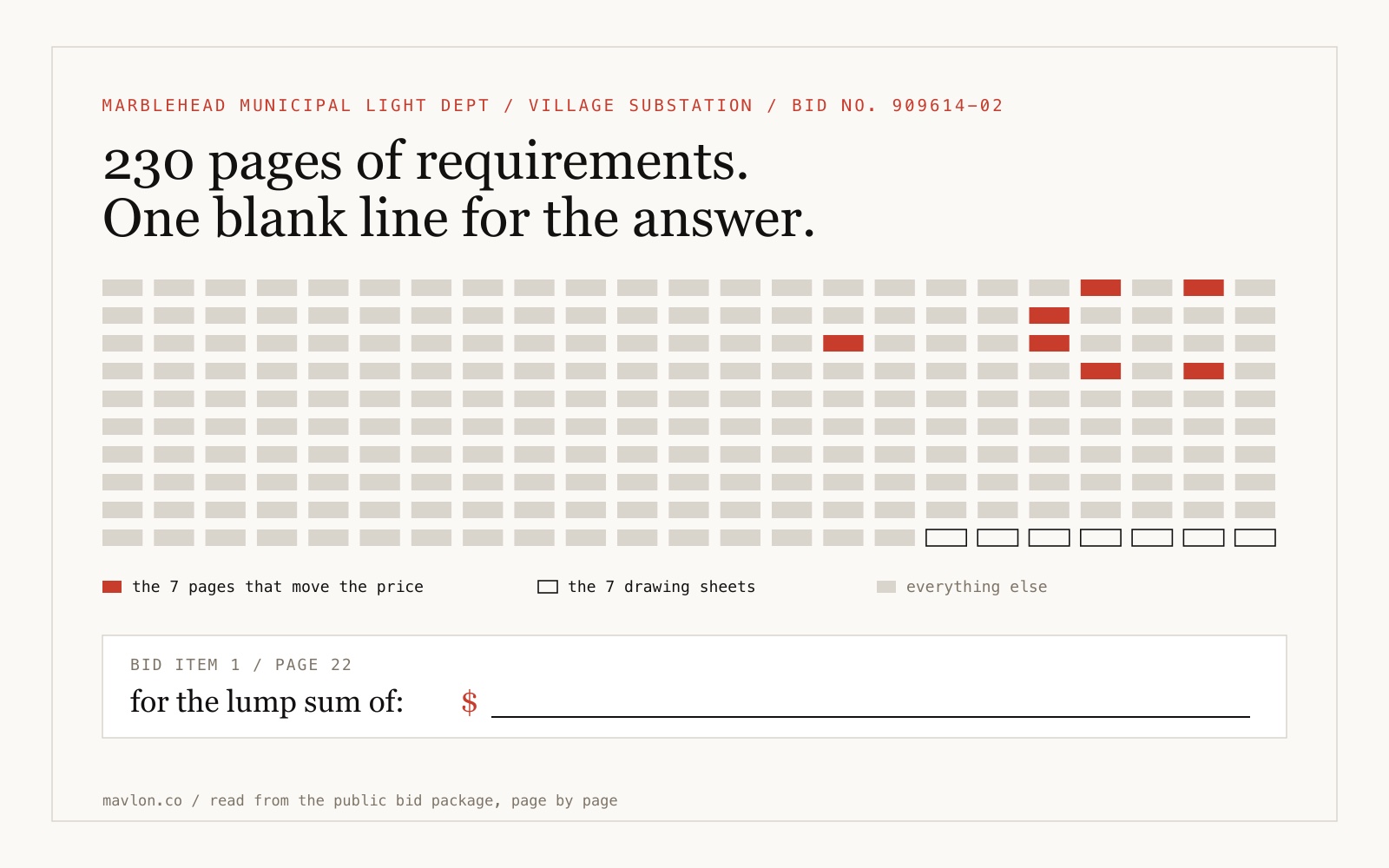
I spent a morning reading a switchgear bid package the way a manufacturer would have to read it. I was not skimming for the ratings and moving on. I read it front to back, the way somebody does when they have to put their name on a number at the end.
The package runs to two hundred and thirty pages. In it, a municipal light department in Massachusetts is buying one outdoor switchgear assembly for a substation, with two separate lineups inside it and a control room attached.
Seven pages in that document change the price. The other two hundred and twenty three mostly do not, and you cannot tell which is which until you have read them.
What stayed with me afterwards was not how much engineering was in the document. I expected that. It was how little room there is to put the answer.
We have written before about what reading real bid packages teaches you across several industries. This one is about a single package in a single category, and what it demands before anybody can quote it.
The package
The buyer is Marblehead Municipal Light Department, a town-owned utility north of Boston. The document was prepared by their consulting engineer.
It went out in June 2022 for the Village Substation. Like most municipal procurement it is public, so anyone can download it and follow along.
What the buyer is asking for
What they are buying, in the words of the summary of work on page 40, is one 25 kV and 15 kV outdoor protected aisle metalclad switchgear assembly with control room.
That sentence needs unpacking for anyone outside the category.
- Switchgear is the set of large switches and circuit breakers that route electricity around a substation and cut it off when something faults.
- Metalclad means a particular grade of construction. Each major live part sits in its own grounded steel compartment, the breakers roll out on rails rather than being bolted in place, and the bus is insulated. It is the higher end of the category, chosen where faults are severe and where crews need to work on one section while the rest stays live.
- Outdoor protected aisle means the whole lineup ships as a building, with a walkway down the middle so technicians stand inside it rather than out in the weather.
So the thing being priced is not a product from a catalogue. It is a building full of engineered equipment, designed for one substation, built once.
The five parts of this switchgear bid package
The 230 pages break into five parts:
- It opens with the commercial and legal terms.
- Next comes a bid form.
- Then there is a bid data sheet the manufacturer has to fill in.
- Four general sections cover scheduling, submittals, delivery and manuals.
- Last comes the technical heart: two specification sections, one for each voltage lineup, running 27 pages each. They are followed by protective device lists, panel schedules, a protection guide, and seven drawings.
Everything you read becomes one number
Page 22 is the bid form. After everything else, this is where the answer goes. Here is the whole of it:
One blank for two lineups and a control room
The form has one item and one blank. The package holds two hundred and thirty pages of requirements, two complete switchgear lineups and a control room, and the commercial answer is a single figure written out in words and then again in digits.
This is the thing people outside this world find hardest to believe. There is no schedule of rates, no breakdown by cubicle and no allowance line.
The word doing the heavy lifting is complete. It means complete as specified in two sections you were expected to read in full.
The price must hold for sixty days
Three sentences further down, the form says that all bid prices shall be firm for sixty days from the date of the bid opening.
So the number does not just have to be right. It has to stay right.
The sentence that turns silence into a promise
Pages 20 and 21 carry what I think is the most expensive sentence in the document. It is easy to read past because it is written as housekeeping.
The two provisions on the bid form
The bid form asks the bidder to mark one of two provisions:
- Provision one says the equipment offered is in accordance with the requirements of the contract documents, notwithstanding any variation between descriptive material furnished and those requirements.
- Provision two says the equipment offered deviates, and the bidder must then list every deviation in full.
Then the form adds this:
Saying nothing means full compliance
Read that again with a quoting hat on. If you say nothing, you have promised everything.
Every requirement buried on page 94 that nobody had time to get to is now a requirement you have agreed to supply, at the price you wrote on page 22.
The deviations box is not paperwork. It is the only mechanism in the entire document for saying we are not doing that one. It is opt-in, and the default setting is total compliance.
Why every page has to be read
I have come to think of this as the real reason reading matters in this business. It is not because reading is virtuous. It is because the contract is written so that unread equals accepted.
It is close cousin to the or approved equal problem, where a phrase that looks like it grants you freedom is governed by a clause somewhere else that takes it back.
Two spare breakers with nowhere to put the price
This is the finding that made me want to write the article, and it sits in a section most people would skim.
Part A: eight spares that go inside the lump sum
Clause 1.09 on page 42 covers spare parts. Part A lists eight items the manufacturer has to supply.
They are indicating lamps in each colour, resistors and sockets for each lamp type, three surge arrestors, half a set of spare primary fuses for every size and rating used, half a set of secondary and control fuses, and three cases of touch-up paint.
Then it says exactly where the money for them goes:
That is clear enough. Those eight items live inside the lump sum.
Part B: two spare breakers to price separately
Then part B says this:
The instruction is to price these separately. Now go back to page 22. There is one line.
The bid form has a single lump sum blank for the entire assembly. It has no second line, no alternates schedule and no unit price table.
The specification instructs the bidder to price two spare circuit breakers separately, and the form the bidder must return offers nowhere to write those prices.
Three ways an honest bidder could answer
- One bidder folds the two spare breakers into the lump sum, because that is the only blank available.
- Another quotes the assembly on the form and attaches the spare breaker prices on a covering letter, which the instructions do allow for deviations.
- A third asks the engineer before the deadline and gets an addendum. That is the correct move, and the one most likely to run out of clock.
Now look at what the utility sees. It sees three numbers. One of them includes two medium voltage circuit breakers and two of them do not.
The spare 15 kV unit is not a trivial item, because it has to be built to work in both 2,000 ampere and 1,200 ampere cubicles, or be supplied as two separate breakers instead.
Much of the spread between bids is scope, not price
This is worth sitting with, because it explains something that people in the industry argue about constantly.
When bids come back spread wide apart, the instinct is to say that one shop is hungry and another is greedy, or that somebody has a better supply deal. Sometimes that is true.
But a great deal of the spread in this category is not price at all. It is scope. Two estimators resolved the same ambiguity differently, and the tabulation flattened both answers into one column of dollars that pretends they were answering the same question.
How a careful document ends up ambiguous
Nobody is at fault here. The engineer who wrote this package wrote a careful, thorough, professional document.
Ambiguity of this kind is not carelessness. It is what happens when a specification section and a bid form are maintained by different logics and assembled into one book.
It happens on almost every package I have read, in every industry I have looked at. On a municipal treatment package we went through, the equipment scope was spread across fourteen sections that never referenced one another, which is the same problem wearing different clothes.
The price holds for sixty days. The equipment is due sixty weeks after the order.
Below the bid item on page 22 there is a small delivery table the manufacturer has to complete. The buyer states what they want, and the bidder states what they will commit to.
| Bid item | Description | Desired delivery |
|---|---|---|
| 1 | Outline, weights and foundation requirement drawing | 12 weeks ARO |
| 1 | Equipment | 60 weeks ARO |
ARO means after receipt of order. The weeks are not counted from the bid date, and they are not counted from drawing approval. They are counted from the purchase order landing.
Sixty days against sixty weeks
Put the two facts side by side:
- The price is firm for 60 days.
- The equipment is due 60 weeks after the order is placed, and the order will not be placed on the day of the bid opening.
That gap is carried by the manufacturer, and it has become a much harder gap to carry than it was when this package was written.
Lead times are longer now
Public lead time trackers now put medium voltage switchgear in the 15 kV class at roughly 52 to 80 weeks, with higher voltage classes running longer still.
Those figures are substantially above where they sat before 2021, because data centre construction is competing for the same factory slots as utilities and industrial plants.
So the estimator is asked to commit to a firm figure, today, for equipment that will be engineered over the following months, built from materials bought at prices nobody yet knows, and delivered more than a year out.
And they must do it before a single hour of the actual engineering has been paid for.
The quote comes before the design
That is the part of this business that I think outsiders never quite absorb. The quote comes first, and the design comes after. The quote is a promise about the cost of work that has not been done.
It is also the reason quoting resists automation in a way that most office work does not. There is no fast feedback loop telling you the number was wrong, and by the time you find out, the estimator who made the call has moved on to the next one.
The buyer hands you the scoring sheet
Pages 27 to 38 are a bid data sheet, and this is a genuinely useful feature that more packages should copy.
The instruction at the top is blunt: bidder to enter product data in the appropriate spaces on the following pages and return with bid.
What the bidder has to fill in
What follows is a structured list of guaranteed characteristics. For each of the two lineups, the manufacturer must state all of these:
- The sheet asks for the make and the type.
- It asks for the height, width and depth of each cubicle.
- It asks for the bus material for the main bus, the feeder bus and the ground bus.
- It asks for the bus dimensions.
- Then it asks for a long run of electrical ratings, breaker data, instrument transformer ratios and accuracy classes.
How to read the data sheet
Read it as a commercial document rather than a technical one and it is the evaluation criteria, published in advance. The utility is telling every bidder exactly which attributes it is going to line up side by side.
That is unusually fair, and it is also a warning. Anything on that sheet is something a competitor will be compared against you on, attribute by attribute, in a spreadsheet, by somebody who does not have to give you the benefit of the doubt.
Two lineups, two sections that look identical and are not
The technical heart of the package is two specification sections:
- Section 26 13 26.21, 15 kV metalclad switchgear assembly, pages 49 to 75.
- Section 26 13 26.31, 25 kV metalclad switchgear assembly, pages 76 to 105.
Why the second section is the dangerous one
They are built on the same skeleton. They have the same headings in the same order and much of the same wording, paragraph for paragraph.
That is exactly why they are dangerous. Twenty seven pages apart, a reader who has already absorbed the first section will move much faster through the second, and speed is precisely the wrong instinct.
The ratings of the two lineups compared
Here are the principal ratings from both, side by side. The 15 kV figures are from page 61, and the 25 kV figures are from page 89.
| Rating | 15 kV lineup, section .21 | 25 kV lineup, section .31 |
|---|---|---|
| Rated maximum voltage | 15.0 kV rms | 27.0 kV rms |
| Nominal voltage class | 13.8 kV rms | 25.0 kV rms |
| Operating voltage | 13.2 kV rms | 23.0 kV rms |
| Basic impulse level | 95 kV | 125 kV |
| Low frequency withstand, 1 minute | 36 kV | 60 kV |
| Rated short time current | 25 kA rms | 25 kA rms |
| Rated momentary current | 25 kA rms, minimum | 68 kA rms, minimum |
The 15 kV section also fixes the current ratings:
- The main buses are rated at 2,000 amperes.
- The main and bus tie circuit breakers are rated at 2,000 amperes.
- The feeder circuit breakers are rated at 1,200 amperes.
That last split is what makes the spare breaker requirement awkward, because the spare has to serve both sizes of cubicle.
Three different voltages describe the same lineup
Look again at the top three rows of that table for the 15 kV lineup:
- The maximum voltage is 15.0 kV.
- The nominal class is 13.8 kV.
- The operating voltage is 13.2 kV.
That is three numbers for one set of equipment.
What each voltage name means
None of this is a contradiction, and I want to be careful to say so plainly.
- The voltage class is what the insulation is built to survive.
- The nominal voltage is the standard label for the system it belongs to.
- The operating voltage is what is actually flowing through it on a Tuesday afternoon.
A 15 kV class assembly is routinely applied at 12.47, 13.2, 13.8 or 14.4 kV. It is rated at 15 kV precisely so that it has margin above whichever of those it serves.
The drawings use a different name from the specification
But now go to the drawings at the back. Sheet 909614-E191-A is titled, in the title block, 13.2 kV switchgear assembly front view elevations.
The specification section governing that same equipment is titled 15 kV metalclad switchgear assembly. The relay and metering one-line on sheet 909614-E201-0 uses 13.2 kV as well.
So the specification names it by class and the drawings name it by operating voltage. An experienced switchgear estimator reads straight past that without blinking.
Somebody newer to the category, or a piece of software matching documents by their labels, can very easily conclude that the drawings and the specification describe two different assemblies. They do not.
Where two numbers compete for the same line
Now comes the one place in this package where I genuinely could not settle the answer by reading, and where I think an estimator has to pick up the phone.
Two figures in the 15 kV section
Stay with the 15 kV section. It gives two figures:
- On page 61 the assembly is given a rated momentary current of 25 kA rms, minimum.
- Four pages later, on page 65, the circuit breaker that goes into that assembly is given a closing and latching capability of 68 kA peak, minimum.
What the two ratings describe
In the American standards for this equipment, momentary withstand and closing and latching describe the same physical event. That event is the first half cycle of a fault, when current is at its most violent and asymmetrical, and the equipment has to survive it mechanically without being asked to interrupt anything.
They are two names for one rating. The two numbers are not two names for one value, though.
Which of the two figures looks right
Closing and latching is conventionally derived from the symmetrical short circuit rating by a multiplier of roughly 2.6, expressed as a peak. Take the 25 kA rms short time rating in this package, multiply it out, and 68 kA peak is exactly what you would expect.
That makes the 68 kA figure on page 65 look right. It leaves the 25 kA momentary figure on page 61 looking like the short time rating repeated rather than the momentary one.
The 25 kV section uses a different unit
Then it gets more interesting. Go to the 25 kV section:
- On page 89 the assembly momentary rating is 68 kA rms, minimum.
- On page 91 the breaker closing and latching capability is 68 kA rms, minimum.
That is the same number as the 15 kV section, with a different unit. Page 65 says peak. Page 91 says rms.
Those are not interchangeable. The standards are explicit that a breaker carries either an asymmetrical rms momentary rating or a peak one, never both, depending on the vintage of the standard it was tested against.
| Where | What it governs | Stated value |
|---|---|---|
| Page 61, section .21 | 15 kV assembly, rated momentary current | 25 kA rms, min |
| Page 65, section .21 | 15 kV breaker, closing and latching | 68 kA peak, min |
| Page 89, section .31 | 25 kV assembly, rated momentary current | 68 kA rms, min |
| Page 91, section .31 | 25 kV breaker, closing and latching | 68 kA rms, min |
What a manufacturer should do with this
I want to be very clear about what I am and am not saying. I am not saying the engineer made a mistake.
I do not have the design basis, I have not seen the fault study behind it, and there are reasonable explanations for all of this that would be obvious to the person who wrote it.
Specifications get assembled from proven previous projects, which is good practice, and a phrase that was exactly right on the last job can land slightly differently on this one.
What I am saying is that a manufacturer pricing this package cannot resolve it from the document alone, and should not try. The right output is not a guess. It is a question.
Submit the question as a request for information before the deadline, with the two page references attached.
What is only on the drawings
Seven drawing sheets sit at the back of the package, pages 224 to 230, drawn at full size rather than letter size. They are:
- 909614-E190-A, 15 kV switchgear equipment arrangement, plan view
- 909614-E191-A, 13.2 kV switchgear assembly, front view elevations
- 909614-E192-A, further assembly elevations
- 909614-E193-A, control panels, front view elevations
- 909614-E201-0, 13.2 kV relay and one line metering diagram
- 909614-E202-0, further relay and metering
- 909614-E230-A, SCADA annunciator panel
What the drawings settle
Those sheets cover the arrangement, the elevations, the one line and the annunciator panel. They settle these questions:
- How many vertical sections are there?
- How are they ordered?
- What goes in each compartment?
- What instruments face the aisle?
- Which alarm points get wired back to the utility control system?
Almost none of that is recoverable from the specification text alone.
The specification tells you what each component must be capable of. The drawings tell you how many of them there are and where they sit, and quantity is most of the price.
This is the practical reason document handling in this business is harder than it sounds. The requirements are not in one place and they are not in one form.
Part of the scope is prose, part is a table, part is a drawing, and the parts do not always agree.
The work is not only factory work
One more thing changes the cost base, and it is three lines on page 40.
The summary of work says the contractor shall furnish and deliver the assembly, and then adds two more items:
- The first is offloading and rigging to place the equipment on the owner's foundation.
- The second is final assembly at destination.
What a factory gate price leaves out
So this is not a factory gate price. A manufacturer who prices this as equipment leaving the loading dock has left out crane time, rigging, a crew travelling to Massachusetts, and the assembly of a multi-section outdoor lineup on site.
For a shop whose normal business is shipping equipment and letting somebody else install it, that is an unfamiliar cost line sitting quietly inside a section titled summary of work.
And the rest of the quiet costs
Collected from across the general sections, each of these is a real cost that never appears as a line item anywhere:
- The owner may conduct a pre-award inspection of the bidder's factory as part of evaluating bids, including a meeting with the proposed design team.
- A detailed design and manufacturing schedule is due within four weeks of award, with thirteen named milestones, required and actual dates in parallel columns, reissued every month.
- A design review meeting may be held at the vendor's own offices.
- Requests for information follow a prescribed numbering and logging procedure, with a minimum of two weeks allowed for each response, and the log is issued monthly with the schedule.
- Warranty runs 60 months from energization or 66 months from acceptance, whichever ends sooner, and covers the entire assembly including all components.
- A bid bond of five percent accompanies the bid.
None of these is dramatic. Added together they are engineering hours, management hours, travel, and a five year warranty reserve on a building full of equipment.
They are all inside the one blank on page 22.
A checklist before you price a switchgear bid package
If I were handing this to somebody about to start on one, this is what I would tell them to settle before touching a spreadsheet.
- Find the bid form first, not last. Count the blanks. The shape of the answer tells you how much room you have to express anything the specification asks you to price separately. If those two things disagree, you have found your first request for information.
- Find the deviations clause and read what happens if you stay silent. On most packages, silence is full compliance. Decide deliberately whether you are taking exceptions, rather than discovering later that you did not.
- Treat near-identical sections as hostile. When one package carries two lineups, read the second section slower than the first, not faster. Build the comparison table yourself, rating by rating, and let the differences announce themselves.
- Separate the voltage names. Write down the class, the nominal and the operating voltage for each lineup, and expect the drawings to use a different one than the specification title. Do not let a label mismatch convince you there are two assemblies.
- Count from the drawings, not the prose. That means sections, cubicles, instruments and annunciator points. The specification governs capability, the drawings govern quantity, and quantity is the money.
- Collect the scope that is not equipment. That means rigging, site assembly, factory inspection, design review travel, the monthly schedule, the warranty reserve and the bond.
- List the questions and send them early. Every requirement you cannot resolve from the document is a question with a deadline attached, and the deadline for questions always falls well before the deadline for bids.
Why we are building Mavlon
I read packages like this one because Mavlon exists to read them, and because I do not believe anybody can build software for this problem without doing the reading themselves.
What we believe the hard part is
Here is our claim, stated plainly. The hard part of quoting engineered equipment is not arithmetic.
It is that the requirements arrive as hundreds of pages written by somebody who does not work for you, spread across prose, tables and drawings that do not always agree. A senior person has to reconcile all of it and commit to one number before anybody is paid to do the engineering.
Every hour that person spends locating requirements is an hour they are not spending on judgement, and judgement is the only part of the job that is actually theirs.
What we are building
We are building the best reader of bid packages in the world. It is not a configurator, not a catalogue pricer, and not a workflow tool with a quoting tab.
It is a system whose entire purpose is to take the document set your customer sent you and do three things:
- It finds every requirement that changes the price.
- It cites each one to the page it came from.
- It puts the contradictions in front of a human being instead of quietly averaging them.
Catalogue pricing solves a different problem
That is a different bet from the rest of the category, and we make it deliberately.
Software that prices from a parts catalogue works beautifully when the product is configurable and the options are known. It has nothing to say about a 230 page document where the scope has to be discovered before it can be priced.
Those are different problems and they need different machines.
What we publish, and what we will not claim
We hold ourselves to the same standard we are asking of the documents:
- We publish the exam we ask to be tested against, including the pass bar, agreed in writing before anything runs.
- We publish what we get wrong.
And we are not going to tell you a machine should decide your margin or decide whether you bid, because it should not. Any vendor who says otherwise is selling you something they have not built.
Talk to us about your packages
If your team prices work from documents like this one, the fastest way to find out whether we are useful is a conversation with the person who built the thing. No forms to fill in, no data to send, no procurement process to start. Just a call.
Or read what Mavlon does for switchgear and switchboard builders, on one page: AI quoting for switchgear and switchboard manufacturers.
Book a demo