Heat Exchanger Specification Sheet: What Each Line Changes in the Quote
If you have quoted a shell and tube exchanger from a customer's heat exchanger specification sheet, you know the sheet is only half of the request.
The other half is the owner's specification behind it, and that document can change what a single word on the sheet means.
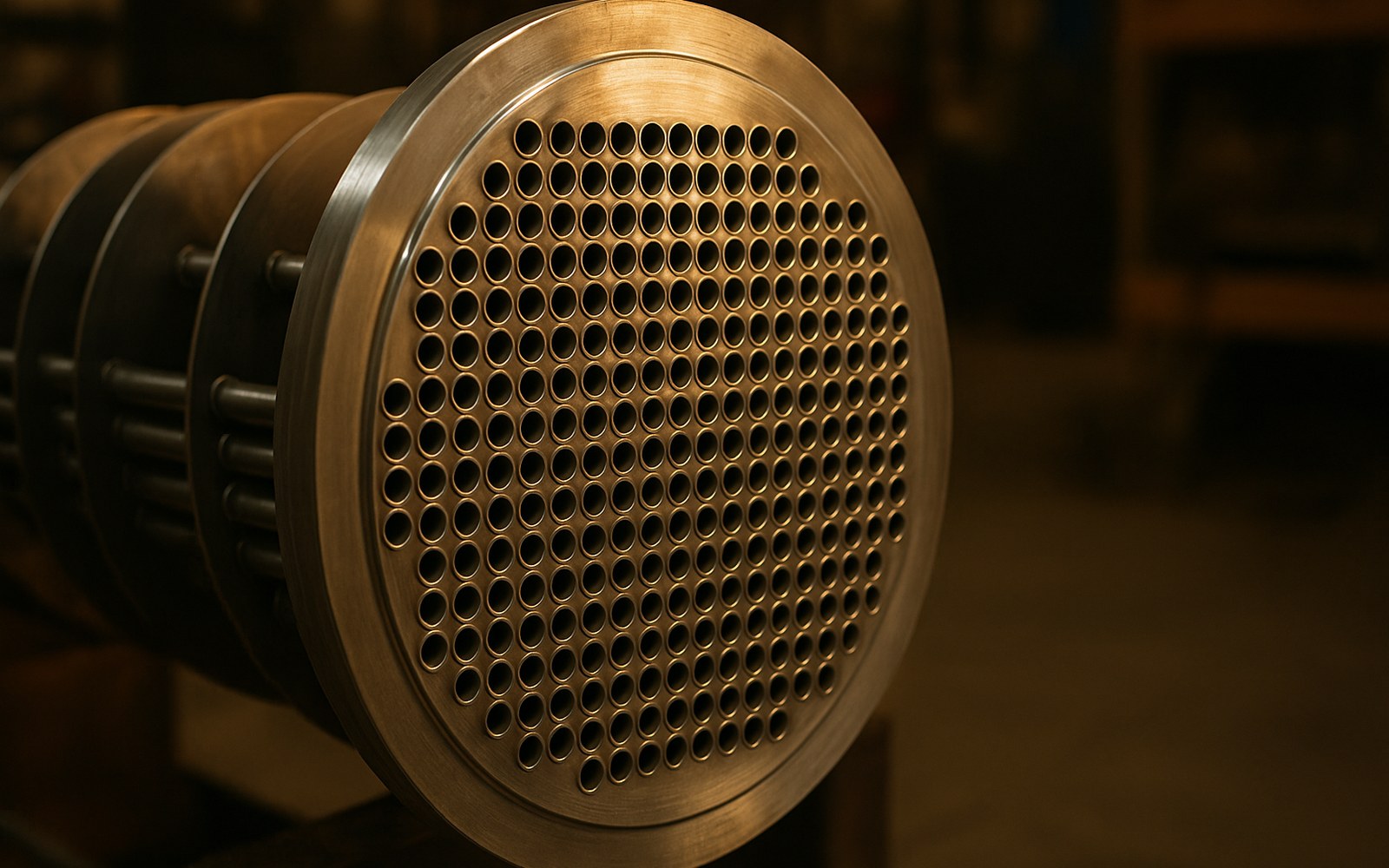
Here is a small example. The tubesheet is the thick plate, drilled with one hole for every tube, that holds the tube ends in place.
A data sheet usually has one line that says how the tubes are joined to it, and ADNOC's shell and tube specification tells you how to read that line:
"If the equipment datasheet specify 'welded', it shall be considered has 'strength welded'."
ADNOC, AGES-SP-06-003 Rev. 1, page 85A seal weld only stops leaks, while a strength weld is designed to carry the load that holds the tube in the tubesheet.
The same page closes the cheaper door completely: "Seal-welded joints are not permitted." The sheet says one word, and the specification turns it into the more expensive joint.
For this guide we read five public documents line by line, with a pencil, the way a proposal engineer reads a new enquiry.
Four are specifications from owners and standards bodies, and one is a real data sheet that was filled in for a single condenser.
Every requirement below is quoted with its page, so you can check it. We also marked the places where the documents disagree with each other, and the places where one document disagrees with itself.
Those are the lines that cause arguments after the order, so they get the most space.
This guide is written for thermal and mechanical design engineers, proposal engineers and estimators at shell and tube and plate exchanger makers.
What we learned from reading five whole public bid packages, commercial pages included, is in reading bid packages. This piece stays with the exchanger itself.
In brief
- The sheet gives you the duty and the geometry, but the owner specification decides the class, the joints, the tests and the spares. You have to price both.
- ADNOC ranks its design data sheets above its own specification, yet the same page says the most stringent requirement applies unless the owner agrees otherwise.
- ADNOC's offshore annex overrides its own main body on points that change the price, including packed joints and the tube to tubesheet mock-up test.
- In ADNOC's specification the supplier guarantees thermal performance even when the owner did the thermal design, unless the design uses proprietary enhanced technology.
- Four of the five documents ask for an ASME code stamp, and the fifth leaves the pressure code to the client.
- The plate exchanger documents disagree on plate material, frame paint, fouling and whether thermal performance must be certified before purchase.
The five documents we read
Each of these documents is public, and the links are in the Sources section at the end. They come from very different buyers: an oil company, a nuclear waste plant, the US military, data centre builders and a university.
| Document | Owner | Date | Pages |
|---|---|---|---|
| Shell and Tube Heat Exchanger Specification, AGES-SP-06-003 Rev. 1 | ADNOC Group Projects and Engineering, for all ADNOC group companies | No date printed; the file sits in a 2021 folder on adnoc.ae | 123 |
| Mechanical Data Sheet, Shell and Tube Heat Exchanger, 24590-PTF-MED-FEP-00003 Rev. 3 | US Department of Energy, Hanford Waste Treatment Plant (a Bechtel sheet) | Rev. 3 signed February 2009 | 21 |
| UFGS 23 57 10.00 10, Forced Hot Water Heating Systems Using Water and Steam Heat Exchangers | USACE, NAVFAC and AFCEC | November 2019 | 47 |
| Plate Heat Exchangers base specification, Rev 0, Version 1.0 | Open Compute Project | Effective 22 August 2025 | 15 |
| Heat Exchangers for HVAC, section 23 57 00 | Columbia University Facilities | Last revised 1 June 2011 | 3 |
What kind of document each one is
- ADNOC's specification is an owner standard. Part I holds ADNOC's own rules, and Part II amends the TEMA standard clause by clause. Six annexures at the end add rules for individual group companies.
- The Hanford sheet is a real data sheet from 2009, filled in for one specific condenser. Its revision table shows it was first issued for procurement in April 2003 and then updated twice to take in the vendor's design.
- UFGS 23 57 10.00 10 is a federal guide specification. A guide spec is a template with blanks such as "[_____]" that the project designer fills in, so a project copy can differ from what you read here.
- The OCP document is a base specification for plate exchangers in data centres. It was written by engineers from four makers: Alfa Laval, Wieland, Kelvion and Danfoss.
- Columbia's section was last revised in 2011. It is written for the consultants who design the university's buildings, not for makers.
Page numbers below are PDF page numbers. ADNOC, UFGS and OCP print the same numbers in their footers, and the Hanford pages match its sheet numbers.
How a heat exchanger specification sheet is laid out
A data sheet is a one or two page form that describes one exchanger, or a set of identical ones.
TEMA, the Tubular Exchanger Manufacturers Association, publishes a blank form of its own, the TEMA heat exchanger specification sheet. Owners and engineering firms often make their own versions with the same kind of lines.
The Hanford sheet is a good example to walk through, because every block on it is filled in. Its first two pages fall into six blocks:
- General data covers the quality level, the seismic category, the design code, the code stamp, the TEMA class and type, the duty and the area.
- Thermal and hydraulic data covers the fluids, flows, temperatures, fluid properties, allowed pressure drops and fouling.
- Mechanical data covers design pressure and temperature, corrosion allowance, shell size, tube count and tube diameter.
- Material data names the material of the shell, channel, tubes, tubesheet, gaskets, baffles and bolting.
- Construction data covers the baffle type and spacing, the tube supports and the weights.
- Notes come last, and they are often where the expensive requirements live.
The TEMA class and the TEMA type
Two short codes on the sheet move the price a great deal. The TEMA class is a single letter, R, C or B.
Class R is meant for the severe service of petroleum processing, class C for moderate commercial and general process service, and class B for chemical process service.
R is the strictest of the three, so it costs the most for the same duty.
The TEMA type is three letters that describe the front head, the shell and the rear head.
An AES exchanger, for example, has a channel with a removable flat cover at the front (A), a one-pass shell (E), and a floating head at the back (S), so the whole tube bundle can be pulled out for cleaning.
A BEM has bonnets at both ends and a fixed tubesheet, so the bundle stays in the shell.
On the Hanford sheet the line reads "TEMA (Class/Type) B".
The field holds a class and no three-letter type. The construction has to be pieced together from the notes, which say "All welded construction on Process side only" and "Inherent steam Bustle Construction".
The line below it asks for "Flow Type (Counter current, etc)" and holds "8 PASS". That is our reading of a pass count entered in a field that asks for a flow arrangement.
It is a small thing, but it shows that a filled-in sheet is not always filled in the way the form intended.
Before you price anything, write down the TEMA class and the three letters of the type.
If either one is missing or has to be guessed from the notes, send that question to the buyer first, because the class and type set the price range before any option is added.
The performance lines: duty, pressure drop and fouling
The top of the sheet tells you what the exchanger has to do.
On the Hanford condenser the duty is 17,165,333 Btu/hr on 3795 square feet of area, with a corrected temperature difference of 18 °F.
The steam enters the shell at 1.11 psia, well below atmospheric pressure.
Allowed pressure drop is a hard limit
The sheet gives an allowed pressure drop for each side. On the Hanford sheet it is 0.093 psi on the steam side and 22.6 psi on the tube side. ADNOC states plainly that the design must stay under these numbers:
"The calculated pressure drops shall not exceed the allowable pressure drops specified on data sheets."
ADNOC, AGES-SP-06-003 Rev. 1, page 26The same paragraph adds that margins shall be added to the calculated clean pressure drop, to make sure the exchanger still performs when it is fouled.
A design that only just meets the allowed pressure drop when clean does not meet ADNOC's rule.
What a fouling factor is
A fouling factor is an extra thermal resistance added to the calculation. It allows for the dirt, scale or biological growth that builds up on tube walls in service.
A larger fouling factor means the exchanger needs more surface, so it costs more.
The five documents handle fouling in five different ways:
| Document | What it says about fouling | Where |
|---|---|---|
| ADNOC | Fouling values go on the data sheet, and the owner is consulted if they are missing. TEMA's tabled values are called over-conservative. | Page 96 |
| Hanford sheet | 0.0015 on the steam side and 0.001 on the tube side, in hr-ft2-°F/Btu | Page 1 |
| UFGS | "Design fouling factor must be [_____]." The designer fills the blank, using TEMA's recommended allowances. | Page 23 |
| Columbia | "A fouling factor of 0.0005 on both sides of the plate", with no unit given | Page 2 |
| OCP | No fouling factor. A target wall shear stress ("Tau") of 25 N/m² is suggested instead. | Page 9 |
ADNOC's wording is worth reading in full, because it tells the thermal designer not to reach for the standard tables:
"TEMA fouling factors are now considered to be over-conservative, with emphasis put on COMPANY experience of actual fouling to guide the value used in the design."
ADNOC, AGES-SP-06-003 Rev. 1, page 96A number with no unit
Columbia's 0.0005 is the one to watch. Our own conversion shows why.
In the US units the Hanford sheet uses, 0.0005 hr-ft2-°F/Btu is a light allowance. In metric units, 0.0005 m²K/W is about 0.0028 hr-ft2-°F/Btu, which is more than five times larger.
The same printed number can mean a small exchanger or a much bigger one, depending on a unit the document leaves out.
Margin on top of fouling
ADNOC also asks for surface beyond the fouling allowance. When a tube leaks in service, the plant plugs both ends of it and runs on with fewer tubes, so ADNOC sizes for that from the start:
"Exchanger shall be designed with a minimum over design margin on duty and flow rate as per process design criteria or allow plugging of 5% tubes for maintenance, whichever is maximum"
ADNOC, AGES-SP-06-003 Rev. 1, page 96A row that does not mean what its label says
On the Hanford sheet, the row labelled "Latent Heat Btu/lbm @°F" holds 1121.1 and 78.6 on the steam side, and 43.07 and 61.05 on the cooling water side. The cooling water never boils, so it has no latent heat.
Our reading is that the row holds enthalpies, not latent heats. The document does not say so. If your thermal designer types that row into a rating program as latent heat, the result will be wrong.
Check the unit and the label of every fouling and property value before it goes into your rating.
If a fouling factor has no unit, ask for it in writing, and state in your quote the fouling values and margin you designed to.
Who owns the thermal design, and who guarantees it
Thermal rating is the calculation that checks whether a given exchanger, with its tube count, tube length, baffles and passes, meets the duty within the allowed pressure drops.
HTRI, the Heat Transfer Research Institute, publishes software for this calculation, and ADNOC names it.
The question that matters for the quote is simple. If the buyer's engineer did the rating and you build what the sheet shows, who answers when the exchanger falls short?
ADNOC puts the guarantee on the maker
ADNOC requires HTRI on page 26, and it asks the maker to repeat the calculation even when ADNOC has already done it:
"Thermal and hydraulic performance, vibration analysis calculations shall be performed and submitted even if thermal design of the heat exchanger is carried out by the COMPANY."
ADNOC, AGES-SP-06-003 Rev. 1, page 46On page 57 it makes the supplier guarantee thermal performance "irrespective of who perform initial thermal design or rating of the heat exchanger".
The same page asks for that performance "in clean and fouled conditions over the entire range of operating conditions" shown on the data sheets.
The exception for enhanced designs
Page 29 carves out one case. When a design uses proprietary technology such as helical baffles, twisted tubes or tube inserts, the thermal guarantee moves:
"the thermal and hydraulic design and guarantee shall be included in the scope of the technology owner, not the equipment manufacturer"
ADNOC, AGES-SP-06-003 Rev. 1, page 29So within one document the maker carries the thermal risk for a plain design and does not carry it for an enhanced one, unless the maker is licensed by the technology owner.
Page 29 also asks for a conventional "Base Case" design next to any enhanced one, so the two can be compared.
How the five documents split the job
| Document | Who sets the thermal design | Where |
|---|---|---|
| ADNOC | The supplier guarantees it, whoever did the rating, except for proprietary enhanced technology | Pages 29, 46, 57 |
| Hanford sheet | "The physical design parameters shall be determined by the seller based on TEMA and HEI standards." | Page 2, note 15 |
| UFGS | The designer shows capacity, temperatures, pressure drops and fouling on the drawings, and the maker selects the unit | Page 23 |
| Columbia | "Consultant shall schedule all parameters of the heat exchanger, including the fouling factor on the drawings." | Page 1 |
| OCP | Channel plate designs are "under full design authority of the manufacturer", and the units must be AHRI-certified | Pages 9, 10 |
A thermal guarantee on a design you did not make is a fixed price risk in its own right.
We looked at where that kind of risk starts, using manufacturers' own annual reports, in fixed price contract risk starts at the quote.
ADNOC also tells you what to do when the data is thin.
Page 26 says that if the designer or the supplier finds the data "insufficient for design purposes, it is his responsibility to request further information".
Silence about missing data is your problem under this document, not the owner's.
Run your own rating on every sheet, even a fully rated one, and keep the file.
In the quote, say whose rating you priced, which cases you checked, clean and fouled, and that the thermal guarantee rests on the process data in the sheet as issued.
The construction lines: class, pressure and the tube bundle
The middle of the sheet fixes the hardware. This is where the owner specification adds the most rules that the sheet itself never mentions.
The class follows the service
"Heat exchangers in process/hydrocarbon service shall be supplied in accordance with TEMA R construction. Heat exchangers in non-hazardous utility service as part of package may be supplied in accordance with TEMA C construction."
ADNOC, AGES-SP-06-003 Rev. 1, page 66Under ADNOC, the class comes from the fluid, not from the buyer's budget. A utility cooler inside a package can be class C, while the same size of exchanger in hydrocarbon service has to be class R.
The front head is chosen for you
ADNOC also picks the front head by service and pressure.
Page 53 says that for fouling service at a design pressure up to 30.0 kg/cm2(G), "Type A front head shall be used." Clean service or a higher pressure gets a type B front head instead.
The same page bans two rear head types outright: "Types P and W are not permitted." Both are packed floating head designs, which page 79 names as the outside packed floating head and the externally sealed floating tubesheet.
Design pressure, vacuum and corrosion allowance
- ADNOC designs for full vacuum whenever steam-out cleaning is needed, unless the data sheet says otherwise (page 66).
- ADNOC also says "Differential pressure shall not be used as design basis unless specified." Designing for the difference between shell and tube pressures gives a thinner tubesheet, so this rule adds metal (page 66).
- ADNOC's standard corrosion allowance for carbon and low alloy steel is 3 mm, and parts other than tubes are chosen for a design service life of 30 years (page 67).
- The Hanford sheet asks for full vacuum on both sides, a corrosion allowance of 0.04 inch, and a design life of 40 years (pages 1 and 3).
Tubes: wall, diameter, length and weight
ADNOC replaces TEMA's tube gauge table with its own on page 69.
It sets a minimum wall for each tube material, for example 2.11 mm for carbon steel and 1.65 mm for austenitic stainless steel. Tubes of 31.75 mm outside diameter or larger need ADNOC's approval.
Removable bundles are limited too.
Page 68 says the maximum length "should be 7315 mm (24 ft) nominal tube length unless otherwise approved by the COMPANY", and page 73 says "The maximum removable bundle weight shall be 20,000 kg." A large duty that breaks either limit needs more shells, and that changes the price far more than any single line item.
An F shell with two pressure drop limits
An F shell has a longitudinal baffle down its length, so the shell side fluid makes two passes in one shell. ADNOC gives two different limits for it.
- Page 20 allows less than 0.7 bar when the longitudinal baffle is welded to the shell, and no more than 0.5 bar for a removable bundle.
- Page 54 says "When F shell is used, limit shellside pressure drop to 0.49 kg/cm2 (7.0 psi) per shell", with no split by construction.
By our conversion, 0.49 kg/cm2 is about 0.48 bar. A welded-baffle F shell designed for 0.6 bar passes page 20 and fails page 54.
Vibration and the "By Others" line
Flow-induced vibration happens when the shell side fluid makes the tubes shake against the baffles, which can wear holes in them.
ADNOC asks for a bundle that stays free of vibration "up to 110% design shell side flow rate", with unsupported tube spans under 80% of the TEMA table values (page 92).
Both rules mean more baffles or supports than a bare TEMA design.
One measure in this check is ρV², the fluid density times its velocity squared, which shows how hard the fluid hits the tubes at the inlet.
The Hanford sheet has three ρV² lines, at the inlet nozzle, the bundle entrance and the bundle exit. All three say "By Others".
Those lines sit in a block headed "Construction Data (To be determined by the supplier when not specified by the buyer)". Under that heading, "By Others" does not tell you who the others are.
Price the vibration check and the extra supports as yours unless the buyer names someone else in writing. Where a sheet says "By Others", ask who that is before you bid.
The tube to tubesheet joint
This one line on the sheet can move a lot of cost, so it is worth understanding the three common joints:
- An expanded joint is made by rolling the tube end outward against the tubesheet hole, often into small grooves cut in the hole. It is the simplest joint.
- A seal weld adds a small weld at the tube end to stop leaks. The rolled joint still carries the load.
- A strength weld is sized to carry the full load on its own. It needs a qualified welding procedure, more inspection and usually a mock-up test.
When ADNOC forces a strength weld
Page 85 lists the cases where tubes "shall be strength welded and lightly expanded".
They include hydrogen service, very toxic service, lethal service, titanium tubes, a minimum design metal temperature below -46 °C, and this one, which catches many ordinary exchangers:
"When the design pressure on either shell or tubeside exceeds 50 bar g"
ADNOC, AGES-SP-06-003 Rev. 1, page 85Add the rule that "welded" on the sheet means strength welded, and the ban on seal welds, and you can see why the sheet alone is not enough.
The Hanford sheet is direct about it too: note 3 says "Tube to tubesheet joint shall be strength welded."
The mock-up test: optional or always?
A mock-up is a test block that copies the real tubesheet and tubes.
It is welded and expanded with the production procedure, then cut open and tested, before any work starts on the real tubesheet.
ADNOC's main body and its offshore annex disagree about when you need one.
- The main body, page 41, says: "Mock-up test for tube to tubesheet joint shall be performed if specified in the datasheet."
- The offshore annex, page 123, says: "Tubes to tubesheet welding and expansion shall be qualified on mock-up blocks similar to that of job tubesheet and tubes."
Page 112 says the offshore requirements "assume priority over main specification wherever conflicts exist." For an ADNOC Offshore job, the mock-up is in scope even when the data sheet says nothing.
Write the joint type you priced into the quote in words, for example "strength welded and lightly expanded, with a mock-up test". If the sheet says only "welded", say which weld you priced and ask the buyer to confirm it.
The material lines
The material block names the grade of each part. The owner specification then adds rules about forms, processes and grades that never appear on the sheet.
What a filled-in material block looks like
The Hanford condenser is stainless steel throughout. The shell, channel, tubesheet and baffles are "SA 240 316 SS (max. carbon 0.030%)", and the tubes are "SA 213 316 SML SS (max. carbon 0.030%)".
The tube side gaskets are "SA 240 316 SS Spiral Wound w/PTFE Filler" and the bolting is "SA-193 Gr B8M" (page 1).
The carbon limit is the detail to catch. It means every plate, tube and forging certificate has to show carbon at or below 0.030%, not just the grade name 316.
Rules from the owner specification
- ADNOC rules out two materials on page 33: "Unless otherwise specified, Stainless Steel SS 304 shall not be used." It also says "Castings shall not be used."
- Tubesheets must be forged: "Plate material is not permitted for the construction of tubesheeets." (ADNOC, page 84)
- In seawater service, tubes and tubesheet or tubesheet cladding must be the same metal: "A dissimilar metal interface is not acceptable." (ADNOC, page 67)
- ADNOC bans explosion bonding on page 86: "Explosive metal bonding on tubesheet and/or explosive expanding of tubes to the tubesheet is not permitted."
- Baffles, seal strips, spacers and tie rods "shall be compatible to tube material to avoid galvanic coupling". (ADNOC, page 34)
A forged tubesheet costs more and takes longer to arrive than one cut from plate. That rule alone can move both the price and the delivery date in your quote.
Titanium tubes: "may" or "shall" be seamless
Two pages of ADNOC's specification, one apart, disagree on this point:
- Page 33 says "Titanium tubes may be seamless."
- Page 34 says "All tubes shall be seamless."
Seamless titanium tube costs more than welded titanium tube. One reading of page 33 lets you price welded tube, and page 34 does not.
Under ADNOC's own rule that the most stringent requirement applies, the safe reading is seamless, and you should say so in the quote.
How much of a U-bend gets annealed
In a U-tube bundle, each tube is bent into a U so the bundle can grow and shrink freely. Bending cold-works the metal.
For austenitic stainless steel, the fix is solution annealing, a heat treatment that restores the metal after bending. ADNOC gives two different extents for it:
- The main body, page 71, says these U-bends "shall be solution annealed after bending over the full length."
- The offshore annex, page 122, asks for "the bend area and at least 150mm of the adjacent straight length" for bends with a mean radius below 5 times the tube diameter.
If "full length" means the whole tube, the work needs a long furnace or a tube supplier who can anneal after bending. Annealing the bend and 150 mm is a local heat treatment, so the two rules can lead to different prices and different suppliers.
Type 304 across the documents
| Document | Type 304 stainless | Where |
|---|---|---|
| ADNOC | Not used unless otherwise specified | Page 33 |
| Columbia | Required: plates "pressed out of Type 304 stainless steel", and all wetted parts in Type 304 | Page 2 |
| OCP | Allowed: plates in 316/316L, 304/304L or titanium | Page 11 |
| UFGS | Offered as one bracketed choice for plates, next to 316, two nickel alloys and titanium | Page 24 |
| Hanford sheet | Not used: everything is 316 with a carbon cap | Page 1 |
List every material rule from the owner specification next to the material block of the sheet. Where a rule depends on a word like "may", state the reading you priced.
The testing lines: hydrotest, heat treatment and the code stamp
A hydrotest fills the exchanger with water and raises the pressure above the design pressure, to prove it is strong and tight.
The sheet gives the design pressure, but the owner specification usually decides how many tests there are and how they are run.
Three hydrotests, not one
"A separate hydrostatic test shall be carried out for shell and tube-side. Then a hydrostatic test for the complete exchanger (both sides) shall be carried out."
ADNOC, AGES-SP-06-003 Rev. 1, page 41The same page asks for the shell side test "with the bonnet or channel cover removed", so the inspector can see the tube joints.
On a floating head exchanger, that needs a test ring or a test flange to close the shell during the test.
Page 41 sets how many of these come with each set of identical exchangers.
A test flange for a design ADNOC says should not exist
Page 83 says "All exchangers with removable bundles with a B-type front head shall have tubesheets extended to equal shell flange outside diameter." The tubesheet must also be thick enough to test the shell side "without the need for test rings".
Pages 41 and 63 still give test flange rules for an exchanger with "a bonnet-type head, a removable bundle, and a tubesheet of diameter smaller than the outside diameter of the connecting shell flange".
The B front head is the bonnet. If page 83 is followed, that exchanger should not exist, so it is worth asking which test hardware the buyer expects.
Test pressures and hold times across the documents
| Document | What it asks for | Where |
|---|---|---|
| ADNOC | Shell side, tube side, then both sides together | Page 41 |
| UFGS, steam shell and U-tube | Designed for 150 psig, factory tested at 300 psig | Page 24 |
| UFGS, plate and frame | Designed for 300 psig, factory tested at 450 psig | Page 24 |
| UFGS, whole heating system in the field | 45 psig "for a period of four hours", with the exchanger in the system | Page 45 |
| Columbia, U-tube | Shell test pressure 300 psig, working pressure 125 psig | Page 1 |
| OCP, gasketed plate | Above DN100, 10 minutes at test pressure plus 20 minutes at working pressure, both sides tested unbalanced | Page 10 |
The unit typos in UFGS
The copy of UFGS we read prints each pressure twice, once in metric units and once in US units. In three places the two do not match:
- Section 2.11.3 says plate and frame units are "factory tested at 3.10 MPa 450 psig". Section 2.11.4, on the same page, says "factory tested at 31.0 MPa 450 psig". The metric figure in 2.11.4 is ten times too high.
- The "150 pound" flange class appears as "1.03 MPa" in section 2.11.1, as "4.03 MPa" in sections 2.11.2 and 2.11.3, and as "68 kg 150 pound class" on page 11.
- The same 300 psig test is "2.02 MPa" in section 2.11.1 and "2.07 MPa" in section 2.11.2.
A "150 pound" flange is a pressure class name, not a weight. Our reading is that the "68 kg" on page 11 converts the name as if it were a weight.
A project copy of a guide spec can carry these typos straight into a bid, so check the US units against the metric ones before you price a test.
Post weld heat treatment
Post weld heat treatment, or PWHT, puts a finished weldment back in a furnace to relieve the stresses that welding leaves behind. ADNOC requires it for cyclic service exchangers with thickness over 20 mm (page 38).
Page 36 adds a cost that is easy to miss. For equipment that needs PWHT, test coupons from the raw material get "one extra cycle of PWHT for future modification/repair".
The coupons must come from the plate with the highest carbon equivalent, so the extra cycle has to be planned before the material is cut.
The code stamp
An ASME code stamp is the mark that an Authorized Inspector has checked the design and the build against the ASME pressure vessel code. National Board registration files the record centrally.
Both need a shop that holds the stamp, and both add inspection fees to every unit.
| Document | Code stamp | Where |
|---|---|---|
| ADNOC | "shall be code stamped and shall be registered with National Board" | Page 19 |
| Hanford sheet | "Code Stamp Yes" and "NB Registration Yes" | Page 1 |
| UFGS | "certified with ASME stamp secured to unit" | Page 23 |
| Columbia | Stamped, with the ASME U-1 data report submitted | Pages 1 and 2 |
| OCP | PED, ASME or UL "as appropriate", per the client's choice | Page 8 |
ADNOC also brings in the supplementary requirements in paragraph 12 of API 660 for lethal or cyclic service, for a vessel thickness of 50 mm and more, and for design pressures above 70 barg (page 19).
That is a second set of inspection rules triggered by thickness and pressure, not by anything printed on the sheet.
Count the hydrotests, the test rings and the PWHT cycles for each exchanger, and put the code stamp and any API 660 supplementary requirements in the quote in words.
For a guide spec, check every pressure in both units before you price the test.
Spares, documents and the bottom of the sheet
The last lines of the sheet, and the last chapters of the specification, cover what ships beside the exchanger. These are separate line items, and some of them are large.
Spares across the documents
| Document | Spares asked for | Where |
|---|---|---|
| ADNOC | Commissioning spares of 10% of bolting or at least 2 sets of each type, and 200% gaskets. A spare tube bundle "if required by the COMPANY". Spare parts quoted separately. | Pages 32, 64 |
| UFGS | A spare parts list "with current unit prices and source of supply" | Page 11 |
| OCP | Spare parts available for at least 10 years from supply | Page 10 |
| Columbia | "a 100 percent back-up heat exchanger for heating applications", and plate frames sized for 25% more plates | Pages 1, 2 |
A full back-up exchanger doubles the quantity, and a spare tube bundle is a large share of a second exchanger's work. Both are easy to miss because they sit far from the performance block.
What goes in with the bid
ADNOC lists the bid documents on page 46.
They include the HTRI input and results, a preliminary general arrangement drawing, a mechanical data sheet, a clause-wise list of deviations, the sub-supplier list and an experience list.
Alternative designs are welcome, but with a condition:
"Alternative design may be offered and specified in proposal. However, the base case shall be submitted as a main scope."
ADNOC, AGES-SP-06-003 Rev. 1, page 46The Hanford sheet sets a quality level, "Q (See Note 10)", and seismic category SC-I.
Note 10 ties the item to "BNI quality level Q specification, which corresponds with vendor quality level QL-2." A nuclear quality programme and seismic qualification add documents and analysis that a commercial job never sees.
Painting and shipping
- ADNOC says external painting "shall only be carried out after hydro test and all other tests have been satisfactorily completed" (page 43).
- Every nozzle and flange ships with "metal covers of 5 mm thickness and synthetic rubber gaskets" (page 44).
Price spares as separate lines, as ADNOC asks, and state the quantity behind each one. If the specification lists a spare bundle or a back-up unit "if required", ask whether it is required before the bid closes.
The owner specification behind the sheet
So far we have walked down the sheet. Now look at the document behind it, because it decides which line wins when the two disagree.
Which document wins
ADNOC's order of precedence on page 17 puts the design data sheets above the project specification, and both above ADNOC's own specification. The same page then adds a rule that pulls the other way:
"Unless specifically stated/agreed with COMPANY, the most stringent requirements shall apply."
ADNOC, AGES-SP-06-003 Rev. 1, page 17Our reading is that a looser value on the sheet does not clearly win against a stricter rule in the specification.
Page 17 also tells the vendor to notify the contractor of "any conflict between this Specification, the related vessel data sheets/drawings, the Codes and Standards", and to get the answer in writing before design starts.
Silence counts as yes
"In the absence of a list of deviations, it will be assumed that the CONTRACTOR/VENDOR complies fully with the Specification."
ADNOC, AGES-SP-06-003 Rev. 1, page 18Anything you do not list as a deviation in the bid, you have agreed to. That includes every conflict in this article that you noticed and did not write down.
The simplest way to keep track is a compliance matrix, which is a table with one row per requirement and your answer beside it.
Our specification compliance matrix is an Excel template you can start from, and it also works in the browser.
An annex that overrides its own main body
ADNOC's six annexures add rules for individual group companies. The offshore annex on page 112 says its requirements "assume priority over main specification wherever conflicts exist." Three of its rules change what the main body says:
- Packed joints are banned in the main body and required in the annex. Page 79 says "Packing boxes are not acceptable." Page 121 says vertical thermosyphon reboilers "shall have Type A design with packed joint for tube side inlet nozzle where heating medium is low-pressure steam."
- The mock-up test goes from optional to mandatory, as shown above (page 41 against page 123).
- The U-bend anneal goes from full length to the bend plus 150 mm, as shown above (page 71 against page 122).
A maker who reads only the main body will price the wrong joint, the wrong test and the wrong heat treatment for an offshore job.
The annex for the group company is part of the enquiry, even when it is the last few pages of a long file.
The conflicts inside the main body
Even without the annexes, ADNOC's main body disagrees with itself in four places that change the price:
- The F shell pressure drop limit is 0.7 or 0.5 bar on page 20 and 0.49 kg/cm2 on page 54.
- Titanium tubes "may be seamless" on page 33, while all tubes "shall be seamless" on page 34.
- The thermal guarantee sits with the supplier on page 57 and with the technology owner for enhanced designs on page 29.
- Bonnet heads must have extended tubesheets on page 83, yet test flange rules for smaller tubesheets appear on pages 41 and 63.
Each of these is a question to settle before the bid, not after the order. They belong in a pre-bid risk assessment, which is a register of risks read from the customer's document page by page.
Write a deviation and clarification list for every conflict you find, with both page numbers. For each one, state the reading you priced. Send the open questions to the buyer before the bid date, as page 17 asks.
Plate exchangers: what a plate heat exchanger specification sheet adds
A gasketed plate exchanger is a pack of thin pressed metal plates clamped between a fixed frame plate and a movable pressure plate by long tightening bolts.
Gaskets between the plates send the two fluids through alternate channels. The plates do the heat transfer, and the frame holds the pressure.
Three of the five documents cover plate units: OCP in detail, UFGS in two short sections, and Columbia in one paragraph.
AHRI certification: optional testing, or certified before purchase?
AHRI, the Air-Conditioning, Heating, and Refrigeration Institute, runs a certification programme for liquid to liquid heat exchangers.
A certified model has had its rated performance checked by the programme, so the buyer does not have to trust the maker's selection software alone.
The OCP document says two things about this that do not sit well together:
- Page 8 says "Thermal lab testing is optional and may be conducted upon customer request or in accordance with AHRI qualification/certification."
- Page 10 says "The plate heat exchangers shall be AHRI-certified", and that the selections "shall be verified and registered by AHRI before purchase".
Under page 10, a maker without AHRI-certified models for the application cannot offer at all. Under page 8, a witnessed thermal test is an extra the customer may or may not ask for.
Plates and gaskets
- Plates in contact with fluids "shall be Alloy 316/316L, Alloy 304/304L, or Titanium", chosen by chloride level using graphs in Appendix A (page 11).
- All channel plates are pressed "in one continuous pressing operation" (page 9).
- Each plate carries "one - piece moulded gaskets", with relieving grooves that direct any leak to the outside (page 11).
- Gaskets "shall be Nitrile, EPDM, or FKM". They are fixed by glue-free methods such as clip-on or snap-fit, though glued gaskets "may also be acceptable" where installation or operating conditions require it (pages 11 and 12).
The frame
- "The frame assembly shall be fully bolted; welded frame assemblies are not permitted." The frame and pressure plates must not have welded reinforcements or stiffeners (page 11).
- Tightening bolts must not need special tools, and the pack must tighten from the fixed plate side only (page 11).
- Units with DN150 connections and larger need bearing boxes on the main bolts, rollers on the carrying bar and lifting lugs for the whole unit (page 11).
- Inlet and outlet connections must sit "in parallel on the frame plate, not diagonally" (page 11).
The frame paint is a small conflict between documents.
OCP asks for "a two-part aliphatic acrylic polyurethane or two-part epoxy paint" (page 11), while UFGS asks for carbon steel frames "finished with baked epoxy enamel" (page 23).
A maker with one standard paint system may match one document and not the other.
Connection velocity can size the frame
OCP limits the velocity inside the nozzle connection to 6.5 m/s for gasketed units and 5.5 m/s for brazed units (pages 10 and 12).
On a high flow duty, that limit can force a larger port, and so a larger frame, than the heat transfer alone would need.
Spare frame capacity
"All plate and frame heat exchangers shall be selected so that the frame can accommodate the addition of 25% extra heat transfer plates."
Columbia University, Heat Exchangers for HVAC, page 2A frame with room for 25% more plates is a bigger frame with longer bolts than the duty needs.
OCP and UFGS say nothing about spare frame capacity, so a maker who quotes the same unit to all three buyers will offer Columbia a frame that is too small.
What the UFGS plate sections leave blank
The UFGS plate sections, 2.11.3 and 2.11.4 on pages 24 and 25, leave three things for the designer to fill:
- The allowed water pressure drop through clean plates is "[_____] kPa psig".
- The minimum flow for turbulence through any two plate segment is a blank.
- "Plate thickness must be not less than [_____] mm inch."
The plate material is a set of bracketed choices: Type 304, Type 316, a nickel-iron-chromium alloy, a nickel-molybdenum alloy, or titanium.
If a project copy reaches you with the brackets and blanks still in it, nobody has decided those lines yet.
Paperwork for plate units
- OCP's data sheet "shall include the surface area, plate thickness, thermal conductivity of fluids, and total number of plates" (page 10).
- The minimum documents are a declaration of conformity, a pressure test certificate and an instruction manual in the regional language (page 8).
- Every unit needs an Environmental Product Declaration, or EPD (page 8).
The EPD line carries a small inconsistency. Page 8 lists "ISO 14025 (Environmental Labels and Declarations)" among the standards, and the next item asks for an EPD "in accordance with ISO 14021".
These are different standards, and the document does not explain the change. We flag it as likely inconsistent; we have not confirmed it with OCP.
| Line | OCP | UFGS | Columbia |
|---|---|---|---|
| Plate material | 316/316L, 304/304L or titanium (page 11) | Bracketed choice of five (page 24) | Type 304 (page 2) |
| Thermal proof | AHRI-certified before purchase (page 10) | Not stated | Not stated |
| Fouling | None; Tau target of 25 N/m² (page 9) | Blank for the designer (page 23) | 0.0005 on both sides, no unit (page 2) |
| Frame paint | Two-part polyurethane or epoxy (page 11) | Baked epoxy enamel (page 23) | Not stated |
| Spare frame capacity | Not stated | Not stated | 25% more plates (page 2) |
| Pressure | Test per the chosen code, with hold times (page 10) | 300 psig design, 450 psig test (page 24) | 250 psig design at 100F, ASME stamped (page 2) |
For a plate enquiry, confirm the plate alloy, the gasket elastomer, the frame paint, the spare frame capacity and whether AHRI certification is a condition of purchase.
Each one can change the model you offer, not just the price of the same model.
Questions to send before you bid
Most of the trouble in these documents can be settled with a short list of written questions. Here is a list built from what we found:
- What are the TEMA class and the full three-letter TEMA type, if the sheet gives only one of them?
- Whose thermal rating are we pricing, and does the thermal guarantee rest on the process data in the sheet as issued?
- What unit is each fouling factor in, and is the overdesign margin already included in the stated surface?
- When the sheet says "welded" for the tube joint, do you mean a strength weld, and is a mock-up test required?
- Which group company or site annex applies, and does it override any part of the main specification?
- Where the specification gives two limits for the same thing, such as an F shell pressure drop, which one governs?
- Who are the "Others" on lines marked "By Others"?
- How many test rings, test flanges and hydrotests do you expect for each set of identical exchangers?
- Is a spare tube bundle, a back-up exchanger or spare frame capacity required, or only "if required"?
- For a plate unit, is AHRI certification a condition of purchase?
The answers go into the compliance matrix, and anything still open goes into the deviation list. A buyer comparing two prices can only see that two makers priced different exchangers if both of them wrote it down.
Where Mavlon fits
We read these documents for this guide by hand. Mavlon's AI Quoting Engine does the same kind of reading on a customer's specification and drawings when an enquiry arrives.
It lists every requirement that changes the price, with the page it came from. It shows where the documents disagree, such as a data sheet and a specification that ask for different joints.
Then it drafts a first quote from the manufacturer's own pricing for the estimator to check.
It does not decide compliance or the price. Your engineers make those calls. You can see how the reading step works on the AI specification review page, and how it fits into an estimator's day in AI for estimators.
Sources
- ADNOC Group Projects and Engineering, Shell and Tube Heat Exchanger Specification, AGES-SP-06-003 Rev. 1, 123 pages, no date printed (the file sits in a 2021 folder on adnoc.ae).
- US Department of Energy, Hanford Waste Treatment Plant (Bechtel), Mechanical Data Sheet, Shell and Tube Heat Exchanger, Waste Feed Evaporator Primary Condenser, 24590-PTF-MED-FEP-00003 Rev. 3, February 2009, hosted by the Washington State Department of Ecology.
- USACE, NAVFAC and AFCEC, UFGS 23 57 10.00 10, Forced Hot Water Heating Systems Using Water and Steam Heat Exchangers, November 2019.
- Open Compute Project, Plate Heat Exchangers base specification, Rev 0, Version 1.0, effective 22 August 2025.
- Columbia University Facilities, Design Requirements, Heat Exchangers for HVAC (section 23 57 00), last revised 1 June 2011.
Found a mistake? Write to atishay@mavlon.co and we will fix it.
Bring a specification you have already quoted
If your team quotes exchangers from a customer's data sheet and owner specification, bring one you have already priced to a demo. We will read it with you and show every requirement that changes the price, with its page, and every place where the documents disagree.
Or see how the reading step works, on one page: AI specification review for manufacturers.
Book a demo