Pressure Vessel Specification: What Owner Specs Add to the Quote
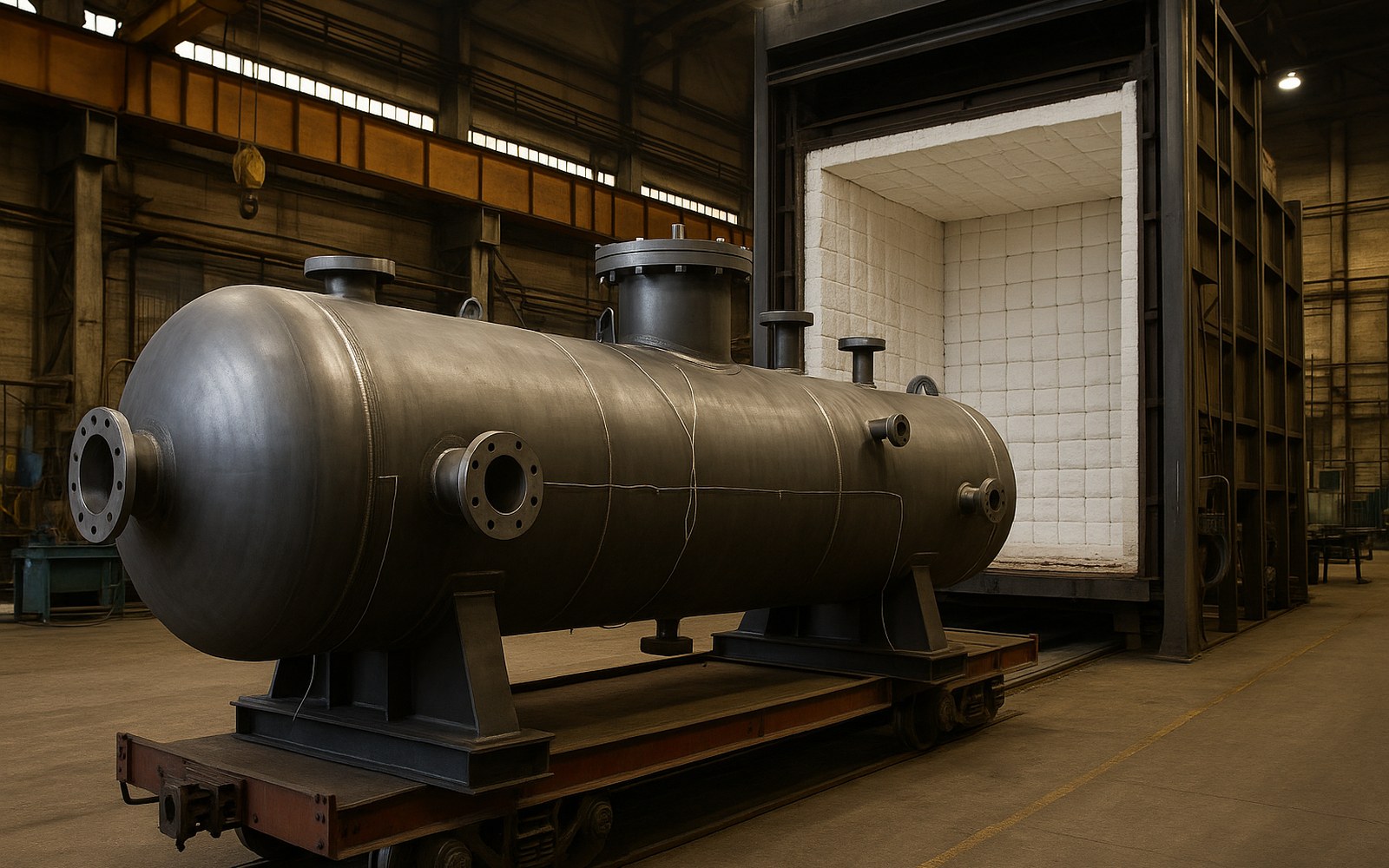
If you have quoted a vessel for a refinery, a gas plant or a government site, you know the ASME code is only the starting point.
The owner's pressure vessel specification sits on top of Section VIII, and many of the things that change your price are written there.
For this guide we read four public vessel specifications from the first page to the last.
One comes from an oil company and one from the engineering contractor of another oil company. The other two come from United States Department of Energy sites.
Here is a taste of what they ask for that the code does not:
- ADNOC wants every radiograph, ultrasonic test and surface crack test done twice on a vessel that gets heat treated after welding: once before the furnace and once after it.
- ADNOC also wants the plate test coupons to go through one extra heat treatment cycle, so the owner can repair the vessel years later.
- Engineers India Limited, writing for Bharat Petroleum, says an offer that contains any technical deviation, or even a clarification, "is liable for rejection".
- A Hanford draft for a 24 foot diameter waste tank asks for full radiography of the shell seams and nozzle welds, and a lifting lug test at 200 tons.
- One ADNOC document gives two different rules for how far a nozzle must sit from a weld seam.
None of these comes from Section VIII, and each one changes hours, materials or schedule.
This guide is for estimators, proposal engineers and applications engineers at ASME vessel shops.
It covers what the four documents add to the code, where they disagree with each other, and where single documents disagree with themselves. It ends with what to write in the quote. Every requirement below is quoted from the document, with its page.
If you are new to reading whole bid packages, start with what five real bid packages taught us. This piece stays on the vessel specification itself.
In brief
- Read the precedence clause before anything else. The four documents rank the owner's rules against the code in four different ways, and one of them says the code wins.
- Price the heat treatment and the inspection that the code does not ask for. The biggest additions are more PWHT, NDE repeated after the furnace, forged parts and third-party checks.
- Find out which bid rule you are under. ADNOC treats a quote with no deviation list as a promise to comply with everything. EIL says an offer that carries any technical deviation is liable for rejection.
- Do not average two numbers that disagree. Write the conflict into your questions, and into the quote with the reading you priced.
- Check the water. The chloride limit for stainless steel test water runs from 25 ppm to 50 ppm across these documents, and one allows salt water for carbon steel while another forbids it.
The four documents we read
Two of the four, ADNOC's and Los Alamos', are owner standards written to be used on every job.
The EIL document is a real bid package, with the standards, job instructions and data sheets in one file. The Hanford document is a draft for a single tank.
| Document | Owner | Revision and date | Pages |
|---|---|---|---|
| ADNOC Pressure Vessel Specification, AGES-SP-06-002 | Abu Dhabi National Oil Company, Group Projects and Engineering | Rev. 1, no printed date (the file was created in October 2021) | 141 |
| EIL specification for pressure vessels: General Specification for Pressure Vessels 6-12-0001 and Supplementary Specification for Carbon Steel Vessels 6-12-0002 | Engineers India Limited (EIL), bidding for Bharat Petroleum's Kochi Refinery expansion | Rev. 5 and Rev. 7, both dated 30 June 2010, inside an RFQ dated 10 October 2013 | 283 in the package; 13 and 7 for the two standards |
| Pretreated Waste Storage Tank (PWST) Specification, RPP-SPEC-67201 | Hanford Tank Waste Operations and Closure, for the US Department of Energy | Rev. A, no printed date, attached to a letter dated 21 January 2026 | 51 |
| Section 43 4113, Gas and Liquid Pressure Vessels | Los Alamos National Laboratory (LANL) | Rev. 2, 29 January 2025 | 47 |
Three cautions before you rely on them
- The Hanford document is a draft. It is attached to an expression of interest, which is a market research letter sent before a request for proposal. Its Attachments A to D, including the nozzle loads, still say "TBD".
- The Los Alamos section is a master template. Words in square brackets are choices the designer makes for each project, so a real project copy may differ.
- The EIL standards in the 2013 Bharat Petroleum package are Rev. 5 from 2010. A later EIL tender lists Rev. 6 of 6-12-0001, which we could not read in full. The EIL pages are scans, so we checked every quote against the page image.
How the page numbers work
Each document numbers its pages its own way. Every page reference below is the number printed on the page, so you can find it in your own copy.
- For ADNOC, it is the footer number "Page X of 141", which is one less than the PDF page.
- For the EIL package, it is the stamp "Page N of 283" on every page of the package. Clause numbers are given where they help.
- For Hanford, it is the printed body page number, which is five less than the PDF page.
- For Los Alamos, it is the footer "43 4113 - X of 47" as the official Word file opens, plus the paragraph number, because Word layout can shift slightly between computers.
What a pressure vessel specification adds on top of ASME Section VIII
Section VIII sets the minimum a vessel must meet. An owner, or the engineering contractor working for it, writes its own document because it wants more than that minimum on its plants.
Two of the four documents say this in their opening lines:
"This specification provides minimum requirements covering material, fabrication, inspection, testing, packing, preservation, shipping transportation"
ADNOC, AGES-SP-06-002, page 5"This specification covers the general requirements for design, fabrication, workmanship, erection, inspection, testing and supply of unfired pressure vessels and is intended to supplement the minimum requirements of the applicable codes."
EIL, 6-12-0001 Rev. 5, clause 1.1, page 143 of 283So most sentences in the owner's document either repeat the code or add something that costs money. The estimator's job is to find the additions and price each one as its own line.
The additions in these four documents fall into six groups. The next six sections take them in this order: heat treatment, NDE of welds and plate, forged parts and other material choices, testing, inspection and paperwork, and preservation and shipping.
Heat treatment: more PWHT than the code asks for
Post weld heat treatment, or PWHT, means heating a finished welded part in a controlled cycle and cooling it slowly. It relaxes the stresses that welding leaves behind and softens the metal next to the weld.
The code tells you when PWHT is required, mostly by material and thickness. These owners add PWHT the code would not ask for, and they say where and how it must be done.
The whole vessel goes in an enclosed furnace
"Chrome-moly material shall be post weld heat treated in all thicknesses unless otherwise specified. When PWHT is required, the entire vessel shall be heat treated in an enclosed furnace."
ADNOC, AGES-SP-06-002, page 30Two things follow from that sentence. First, chrome-moly steel gets PWHT even when it is thin enough for the code to skip it.
Second, heat treating a vessel in sections or with local heating bands needs the owner's approval.
If your furnace is shorter than the vessel, you need either a bigger furnace or an approved procedure for the joining weld. Both cost money, and the second costs time before you start.
EIL asks for something similar: "Vessels shall be post weld heat treated as a complete unit including skirt/support, wherever practicable." That is clause 4.8.2 on page 148 of 283.
The skirt goes into the furnace with the vessel, so the furnace has to fit the skirt as well.
Sour and wet hydrogen sulphide service removes the code's exemptions
Sour service means the vessel will hold fluids with hydrogen sulphide and water. Hard or stressed welds can crack in that service, so owners want every weld heat treated.
"Other than austenitic stainless steel, all welds shall be PWHT. The exemption granted by the Code is not permitted."
ADNOC, AGES-SP-06-002, wet hydrogen sulphide service, page 78EIL's carbon steel supplement says the same thing more briefly: "Vessels in Hydrogen/Amine/ Sour (H2S)/Cyclic service shall be PWHT." That is clause 4.3.2 of 6-12-0002, on page 157 of 283.
Under these two documents, a thin carbon steel drum that the code would let you ship without PWHT goes through the furnace anyway if the data sheet says sour, amine or cyclic.
Formed heads get their own heat treatment
Rolling a shell or pressing a head stretches the steel. Both owners ask for heat treatment after heavy cold forming, but they ask for different treatments.
- ADNOC says carbon and low alloy parts "cold formed by more than 5% shall be subjected to an appropriate normalizing treatment and, if necessary, a tempering treatment" (page 15).
- EIL says "Cold formed dished ends or knuckles shall be stress relieved, unless otherwise specified in requisition" (6-12-0002, page 157 of 283).
The Kochi data sheet shows how this plays out. It says post weld heat treatment "NIL" and, on the next line, heat treatment "HEAD AS PER SPEC." (page 230 of 283).
The vessel skips PWHT, but the heads still get stress relieved. An estimator who reads only the PWHT line would miss that cost.
One extra cycle on the test coupons
Steel plate for a heat treated vessel is ordered with a simulated test.
The mill heats a sample of the plate through the same cycles the vessel will see. Then it tests the sample to prove the plate keeps its strength.
"For equipment, which requires PWHT, simulated coupon from raw material shall be subjected to one extra cycle of PWHT for future modification/repair by the COMPANY."
ADNOC, AGES-SP-06-002, material table note 3, page 66The same note adds that "Required heat treatment for plate, heads, PWHT for the equipment, repair by the VENDOR shall be considered extra." It also says "Combining of PWHT cycles are not permitted."
The number of simulated cycles goes on the plate order, so it must be settled before you buy steel.
Make a small table for each vessel. List the forming heat treatment, the head heat treatment, the vessel PWHT, an allowance for repairs and the owner's extra cycle.
Send the total to the plate mill with the enquiry. Then price the furnace, the fixtures and the transport in and out of it.
Radiography and other NDE beyond the code
NDE means nondestructive examination: checking welds and plate for flaws without cutting them.
Radiography, or RT, is an X-ray or gamma ray picture of a weld. Ultrasonic testing, or UT, uses sound waves to find flaws inside the metal.
Spot radiography means taking short sample pictures along a weld. Full radiography means covering the whole length.
The code links the two to joint efficiency, which is a factor in the wall thickness formula. In short, the more of the weld you radiograph, the thinner the wall the code lets you use.
The default amount of radiography
"Unless otherwise stated on the datasheet the minimum joint efficiency for pressure part calculation shall be 85% (spot radiography) in accordance with ASME VIII Div.1, UW-52."
ADNOC, AGES-SP-06-002, page 32In plain words, ADNOC does not accept a vessel designed with no radiography at all. EIL and Los Alamos set the same floor:
- EIL says "spot radiography is the minimum requirement for all vessels" (6-12-0001 clause 5.4.1, page 149 of 283).
- Los Alamos says "the minimum radiography required is spot radiography in accordance with UW-52" (paragraph 2.4.F.1, page 30 of 47).
The Hanford draft goes much further. It asks that "Category A, B, and D weld joints shall be full penetration and 100% radiographed per ASME BPVC Section V" (page 16).
Category A joints are mainly the long seams, B joints the round seams, and D joints the nozzle welds. So Hanford asks for every main seam and every nozzle weld to be fully radiographed.
NDE repeated after the furnace
"All NDT including radiographic, ultrasonic, magnetic particle or liquid penetrant examinations shall be performed identically before and after PWHT of the vessel."
ADNOC, AGES-SP-06-002, page 32On a heat treated ADNOC vessel, the NDE bill is paid twice.
EIL is lighter here. Its clause 5.4.5 lets you radiograph before or after PWHT. If you do it before, it asks for "an additional radiography or alternatively, ultrasonic examination" after PWHT (page 149 of 283).
ADNOC also asks for magnetic particle testing of the accessible pressure welds after the hydrotest, using the AC yoke method (page 36). On a heat treated vessel, that is a third round of surface testing on the same welds.
Ultrasonic testing of the plate itself
"Shell and head plates of 38 mm thickness and above, even if design pressure is < 50 bars, shall be UT tested on a 75 mm square grid system."
ADNOC, AGES-SP-06-002, page 34This test looks for laminations, which are flat layers of separation inside rolled plate. ADNOC sets the acceptance level as level B of ASTM A578 on the same page.
You can buy the test from the mill or do it in the shop. Either way, it is a cost the code does not require.
Parts that always get full radiography
- Both ADNOC and EIL ask for every nozzle rolled from plate to be fully radiographed (ADNOC page 33; EIL clause 5.4.3, page 149 of 283).
- EIL asks for the weld seams of formed heads to be fully radiographed "after forming and heat treatment, if any" (clause 5.4.4, page 149 of 283).
- EIL asks for every conical reducer to be a toricone, and for "100% radiography" of its seams (clause 3.4, page 144 of 283).
A toricone is a cone with a curved knuckle at each end where it meets the cylinder, instead of a sharp corner. EIL wants the knuckle radius to be at least 10% of the adjoining diameter.
The knuckles take more forming work than a plain cone, and the full radiography adds film and time.
Draw a simple NDE map. Show every seam, every nozzle weld, and the stages at which each one is tested: before PWHT, after PWHT and after the hydrotest.
Then count the film and the technician days from the map, not from a percentage of the shop hours.
Forged flanges, self-reinforced nozzles and other material choices
The code allows a range of ways to build a nozzle or a flange. Owner specifications narrow that range, usually toward the heavier and more expensive choice.
Flanges must be forgings
"All nozzle flanges, blind flanges, specialist flanges and body/girth flanges shall be forged. Flanges made from plate are not acceptable."
ADNOC, AGES-SP-06-002, page 18ADNOC also says that "Flat heads and flanges shall not be machined from plate but shall be forgings" (page 16).
A large body flange that you might otherwise cut from plate becomes a forging on order, with its own price and lead time.
Self-reinforced forged nozzles
Cutting a hole in a shell removes metal that was carrying pressure. The usual fix is a reinforcing pad, which is a ring of plate welded around the nozzle.
A self-reinforced nozzle is a forging whose neck is thick enough near the shell to replace that metal by itself, so no pad is needed.
ADNOC asks for self-reinforced nozzles under any of these conditions (page 19):
- The design temperature is above 399 °C, or above 230 °C in hydrogen service.
- The vessel is in cyclic service.
- The wall thickness exceeds 40 mm.
- The vessel is in sour or lethal service.
EIL's trigger is different. Its carbon steel supplement asks for self-reinforced forged nozzles of 80 NB (3 inch) and above "for equipments where nominal thickness of shell/head exceeds 50 mm" (6-12-0002, page 156 of 283).
So on a 45 mm shell in plain service, ADNOC wants forged self-reinforced nozzles and EIL does not. The same vessel has two very different nozzle bills depending on whose document it is built to.
Small nozzles get heavier pipe and gussets
ADNOC sets a minimum pipe schedule for nozzle necks on page 17. For carbon steel, nozzles of 1.5 and 2 inch are Schedule 160, and anything larger is at least Schedule XS.
On the same page it asks that "Nozzles 2” NPS and below shall be provided with two stiffeners 40 x 6 mm at 90 degrees apart."
The Kochi data sheet has the same rule in its note 9: "NOZZLES 50NB AND BELOW SHALL BE STIFFENED WITH 2 NOS. 40 x 6 THK FLATS 90° APART" (page 230 of 283).
This is one of the few places where two of the documents agree exactly on a detail.
Banned shortcuts and minimum ratings
- ADNOC does not permit "Socket Welded, Threaded Coupling, Single or double fillet welds, Screwed, Tapped or Threaded Openings, Pad Type, Built-up Type and Stubbed" connections (page 19).
- ADNOC says "All flanges for relief valves shall be Class 300 minimum" (page 21), even when the vessel's other flanges are Class 150.
- ADNOC sets the minimum manhole at 24 inches, allows 20 inches only with approval, and says the inside diameter can never be less than 460 mm (page 22).
- Los Alamos says "Manways less than NPS 24 (DN 600) shall not be allowed" (paragraph 1.4.C.22, page 11 of 47) and bans "Slip-on, threaded, and socket weld flanges" (paragraph 1.4.C.2, page 9 of 47).
Minimum corrosion allowance
Corrosion allowance is extra wall thickness added on top of what pressure needs, so the vessel can lose metal in service and still be safe. Some owners set a minimum:
- Los Alamos sets a minimum allowance of "0.125 inch (1/8 inch)" (paragraph 1.4.A.2, page 8 of 47).
- The Hanford draft sets "1/8 inch for the vessel and 1/16 inch for the penetrations/nozzles" (page 10).
- The Kochi data sheet sets 3 mm for that vessel (page 230 of 283).
- AGES-SP-06-002 itself sets no general minimum for vessels. It gives "at least 1.6 mm" only for storage spheres (page 55). ADNOC's design rules sit in a separate document, Design Criteria for Static Equipment, which we did not read.
EIL adds two details on corrosion allowance that are easy to miss (6-12-0001 clause 3.2, page 144 of 283).
The allowance must be added to both sides of tray support rings. Removable internals that are bolted or clamped in place, except trays, get half the allowance on each face that touches the vessel contents.
Extra wall is extra plate weight, and the weight change on a large shell adds up. A quick way to see it is the metal weight calculator.
Run your nozzle schedule through the owner's rules one nozzle at a time: forged or pipe, pad or no pad, schedule, flange rating and stiffeners. The nozzle list is where these documents move the material price the most.
Testing: hydrotest water, hold time, hardness and impact tests
A hydrotest means filling the finished vessel with water and pressurizing it above its design pressure, to prove it holds.
The code sets the test pressure. Owners add rules about the water, the instruments and how long the pressure is held.
What the test water may contain
Chlorides are salts dissolved in water. Left on stainless steel, especially when the water dries, they can cause cracking. That is why owners limit chlorides in the test water for stainless vessels, and the limits differ:
- Los Alamos asks for potable water "with a chloride ion content of less than 25 ppm" for austenitic stainless steel vessels (paragraph 2.4.G.2, page 31 of 47).
- ADNOC's offshore annex says the water "shall not contain a concentration of chlorides more than 30 ppm" (page 137).
- ADNOC's main text says "Test water shall contain less than 50 ppm chlorides" (page 44), and asks for "a chemical analysis certificate of the test water for each vessel" (page 43).
- The Hanford draft, for a carbon steel tank, asks for test water under 250 ppm chlorides and a final rinse under 50 ppm (page 29).
Carbon steel is a different story. EIL says "Sea water shall not be used," while ADNOC's offshore annex says carbon steel vessels "may be hydrostatically tested with potable, brackish or salt water as available."
The EIL rule is clause 5.6.3 on page 149 of 283. The ADNOC rule is on page 137.
Drying differs too. ADNOC says "Hot air drying is not permitted" for stainless vessels (page 44).
Its offshore annex asks for carbon steel vessels to be "thoroughly dried with hot air or steam" after a test with non-potable water (page 137). EIL asks for every vessel to be "thoroughly dried by blowing dry air" (page 149 of 283).
How long the pressure is held
ADNOC's offshore annex says "The test pressure shall be held for at least 1 hour per 25 mm vessel wall thickness (excluding inspection time)" (page 137).
Los Alamos says "Hold test pressure for 15 minutes, minimum" (paragraph 2.4.G.1, page 30 of 47).
On a vessel with a 75 mm wall, ADNOC Offshore's rule means three hours under pressure, plus the time to inspect.
Long holds tie up the test bay, the crane and the inspector, so they belong in the schedule and the price.
Instruments and charts
"A minimum of two calibrated pressure gauges are to be installed. One at the topmost point and one near the test header. Chart recorders are mandatory to be used to record the hydrotest."
ADNOC, AGES-SP-06-002, page 37EIL adds a temperature rule: the test water "shall preferably not be less than 16° C" (clause 5.6.1, page 149 of 283). In a cold shop that may mean heating the water.
Hardness limits
Hardness is measured on welds because a hard weld or heat affected zone (the metal next to the weld) is more likely to crack. BHN is the Brinell hardness number, one common scale.
ADNOC says that after the final PWHT, "Hardness values shall not exceed 200 BHN" (page 36). It wants readings on the circumferential, longitudinal, nozzle, stub and attachment welds.
EIL uses the same 200 BHN limit on its production test coupons (6-12-0002, page 158 of 283).
If readings fail, ADNOC allows one re-test and then asks for the heat treatment to be repeated (page 37).
A failed hardness survey can send a finished vessel back to the furnace, which is a risk worth pricing on sour service jobs.
Impact tests and production test plates
MDMT means minimum design metal temperature: the coldest metal temperature the vessel is designed for.
A Charpy impact test breaks a small notched sample at a set temperature. It shows whether the steel will bend rather than snap when it is cold.
ADNOC keeps it simple: "Impact testing shall be done at the MDMT of the vessel" (page 30).
EIL sets its own temperatures for production coupons (page 158 of 283). For low temperature service, it uses the lowest of the minimum ambient, design and MDMT temperatures.
For vessels over 50 mm thick in warmer service, EIL tests at the "lower of 0°C or lowest ambient temperature of the site". That can be colder than the MDMT on the data sheet.
A production test plate is a sample plate welded alongside the vessel seams with the same procedure, and heat treated with the vessel.
It is then cut up and tested in a laboratory. The two owners call for them in different cases:
- EIL asks for them only on "vessels over 50 mm nominal thickness" (6-12-0002, page 158 of 283).
- ADNOC asks for them on "Any pressure vessels subjected to PWHT", on vessels with an MDMT below -29 °C, and on P1 carbon steel "whenever impact testing is required" (page 79). ADNOC also wants all the coupon tests witnessed by the owner.
A load test on the lifting lugs
The Hanford draft asks that the "Lifting lug proof test shall be performed at 200 tons (approximately 2x the dead weight, TBV)" (page 29). TBV means to be verified.
The test is a hold point, and it is followed by full dye penetrant testing of the lug welds.
Inspection, the code stamp and the paperwork
The code requires an inspector for a stamped vessel. Owners add their own inspectors, their own hold points and their own records on top.
The U stamp and National Board registration
The U stamp is the ASME certification mark that a certified shop applies to a Section VIII Division 1 vessel. An Authorized Inspector checks the work before the mark goes on. U2 is the mark for Division 2.
National Board registration means the vessel's data report is filed with the National Board of Boiler and Pressure Vessel Inspectors under a registration number.
- ADNOC says "Pressure Vessels shall be ASME stamped, “U” or “U2” certified and registered with the National Board" (page 92).
- Los Alamos says "Authorized Inspector monitoring is required" and that vessels "shall be numbered and registered with the National Board" (paragraphs 1.1.E.7 and 1.1.E.8, page 3 of 47).
- The Hanford draft says the tank "is not an ASME code stamped vessel", but it must be built "to the same rigor" as a Division 1 vessel (page 1). It still asks for a seller that is "audited, approved, and certified by ASME BPVC certification board" (page 23).
- EIL's data folder asks for the "Manufacturer's Code Certificate" and a "Rubbing of name plate" (clause 9.0, page 152 of 283). Where the Indian Boiler Regulations or India's Static and Mobile Pressure Vessels Rules apply, getting the approval is the "vendor's responsibility" (clause 3.5, page 144 of 283).
No stamp does not mean no code cost. At Hanford you still need the ASME certificate, the procedures and the records. What you skip is the stamp itself.
Third-party inspection
TPI means third-party inspection: an independent inspection company that witnesses tests and signs documents for the buyer. It is separate from the Authorized Inspector that the code requires.
- ADNOC asks that design "Calculation notes shall be certified by a third party inspection. A certificate is acceptable" (page 86). Its quality section says quality issues "shall be approved and certified by the Third party Authority (TPA)" (page 60).
- EIL says that for foreign vendors, "Stagewise & final inspection of the equipment including all components and internals shall be carried out by third party inspection agency. Quoted price shall include for the same" (page 125 of 283). For Indian vendors, EIL itself inspects.
- EIL also asks for the inspector's "written approval" at every stage, from raw material identification and edge preparation through rolling, nozzle setting, radiography, stress relieving, the pressure test and painting (clause 5.3, pages 148 and 149 of 283).
Hold points and notice
A hold point is a step where work must stop until the buyer's inspector has seen it or waived it. The documents set different notice periods:
- The Hanford draft asks for notice "at least 15 working days in advance of the time items will reach any HOLD POINTS" (page 27).
- Los Alamos asks for "a minimum of seven (7) working day advance written notice of shop acceptance tests" (paragraph 1.6.B.11.e, page 18 of 47). Its hold point form in Appendix B says the buyer "will require five (5) days notification" (page 41 of 47).
- Los Alamos lists at least four hold points: NDE of welds and repairs, the hydrotest, the source verification test and final inspection (paragraph 1.7.D.1.c, page 23 of 47).
Quality programs and proof of material
The Hanford draft asks for a quality program that meets ASME NQA-1, the nuclear quality standard, and DOE Order 414.1D (page 20).
If the steel mill is not accredited to ISO/IEC 17025, the seller must also have an accredited laboratory check the chemistry and properties "for each heat/lot used" (page 16).
Los Alamos asks for a firm "regularly engaged in this type of work for a period of no less than [3] years" (paragraph 1.7.B, page 21 of 47). The bracket shows the number is the designer's choice.
Records and the data book
- ADNOC wants "Radiography certificates (not films)" in the data report (page 85) and asks the vendor to keep records "for at least ten (10) years" (page 90).
- EIL asks for radiographic reports "WITH FILMS" and says "Vendor to store these for 5 years" (page 121 of 283). Final documents come as six prints and two CDs or DVDs.
- The Hanford draft asks for records to be kept "for not less than ten years after completion" (page 25).
The deadline for the data book, the bound set of certificates and reports that travels with the vessel, differs as well:
- EIL wants it "within 2 weeks after dispatch of equipment" (page 120 of 283).
- ADNOC wants it "not later than 14 days after acceptance of the equipment" (page 88).
- Los Alamos wants it "at the completion of equipment testing but prior to or at shipment" (paragraph 1.6.C.4.a, page 21 of 47).
Preservation, marking and shipping
The last group is small per item but easy to forget. It covers how the vessel is protected, marked and closed up for the trip.
How long the protection must last
- ADNOC asks for protection against ocean transit and site storage, and says "Extended period protection shall be 18 months minimum" (page 41).
- The Hanford draft asks for "penetration covers suitable for 5 years storage" (page 34).
- Los Alamos asks for a long term storage procedure if the vessel will be stored "for longer than one month prior to being installed" (paragraph 1.8.D, page 25 of 47).
Flange covers for shipping
All three documents that mention flange covers set a different thickness:
- ADNOC: "Covers shall be a minimum of 6 mm thick and shall be installed with a full-width gasket using a minimum of four (4) full diameter bolts" (page 40).
- EIL: "metal covers (minimum 5 mm thk.) using atleast four bolts" (clause 6.3.1, page 151 of 283).
- Los Alamos: "1/2 inch thick wood or 1/8 inch thick suitable metal plate", held by at least a quarter of the bolts and never fewer than four (paragraph 2.3.C.6, page 28 of 47).
Other shipping items
- Los Alamos asks for "A means of pressure relief" on the vessel during shipping (paragraph 2.3.D.4, page 29 of 47).
- ADNOC wants the centre of gravity painted as a 75 mm stripe on vertical vessels, with the shipping weight in metric tons beside it (page 39).
- ADNOC asks for carbon steel vessels to be blast cleaned inside to SSPC-SP6, and for all painting to be done after the hydrotest (page 39).
No deviation list means full compliance: how the bid rules decide what you write
Everything above changes what you price. This section changes how you write the quote. The four documents treat exceptions in very different ways, and getting it wrong can cost you the job or the margin.
ADNOC: list it in the quotation, or you have agreed to it
"Deviations to this Specification are only acceptable where the CONTRACTOR/VENDOR has listed in his quotation the requirements he cannot comply with and the COMPANY/CONTRACTOR has accepted in writing these deviations before the order is placed."
ADNOC, AGES-SP-06-002, page 14"In the absence of a list of deviations, it will be assumed that the CONTRACTOR/VENDOR complies fully with the Specification."
ADNOC, AGES-SP-06-002, page 14Under ADNOC's rule, a quote with no deviation list is a promise to meet all 141 pages.
After the order, changes go through a concession request, and "The COMPANY decision shall be final without any cost & schedule impact to the COMPANY/project" (page 14).
So the deviation list is not paperwork at the end of the bid. It is the only place where an exception can be accepted with a price attached.
EIL: no technical details in the offer at all
"If the offer contains any technical deviations or clarifications or stipulates any technical specifications (even if in line with the MR requirements), the offer is liable for rejection."
EIL, Instructions to Bidders for the Kochi package, page 123 of 283The same page says "The submission of prices by the bidder shall be construed to mean that he has confirmed compliance with all technical specifications."
The covering letter adds that "the Bid shal be evaluated as received and technical queries may not be issued" (page 2 of 283). It also says price changes made against clarifications are not allowed (page 3 of 283).
Under EIL's rule, the only time to raise a question is before the bid goes in. After that, you have priced whatever the documents say, read the strictest way.
Two more sentences on page 123 decide what that price must cover:
- "The quoted price includes for the “HOLDS” details of which are indicated on the Drg." A hold is an item the engineer has not settled yet.
- "The weights indicated on EIL Engineering Drgs. do not form the basis for offer, since these are approximations only." You must take off your own weights.
The Kochi data sheet marks five items as holds: the nozzle orientations, the nozzle elevations, the support height, one flange rating, and the size and number of some level instrument nozzles (page 230 of 283).
The instructions also set a forming allowance: "Dished ends and hot formed pressure parts shall have 10% or 2mm (whichever is higher) allowance for scaling and thinning" (page 123 of 283).
On a 25 mm head, that is 2.5 mm of extra thickness to buy.
A lump sum that includes open holds is a fixed price on things nobody has drawn yet. We wrote about that risk in fixed price contract risk starts at the quote.
Los Alamos: a compliant base bid, with alternates beside it
Los Alamos says "The Subcontractor shall provide a base bid in full compliance with LANL’s request for quotation" (paragraph 1.7.D.9.a, page 25 of 47).
You may also offer an alternate design if it saves money or time. However, "Alternative design quotations shall be accompanied by the base quotation and be clearly noted as an alternate."
After award, technical changes go through a Supplier Deviation Disposition Request, and nothing changes until the buyer approves it in writing (paragraph 1.6.B.16.a, page 19 of 47).
Hanford: changes after award are substitutions
The Hanford draft defines the term: changes "proposed by the SELLER after award of the contract are considered to be requests for substitution" (page 3).
When two requirements conflict, "the SELLER shall submit an RFI" (a request for information) before using either one (page 8).
- Under an ADNOC style rule, send a full deviation list with the quote, each item tied to the clause and page, and a price for compliance where you can give one.
- Under an EIL style rule, send every question before the due date, because the offer itself cannot carry them.
- Under a Los Alamos style rule, price the compliant base first, then offer your cheaper idea as a clearly labelled alternate.
Where the four documents disagree with each other
Laid side by side, the four documents give different answers to the same nine questions. A shop that quotes several owners cannot carry one standard set of assumptions from job to job.
| Question | ADNOC AGES-SP-06-002 | EIL 6-12-0001 (Kochi package) | Hanford PWST draft | Los Alamos 43 4113 |
|---|---|---|---|---|
| Who wins a conflict | UAE law, then data sheets, project spec, company spec, then codes; the most stringent applies (page 13) | Drawing, then specifications, then codes; the most stringent governs (page 143) | The specification supersedes the documents it references (page 4) | ASME Section VIII and regulations "will take precedence" (page 8 of 47) |
| Exceptions in the bid | Must be listed in the quotation; no list means full compliance (page 14) | Any technical deviation or clarification makes the offer "liable for rejection" (page 123) | Changes after award are requests for substitution (page 3) | Compliant base bid, plus clearly noted alternates (page 25 of 47) |
| Default radiography | Spot, 85% joint efficiency, unless the data sheet says otherwise (page 32) | Spot as a minimum, with extra rules (page 149), changed by the job instructions (page 125) | 100% on long seams, round seams and nozzle welds (page 16) | Spot per UW-52 (page 30 of 47) |
| Code stamp | U or U2 stamp and National Board registration (page 92) | Code certificate and nameplate rubbing in the data folder (page 152) | No stamp, but an ASME certified seller (pages 1 and 23) | Stamp, Authorized Inspector and National Board registration (page 3 of 47) |
| Test water | Stainless under 50 ppm chlorides (page 44); offshore 30 ppm, and carbon steel may use salt water (page 137) | Clean potable water; no sea water (page 149) | Under 250 ppm chlorides, rinse under 50 ppm (page 29) | Stainless under 25 ppm chlorides (page 31 of 47) |
| Hydrotest hold time | Offshore: 1 hour per 25 mm of wall (page 137) | Not stated in 6-12-0001 | Not stated; ASME rules apply | 15 minutes minimum (page 30 of 47) |
| Flanges over 24 inches | Nozzle flanges to ASME B16.47 Series A (page 20) | ASME B16.47 Series B (page 145) | Not stated; only B16.5 is listed | B16.5 or B16.47, the designer's choice (page 10 of 47) |
| Shipping flange covers | 6 mm metal, full gasket, at least 4 bolts (page 40) | 5 mm metal, at least 4 bolts (page 151) | Penetration covers for 5 years of storage (page 34) | 1/8 inch metal or 1/2 inch wood, at least 4 bolts (page 28 of 47) |
| Records | Radiography certificates, not films; keep records 10 years (pages 85 and 90) | Reports with films; store 5 years (page 121) | Keep records 10 years after completion (page 25) | No retention period stated |
Two rows deserve a second look. The flange row matters because Series A and Series B flanges over 24 inches are different forgings with different bolt patterns.
Pricing the wrong series means buying the wrong forging, and a flange that will not bolt to the owner's piping.
The first row matters even more. If the specification and the code conflict, Los Alamos tells you to follow the code. The other three tell you to follow the stricter rule or the specification.
So the same conflict can have opposite answers, depending on the owner.
Where a single document disagrees with itself
In documents of 47 to 283 pages, the clauses do not always agree with each other. Here are the conflicts we found inside each document.
In each case, pricing one reading without saying so leaves the risk with you.
ADNOC: two rules for seam spacing
On page 16, ADNOC says adjacent seams in plate must be offset by "the greater of 100 mm or four (4) x plate thickness".
On page 31, it says the distance between long seams "shall be 200 mm or five (5) times the wall thickness, whichever is larger."
For a 20 mm shell, the first rule gives 100 mm and the second gives 200 mm. The plate layout, and sometimes the number of plates, depends on which one you follow.
ADNOC: two rules for nozzle clearance
On page 17, ADNOC says openings and attachments "shall clear weld seams by more than 2.5 *sqrt (r.t)".
On page 30, it says nozzles "should be placed away from pressure containing welds to the greater of 50mm or 2 x t min". Where that is not possible, the covered seam is ground smooth and fully radiographed.
The gap between the two is large. Take a shell with a 1,000 mm radius and a 20 mm wall: the first rule works out to about 350 mm, and the second to 50 mm.
That is our arithmetic, not the document's. It shows why the nozzle layout you price depends on which page you read.
ADNOC: what the skirt is made of
- Page 63 says "Plate material of skirt shall be the same as that of pressure vessel."
- Page 25 asks for shell material only at the top of the skirt, for a length of 2.5 times the square root of radius times thickness, or 600 mm, whichever is greater.
- The material table on page 65 lists SA 285 Grade C and SA 283 Grade C, which are cheaper plates, for carbon steel skirts.
On a tall column the skirt is a lot of steel, so the grade you price for it matters.
ADNOC: hardness, test water and the warning sign
- The general hardness limit is "200 BHN" after PWHT (page 36). The sour service section allows heat affected zone hardness up to "248 Hv10 (Brinell 237 HBW)" in the weld procedure test (page 75). The general rule is stricter than the sour service rule.
- The main text allows stainless test water under 50 ppm chlorides (page 44), while the offshore annex allows no more than 30 ppm (page 137). The annex says it takes priority for ADNOC Offshore, so an estimator who reads only the main text prices the wrong water.
- The PWHT warning on the vessel appears in three versions: 75 mm letters saying "Do Not Flame Cut or Weld" (page 39), 150 mm letters with similar words in the stainless and clad steel section (page 45), and "DO NOT BURN, WELD OR HAMMER" (page 80).
EIL: the job instructions overrule the standard
When spot radiography is specified, the EIL standard asks for all T joints plus at least 5% of the remaining weld length (6-12-0001 clause 5.4.2, page 149 of 283).
The job instructions then say that clause "shall be replaced" (page 125 of 283). The new rule is one spot of at least 150 mm in each long and round seam, plus one T joint in each round seam.
Two more conflicts sit inside the same package:
- The standard allows "Other specifications of equivalent grade" with EIL's written approval (clause 2.2, page 143 of 283). The data sheet strikes out the words "OR EQUIVALENT" from its material heading (page 230 of 283).
- The standard asks for codes "in their latest edition including their addenda at the time of bidding" (clause 2.1, page 143 of 283). The data sheet fixes "EDITION 2010+2011 ADDENDA" on an RFQ dated October 2013.
The lesson is simple. An estimator who reads only the standard prices the wrong radiography. The job instructions and data sheet must be read with the standard, not after it.
Hanford and Los Alamos
- Hanford asks for the nameplate to be "attached by tack welding", and on the same page asks to "seal weld data plate to the equipment" (page 34). A tack weld and a seal weld are different jobs.
- Hanford's cleaning section asks for a final rinse "with less than 50 ppm chlorine" (page 19), while the test section says "less than 50 ppm chloride" (page 29). Chlorine and chloride are different tests.
- Hanford fixes the corrosion allowance at 1/8 inch (page 10), and also asks the seller to "Provide a recommendation for the corrosion allowance" (page 14).
- Los Alamos says in one place that the minimum radiography "shall be as required by the applicable design Code" (paragraph 1.7.D.3.c, page 23 of 47), and in another that it is spot radiography (page 30 of 47). The code can require less than spot radiography.
Put every conflict on your question list with both page numbers. If the answer has not come back by the due date, write the reading you priced into the quote.
A written assumption protects you, and a silent one does not. We walk through building that list in pre-bid risk assessment.
A checklist to use before you price
Here is the order we would read a new vessel specification in, based on these four documents:
- Find the precedence clause. Write down whether the data sheet, the drawing, the specification or the code wins, and whether "most stringent" applies.
- Find the bid rule. Decide whether you need a deviation list, a pre-bid question list, or a compliant base bid with alternates.
- Read the job instructions and data sheets with the standard. In the EIL package, the instructions change the standard's radiography rule and the data sheet removes "or equivalent".
- Check any annexes for your site. ADNOC's offshore annex changes its main text on test water and radiography thickness, and adds a hydrotest hold time.
- List every requirement that adds cost, with its page: extra PWHT and cycles, repeated NDE, plate UT, forgings, nozzle schedules, coupons, hardness surveys, TPI, records and preservation.
- List every conflict, inside the document and against the code, with both pages.
- List every hold and every TBD, and decide how you will price the open items.
- Send questions early, and write the answers, or your assumptions, into the quote.
A requirements list like this is easier to keep in a spreadsheet, one row per clause, with columns for the page, whether you comply, and the cost. Our specification compliance matrix template is set up that way.
Where Mavlon fits
Mavlon's AI Quoting Engine does the reading part of this work. It reads the customer's specification and drawings, and lists every requirement that changes the price, each with its page.
It also shows where the documents disagree, instead of quietly picking one reading. Then it drafts a first quote from the manufacturer's own pricing, for the estimator to check.
It does not decide whether you comply, and it does not set the price. The estimator does both.
We read the four documents in this guide ourselves, for this article. The review step is described on its own page, AI specification review.
Sources
- Abu Dhabi National Oil Company, Pressure Vessel Specification, AGES-SP-06-002, Rev. 1. No printed date; the file was created in October 2021.
- Engineers India Limited for Bharat Petroleum Corporation, RFQ SM/A307-IC-VV-MR-6007/59, Pressure Vessels CS (up to 25 mm), Kochi Refinery, dated 10 October 2013. It contains General Specification for Pressure Vessels 6-12-0001 Rev. 5 and Supplementary Specification for Carbon Steel Vessels 6-12-0002 Rev. 7, both dated 30 June 2010.
- Hanford Tank Waste Operations and Closure for the US Department of Energy, Pretreated Waste Storage Tank (PWST) Specification, RPP-SPEC-67201 Rev. A, a draft attached to the expression of interest dated 21 January 2026.
- Los Alamos National Laboratory, Master Specification Section 43 4113, Gas and Liquid Pressure Vessels, Rev. 2, 29 January 2025.
Bring a vessel specification you have already quoted
If your team quotes vessels against owner or EPC specifications, bring one you have already priced to a demo. We will go through it with you and show each requirement that changed your number, tied to its page, and each place where the documents disagree.
Or read what Mavlon does for fabricators, on one page: AI quoting for custom metal fabricators.
Book a demo