Quoting Custom Gangways and Docks: The Hard Part
I have seen six licensed contractors price the identical 4,000 square feet of aluminum floating dock, from the same drawings, to the same specification, on the same afternoon, at $110 a square foot and at $300 a square foot, with four more prices scattered in between.
That was a public Florida letting, and every number is on the state's own bid tabulation.
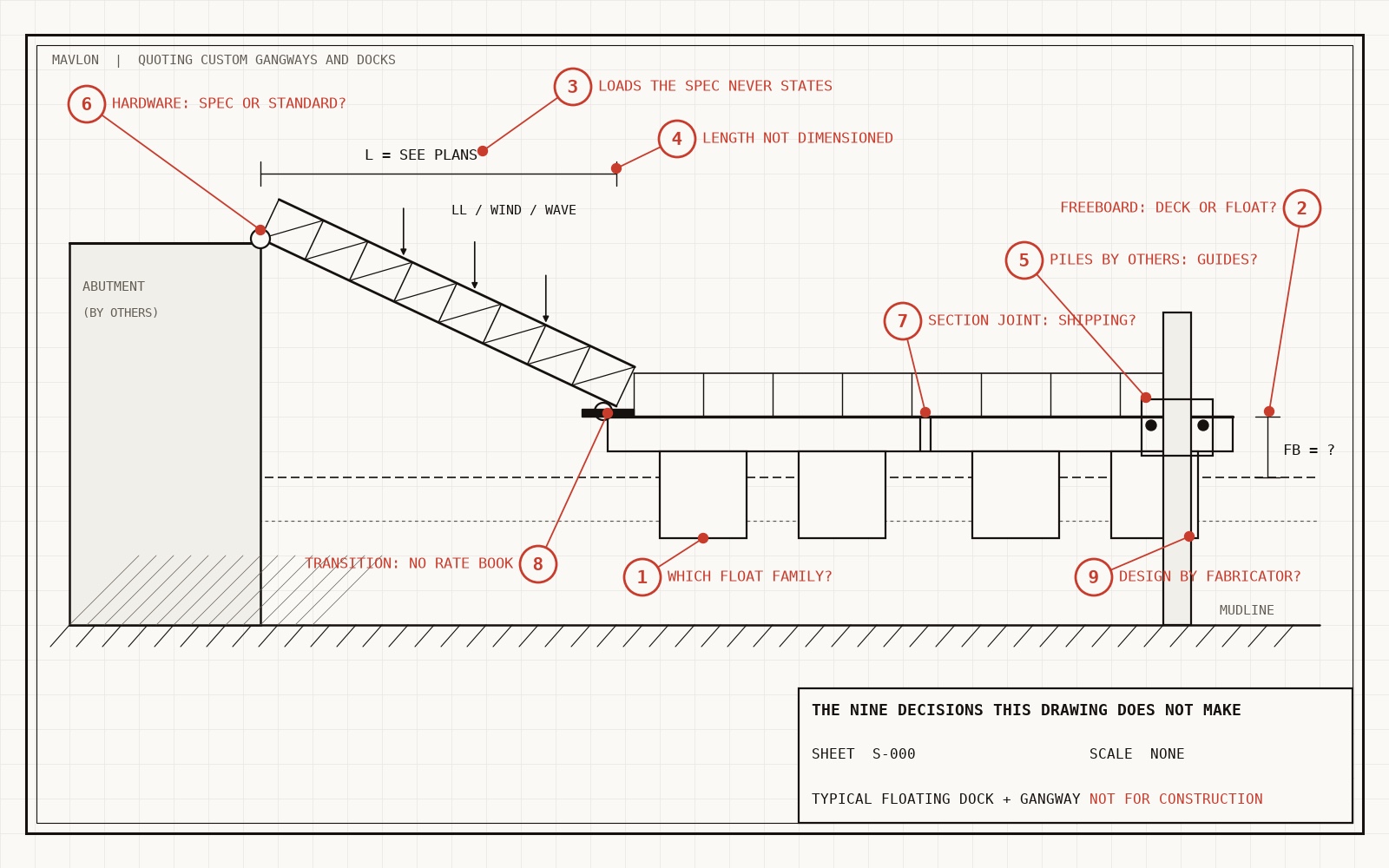
Nobody in that room was incompetent. They had simply made nine decisions differently, because the documents had not made those decisions for them.
This whole article on quoting custom gangways and docks is about those nine decisions.
If you have quoted this kind of work, you already know that the arithmetic is the easy part. Every shop has a spreadsheet, an estimating workbook, or a rate book that turns a configuration into a price in seconds.
The hard part of quoting custom gangways and docks is everything that has to happen before the spreadsheet can be filled in. It means deciding what the package is actually asking for, on evidence that is scattered across a hundred or more pages and frequently contradicts itself.
What follows is a tour of those nine decisions, in the order an estimator meets them, with the evidence drawn from documents anyone can open.
We have also written separately about what reading real bid packages taught us and about how software reads a gangway package step by step. This piece is the layer underneath both. It covers the reasons the work is hard in the first place.
Why quoting custom gangways and docks is harder than it sounds
Start with the thing everyone gets wrong about this work, including software vendors, including us at first.
The product looks like a catalogue item
A floating dock or a truss gangway looks like a catalogue product. It has a width, a length, a deck material, a rail style, a live load.
Feed those into a pricing model and out comes a number, and the pricing models shops actually use are good. We have reproduced several offline, to the penny, from the shop's own filed workbooks.
The calculator was never the problem.
A bid package is written for the general contractor
The problem is that the inputs to the calculator are not written down anywhere in the form the calculator needs them.
A public bid package for a marina or a village waterfront is written by an engineer for a general contractor, with the dock fabricator as one subcontractor among thirty.
The fabricator's product appears on a handful of sheets, in two or three specification sections, and in whatever addenda arrived after the plans were drawn. That leaves gaps like these:
- The live load may be stated once, for a different structure.
- The gangway length may not be stated at all.
- The float type may be implied by a freeboard number that itself is only implied by a note.
An estimator's ninety minutes, or a day, goes into extracting a configuration the package never states in one place. Then it goes into a series of judgment calls about what to do where the package is silent, ambiguous, or wrong.
Two competent estimators, two different numbers
Every one of the nine decisions below is a place where two competent estimators, reading the same documents, can reasonably land on different numbers. That is what the Florida spread measures.
It is also why a category of software that starts from your catalogue cannot help with this work. The catalogue is downstream of the decisions.
What actually arrives: a 179-page package for one gangway and some floats
Take a concrete case. In late 2025 the Town of Cape Vincent, New York, posted its waterfront improvements bid package on the town website.
It is 179 pages covering the whole job, of which the aluminum gangway and floating dock work is a modest slice.
We read the entire thing, page by page, and later ran it through our own engine. So we can say exactly what a fabricator's estimator would have had to find.
Three things the package says twice, or not at all
- The gangway deck material is specified twice, differently. Specification section 35 50 20, on page 102, names one product. Drawing sheet CM-5.01, on page 117, calls for grooved timber. That means a different material, a different weight and a different fixing method, and the weight feeds straight into the float sizing.
- The deflection limit is stated twice, differently, on the same page. One paragraph says the dock must not deflect more than L over 360, and another on the same page says L over 180. One is twice as strict as the other, and it drives the framing.
- The gangway length is not in the specification at all. The section says to see the plans. The real number, 46 feet, sits on exactly one sheet, in the corner of a side view. If you miss that sheet you are measuring a drawing with a scale rule, which is a guess wearing a ruler.
Resolving them is reading, not arithmetic
There are seven disagreements of that kind in one package, for a product that occupies a small fraction of it.
None of them is exotic. Every estimator who has priced this work has met all three.
The point is that resolving them is not arithmetic and not lookup. It is reading, cross-referencing, and deciding, and it has to happen before the first number goes into the calculator.
With that as the backdrop, here are the nine decisions, one at a time.
Decision 1: which float family the dock belongs to
An aluminum floating dock is carried by one of a few families of flotation:
- One family is foam-filled or encapsulated floats, where a polystyrene core is sealed in a shell.
- Another is discrete polyethylene tubs mounted in rows under the frame.
- A third is pontoons.
The families are not interchangeable at the pricing stage. They have different buoyancy per foot, different frame requirements, different price bands, and different limits on the freeboard they can deliver.
The package gives clues, not a name
The package rarely names the family. What it gives you is clues: a freeboard requirement, a live load, a mention of foam or of polystyrene, a float model in a detail, or nothing at all.
The estimator infers the family from those clues, and the inference is the single largest lever in the quote.
The mistake that taught us this
We know this from a mistake of our own. In one of our early blind tests, our engine read a package as a tub-float dock when the specification's language meant an encapsulated-foam system.
The resulting quote came out more than 40 percent low. It was the same package and the same arithmetic, with the wrong family.
We fixed it with a gate that refuses to price a dock until the family is confirmed. That gate now sits before every dock quote the engine produces, because the error is too large to catch downstream.
Check the family against the freeboard
The physics gives you the tie-breaker. If the specification requires a freeboard that a light tub system cannot reach without the tubs being mostly out of the water, the tub reading is presumptively wrong, however cheap the tubs look.
Run the buoyancy check before you pick the family, not after.
Decision 2: freeboard, and the line you measure it to
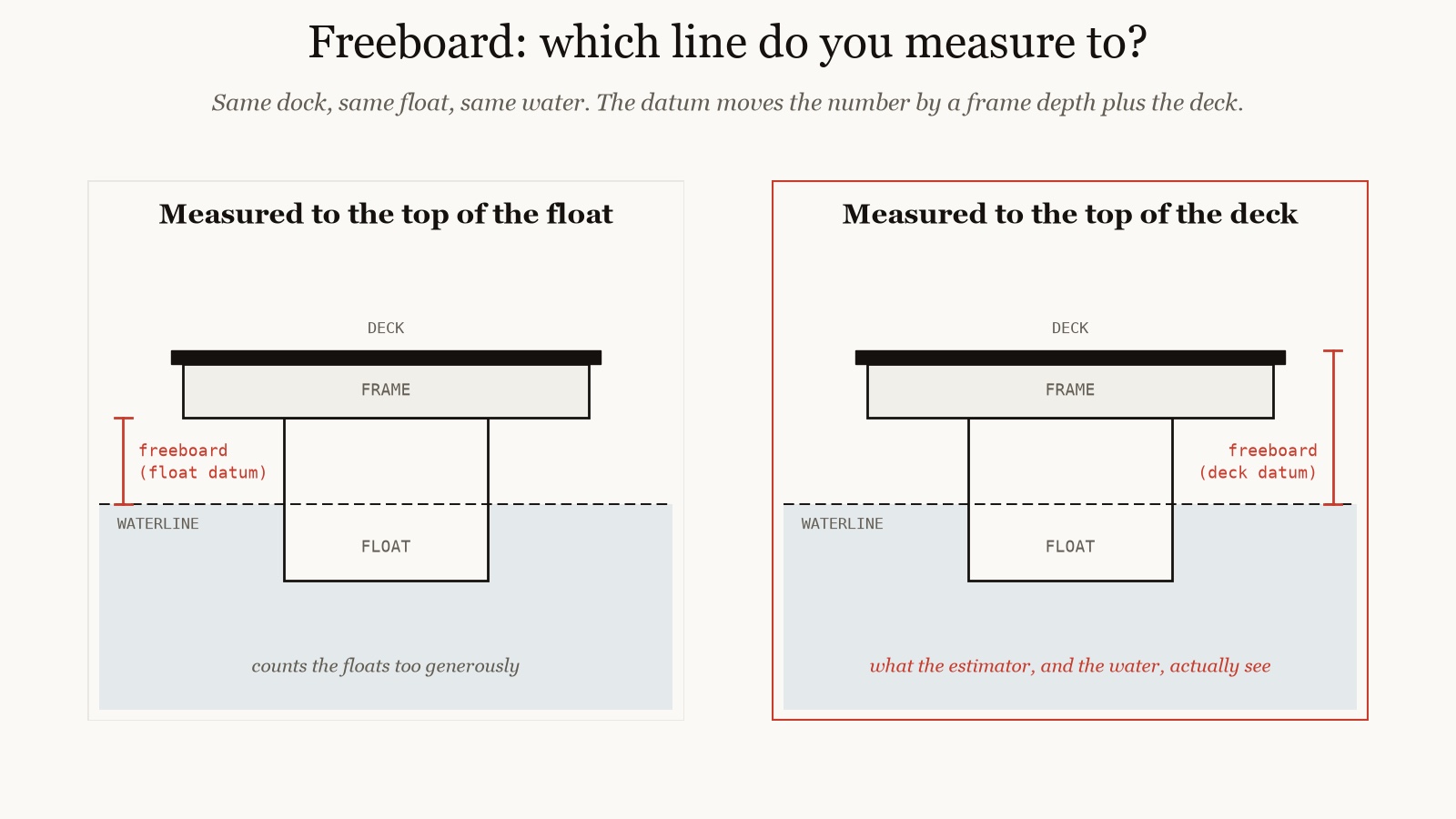
Freeboard is the distance from the waterline to the top of the deck.
Every dock specification cares about it because it decides whether a boater steps down into the boat or climbs up, and whether a wave puts the deck under.
It is also the number that sizes the floats, and it hides a measurement trap that we walked into ourselves.
Where the measurement goes wrong
The trap is the datum. The float's top is not the deck's top. Between them sit the frame, typically eight to twelve inches of aluminum channel, and the deck itself.
A calculation that measures freeboard to the top of the float undershoots the real number by a full frame depth plus the deck, on every dock, every time.
How our engine got this wrong
Our engine did exactly this for a while. Its buoyancy check measured to the float, concluded that every design was sitting too low, and quietly specified bigger floats than the fabricator would have chosen.
The totals still looked plausible, which is how the error survived. The money was roughly right and the product was wrong.
When we corrected the datum to the deck top, the float selection snapped into agreement with what real estimators choose.
The loaded case and the stated freeboard
Two practical rules come out of that:
- The loaded case governs. With the specified live load on the deck, the dock must still sit clear of the water. Many designers set that minimum around eight inches, and a frame that is deep enough to hold that clearance is part of the answer.
- If the package states a freeboard, treat it as a minimum constraint that drives float height upward step by step, not as a number to hit by jumping to a different float model.
We put the whole calculation, with the deck-top datum, into a free dock float calculator so anyone can check a design in a minute.
Decision 3: the loads the specification never states
Three loads decide the structure, and a surprising share of packages state none of them for the fabricator's product.
Live load decides which product it is
Residential floating docks are often designed around 20 to 30 pounds per square foot. Public gangways commonly carry 50 or 100.
Those are different products with different floats, framing, and price.
When the package is silent, the estimator has to assume a value, state the assumption on the quote, and accept that a competitor may have assumed differently. That is one of the mechanisms behind the Florida spread.
Wind speed depends on the code edition
Wind has a trap inside it. Wind speeds in specifications come from a code edition, and the editions do not measure the same thing:
- Older ASCE 7 editions state an allowable-stress basis speed.
- ASCE 7-10 and later state an ultimate basis speed that is numerically higher for the same site, by a factor of about 1.29.
A package that prints 140 miles per hour on the newer basis is describing roughly 108 on the older one.
An estimator whose pricing tool was calibrated on one basis, fed a number from the other, will over-build or under-build the lateral bracing without anyone noticing, because both numbers look like wind speeds.
The honest handling is to identify the edition before the number goes anywhere, and to flag it when the edition is unstated.
Waves set a limit on light float systems
Light aluminum float systems are typically rated for around two feet of wave. Above that the product family changes, or the answer is a feasibility conversation rather than a price.
Packages state a design wave height less often than they should. When they state one above the limit, it is frequently buried in a coastal engineering appendix nowhere near the dock drawings.
Decision 4: the dimension that is not on the drawing
Every gangway has several true lengths:
- One is the bearing span between supports.
- One is the fabricated length of the truss.
- One is the overall length including landings and transition plates.
All three are real, and all three may be printed somewhere. The one you price from is a choice the drawing does not make for you.
We have watched capable readers, human and machine, extract every dimension chain on a sheet perfectly and then split on which length to quote. They split because the choice is shop convention, not print.
Clear width is not outside width
Width has the same shape. Public specifications state clear width, the walking width inside the rails.
Truss gangway price grids are usually indexed by outside width, which runs roughly a foot wider for the same clear opening.
Enter the clear width into an outside-width grid and the gangway is priced a size too small. That error recurs so reliably we built a rule for it.
When the dimension is missing from the package
Then there is the dimension that is not there. It goes missing in three ways:
- Specifications say "see plans".
- Plans say "typical" and show one of several structures.
- The key plan that lists every unit looks like boilerplate and gets skipped, so a package with three gangways at three locations is priced as one.
When a load-bearing dimension is genuinely not stated, the temptation is to scale it from the drawing. Do not. A scaled dimension corroborates nothing.
Treat the dimension as a question to the engineer with a bracket around it. It belongs on the quote as an assumption, not inside a number.
Decision 5: the parts that belong to somebody else
A floating dock does not float alone. It is held by piles, and on nearly every public package the piles are by others. They are driven by a marine contractor to a layout that may not be final when the fabricator quotes.
The pile guide count is an assumption
The fabricator supplies the pile guides, and the guide count depends on the pile layout. So the quote carries a count "assumed for budgetary purposes" that a competitor may have assumed differently.
Whether a small standalone dock gets two guides or four is a site judgment. Whether a long finger needs a guide at its end, and bracing to go with it, is another.
The shore connection and the utilities
The same dependency shows up at the shore. The gangway's upper end lands on an abutment, a seawall cap, or a platform that is usually someone else's scope.
The connection detail there, the hinge and the bearing plate, decides hardware that is inside the fabricator's price.
Utility clearance under the deck, four inches or six, changes the frame and the stringers and moves the price of a main run by a visible margin. It is set by the electrical and water design, not the dock design.
None of these is in the fabricator's control, and all of them are in the fabricator's number.
Decision 6: the shop's standard, or the specification's gold plating
Public specifications are written defensively. They call for 316 stainless hardware, powder-coated finishes, premium rail heights and composite fenders, whether or not the job needs them. They also say "or approved equal" forty times.
The estimator's decision is which of those to price as written and which to price at the shop's standard with the upgrade offered as an alternate.
The two-part rule experienced shops follow
The practice that experienced shops follow, and that we had to learn the hard way, is a two-part rule:
- Structural and load items are priced exactly as specified. That covers live load, spans, widths, freeboard and ADA geometry. There is no baseline for those.
- Finish and cosmetic items are priced at the shop's standard when the specification's criteria are incomplete. The delta is moved to a clearly labelled alternate line or an assumption note.
A quote that gold-plates every clause prices itself out of the job. A quote that quietly substitutes on a load item gets the job and loses money.
What a blind test taught us about boilerplate
In one of our blind tests the engine followed the specification's finish clauses to the letter. It came out about a third high against what the shop actually quoted.
That is how we learned that the shop's boilerplate, "mill finish unless noted otherwise," is a pricing policy, not a footnote.
Whether a clause applies to this assembly
One specific instance is worth knowing. A clause requiring 316 stainless hardware usually does not apply to an aluminum gangway hinge, which is a different assembly. Reading it as if it did adds a large, unnecessary upgrade.
Whether a given clause applies to a given assembly is exactly the kind of judgment the package leaves to the reader.
Decision 7: how it ships
A dock that is 245 feet long on the drawing is not one piece of aluminum. It is a run of sections joined in the water, and the sectioning is a quoting decision with money in it.
What fits on a truck
Sections are limited by what fits on a truck:
- Past eight and a half feet wide, a load needs permits.
- Past roughly twelve feet, most states start requiring escorts.
So twelve feet is a practical ceiling on module width, and anything wider becomes two modules side by side. Lengths cluster around 25 to 40 feet for similar reasons.
How a long run is divided
A long run can be divided into equal sections, into a repeated reference section, or around a feature at the end. How it is divided changes the count of joints, the connection hardware, and the fit-up labor, and the package almost never says.
Two estimators at the same shop can divide the same run differently on different days. We have seen it in filed workbooks.
It is a small lever compared with the float family, but it is a lever.
Put the sectioning on the quote as a stated assumption with the shipping dimensions attached, because the office manager pricing freight needs them anyway.
Decision 8: the pieces no rate book has
Every rate book covers the standard product: the gangway grid by width and span, the dock by width and length and deck.
Real packages ask for things beside the grid:
- A transition plate that bridges the gangway to a dock at an odd angle
- Stairs
- Saddles to carry a gangway over an existing structure
- An unusually tall truss where the span demands it
- Extended end hoops
- A double stainless shackle hinge on both ends
- A kayak slide
- A gate
How to quote a piece with no book price
These are priced from weight and labor, by a person, from the last time the shop built something similar.
The honest way to quote them is to say so. Give a bracketed figure with its basis stated, never a number that pretends to come from the book.
Where an automated system should stop
This is also where any automated system, ours included, should visibly stop and hand the item to the estimator.
A quote in which every custom piece has a confident price and no provenance is a quote in which somebody guessed.
Decision 9: when the package asks the fabricator to design it
The last decision is whether there is a quote to give at all.
Some packages describe the dock's location and purpose and leave the layout, the sectioning, and the float arrangement to the fabricator. That is design-build in everything but name.
On those, the structural dimensions of the product are printed nowhere, because nobody has designed the product yet.
The right answer is a list of questions
The wrong answer is to guess a layout and price it as if the package had specified it.
The right answer, which experienced shops give and which we now score as a pass in our own testing, is a structured list:
- Here is what these documents do not dimension.
- Here are the assumptions we would need to price it.
- Here is a budgetary bracket on each.
A quote that is a set of questions is not a failure. It is the correct output for a package that has not finished asking.
Aluminum gangway for floating dock work: why gangways are harder still
Everything above applies to both structures, but gangways add three constraints of their own that make an aluminum gangway for floating dock projects the most frequently mis-quoted item on a waterfront package.
The length is a site number
Under the 2010 ADA Standards, a gangway is treated as a ramp with a maximum slope of 1:12 at the worst water level. That limit holds unless one of two things is true:
- The gangway is at least 80 feet long.
- The facility has fewer than 25 boat slips and the gangway is at least 30 feet long.
The slope depends on the vertical distance between the shore landing and the dock at low water, which depends on the tidal or pool range at that site.
So the length is not a catalogue choice. It is derived from the site, and if the package does not state the range, the length is an assumption.
Our ADA gangway slope calculator does the derivation and shows which exception, if any, applies.
The product changes class at a span boundary
Truss gangways are priced from a grid up to a certain span. Beyond it the product becomes a bridge, priced from a different book with a different structure.
The two books can disagree by a large margin at the boundary and agree in the middle. So which book a borderline span belongs to is worth a great deal of money. It is, once again, shop convention rather than anything the package states.
A span a few feet over the line, at a light live load, may be interpolated on the lighter book. At a heavy live load it may not. That judgment is invisible from outside the shop.
The hardware at both ends is part of the structure
Hinges, rollers, transition plates, end hoops, and the bearing at the shore connection are inside the gangway price but not in the gangway grid.
A specification's hardware clauses land on them in ways that need interpretation, as with the 316 clause above.
What the public bid data says these decisions cost
Return to the Florida letting from the opening. These are its numbers:
- Six pre-qualified contractors priced one 4,000 square foot aluminum floating dock from identical drawings and specification.
- Their unit prices ran from $110 to $300 per square foot, which is a 2.7x spread.
- On the gangway line the spread reached 4x.
One number on three different products
One bidder priced the floating dock, the gangway, and a fixed platform, three different products, at exactly $204.24 per square foot, to the penny.
That is not an estimate. It is a single blended number spread across lines, usually because the marine scope came from one subcontractor quote or none.
The full teardown, with every bidder's numbers, is in our floating dock cost analysis.
Reading the spread through the nine decisions
Read that spread through the nine decisions and it stops being mysterious.
- A bidder who resolved the float family, the freeboard datum, the loads, and the length from the documents, and who knew which of the specification's clauses applied to the product, could price the dock tightly and did.
- A bidder who could not resolve them priced the uncertainty as margin, or plugged a number and moved on.
The spread is the market's price for this article, and the estimator who does the reading well is the one who wins the line.
A pre-pricing checklist for gangway and dock packages
If you take one practical thing from this piece, take this.
Before any number enters the calculator, walk the nine decisions and write down, for each, what the package says, where it says it, and what you assumed if it did not. Then put the assumptions on the quote.
The nine decisions for quoting custom gangways and docks, in one table
| Decision | Where to look | If the package is silent |
|---|---|---|
| Float family | Freeboard requirement, live load, foam or polystyrene wording, float details | Run the buoyancy check first; pick the family the freeboard can actually reach; state it |
| Freeboard and datum | Dock notes, marina design criteria, the deck section | Design to the deck top, check the loaded case, state the unloaded figure |
| Live load, wind, waves | Structural general notes, design criteria sheet, coastal appendix | Assume, state, and flag; identify the wind code edition before using the number |
| Lengths and widths | The one sheet with the dimension; key plan for the unit count; "clear" versus outside width | Never scale; ask with a bracket; count units from the key plan |
| Piles, shore, utilities | Pile plan, abutment detail, electrical and plumbing drawings | Assume the guide count for budget and say so; note utility clearance |
| Standard versus specification | Finish, hardware, fender, and rail clauses; "or approved equal" | Price structural items as specified; price finish at standard with alternates |
| Shipping and sections | Dock lengths, site access, delivery notes | State the sectioning and the shipping dimensions |
| Custom pieces | Details for transitions, stairs, saddles, gates | Bracket from weight and labor with the basis written down |
| Design responsibility | Whether the product's own dimensions appear anywhere | Quote a list of questions with budgetary brackets, not a guessed layout |
What the walk does to a quote
Shops that run that walk consistently produce quotes that look different from their competitors' quotes. Those quotes are shorter on surprises, longer on stated assumptions, and closer to the number the job actually costs.
It is also, not coincidentally, the exact list a piece of software has to work through before it can be trusted with this work, which is why we built ours around it.
Where software fits, honestly
None of the nine decisions is arithmetic. That is the point that most "AI quoting" products miss, because most of them automate the calculator.
What software can do with a package
What can genuinely be automated is the reading. Software can do these parts of it:
- It can find the one sheet with the length.
- It can catch the two decking materials and the two deflection limits.
- It can pull every load and every freeboard with its page number.
- It can put the nine decisions in front of the estimator with the evidence attached, ranked by how many dollars ride on each.
The deciding stays human, but the finding does not have to.
Mavlon builds exactly that engine for custom fabricators. The fastest way to see whether it earns its place on your work is to book a 30-minute demo and bring the ugliest gangway and dock package you have quoted this year.
We will read it live, together, and you can check every citation against your own copy.