AI for Quoting Complex Marine Structures: A Practical Guide
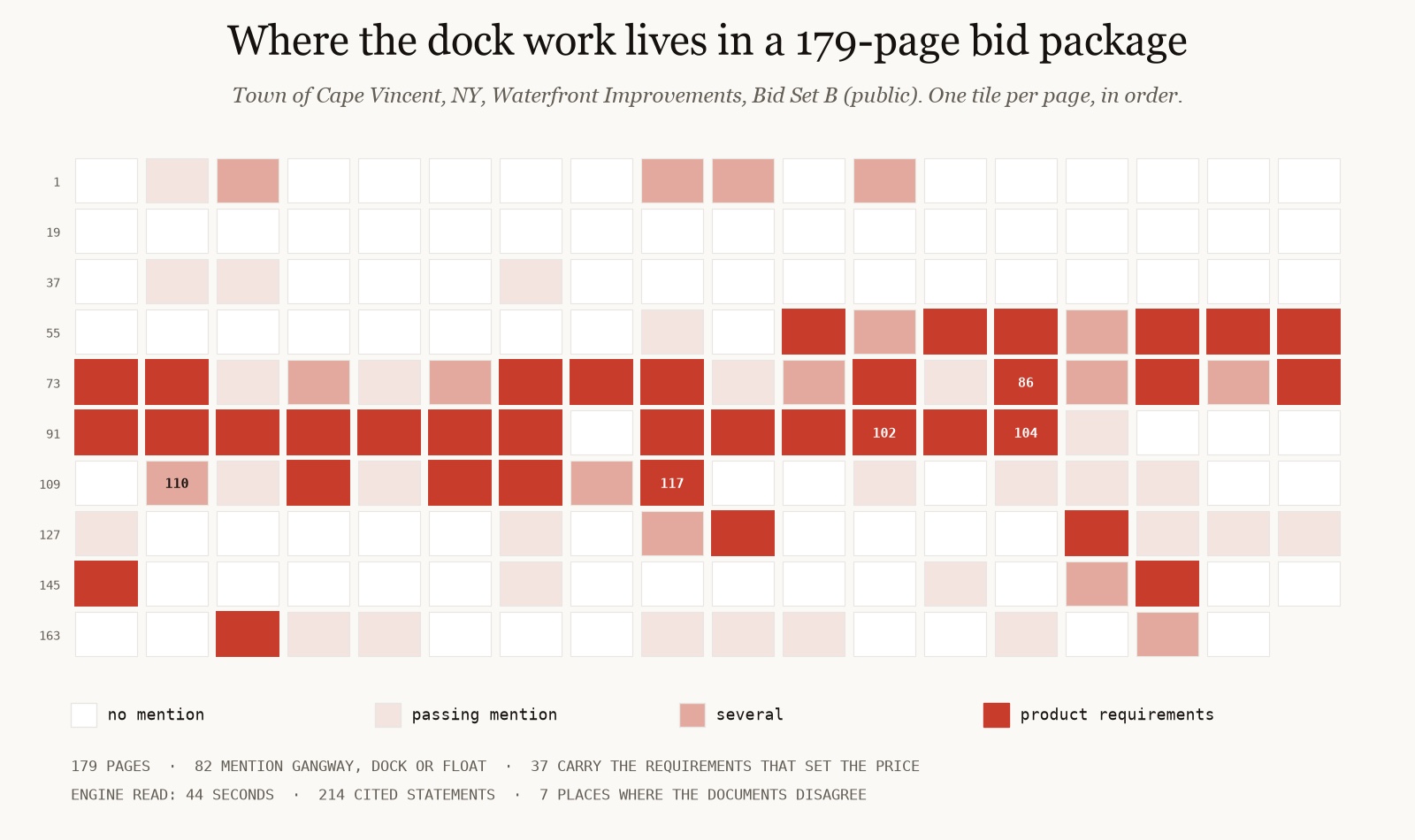
I watched a piece of software read a 179-page waterfront bid package in 44 seconds and hand back 214 statements, each with a page number attached, along with seven places where the drawings and the specification disagreed with each other. A month earlier I had watched the same software read a different package, decide the floating dock sat on polyethylene tubs when the specification meant encapsulated foam, and quote the job more than 40 percent low. Both things are true of AI for quoting complex marine structures, and any honest guide has to hold both at once.
This is that guide. It is written for the estimator or owner at a fabricator or marine contractor who prices floating docks, truss gangways, fixed piers, and the accessories around them, and who has been told, by vendors and by the general press, that AI now does this. Some of it does. Most of what is sold as construction estimating AI does not touch the part of marine work that costs hours, and the part it does touch needs a specific set of checks that nothing built for concrete takeoffs will run. We build in this lane, so read our conclusions with that in mind; we have tried to make every one of them checkable against a public document or against a mistake we admit to.
The companion piece, why quoting custom gangways and docks is harder than it sounds, walks the nine decisions a package never makes for you. This one is about what a machine can take off your desk, what it cannot, and how to tell the difference before you pay for it.
What AI for quoting complex marine structures can and cannot do
A custom marine quote is four jobs wearing one name. Reading: finding every load, dimension, material, and requirement in the package, wherever it hides. Scoping: deciding which structures are yours, how many, and what is by others. Arithmetic: turning a configuration into a price through the shop's rate books. Judgment: the calls the documents leave open, and the margin. Three of the four are mechanical in the sense that a careful junior with infinite time would get them right; the fourth is why senior estimators exist.
AI, done properly, takes the first three and leaves the fourth exactly where it is. That sentence is the whole thesis, and the evidence for it is where our own engine broke while we built it. We log every class of failure we have ever hit, with the guard that now prevents it. Forty-four classes so far. Sorted by kind, they look like this:
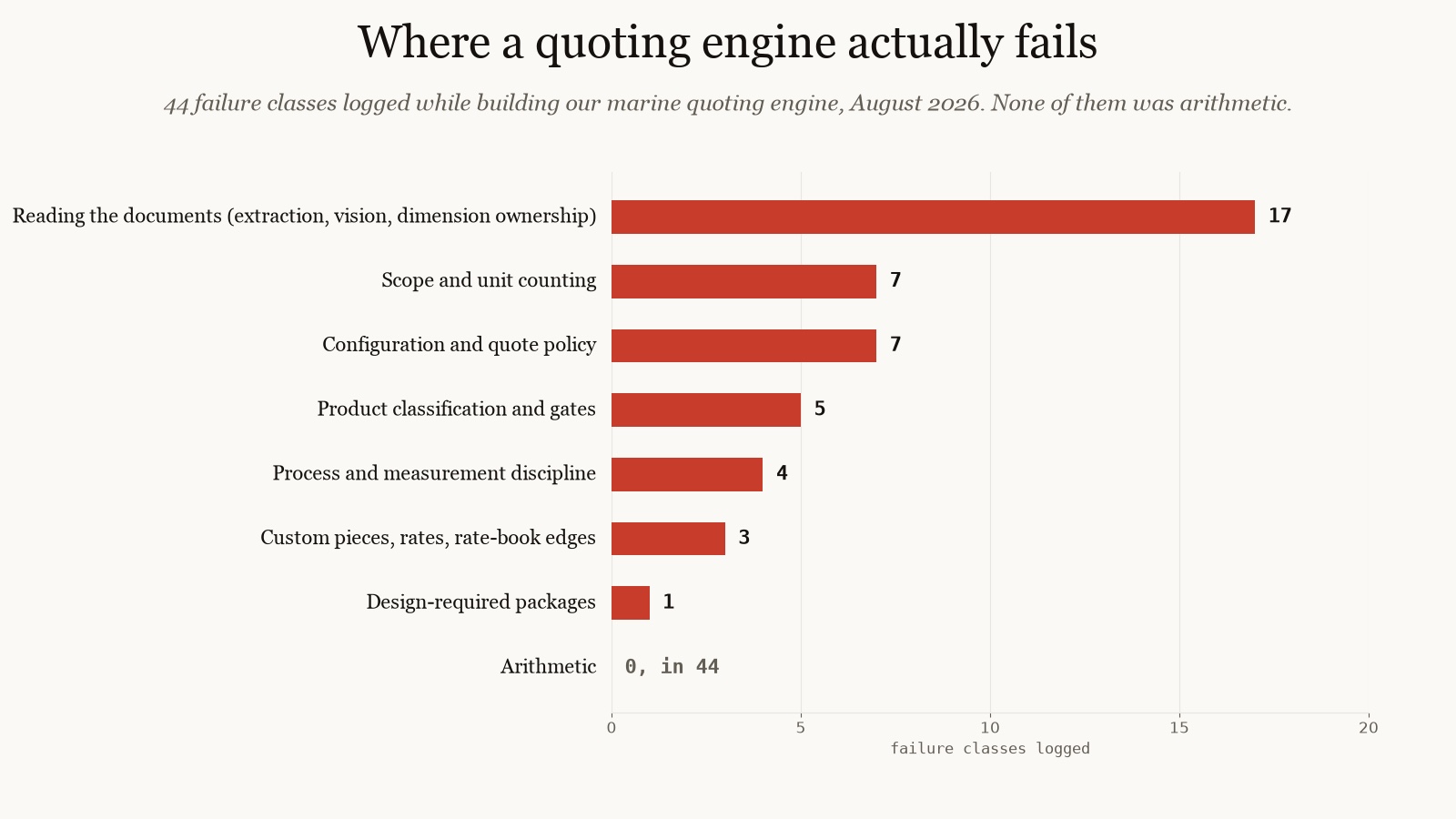
Seventeen of the forty-four are document reading: a D-size sheet squeezed into a vision model at roughly 57 dots per inch reading as blank, a dimension attributed to the wrong structure because the arrow was ignored, a graphic scale bar read as a width, one run finding fifteen dimensions on a sheet and the next run three. Seven are scope: three gangways at three sites collapsed into one because the key plan looked like boilerplate, a fixed catwalk labelled gangway on the drawing, steel platforms by others priced as if they were ours. Seven are configuration and policy: pricing a specification's powder-coat clause at full cost when the shop's practice is mill finish with an alternate. Five are product classification. Zero are arithmetic. The calculator was never the problem, and any vendor whose demo is mostly a calculator is demonstrating the solved part.
Why general construction estimating AI misses marine work
Search for AI construction estimating and you find takeoff tools: software that counts, measures, and quantifies from a plan set. Concrete volumes, linear feet of curb, square feet of paving. They are genuinely good at that, and for a general contractor they are the right product. Search the same tools for the word marine and the engines themselves tell you it is missing.
The reason is structural. A dock fabricator's cost is not driven by quantity takeoff; a 4,000 square foot dock is 4,000 square feet whichever tool counts it. It is driven by interpretation: which float family the specification implies, whether a 140 mile-per-hour wind figure is on the newer or the older code basis, which of the gangway's several true lengths the shop prices from, whether a 316 stainless clause applies to an aluminum hinge. Those are reading and classification problems, and a takeoff engine has no opinion about any of them. In a public Florida letting we analyzed, six contractors priced the identical 4,000 square foot dock between $110 and $300 per square foot; the takeoff was identical for all six, and the 2.7x spread came from everything a takeoff tool does not do.
So the first practical rule: if a vendor's marine story is "we measure your drawings," you are being sold a tool for a different trade. The questions that follow are the ones that separate reading from measuring.
Step 1: feed it the whole package, not excerpts
The most common way to make any AI look good on a bid package is to feed it the four pages that matter. It is also the most common way to waste the exercise, because a human just did the job the machine was supposed to do: deciding which pages matter. The requirements that price a dock are scattered, and they are scattered on purpose, because the specification was written by an engineer for a general contractor with thirty trades in it.
The figure at the top of this article shows what that scatter looks like on a real document. The Town of Cape Vincent, New York, posted its waterfront improvements bid package on its website in late 2025: 179 pages. We indexed every page for the words gangway, dock, and float. Eighty-two of the 179 pages mention at least one of them, mostly in passing: general conditions, bid forms, the boilerplate that repeats the project name. About forty pages carry the requirements that actually set the price, and they cluster in two places: the floating dockage specification section around pages 86 to 104, and the drawing sheets around 110 to 117. The deck material lives on page 102 in the specification and again, differently, on page 117 in the drawings. The gangway length appears on one drawing sheet only.
Feed all 179. Feed the addenda, because addendum two is where the decking material changes. Feed the geotechnical or coastal appendix, because that is where the design wave height hides when the dock notes do not state one. Feed the covering email thread, because "we would like to use our standard rail" arrives in email, not in the specification. And insist that the system handle the plan set as it is: on this package, all but one page carried an embedded text layer, which a well-built reader treats as ground truth and extracts deterministically; the scanned exception has to be read as an image, tiled at full resolution rather than squeezed whole into a vision model, or it reads as nothing.
Step 2: demand a page citation for every value
When the system reports that the live load is 60 pounds per square foot, the next question is always: where does it say that? An answer without a page number is a rumor. An estimator who must reopen the package to verify each extracted value has not saved reading time; they have added a verification pass on top of it.
The standard to hold any tool to, ours included, is the one we hold ourselves to on the Cape Vincent package: every extracted statement carries its source page, the wording is boxed on the sheet so a glance confirms it, and when a value came from a scanned page the system says it is a scan rather than pretending to a precision it does not have. 214 statements, 214 citations. On a marine package this matters more than on most, because the values that drive float sizing, freeboard and live load, are exactly the ones most often stated once, in a section the estimator would not think to open, for a structure that may or may not be the one being priced.
Step 3: make it surface conflicts, never resolve them
Real packages disagree with themselves, and the disagreements are where money is lost. On Cape Vincent the engine found seven. Specification section 35 50 20, page 102, names one deck product for the gangway; drawing sheet CM-5.01, page 117, calls for grooved timber. Different weight, different fixing, different float sizing downstream. On the dock, one paragraph limits deflection to L over 360 and another on the same page to L over 180, one twice as strict as the other. We put a screen recording of a conflict like this online, where the specification says 48 inches and the drawing says 60.
The wrong AI behavior, and the default behavior of a chat assistant, is to pick one silently and move on, usually the one it read most recently. The right behavior is to present both, cite both, and stop. A conflict is a question for the engineer of record, an assumption to state on the quote, or a bid-day judgment, and all three belong to a human. A system that never reports a conflict on a real package has not read it.
Step 4: gate the product classification before any price
This is the marine-specific step that no general tool will run, and it is where our largest error lived. A floating dock belongs to a family before it belongs to a price: encapsulated foam, polyethylene tubs, or pontoons, and the families are not interchangeable in buoyancy, framing, or cost. The package rarely names the family outright; it implies it, through a freeboard requirement, a live load, a stray word like polystyrene, or a float model in a detail. Our engine once read polystyrene as a tub-shell keyword on one package and as a foam-core keyword on another, and got one of them wrong by more than 40 percent of the quote. The guard is now a gate: no dock is priced until the family is confirmed, with the buoyancy check run first and the freeboard measured to the deck top, not the float top, a datum mistake we also made and describe in the companion article.
Gangways have their own classification traps. A structure labelled gangway on the drawing that has no hinge, no rollers, and no floating end is a fixed catwalk, priced as a bridge from a different book; our engine priced one as a gangway before we taught it to look for the hinge rather than the label. And a span a few feet beyond the gangway grid's boundary belongs to the bridge book on one reading and an interpolation on another, with the two books disagreeing by a wide margin at exactly that seam. Any AI worth paying for should show you which book it used and why, and flag the borderline case rather than choosing quietly.
Step 5: resolve dimensions the way an engineer does, with receipts
A walkway drawing prints several true lengths: bearing span, fabricated length, overall length with landings. Frontier AI models read every dimension chain on the sheet perfectly and then split on which one to quote, because the choice is shop convention rather than print. Dimension text belongs to whatever the leader line points at, not to whatever is nearest, and teaching a system to follow the arrow, and to abstain when the arrow is ambiguous, killed a whole class of wrong reads that plain OCR plus a language model never fixes. Some packages state a clear span as "see drawing" and the drawing never prints it, but a working-point table and a gap dimension on another sheet reconstruct it exactly; an estimator does that in their head, and a machine has to do it with geometry and show the work.
Two rules any system must obey here. Never scale a load-bearing dimension from the drawing; a scaled value corroborates nothing and belongs on the quote as a bracketed question. And convert clear width to outside width before touching a truss gangway grid, because the grids are indexed by outside width, roughly a foot more than the walking width the specification states, and the mistake prices the gangway a size too small every time.
Step 6: price in your own logic, never the vendor's
The pricing half of the problem has a trap too, and it is not the arithmetic. Shops' estimating workbooks are real formal pricing models; we have reproduced several offline, exactly, from a shop's own filed files. A quoting AI should replace the spreadsheet and keep the logic, not impose a cost model of its own that knows nothing about your labor, your scrap factor, or your margin structure.
What it must add is discipline about time. Old quotes are priced in old money. Aluminum rates moved sharply across 2025 and 2026, and a system that learns from three years of history without normalizing for rate era learns three different prices for the same dock. Every comparison to past work should be shown raw and era-normalized, with the rate delta on its own line, or the accuracy number it reports is fiction. And some lines are never formula-driven: freight is the classic, priced by the office manager from real shipping dimensions after the quote. An honest engine prints TBD there, with the shipping dimensions attached, rather than inventing a number.
Step 7: keep the estimator on the decisions that carry dollars
The output that earns trust is not a total. It is a priced argument in three passes: what and how much; what is yours to decide, presented as the handful of calls ranked by the dollars riding on each, one signed figure per option; and where every number came from. In marine work those calls are predictable: standard rail versus the specified upgrade, the pile guide count assumed while piling is by others, the sectioning of a long run, which book a borderline span belongs to, and whether a spec clause applies to a given assembly.
Two behaviors matter most. When the specification asks for upgrades but its criteria are incomplete, experienced shops price their standard and move the delta to an alternate; an engine that follows the spec to the letter prices wrong in the cases that matter, which is a mistake we made and now guard against. And when the package does not dimension the product at all, because the fabricator is being asked to design the layout, the correct output is a structured refusal: these documents do not dimension the product, here are the assumptions we would need, here is a bracket on each. We score that as a pass in our own testing. Ask any vendor what their system does on that package; the answer tells you everything.
The marine-specific checks any AI must pass
Put together, here is the checklist we would hold any system to on dock and gangway work, ours first. Each row is a place where a general tool has no opinion and a marine quote lives or dies.
| Check | Why it is marine-specific | What failure looks like |
|---|---|---|
| Float family gate before pricing | Foam, tubs and pontoons are different products with different buoyancy and cost | A quote 40 percent off on a family misread |
| Freeboard to the deck top, loaded case checked | Freeboard sizes the floats; the datum shifts it by a frame depth | Every dock over-floated; right money, wrong product |
| Wind code edition identified | Ultimate and allowable-stress speeds differ by about 1.29 for the same site | Lateral bracing over- or under-built silently |
| Wave height against the product limit | Light aluminum systems are rated around two feet | A price where the answer was a feasibility conversation |
| Gangway length from site water range, ADA slope | 1:12 at low water, with the 80-foot and small-facility exceptions | A catalogue length on a site that needs a longer one |
| Product class at the span boundary | Gangway grid versus bridge book, disagreeing at the seam | The wrong book chosen quietly |
| Pile guide count stated as an assumption | Piling is by others and the layout may not be final | A count that differs from every competitor's, unexplained |
| Clear width converted to outside width | Truss grids are indexed by outside width | Gangway priced a size too small |
| Hardware clause applicability | 316 stainless clauses versus aluminum hinge assemblies | An unnecessary upgrade priced in full |
The do-it-yourself route, honestly
A fair number of shops have built their own assistant: a ChatGPT or Claude project loaded with rate cards, quoting rules, and format examples. Build it. It is a weekend of work, it teaches your team what the technology does, and for lookups, quote wording, vocabulary questions, and small clean documents it genuinely helps. We wrote the build-or-buy guide for exactly that project, including the ten instruction rules worth stealing.
It also hits a wall on marine packages, in a predictable place. A 179-page package does not fit a chat context, so someone pre-digests it, which is the job. Extracted values carry no citation you can verify. The same package read twice gives two different freeboards. And none of the marine checks above will run, because a chat assistant has no float-family gate, no buoyancy calculation, no notion of which book a 54-foot span belongs to. The wall is not a prompting problem; it is the difference between a chat window and a pipeline. Our teardown of what breaks when ChatGPT reads real bid packages shows it on a public document, and the question of whether you may upload the drawings at all deserves its own answer before any of this.
How to test any vendor, including us: the marine blind test
Demos are choreography. The only evaluation with information in it is the one you control, and for marine quoting it looks like this:
- Pick five past packages you already quoted. Include one ugly one, one with a design-required structure, and one where the specification and drawings disagreed. Gather the documents your team had on day one.
- Keep the filed quotes out of the vendor's reach entirely. A system tested on answers it was handed proves nothing, and the leak happens by accident more often than by design: a quote PDF in the same folder, a total mentioned in an email.
- Run all five cold, and run one of them twice on different days. The difference between the two runs is the system's variance, and it tells you how much any single answer can be trusted. Clean packages should read identically; ambiguous ones will swing, and the question is whether the system tells you so.
- Score the reading before the pricing. Line by line against the documents: found, missed, invented, flagged. Then the pricing, end to end from package to quote, against your filed numbers, raw and era-normalized. Refuse component accuracy claims; a system handed each part's inputs is demonstrating the calculator.
- Check what it did on the design-required package. A confident layout and a confident price is a fail. A structured list of what the documents do not dimension, with brackets, is a pass.
- Agree the bar in writing before you start. Ours, published: on ten held-out jobs the system has never seen, seven of ten job totals within 15 percent of the filed quote, with a failed-to-process counted as a miss, scored live so nobody tunes on the test set.
Two afternoons of that beats two months of demos, and it works on every vendor in the category. If a vendor declines the format, that is information too.
What this looked like on the Cape Vincent package
To make the abstract concrete, here is what the engine returned on the public package in the figure, in the order an estimator would use it. First, the scope: the gangway and floating dock units, with the fixed structures and the work by others excluded and labelled as such. Then the requirements, 214 of them, each citing its page: the live loads, the deck materials from both the specification and the drawings, the deflection limits, the freeboard and float references, the accessibility requirements, the hardware clauses. Then the seven conflicts, both sides cited, with the decking disagreement and the deflection disagreement at the top because they carry the most dollars. Then the questions: what the documents do not state, what the engine assumed, and what should go back to the engineer of record. The whole read took 44 seconds. What it did not do was decide the deck material, choose the deflection limit, or set a price the estimator had not reviewed; those stayed exactly where they belong.
That is the honest shape of AI for quoting complex marine structures today: an hour of reading turned into a minute, a set of citations an estimator can check at a glance, the conflicts and decisions ranked and waiting, and the judgment untouched.
The honest limits
More data fixes some things and never fixes others, and a vendor who claims otherwise is selling. More packages fill thin lanes: rare variants, unusual accessories, product families the system has seen too few of. They never fix inputs that exist in nobody's workbook, such as a site's wave loading when no document states it; per-project judgment calls, such as whether a long finger gets bracing; or dimensions that are not drawn. Those are customer questions, and the most credible thing a system can do is say so plainly. Custom fabrications, stairs, saddles, tall trusses, transition plates, are priced from weight and labor by a person, and an engine should suggest a basis with provenance and hand the line over, never invent the number. And margin is not a modelling problem; it is the business.
Build the assistant, run the blind test, hold every vendor to the checklist. Mavlon is the lane this guide describes, a package-reading engine that drafts the quote in your own pricing logic with every value cited and every decision handed back to your estimator, and the fastest honest way to find out whether it earns a place on your work is to book a 30-minute demo and bring the marine package you least want to read again. We will read it live, and you can check every citation against your own copy.