Tacton Alternative for Custom Manufacturing: Honest Guide
I have watched a custom fabricator's estimating lead sit through a beautiful CPQ demo, nod along at the configurator, the visual model, the instant document, and then ask one question that ended the meeting: "Where do I put the customer's drawings?" There was no answer, because in that product category the customer does not send drawings; the customer picks options. Everyone in the room slowly realized they had spent an hour admiring a machine built for somebody else's business.
If you searched for a Tacton alternative, the results you got almost certainly missed that moment. Gartner, G2, and Capterra will hand you lists of other CPQ platforms, ranked by review counts. Those lists answer one narrow question: which other configurator could I buy? This guide starts one step earlier, with the question the lists skip: why are you leaving? Because in our experience the reason for leaving decides everything, and for one specific group, custom manufacturers whose work arrives as someone else's bid package, the honest answer is not another CPQ at all.
We wrote a broader buyer guide to AI quoting software that maps the whole category. This page focuses on the Tacton decision specifically: what Tacton is genuinely good at, the three reasons people go looking for a replacement, what belongs in each lane, what switching really costs, and how to test any vendor, including us, before believing them.
Start with why you are leaving
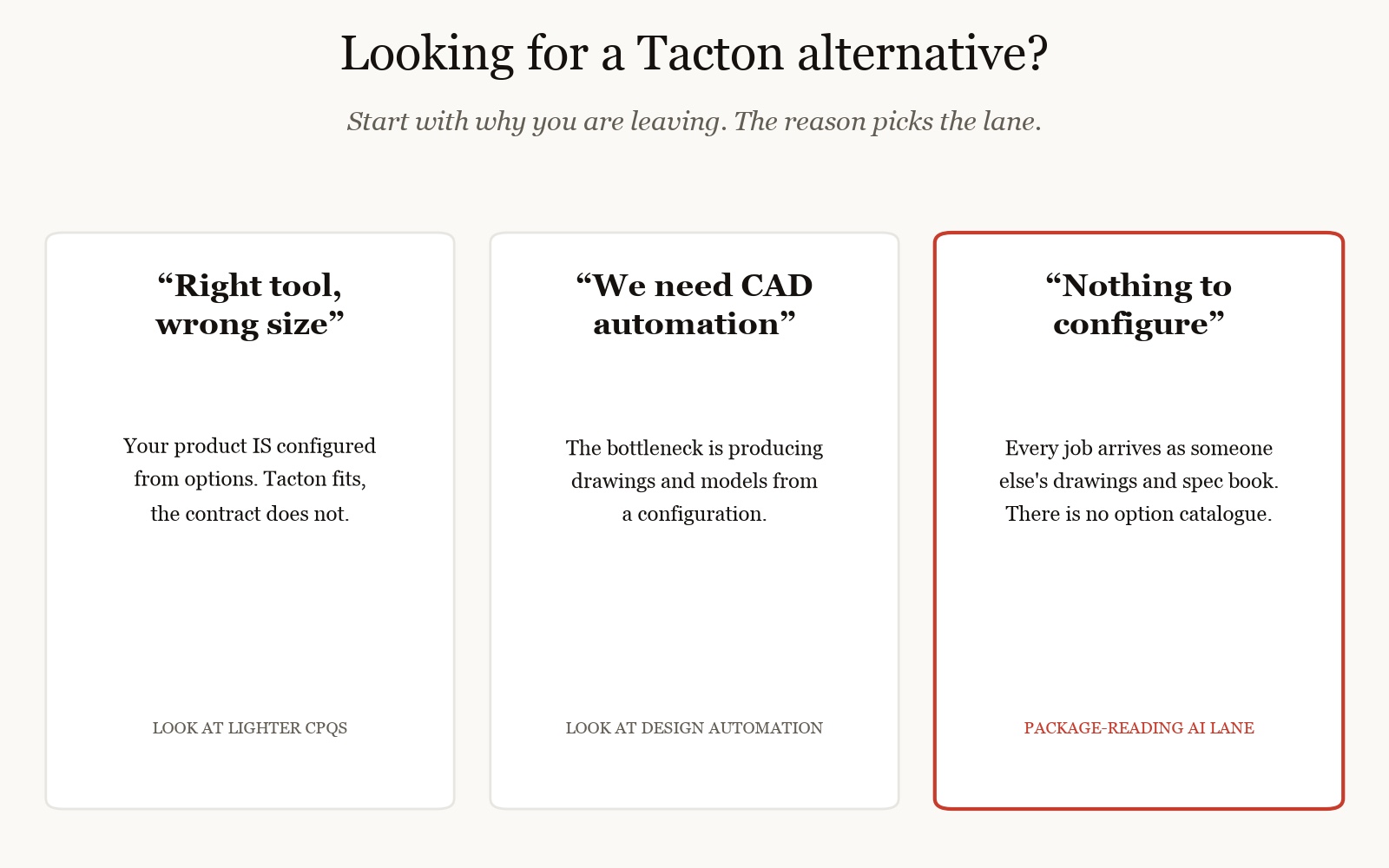
Talk to enough teams shopping for a replacement and the reasons sort into three piles, and almost nothing else:
- "Right tool, wrong size." Your product genuinely is configured from options, the configurator works, but the platform is heavier than your team or budget wants to carry: enterprise contract, dedicated modeling skills, implementation and maintenance effort sized for a large organization.
- "The bottleneck is engineering output, not selling." What you actually need is drawings, models, and manufacturing data generated automatically from an order, and you came to CPQ hoping it would solve that.
- "We never had anything to configure." The uncomfortable pile. The demo was great, the implementation stalled, and the stall had one cause: your jobs do not come from an option catalogue. They come from a customer's drawing set and specification book, different every time.
Each pile leads somewhere different. Mixing them up is how companies buy the wrong replacement and repeat the same eighteen months with a new logo on the invoice. Before sorting yourself into a pile, though, fairness demands the section most alternative pages skip.
What the aggregator lists get structurally wrong
It is worth thirty seconds on why the standard search results mislead, because the failure is structural, not lazy. Review aggregators rank by review volume and sentiment inside a category page, and the category boundaries are drawn loosely enough that tools with no configurator at all, sales-enablement suites, proposal builders, screen-sharing utilities, routinely appear as top "alternatives" to a constraint-based configuration platform. One widely indexed list we checked while writing this guide ranked a cold-outreach tool and a digital-asset manager among the top ten replacements for Tacton. Nobody at those companies claims to configure products; the algorithm simply counted reviews near a keyword.
The subtler failure is inside the legitimate entries. A review score averages the experiences of reviewers whose businesses may look nothing like yours: a dealer network configuring truck bodies, a software company quoting subscription tiers, and a fabricator who should never have bought a configurator all feed the same star rating. If you use the lists at all, use them as a phone book, then do your own sorting with the reviewer firmographics: filter to manufacturers, then to your size band, then read the three-star reviews specifically, because that is where the honest fit commentary hides. And notice what no list can tell you: whether the category itself is the right one. That question, the one this guide is built around, never appears in a ranking because rankings presuppose the category.
What Tacton gets genuinely right
Tacton has spent over twenty-five years building for manufacturers of configured products, and it shows. Their constraint-based configuration engine is widely regarded as one of the strongest in the industry: instead of brittle if-then rule chains, it solves the whole configuration as a constraint problem, which means it handles enormous option spaces and tells a salesperson not just that a combination is invalid but what would make it valid. For products with high variance, trucks, compressors, industrial machinery, that engine is the difference between a configurator that helps and one that lies.
The rest of the platform earns its reputation honestly too, judged on their public materials and customer stories:
- Design automation. A configuration can generate CAD output automatically, which turns days of engineering-to-order drafting into minutes for products whose variants are rule-describable.
- Visual configuration. Buyers and dealers assemble the product visually, seeing what they are buying as they choose.
- Manufacturing focus. Tacton builds for manufacturers only, and their platform reflects real manufacturing concerns: variant pricing, production handoff, what they call a connected source of configuration truth from sale to delivery.
- Enterprise governance. Roles, approvals, versioned product models, the controls a large sales organization needs.
So here is the first honest conclusion, and it is one a vendor writing about a bigger company's product should say plainly: if your product is configured from options and the configurator is delivering, the burden of proof is on leaving, not staying. Enterprise software migrations fail often enough that "we are annoyed with the contract" is a thin reason to rebuild a working product model somewhere else. The rest of this guide is for the teams where something structural, not cosmetic, does not fit.
The right Tacton alternative depends on the lane, not the list
Aggregator lists rank whatever product the crowd reviewed, which is how sales-enablement tools with no configurator at all end up on a Tacton alternative page. Sorting by lane instead: replacements for a configurator, tools for engineering automation, and a third lane for work that was never configurable. Take the piles from above one at a time.
Lane one: your product is configured, but Tacton is too heavy
This is the real CPQ-to-CPQ comparison, and the only pile where those aggregator lists genuinely help. The platforms below all live in the configure-price-quote lane; the differences that matter are configurator depth, implementation weight, and what ecosystem they assume. Descriptions are from public materials, ours to check against your own demo notes, not to replace them:
| Platform | Where it positions, per public materials | Worth a look when |
|---|---|---|
| Epicor CPQ | Visual and 3D configuration with a rules engine, formerly KBMax; strongest story inside the Epicor ERP world | You run Epicor ERP, or visual configuration for dealers is the point |
| Configure One Cloud | Configurator-first CPQ aimed at mid-market manufacturers | You want the configurator without enterprise platform weight |
| Experlogix | CPQ tied closely to Microsoft Dynamics and Salesforce ecosystems | Your CRM is the center of gravity |
| Infor CPQ | CPQ inside the Infor ERP family | You are an Infor shop wanting one vendor |
| Oracle CPQ / Salesforce (Agentforce Revenue Management) | Enterprise CPQ inside the two big clouds | You are leaving Tacton for ecosystem reasons, not weight reasons |
| QuoteWerks | Quote and proposal tool, lighter than a true configurator | Your configuration needs turned out to be modest all along |
Two honest cautions on this lane. First, the constraint engine is Tacton's crown jewel; if your product model leans hard on constraint solving, verify in a pilot that the replacement's rules engine can carry the same model before you sign anything, because "we also have a configurator" covers an enormous range of depth. Second, a cheaper platform with a weaker configurator is not a saving; it is a slow-motion re-implementation. Price the model rebuild, not the license.
How to pilot a configurator swap without betting the company
If lane one is you, resist the big-bang migration every vendor's services team will propose. The de-risked version: pick one product family, ideally your second-most complex, complex enough to stress the rules engine, not so complex that modeling it takes a quarter, and rebuild only that family in the candidate platform while Tacton keeps running everything. Give it sixty days and three written success criteria agreed before the pilot starts: the new model prices the family's last fifty real orders to the same numbers, a salesperson who never saw the tool can quote the family unassisted after one training session, and your own admin, not the vendor's consultant, can add an option end to end. If the pilot clears all three, you have de-risked the model rebuild with evidence. If it clears two, you have learned exactly where the replacement is weaker, while your production system never blinked. The sixty days also surfaces the soft costs no reference call mentions: how responsive support is when you are small, how the licensing really meters, and whether the documentation assumes a skill your team lacks.
Lane two: what you actually need is design automation
Some teams shopping in this market discover, once they say the problem out loud, that selling was never the bottleneck: engineering was. The orders arrive fine; what burns weeks is producing the drawings, models, and manufacturing data for each variant. If that is your pile, you want the design-automation lane: DriveWorks, which automates SolidWorks-based design from rules, is its best-known resident, and Tacton's own design automation product competes here as well, sometimes making the answer "keep Tacton, use a different part of it." The test for this lane is simple: can an engineer write down the rules that turn an order into a drawing? If yes, rule-driven CAD automation is mature technology and you should use it. If every order needs fresh engineering judgment that no rule captures, no automation product in this lane will save you, and you are probably in the third pile.
A useful self-test for the boundary: take your last ten orders and ask a senior engineer to write, on one page, the rules that would have produced each one's drawings from the order data alone. If the page fills with clean if-then statements, lane two will repay you handsomely; rule-driven CAD automation is mature, well-supported technology with decades of production use behind it. If the engineer keeps writing "depends on the site," "we called the customer," or "you have to look at their drawings," stop; those phrases are the sound of judgment that lives in documents and conversations, not in rules, and no amount of automation tooling converts it. The ten-order test costs an afternoon and routinely saves a six-figure procurement aimed at the wrong lane.
Lane three: there was never anything to configure
Now the pile this guide exists for. A configurator, any configurator, Tacton's included, rests on one assumption so basic it is rarely said aloud: your product exists before the order does. It exists as a model, a catalogue of options, compatibility constraints, pricing formulas. The customer's job is to pick; the machine's job is to price the picks.
Custom manufacturing, the kind older software categories called engineer-to-order, breaks that assumption at the front door. A custom fabricator quoting municipal work, marine structures, water treatment equipment, or precast concrete does not receive orders as option picks. The request for quote arrives as a third party's construction bid package: a drawing set that can run past a hundred sheets, a specification book organized in CSI divisions, addenda that quietly change the decking material two weeks in, and the phrase "or approved equal" doing heavy lifting throughout. Before anyone can price anything, an engineer sits down and reads, for hours on a clean package and days on an ugly one. We have written about what that reading actually involves from packages we have taken apart page by page.
Feed that business into a configurator and the implementation dies the same death every time, not because the software is bad but because step one of its worldview, "define your product's options," has no answer. There is no option catalogue. The customer's engineer already made every decision and expressed the result as drawings. The quoting cost is not in assembling picks; it is in extracting requirements from documents that were not written for your convenience, noticing that sheet S-301 and the spec book disagree about a load, and knowing which one governs.
If you recognized your shop in that paragraph, here is the plain statement no CPQ vendor's alternative page will give you: swapping Tacton for another configurator will not help you, at any price, because your problem was never configuration. Your problem is reading. And reading is a different machine.
What the reading problem looks like on real documents
Two concrete, checkable examples, both from public documents, of what "the problem is reading" means in practice. The first: we once fed our own engine a 668-page municipal specification book, the kind that governs a real equipment bid. Buried in it were fourteen sections relevant to the process equipment being quoted, and the requirements inside them, each tied to a page, were what an estimator would otherwise spend a working day locating by hand. No configurator has an opinion about page 412 of somebody's spec book; the entire task is invisible to that category of software.
The second example shows what the reading costs when it goes wrong. In a public Florida bid letting we analyzed line by line, six pre-qualified contractors priced the identical 4,000 square feet of aluminum floating dock, same drawings, same spec, same day. Their prices ranged from $110 to $300 per square foot, a 2.7x spread on identical scope, and on the gangway line the spread reached 4x. The full teardown is in our floating dock cost analysis, and the point for this guide is simple: when professionals armed with the same documents diverge that widely, the divergence is not arithmetic. It is reading and interpretation, priced as uncertainty. That is the lever a custom fabricator's quoting tool has to move, and it is a lever no option catalogue touches.
What package-reading AI does instead
The lane built for that problem does not start from a product model. It starts from the documents. Package-reading AI, the category Mavlon works in, ingests the customer's bid package whole: plan set, spec book, addenda, the covering email thread. What comes out the other end, in a serious implementation, is not a chat summary; it is a working draft of the quote, with properties that matter to the engineer who has to sign it:
- Every extracted value cites its page. When the system says the live load is 60 psf, it shows the sheet and boxes the wording, so verification is a glance, not a re-read.
- Conflicts surface instead of resolving silently. Drawing says one thing, spec book another: both appear, cited, for a human ruling.
- Gaps become questions, never guesses. A missing dimension or an unstated requirement lands on an ask-the-customer list, not inside an invented number.
- Pricing runs in your logic, not a vendor's cost model. The draft prices the way your shop prices, and the estimator reviews the big decisions ranked by dollar impact, then owns the final number.
Notice what stays human: judgment. The machine does the reading a junior could theoretically do if you had infinite juniors; the estimator does what estimators were hired for. We have described how this engine design works, and where chat tools hit their ceiling on the same documents, in our teardown of what actually breaks when ChatGPT reads bid packages, and the DIY end of the spectrum in the build-or-buy guide.
The honest decision table
The whole guide in one place. Find your row, and note that two of the rows say stay:
| Your situation | Honest answer |
|---|---|
| Product is configured from options; configurator delivers; contract annoys you | Stay on Tacton; renegotiate before you re-platform |
| Product is configured; platform is genuinely too heavy for your size | Lane one: mid-market CPQ, priced as a model rebuild, not a license swap |
| Orders flow fine; producing drawings and models per variant is the burn | Lane two: design automation, possibly Tacton's own |
| High product variance, deep constraint logic, enterprise scale | Probably stay; few rivals match the constraint engine, verify in pilot |
| Every RFQ is a customer's bid package; engineers read for hours before pricing | Lane three: package-reading AI; no configurator fixes this |
| A configured standard line AND a custom bid-package business under one roof | Two tools; CPQ for the catalogue side, package reading for the bid side |
Switching costs nobody puts in the brochure
Whichever lane you land in, price the move honestly, because the license fee is the small number. Leaving a CPQ means rebuilding the product model: every option, constraint, and pricing rule your team encoded, some of it institutional knowledge that lives only in the model itself, re-expressed in a new platform's language, then re-integrated with CRM and ERP and re-taught to every salesperson. Teams that have done it describe it as a second implementation, not a migration. That cost cuts both ways in this guide: it is the strongest argument for staying when Tacton fits, and it is exactly the cost you never pay in lane three, because a package-reading system does not replace a configurator; it reads documents a configurator was never going to read. Adopting one leaves whatever CPQ, ERP, or spreadsheet machinery you run today exactly where it is.
The mirror-image trap deserves naming too. Teams that forced a configurator onto bid-package work sometimes stay years past the evidence, because the model cost so much to build that abandoning it feels like waste. Sunk cost is sunk. The question is never "what did the current tool cost," only "what does each future year of the mismatch cost," and for a shop quoting hundreds of packages a year with engineer-hours of reading in each one, that yearly number is rarely small.
How to run the evaluation, whoever you talk to
Every vendor demos beautifully on their own examples; the entire information content of an evaluation lives in what you bring. Our standing advice, identical for Tacton, for every platform in the tables above, and for us:
- Bring your ugliest recent job, not your cleanest. For a configurator evaluation: your gnarliest real product with its worst option interactions. For a package-reading evaluation: the bid package your estimators still complain about, addenda included.
- Make the vendor work your case live. Watch what happens on first contact with your reality, not slideware. Where does the demo driver hesitate; what gets skipped.
- Score reading and pricing separately in lane three: what did the system extract, miss, or flag, checked against the documents, before you look at any priced number.
- Ask where the system refuses. A trustworthy tool in any lane has visible edges: configurations it will not allow, values it will not guess. A demo with no refusals is a demo that has not met reality yet.
- Talk to a customer whose business shape matches yours, not the vendor's flagship logo. A truck maker's success story tells a dock fabricator nothing.
Five questions that expose a lane mismatch in one demo
If you suspect you are in the third pile but are not sure, these questions settle it quickly, asked of any configurator vendor with a straight face:
- "Here is last month's actual RFQ, a 96-sheet drawing set and a spec book. Walk me through day one." A lane-one product has a day-one answer involving your product model. If the answer involves your team first converting the package into structured inputs by hand, the software is asking you to do the job it was supposed to remove.
- "Which of our last twenty quotes could a salesperson have produced alone in your tool?" If the honest answer is none, because every quote needed an engineer's reading, the selling layer is not your bottleneck.
- "What does your product do with a conflict between a drawing and a spec section?" Configurators prevent conflicts inside the model; they have no concept of conflicts between documents they never read.
- "Show me where the customer's addendum enters the system." Watch carefully; there is no slot for it.
- "What fraction of your customers look like us?" Then ask to speak to one. The silence has information in it.
None of these questions is hostile, and a good CPQ vendor will answer the last one honestly, because shops in the wrong lane become the churn statistics and reference-call disasters of their next fiscal year. Fit protects both sides.
The arithmetic of staying mismatched
Because "we will make it work" always has a constituency, put a number on the alternative. A custom fabricator quoting 250 bid packages a year, with an engineer averaging two hours of reading and extraction per package before pricing judgment starts, is spending 500 engineer-hours a year on reading alone; at a loaded $85 an hour that is $42,500, every year, in a cost no configurator line-item will ever show, because it happens before the tool opens. Add the quiet second cost: the packages not quoted at all when the queue backs up, each one a bid that went to a competitor unread. Whatever tool you choose after this guide, choose it against that number, not against the license fee.
Where Mavlon fits, said as the vendor we are
Mavlon is the lane-three machine. Our engine reads the whole bid package, cites every extracted value to its source page, surfaces conflicts and the decisions worth an estimator's time ranked by dollar impact, and drafts the quote in your own pricing logic, with the final number staying human. We are not a CPQ, we do not model option catalogues, and if your product is configured from options this page has already told you to look at Tacton and its real peers instead. If your work arrives as bid packages, the fastest honest test is the one above: book a 30-minute demo, bring your ugliest package, and watch what happens to it live.
One more thing worth saying in a guide like this. Custom manufacturers have been told for a decade that their quoting problem is a process problem, solvable with more discipline inside tools built for a different business. It never was. It is a reading problem, it was always a reading problem, and reading finally has software of its own.