Is It Safe to Upload Engineering Drawings to ChatGPT?
I have watched this happen in real estimating rooms: a bid package lands, the clock is running, and somebody quietly drags a customer's drawing into ChatGPT to ask what a callout means. It works, sort of, and nobody mentions it in the Friday meeting. Then one day a quality manager or an IT director asks the question out loud, and the room goes quiet, because nobody actually knows the answer.
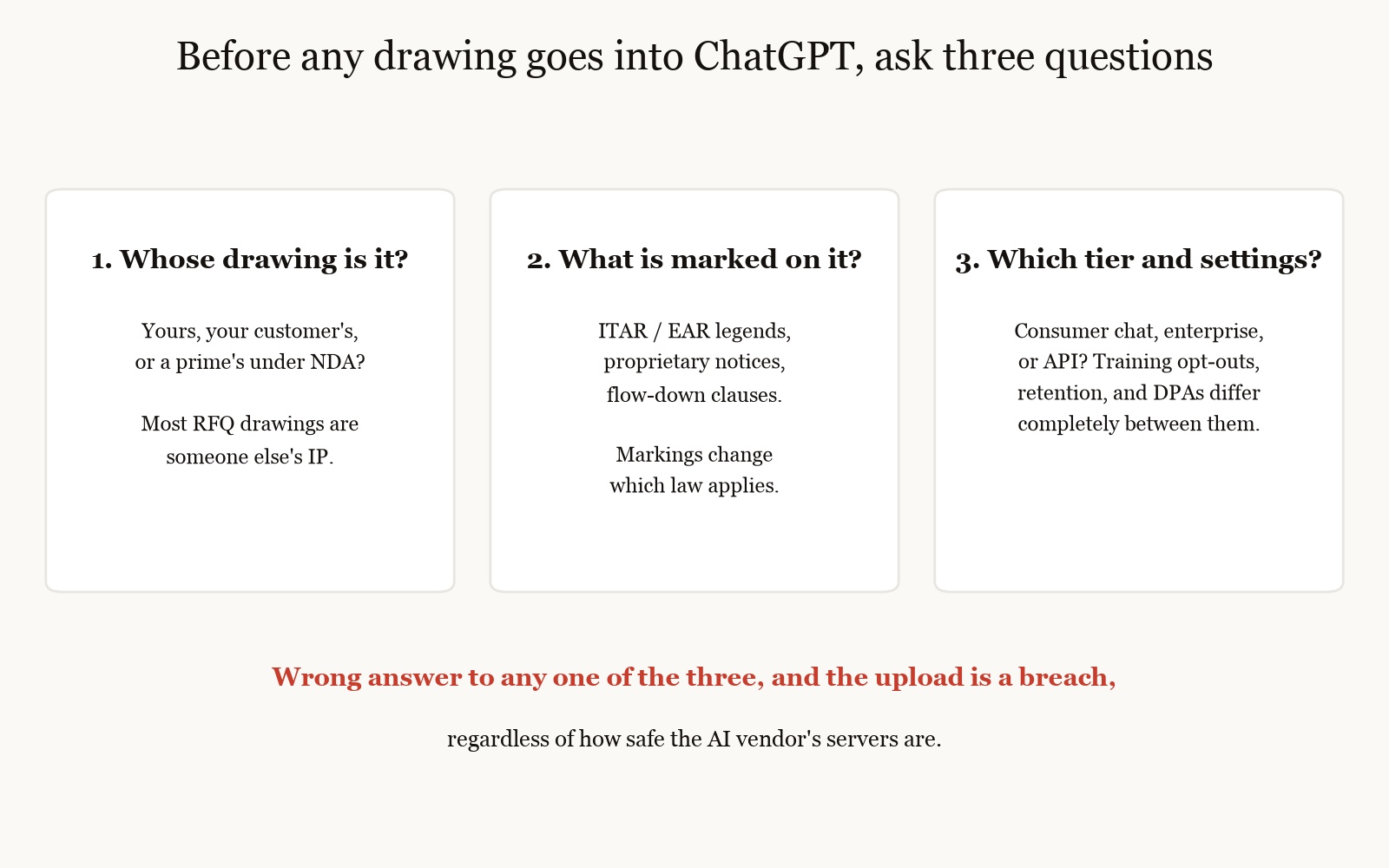
So let us answer it properly. Is it safe to upload engineering drawings to ChatGPT? The honest response is that "safe" is three separate questions wearing one word, and most articles on this topic answer only the easiest one. This guide walks all three, in the order a manufacturer should ask them, and ends with a shop policy you can copy this afternoon. One note before we start: we build AI software that reads bid packages for manufacturers, so we think about this daily, and we will tell you where our interest lies when it matters. And nothing here is legal advice; for export control and contract questions, your counsel gets the final word.
The short answer, for the person who needs it now: if the drawing is yours, carries no restrictive markings, and you are on a business tier with model training excluded, uploading it is a reasonable, defensible choice that thousands of engineering teams make daily. If the drawing belongs to a customer, carries an export-control legend, or is going into a personal free-tier account, stop: the risk is not that the AI vendor gets hacked, it is that the upload itself already broke an agreement or a law, no matter what happens to the data afterward.
What follows: the three questions in depth, five real scenarios judged, what actually happens to an upload mechanically, a five-rule shop policy to copy, the estimator tricks that avoid uploads entirely, the owner's liability view, and the honest capability question that survives even a perfectly safe setup. It is long because the question deserves a complete answer once, instead of a dozen partial ones.
Is it safe to upload engineering drawings to ChatGPT? Three questions decide
The security conversation about AI tools usually starts with the vendor: is the connection encrypted, where are the servers, will my data train the model. Those questions matter and we will get to them, but for a manufacturer they are the third question, not the first. The first two are about the drawing itself, and they are the ones that bite.
Question one: whose drawing is it?
Here is the fact that reframes everything for a custom manufacturer: most of the drawings in your inbox are not yours. If you quote from customer RFQs, the plan set was drawn by a consulting engineer, owned by their client, and sent to you for the narrow purpose of preparing a bid. It very often arrived under an NDA, or under bid terms that restrict disclosure, and even without a signed NDA, it is somebody else's intellectual property handed to you in confidence.
Uploading that drawing to any third-party service, an AI chat tool, a file converter, anything, is a disclosure to a third party. Whether that disclosure is permitted depends on the agreement, not on the service's security. A typical NDA restricts sharing confidential information with third parties except those under equivalent obligations who need it for the permitted purpose. Whether a consumer AI chat account qualifies is, at minimum, a genuine question, and "our estimator pasted it into his personal ChatGPT" is not a sentence anyone wants to say in a dispute.
This is the risk the AI-safety articles skip, and it is the biggest one, because it exists even if the AI vendor's security is flawless. The breach happens at the moment of upload, not at some hypothetical later leak. Before the tier debate and the settings screenshots, ask the ownership question. Your own shop drawings of your own product are one story; a prime contractor's stamped plan set is a completely different one.
Question two: what is marked on it?
Now look at the title block and the border. Markings change which rules apply, and one family of markings changes everything: export control.
If a drawing carries an ITAR legend, or is technical data for a defense article, uploading it to a general-purpose cloud AI service is not a judgment call, it is a potential export violation. Export-controlled technical data has to stay within controlled environments; putting it on servers where access by non-U.S. persons cannot be ruled out can itself constitute an unauthorized export, the so-called deemed export problem. The same logic applies, with different thresholds, to EAR-controlled data. Penalties in this area are the kind with commas in them, and "the AI tier had a no-training clause" is not a defense, because training was never the issue; disclosure was. If your shop touches defense work, your AI policy needs a hard line here, and it needs to be communicated to every estimator, not just the compliance binder.
Below export control sit the quieter markings that still matter: proprietary legends, "do not reproduce" notices, and the flow-down clauses that large OEMs and primes attach to their supplier terms, which frequently restrict where and how their technical data may be processed or stored. If you supply the aerospace primes, the restriction you are looking for may not be on the drawing at all; it is in the quality and procurement terms you signed when you became a supplier. The drawing is marked in the contract, so to speak.
Question three: which tier, and which settings?
Only now does the familiar security conversation begin, and here the honest summary is: the difference between tiers is bigger than most users realize, and the defaults are not where a business should sit.
Policies change, so treat this as the pattern to verify rather than the current fine print. As a general structure, consumer chat tiers may use your conversations and uploads to improve models unless you find and disable the relevant setting, and your data lives under a consumer terms-of-service with limited contractual recourse. Business and enterprise tiers, and the developer APIs, typically exclude customer content from model training by default, offer data processing agreements, define retention windows, and support single sign-on and admin controls. That is not a marketing distinction; it is the difference between "we trust the defaults" and "we have a contract."
| Dimension | Personal consumer account | Business / enterprise / API |
|---|---|---|
| Model training on your content | Possible by default; opt-out setting must be found and disabled | Excluded by default under the standard terms |
| Contractual protection | Consumer terms of service | DPA, defined retention, security commitments |
| Who controls the account | The individual employee | The company, with admin visibility and SSO |
| What happens when the employee leaves | The chat history, and the uploads, leave with them | The workspace stays yours |
Verify the current state of these in the vendor's data controls and enterprise documentation before relying on them; the direction of the pattern has been stable, but the details move. The practical rule is simpler than the fine print: work content goes only into accounts the company controls, on tiers where training is excluded and a DPA exists. If your estimators are using personal accounts for work drawings, the tier conversation is already lost.
What actually happens to an upload
It helps to demystify the mechanics, because the fears people carry are often the wrong ones. When you upload a drawing to a major AI chat tool, the transfer is encrypted, and the file lands in the vendor's cloud storage attached to your conversation. From there, four things matter more than the encryption everybody already assumes:
- Retention. The conversation and the file persist in your history until deleted, and deletion from your view is not always instant destruction on the backend; vendors describe deletion windows in their policies. A drawing you uploaded in March may still exist somewhere in July.
- Training use. Covered above: tier-dependent, setting-dependent, and the single most important line to verify.
- Human review. Vendors reserve the right to have people review conversations flagged for abuse or safety. Rare, but "no human will ever see this" is not a promise any consumer tier makes.
- Downstream copies. Anything the model outputs about your drawing, summaries, extracted tables, the analysis your estimator pastes into an email, lives outside the AI tool entirely and inherits none of its protections. The upload is one exposure; the derivatives are another.
None of these is scandalous; every cloud service has equivalents. The point is that "is it encrypted" is the question people ask, and "who can see it, for how long, and what does it train" are the questions that matter.
Five real scenarios, judged
Abstract rules blur; verdicts stick. Here are the five uploads that actually happen in estimating rooms, judged by the three questions:
| Scenario | Verdict | Why |
|---|---|---|
| Your own shop drawing of your own fixture, no markings, company business-tier account | Defensible | You own it, nothing restricts it, training is excluded by contract |
| A public agency's bid package downloaded from their procurement portal | Defensible | Public record: confidentiality is not the issue; reading reliability is |
| A customer's RFQ drawing set received under NDA, personal ChatGPT account | No | Third-party disclosure of confidential IP; the upload itself is the potential breach |
| A prime contractor's plan set with proprietary legends and supplier flow-downs | No, without written approval | Contract terms restrict where their technical data may be processed |
| Anything carrying an ITAR or EAR legend, any tier | Never | Potential unauthorized export; controlled environments only |
The public-package row surprises people, and it is worth dwelling on, because it cuts the other way. Public bid documents, the municipal spec books and DOT plan sets that public agencies publish for anyone to download, carry no confidentiality problem at all. Uploading those to any AI tool is legally boring. There, the entire question collapses into capability: not whether you may, but whether the tool reads 179 pages correctly, which is a different article and a different kind of software. If your shop bids public work, your AI question was never really a safety question; it was a reliability question wearing a safety costume.
A shop policy you can copy
Most shops do not need a ten-page AI policy. They need five rules, one owner, and a sentence in the onboarding doc. Here is a starting point, written to be edited:
- Customer and third-party drawings do not go into general AI tools without a named person's approval. Default answer is no; the approver checks the NDA and the customer's terms before any exception.
- Anything with an export-control legend never goes into a general AI tool. No exceptions, no approvals. If your shop handles defense work, this rule gets its own line in training.
- Work content only in company-controlled accounts, on a business or API tier with model training excluded and a DPA in place. Personal accounts are for personal questions.
- Strip what the question does not need. If you want to ask about a weld symbol or a tolerance callout, a cropped detail with the title block excluded asks the same question with a fraction of the exposure.
- Write down what was uploaded where, when an exception is made. Not bureaucracy; just an email to the approver. The list becomes priceless the one time a customer asks.
One more observation from the field: the mature shops we meet have already crossed this bridge. More than one manufacturer we have worked with maintains written rules for their internal AI experiments that would put many software companies to shame, including treating inbound customer emails and attachments as untrusted input that their AI tools must never act on blindly. The industry is not behind on this; the median shop just has not written its rules down yet.
The trick most estimators miss: you often do not need the upload at all
Here is the workflow point that dissolves half the problem. When an estimator asks whether it is safe to upload engineering drawings to ChatGPT, the underlying need is usually much smaller than the drawing: what does this weld symbol mean, how do I read this fit callout, what does this spec clause require. Those are text questions wearing a PDF costume.
Type the callout instead. "What does a 3/8 fillet weld symbol with a G in the tail mean" gets a better answer than a photographed title block, uploads nothing, and breaches nothing, because a standard symbol carries none of your customer's confidential information. The same goes for tolerance classes, material specs, and code clauses: the vocabulary of engineering is public knowledge, and asking about vocabulary requires no documents at all.
When the question genuinely needs the picture, crop it. A detail view with the title block, project name, and border zone excluded asks the technical question while carrying a fraction of the confidential payload. It is not a legal cure, an identifiable proprietary design is proprietary with or without its title block, but for generic details it converts a document disclosure into something closer to a textbook question. The escalation ladder is: text first, crop second, full document only through the sanctioned channel with the three questions answered.
Why banning it outright backfires
One tempting response to everything above is a blanket ban: no AI tools, ever, for anyone. We have watched shops try it, and the result is predictable, because the pressure that sent your estimator to ChatGPT at 4 PM on a bid deadline does not vanish with a memo. It goes underground: personal phones, home laptops, personal accounts, exactly the venues with the worst protections and zero visibility. Security people call this shadow IT, and AI has given it a second life.
The shops that handle this well do the opposite of banning: they provide a sanctioned channel and make it the path of least resistance. A company-controlled business tier, the five rules above, and a clear owner for exceptions costs a few hundred dollars a month and converts an invisible risk into a managed one. The policy question is not "should our people use AI", because they already do; it is "will the company be in the room when they do".
Six questions for any AI vendor before work data flows
Whether it is a chat tool's enterprise tier or a purpose-built system like ours, the same six questions separate a real data posture from a slide about one. Ask them in writing:
- Is customer content excluded from model training, in the contract rather than a settings page?
- Is there a data processing agreement, and does it cover the AI subprocessors behind the product?
- What is the retention window, and what does deletion actually delete?
- Where does the data live, and can you commit to a region?
- What is the breach notification commitment, in hours?
- Who owns the outputs and any database built from our documents when we leave?
A vendor who answers all six the same day, in writing, is telling you something. So is one who cannot. When we built our own answers to these, NDA first, DPAs with the AI providers, defined U.S. or EU hosting, a pilot that stores nothing, and a production database the customer owns, the exercise taught us that question six is the one most vendors have never been asked and least want to answer.
Safe is only half the question
Suppose you do everything right: your own drawing, no markings, enterprise tier, training excluded. Uploading is now defensible. The question nobody asks next is the one that actually determines whether the exercise was worth it: did the model read the drawing correctly?
We build drawing-reading AI for a living, and here is our honest field report on what general chat assistants do with engineering documents. On a small, clean, born-digital PDF, they perform genuinely useful extraction. On real packages, the failure modes are structural, not occasional:
- Scanned sheets go dark. A large share of real-world drawing pages carry no text layer, and a full-size sheet squeezed through a chat upload gets downscaled until its annotations are physically unreadable to the model, which then returns confident answers built on whatever survived.
- Dimensions get misattributed. On a crowded sheet, which structure owns the number 45.00 is decided by a leader line the model did not follow. We have measured frontier models reading every dimension on a sheet correctly and still disagreeing about which structure each one belongs to.
- Long documents fall out of context. The requirement on page 141 that contradicts page 12 is exactly the kind of thing a context-limited chat session silently loses, and it is exactly the kind of thing that decides bids, as we showed when we documented what breaks when ChatGPT reads real bid packages.
- Gaps become guesses. A chat assistant's failure mode is a plausible answer; an estimator's failure mode is a question. Those are opposite instincts, and only one of them is safe to price from.
None of this means chat AI is useless for engineers; it means the safety question and the reliability question have the same answer: fine for small, self-contained, low-stakes questions on documents you own; wrong tool for whole packages, third-party documents, or anything you will sign a number against.
Where to verify, and how to prove you did
Every vendor claim in this article should be checked against the vendor's own current pages, because these policies are living documents. The pages worth bookmarking are the data-controls or privacy-settings screen inside the product, the enterprise privacy or trust page the vendor publishes for business customers, and the data processing agreement itself. The phrases to search for are "train", "improve our models", "retention", and "subprocessors".
Then do the one thing almost nobody does: date your verification. A screenshot of the settings screen and the policy page, saved with a date, turns "we believed the tier excluded training" into "on this date, the vendor's published terms said this, and here it is." If a customer audit or a dispute ever asks how your shop handled their data, that folder is the difference between a policy and a story about a policy.
A note for the owner reading this
If you run the shop, one more uncomfortable truth: your exposure does not depend on whether you knew. An estimator uploading a customer's drawings from a personal account is still your company disclosing a customer's confidential information, as far as the customer and their lawyers are concerned. The NDA was signed by the company; the breach belongs to the company; "we had no policy" makes it worse, not better.
Two practical consequences. First, the customer audits are coming: supplier questionnaires increasingly include AI-usage questions alongside the familiar cybersecurity ones, and "we have a written policy, a sanctioned tool, and an exception log" is the answer that passes. Second, check what your cyber insurance actually says about data you disclosed voluntarily through an unsanctioned service, because policies written before the AI era can be ambiguous exactly there. Neither point is a reason for panic; both are reasons the five-rule policy above is an afternoon well spent.
The leak nobody audits: your own quote
One direction of this risk gets all the attention, customer documents flowing in, while the other direction flows out unwatched. Estimators paste their own draft quotes into AI tools to tighten the wording, summarize the exclusions, or translate for an overseas client. Think about what that document contains: your rates, your margins by line, your assumptions, the shape of your pricing logic. For a custom manufacturer, that logic is the crown asset, the thing that took twenty years of won and lost bids to calibrate, and it just went into a third-party tool under whatever terms that account carries.
The same three questions apply, with the twist that now the drawing is yours and the confidentiality being spent is your own. A business tier with training excluded makes this defensible; a personal account makes your pricing structure part of somebody's data exhaust. We are opinionated here because our own product is built around the principle that a shop's pricing logic should never leave the shop's control: our engine applies the customer's logic without absorbing it into any model, precisely because we think the industry's most underpriced asset is the estimator's twenty years. Guard the outbound direction with the same policy as the inbound one.
The same three questions, beyond ChatGPT
Everything above transfers. Asking whether it is safe to upload engineering drawings to ChatGPT is really asking about a category, and the framework does not change when the logo does. Claude, Gemini, Copilot: same three questions, same tier logic, same export-control hard line, with vendor-specific details to verify in each one's current data controls. If your team uses several, your policy should name the sanctioned one, because five tools with five setting screens is how one of them ends up misconfigured.
And do not stop at the famous names. The uploads nobody audits are the mundane ones: free online PDF converters, OCR websites, file-compression tools, "merge two PDFs" pages. Estimating teams feed customer drawings to these constantly, and most carry weaker terms than any major AI vendor, some explicitly claiming rights to process uploaded content. A drawing that must not go into ChatGPT must not go into a free PDF-splitter site either; the NDA does not distinguish. The honest audit of "where do our customers' drawings go" usually finds a dozen services nobody ever vetted, and the AI policy conversation is the right moment to sweep them all.
What purpose-built handling looks like
Since we are a vendor in this space, here is the disclosure-and-example paragraph, and you should read it knowing we sell the thing being described. When manufacturers need whole bid packages read, the serious version of "safe" looks like this, and it is what we built: an NDA before any document moves, data processing agreements with the underlying AI providers, customer data on defined U.S. or EU servers, sign-in through the customer's own identity system, a pilot that stores nothing after it runs, and a production database the customer owns, so leaving takes their data with them. On the reading side, every extracted value is cited to its source page, scans are labeled as scans, and ambiguity becomes a flagged question rather than a guess. That combination, contractual custody plus verifiable reading, is the standard we think any shop should hold any vendor to, us included; our buyer guide to AI quoting software has the full evaluation checklist.
So, one last time, is it safe to upload engineering drawings to ChatGPT? With the ownership checked, the markings read, and the tier chosen deliberately: yes, for the right documents, and knowing exactly which documents those are is the whole skill. Without those checks, the question was never really about ChatGPT at all.
The point is not that chat tools are bad and purpose-built tools are good. The point is that "is it safe" has a knowable answer, and it is answered by ownership, markings, tier, and workload, in that order. Ask the three questions, write the five rules, and the quiet Friday-afternoon upload stops being a gamble and becomes a policy.