Battery Energy Storage System Specification: What an RFP Asks You to Price
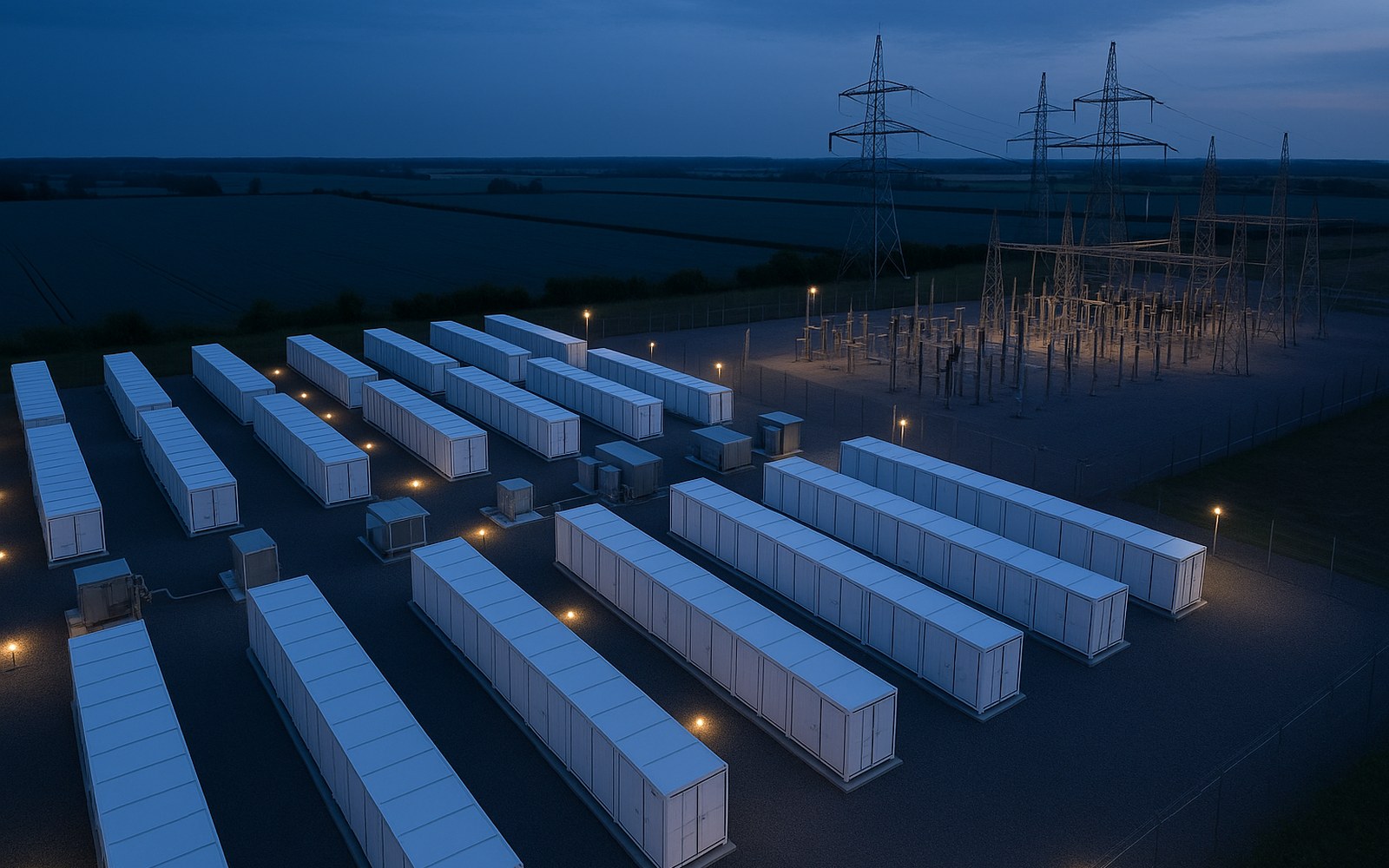
If you have quoted a battery storage job for a utility, you know the number on the cover page rarely decides your price. The real question is where the megawatt-hours are counted, and who pays for the energy lost on the way.
For this guide we read five public documents line by line. Each one is a battery energy storage system specification that a supplier was asked to price, sign or fill in.
They come from a city utility in Los Angeles, a utility in Indiana, a government buyer in India, a ministry in Cyprus and a sewer district in California. The plants run from 207 kW to 600 MW.
We skipped the ratings, because you already know how to price those. We looked for the sentences that move the price without looking like they do.
- One document measures every guarantee at the high-voltage grid connection, while another measures efficiency at the inverter terminals.
- Required round-trip efficiency runs from 80 percent to "greater than 92% STC", and STC is a solar panel test condition.
- Warranties run from three years to twenty years.
- Four of the five documents still carry wording written for solar plants.
We wrote about bid packages in general in reading bid packages. This piece is for the proposal or applications engineer at a battery integrator, or at a maker of inverters and battery enclosures.
The five documents we read
All five are public, and the links are in the Sources section at the end.
| Document | Owner | Date | The supplier's job |
|---|---|---|---|
| Attachment A, Standalone Energy Storage System Specifications for LADWP Transmission Reliability Projects | Los Angeles Department of Water and Power, through the Southern California Public Power Authority | Posted April 2026 | Provide and maintain a standalone battery under an energy service agreement |
| Exhibit F, BESS Scope of Work and Technical Requirements, Rev 0 | AES Indiana | February 6, 2023 | Build 200 MW / 800 MWh turnkey |
| Request for Proposals, 600 MW / 1200 MWh BESS (DC Package), with Annexure B, amendments, clarifications and service agreement | Solar Energy Corporation of India (SECI) | August 4, 2025, amended September 2025 | Supply the battery side up to the inverter output, then service it |
| Annex II, Appendix 2, Technical Specification | Cyprus Ministry of Energy, Commerce and Industry | May 17, 2024 | Meet a technical annex to a draft grant scheme |
| Request for Proposals, Battery Energy Storage Systems, Job No. 24600-14 | Las Gallinas Valley Sanitary District, California | April 5, 2024 | Install two batteries behind the meter at a wastewater plant |
Two caveats and a note on pages
- AES Indiana is an investor-owned utility, not a public power utility. Its document is public on the utility's website.
- The Cyprus document is a consultation draft for a grant scheme, not a project tender. Its first page calls the specifications "indicative".
Every page number here is the PDF page number. For the Los Angeles, Indiana, Cyprus and Las Gallinas documents, the printed number is the same. SECI's Annexure B and service agreement have no printed numbers.
Six numbers, side by side
Here is the whole comparison on one screen, with the page for each cell.
| Topic | Los Angeles (Att. A) | AES Indiana | SECI, India | Cyprus (draft) | Las Gallinas |
|---|---|---|---|---|---|
| Where guarantees are measured | Point of interconnection, above 100 kV (p13, p3) | High-voltage point of interconnection (p4) | Efficiency at the inverter AC terminals (Amendment-01 p19); energy owed at 220 kV, checked at the inverters (Annexure B p4) | Point of connection (p2) | Not stated |
| Round-trip efficiency | Bidder declares a value, tested yearly (p13) | At least 85%, auxiliary losses included (p4) | 86%, auxiliary use included (Amendment-01 p16) | At least 80% at start, 75% at year 10 (p3, p4) | "greater than 92% STC" (p11) |
| Availability | 98% each month (p11) | 99% a year (p4) | 98% a year (SLA p16) | 92%, two-year average (p4) | Not set |
| Fade and augmentation | No energy loss until the last 5 years, then up to 3% a year (p11) | Full power and duration for 20 years (p7) | Falls from 1200 to 840 MWh; 70% floor (Annexure B p4, p5, p14) | No loss for 10 years; room for 20% more (p4) | Materials "warranted against degradation" for their life (p10) |
| Warranty | Bidder states it (p4) | 3 years (p47) | 5 years, battery covered to end of life (Annexure B p29) | Not set in this annex | 20 years on batteries and inverters (p10) |
| UL 9540A fire test | Listed (p5) | Not listed; UL 9540 is (p15) | Required, cell to system (Annexure B p13) | Large-scale test required (p7) | Not mentioned |
No two columns match on more than one row. A supplier who prices "the standard battery" against all five is pricing five different products.
What a battery energy storage system specification asks you to price
Strip away the forms, and each document asks for the same eight promises. Each one costs money outside the price of the cells.
- You promise an amount of energy, measured at a stated point.
- You promise an efficiency, also measured at a stated point.
- You accept a rule for how much the energy may fade over the years.
- You promise an availability figure, which is the share of time the plant must be ready to work.
- You accept a number of charge and discharge cycles a year.
- You provide a fire design, with the test reports that prove it.
- You agree to a boundary that says which equipment around the battery is yours.
- You give a warranty and a service period.
The measuring point decides how much battery you build
This is the main finding. The five documents measure their guarantees in five different places, and the gap between them is energy you have to buy.
What a measuring point is
Energy leaves the cells as direct current and passes through the power conversion system, or PCS. The PCS is the bank of inverters that turns battery current into grid current and back.
After the PCS come cables, a medium-voltage transformer, a main transformer and a line to the utility. The point of interconnection, or POI, is where the plant meets the utility's system, usually on the high-voltage side.
Every step loses a little energy, and the cooling and controls draw power too. So 1,200 MWh promised at the POI needs more battery than 1,200 MWh promised at the PCS terminals.
SECI prints the gap in its own table
The Indian document defines two points on page 2 of Annexure B.
"Point A: Point A is the point of interconnection of the Project at 220 kV substation end."
SECI, Annexure B, PDF page 2Point B is the "AC terminals of PCS". Page 3 asks for at least 1400 MWh of battery on the DC side, and 1200 MWh delivered at the point of interconnection.
Page 4 lists fixed losses for the equipment in between, such as "BESS Transformer Efficiency 98.50%". Its yearly table shows that 1200 MWh at Point A in year 1 means 1248.0 MWh at Point B.
Multiply the five loss figures together and you get about 96 percent, by our arithmetic. That is why Point B sits about 4 percent above Point A.
The trap inside SECI's split
SECI's battery supplier stops at the PCS output terminals. A separate "AC package" contractor supplies the transformers and the 220 kV bay (Annexure B, pages 6 and 7).
Yet page 4 tells the battery supplier to size "considering loss parameters for systems not in the scope of the Contractor". You size your battery for losses in equipment that someone else will choose.
Los Angeles and Indiana measure at high voltage
Los Angeles requires connection "at transmission level only (greater than 100kV)" (page 3). Then page 13 settles where the tests happen.
"All parameters shall be measured at the POI."
LADWP Attachment A, page 13The plant must also supply reactive power "between ±0.8 power factor at the Point of Interconnection (POI)" (page 8). Reactive power supports grid voltage.
At a 0.8 power factor, the inverters and transformer need a rating about 25 percent above the megawatt figure, by our arithmetic.
AES Indiana writes the oversizing into its first table. It asks for 200 MW at the point of interconnection and a minimum of 235 MVA at the substation (page 4).
Cyprus is strict, and one document names no point
Cyprus says all performance requirements "will be referred to PoC", its point of connection (page 2). On page 3, energy is counted from 100 percent charge down to 0 percent.
Suppliers often quote usable energy inside a narrower charge window. Cyprus does not allow that discount.
Las Gallinas asks for "4 kWh per kW, minimum" (page 7), but never says where the kilowatt-hours are counted.
A second point inside one document
Los Angeles tests its guarantees at the POI. Its control tables, though, use a different point: "Monitor grid frequency on the ESS side of the Point of Delivery" (page 21).
Pages 22, 24 and 25 also use the "Point of Delivery". The document never says whether the two are the same place.
For every guarantee, write down where it is measured, which meter measures it, and whether the cooling and control loads are inside the number. Ask about any gap before the bid, or state your assumption in the proposal.
Round-trip efficiency: 80 to 92 percent, depending on who writes it
Round-trip efficiency, or RTE, is the energy that comes out divided by the energy that went in. At 85 percent, every 100 MWh you charge gives back 85 MWh.
The figure only means something with its measuring point and the auxiliary load. That is the power used by the cooling, the battery management system and the controls.
What each document asks for
- Cyprus asks for at least 80 percent at the point of connection, counting "all necessary HVAC systems" and "all transformer and converter losses" (page 3).
- AES Indiana asks for at least 85 percent at the high-voltage POI, "including auxiliary power losses" (page 4).
- SECI asks for 86 percent at the PCS terminals, including auxiliary consumption (Amendment-01, page 16).
- Las Gallinas asks for "Roundtrip system efficiency greater than 92% STC" (page 11).
- Los Angeles sets no figure. The bidder declares one, and it is tested at the POI every year (page 13).
The highest number is the least defined. STC means standard test conditions, a solar panel term. Ask what the buyer will actually measure before you promise 92 percent.
Only Cyprus writes a falling efficiency floor into its text. RTE must "not fall below 75% at the end of the 10-year period" (page 4).
How SECI's test changed during bidding
The original Annexure B asked for "(i) 86% at the PCS AC Terminals (ii) 82% at the 220 kV Interconnection Point" (page 50). One bidder pushed back on the second figure.
"appears remotely attainable at SOL and not attainable over the project life"
SECI, Clarifications, PDF page 1, row 21SOL means start of life. Amendment-01 then dropped the 220 kV test, leaving 86 percent at the PCS terminals (page 19).
It also replaced a line on page 14 of Annexure B that said "System ac-dc-ac efficiency*: >85%". Until then, one specification asked for two different efficiency figures.
What a shortfall costs in India
SECI prices a missed efficiency test as lost energy over years. The formula uses "Rs 4.5 per kWh" and a discount rate of "8.5%" (Annexure B, pages 53 and 54).
Amendment-02 sets the period: "N is 15 years" (page 2). During service, a yearly shortfall draws further damages at the same rate (SLA, page 15).
Quote efficiency as a full sentence: where it is measured, at what power, between which charge levels, and whether the auxiliary load is inside it. If the buyer's definition differs from your test data, list an exception.
Fade and augmentation: who pays to keep the energy
Lithium-ion batteries lose capacity as they age and cycle. Augmentation means adding battery later, or installing extra at the start, so the plant keeps its promised energy.
The fade rule decides how much extra battery you carry. It is often the largest cost that never appears on the equipment list.
Los Angeles: no fade for ten years
The Los Angeles term for lithium-ion is "a minimum fifteen (15) years" (page 3).
"Lithium-ion BESS shall maintain its Guaranteed Energy value until the last five (5) years of the Agreement."
LADWP Attachment A, page 11After that, energy "may degrade by up to three (3) percent" a year. So for ten years you either oversize on day one or add battery along the way.
Page 4 says the seller installs, repairs, augments and maintains the plant, "however, the Buyer shall have full operational control over the ESS." You carry the wear, and the buyer decides how hard the battery works.
The same page contradicts itself
Item c on page 11 says "100% SOC shall be equal to the Guaranteed ESS Energy during the entire term of the Agreement." SOC means state of charge.
If a full battery must hold the guaranteed energy for the whole term, the fade allowed in item b can never be used. Ask which item governs.
AES Indiana: full nameplate for twenty years
"The Project shall maintain BESS nameplate output power and duration over the entire 20-year period."
AES Indiana Exhibit F, page 7Page 15 asks for "estimated O&M costs to maintain this capacity", meaning operation and maintenance. Page 12 says only that "an augmentation plan may be required", which page 7 makes close to certain.
SECI: a falling schedule with a floor
India lets the energy owed at 220 kV fall 30 MWh a year, from 1200 MWh to 840 MWh by year 13 (Annexure B, pages 4 and 5). The floor is "not less than 70% of this capacity" (page 14).
The rule is gentler, but the penalties are firm:
- The supplier must make "periodic replacements/replenishments of unit batteries" up to end of battery life (Annexure B, page 16).
- The downtime for those replacements counts against availability (page 16).
- A capacity shortfall costs "Rs. 8,000 per kWh for the shortfall in capacity", or augmentation within 90 days at the buyer's option (SLA, page 17).
That charge is liquidated damages: a fixed amount written into the contract, paid when a promise is missed.
Cyprus: no fade for ten years, and room to grow
Cyprus wants the guaranteed energy "retained during the first 10 years of operation" (page 4). It also wants free space "for at least 20% additional capacity", which is land you design now for batteries that come later.
Its own checklist then allows degradation of "<20 %" over the battery's life (page 9). The text and the checklist describe two different deals.
Build the fade curve from the buyer's duty, not the cell maker's standard curve. Show the energy you guarantee at the buyer's measuring point for every year. Los Angeles asks for exactly this as "Exhibit 4" (page 11).
Availability: the same word, four formulas
Availability is the share of time the plant is ready to work when asked. The targets look close, but the formulas differ.
- AES Indiana asks for "99% annual availability" (page 4).
- Los Angeles asks for 98 percent for lithium-ion, tested every month (page 11).
- SECI asks for "an annual Availability of not less than 98%" (SLA, page 16).
- Cyprus asks for 92 percent under the IEEE 762 standard, averaged over two years (page 4).
- Las Gallinas sets no figure.
Why 92 percent can be harder than 98
Under the Cyprus method, derating "due to environmental conditions" counts against availability, and so does any outage "due to planned maintenance" (page 4). A hot afternoon at reduced power counts against you.
Los Angeles, by contrast, counts only planned maintenance hours beyond an agreed allowance (Attachment A, page 26). Compare the methods before you compare the percentages.
One buyer, two formulas
Los Angeles Attachment A weights power and storage availability at 0.5 each (page 26). Its companion Attachment B, from July 2026, counts outage hours instead (page 22).
Attachment B also adds "SCADA Failure Hours", when the buyer cannot read or control the plant because control equipment has failed.
A communications fault is an outage
"If SCADA control for ESS is not available or ESS is not visible via SCADA to the Buyer's Energy Control Center, then the ESS shall be considered unavailable, unless otherwise specified by the Buyer."
LADWP Attachment A, page 12SCADA is the utility's remote monitoring and control system. A failed network link can cost you availability while every cell is healthy.
Page 26 then asks for the plant to be "visible on Respondent's SCADA system", which is the seller's system. Ask which one counts.
What a miss costs
- Los Angeles cuts the monthly capacity payment, and below 90 percent after the cure period the battery is "in default" (Attachment A, page 12).
- Attachment B charges an "Energy Storage Damage Amount" in dollars per MWh (page 23).
- SECI values the shortfall at Rs 4.5 per kWh of scheduled energy (SLA, page 17).
Bidders asked SECI to lower availability to 95 percent (Clarifications, rows 13 and 18). SECI kept 98 percent and capped use instead: "Total no. of annual cycles shall be 550."
Model availability with the buyer's formula. List what counts against you, such as maintenance, weather, communication faults and replacement downtime, and price the spares and redundant links that it demands.
Cycles: how hard the battery will work
A cycle is one full charge and discharge. The yearly count sets how fast the cells wear.
- Los Angeles asks for "a minimum of 365 equivalent cycles per calendar year", and may "request additional cycles, for a fee" (page 8).
- SECI allows up to two cycles a day, "with a maximum no. of 550 cycles per year" (Amendment-01, page 16). It asks for 8000 rated cycles at 80 percent depth of discharge, which is how far the battery is emptied each time (Annexure B, page 14).
- Cyprus asks for "at least one (1) cycle/day" over "7300 complete charge/discharge cycles" (page 9).
- Las Gallinas asks the battery to "Discharge daily" to cut peak demand charges (page 12).
- AES Indiana's duty cycle sits in an attachment that is not in the published PDF.
A minimum and a maximum are very different promises. Los Angeles sets a floor, so your wear is open-ended. SECI sets a ceiling, which caps it.
Cyprus has an arithmetic problem. At one cycle a day, 7,300 cycles is 20 years, but the next line asks for a lifetime of "Minimum 10-years".
Where the document sets only a minimum, price a stated number of cycles a year and add a rate for extra ones.
Fire safety: UL 9540A is not in every document
UL 9540 is the safety listing for a complete storage system. UL 9540A is a test that shows whether a fire in one cell spreads to the next cell, module and unit. NFPA 855 is the US installation standard.
A UL 9540A report is either one you hold for your exact product or one you must pay for.
- Los Angeles lists "UL Standards 9540, 9540A" and others, NFPA 855 and the "2025 California Fire Code" (page 5).
- SECI requires UL 9540A "At cell/module/rack /system level" (Annexure B, page 13).
- Cyprus requires a "large-scale fire test" to UL 9540A (page 7).
- AES Indiana lists UL 9540 but not UL 9540A (page 15). It names the system instead: "automatic solid aerosol suppression" (page 19).
- Las Gallinas names none of the three. We searched all 154 pages.
Civil work hiding in a fire clause
Cyprus shows how much site work a fire section can add:
- Containers stand at least 1 m apart, and 3 m apart on the sides with doors (page 5).
- Battery containers stay at least 30 m from occupied buildings (page 5).
- A fire road at least 5 m wide runs around the site (page 5).
- Without reliable mains water, a fireproof tank of "at least 20 m3" is needed (page 7).
Page 7 says suppression "shall be of water sprinkler type", and the next item allows an aerosol system "Alternatively". Price the one you will offer, and name it.
AES Indiana's fire design follows an owner guidance document that is not attached (page 19). Page 20 says the owner's guidelines win any conflict.
List every fire standard and document the specification names, and mark the reports you hold. Ask for any cited document that is missing. Where none is named, ask what the local fire authority expects.
Scope: where your supply stops
The scope boundary decides what you price, and what you stay responsible for when someone else supplies it.
SECI splits the plant in two
SECI's battery supplier provides the racks, the enclosures with cooling and fire protection, the PCS, the control systems and the DC cables. The AC package contractor gets the transformers and foundations (Annexure B, pages 6 and 7).
"Auxiliary AC power required for BESS auxiliary sub-system viz. container HVAC, fire protection, lighting, and control systems etc. is not in the scope of the Supplier."
SECI, Annexure B, PDF page 19Yet the 86 percent efficiency guarantee includes auxiliary use. You do not supply the cooling power, but every kilowatt-hour it uses counts against you.
Each container must be "a minimum of 5 MWh" (page 10). The PCS output must be 690 V (page 19). A bidder asked for "as per OEM", and SECI answered "Tender conditions remains unchanged" (Clarifications, row 9).
AES Indiana makes everything yours
Indiana's owner-supplied equipment list reads "Not applicable. Contractor shall furnish all equipment for the project." (page 7). Other lines add cost:
- If extra construction land is needed, the contractor must buy it and "include the cost ... in its bid" (page 10).
- The PCS must give full rating at "50 °C" (page 37), ten degrees above the site table's 40 °C limit (page 11).
- The PCS must come from Power Electronics, Siemens, SMA or TMEIC (page 38).
- The battery supplier handles "decommissioning, removal, and recycling of all expended battery cells" (page 16).
Los Angeles and Las Gallinas
In Los Angeles, "The cost of interconnection and any associated expenses are the sole responsibility of the Respondent" (page 2). The price splits into a fixed price for availability, fixed and variable maintenance prices, and a buyout price for each year (page 17).
Las Gallinas names products: "Tesla, SYL, Fortress, or equal." (page 11). Its price form even has a line for an "SEL 735, 700G relay" (page 27).
Make a scope table with three columns: yours to supply, someone else's, and yours to coordinate. A specification compliance matrix keeps every line tied to its page.
Warranty and service: three years to twenty
The warranty turns your assumptions into years of labour, spares and cells.
- AES Indiana asks for a warranty "for a period of three years from substantial completion" (page 47).
- SECI asks for "an unconditional, 5 (five) -year parts and labour warranty on all BESS equipment except battery" (Annexure B, page 29). The battery is covered to end of battery life, with replacements on site "within 2 weeks of notification".
- Las Gallinas says "BATTERIES AND INVERTERS shall be warranted for 20 years from the date of installation" (page 10).
- Los Angeles asks that "All ESS warranty terms and limitations shall be explicitly stated in the proposal" (page 4).
When the service period and the promises do not match
Las Gallinas pairs its 20-year warranty with a "5-year maintenance agreement" (page 7). Someone has to maintain the plant in years 6 to 20.
Amendment-01 cut SECI's service period from 15 years to "10 (ten) years" (page 1). But the efficiency damages still run for "N is 15 years" (Amendment-02, page 2).
A promise that outlives the service contract is one you keep without being on site. Price it that way, or ask for it to be removed.
Write the warranty as a table: what is covered, for how long, under what limits, and who maintains the plant in each year.
When a document disagrees with itself
Read each document against itself before you read it against your catalogue. Every one of the five contradicts itself at least once.
Solar text left in battery specifications
- AES Indiana asks for inspection of "trackers, tracker foundations" (page 52). Trackers turn solar panels toward the sun.
- SECI listed an "Electroluminescence camera" (Annexure B, page 39), a solar panel tool, and an availability test using "logged irradiation values" (page 45). Amendment-01 removed or rewrote these.
- Cyprus cites a standard for "Photovoltaic off-grid application" (page 10).
- Las Gallinas sets an alarm "based on existing irradiance and temperature" (page 17).
Leftovers are not harmless. SECI's leftover test had a pass mark of "at least 99%" (page 45), against 98 percent everywhere else.
Other contradictions worth a question
- SECI said "Grid Charging No" beside grid support use cases (Annexure B, page 14). Amendment-01 changed it to "Yes" (page 16).
- SECI's answers told bidders the efficiency terms were "unchanged" (rows 11 and 21), yet Amendment-01 dropped the 220 kV test.
- AES Indiana sites the plant at the "coal-fired Petersburg Generation Station" (page 4), then on "a greenfield site" (page 10).
- AES Indiana gives SCADA programming mostly to the owner (page 6), then makes the contractor provide "a complete functional and integrated SCADA" (page 42).
- Cyprus asks for one to four hours of storage on page 1, and one to three hours on page 3.
- Las Gallinas rates the battery for "0F to 120F" (page 11), and gives the site as "30 to 115 degrees Fahrenheit" (page 17).
The cost comes when two bidders resolve the same contradiction differently and neither writes it down.
What to do before you price
The routine below works on any battery energy storage system specification, whether it runs to 13 pages or 154.
Read the amendments first
In India, the amendments changed the service period, grid charging, the efficiency test and the cycle cap. Read the latest documents first, then the original.
Ask these questions before the bid
- Where is each guarantee measured, and by which meter?
- Is the auxiliary load inside the efficiency figure, and who supplies it?
- Which fade rule governs when two clauses disagree?
- Which availability formula applies, and does maintenance count against it?
- Is the cycle number a minimum or a maximum?
- Which fire test reports will the buyer and fire authority expect?
- Where does your supply stop, and who owns each interface?
- Who maintains the plant if the warranty outlasts the service period?
Turn open questions into written terms
If no answer arrives in time, write your reading as a clarification. For example: "Energy and efficiency guaranteed at the PCS AC terminals, auxiliary load included."
If you cannot meet a requirement, write an exception with what you can meet. Las Gallinas even has a page for "Omissions and Exceptions" (page 28).
We cover building that list in pre-bid risk assessment. Why a fixed price is only as safe as its assumptions is in fixed price contract risk.
Send questions in writing and keep every answer with its date. When an answer disagrees with an amendment, as SECI's did, ask which governs.
Where Mavlon fits
We read these five documents by hand for this guide, because this is the work Mavlon is built to help with.
Mavlon's AI Quoting Engine reads the customer's specification and drawings. It lists every requirement that changes the price, each with its page, and shows where the documents disagree, such as two measuring points or two efficiency figures.
It then drafts a first quote from the manufacturer's own pricing for the estimator to check. It does not decide compliance or the price. The proposal engineer does both.
Because each line carries its page, the proposal engineer can check every flag against the customer's own document. More is in AI specification review for manufacturers.
Sources
- Attachment A, Standalone Energy Storage System Specifications for LADWP Transmission Reliability Projects, Southern California Public Power Authority for the Los Angeles Department of Water and Power, April 2026.
- Attachment B, Energy Storage Specifications, Q3/Q4 2026 RFP, same owner, July 2026.
- Petersburg BESS Project, Exhibit F, BESS Scope of Work and Technical Requirements, Rev 0, AES Indiana, February 6, 2023.
- Solar Energy Corporation of India, RfP No. SECI/C&P/OP/15/0001/25-26, 600 MW / 1200 MWh BESS (DC Package), August 4, 2025: request for proposals, Annexure B, Amendment-01 (September 15, 2025), Amendment-02 (September 23, 2025), clarifications, service level agreement, and the result, which names Pace Digitek Limited at INR 11,59,31,14,407.03.
- Annex II, Appendix 2, Technical Specification: Installation, Performance and Safety Specifications of Battery Energy Storage Systems, Cyprus Ministry of Energy, Commerce and Industry, consultation draft, May 17, 2024.
- Request for Proposals, Battery Energy Storage Systems, Job No. 24600-14, Las Gallinas Valley Sanitary District, April 5, 2024.
Bring a specification you have already quoted
If your team answers battery storage RFPs, bring one specification you have already priced to a demo. We will go through it with you and show each requirement that changes the price, with its page, and every place where the documents disagree.
Or read how Mavlon reviews a customer specification, on one page: AI specification review for manufacturers.
Book a demo