How Long Should a Quote Be Valid For? 180 Days Became 260
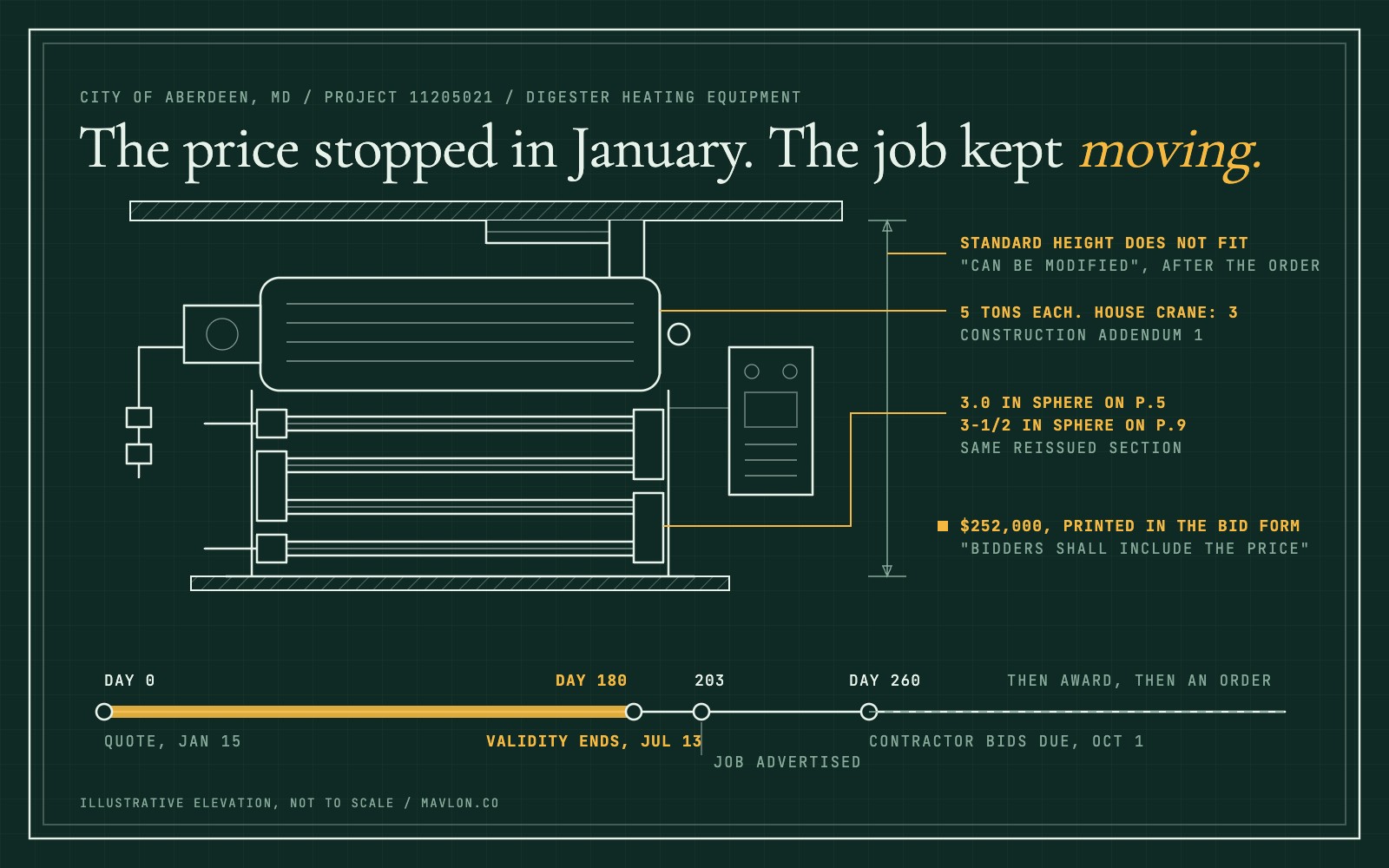
How long should a quote be valid for? Search for it and you will be told thirty days, sometimes sixty or ninety. I found a public case where a manufacturer was asked to hold its price for 180 days, did so, and was still being held to it on day 260 with no order in sight. It is the clearest lesson about a quote validity period I have come across, because every document is public and anyone can check the dates.
I had gone looking for a heat exchanger bid to read, and found something better: the whole public life of one equipment quote. Seven documents over ten months, from the day a city asked three manufacturers for a price to the day that price was printed, to the dollar, in a bid form that contractors had to sign. The process has a name, equipment preselection, and if you build process equipment for water and wastewater plants you have lived through it. I had never seen it laid out end to end in documents anyone can download.
The equipment is a pair of digester heaters for a wastewater plant in Maryland. The price was $252,000. What interested me was not the number. It was everything that happened to the number after the manufacturer had given it: what it was made to carry, how long it was made to last, and how much of the job was still moving when it was already fixed.
This is the fourth piece in a series reading real bid documents, after switchgear, fire trucks and overhead cranes. Those were about reading a specification before you price it. This one is about what happens afterwards.
In brief
- A city asked equipment manufacturers for a price valid for 180 calendar days. The 180 days ended on July 13, 2020.
- The installation contract was not advertised until August 5. Contractors' bids were due on October 1, day 260, and every bidder was told to carry the manufacturer's January price of $252,000.
- A purchase order could only follow evaluation, award and notice to proceed. The real validity period was closer to a year than to six months.
- Meanwhile the manufacturer's stated lead time had been turned into a 300 day contract deadline with liquidated damages, and the unit's dimensions were still changing.
- The lesson for anyone quoting built-to-order equipment: the validity you are asked for is not the validity you will be held to. Price the second one, or write an escalation rule.
The documents
The owner is the City of Aberdeen, Maryland, and the site is its Advanced Wastewater Treatment Plant. The engineering project number on every page is 11205021. There were two separate solicitations, and I read every public document from both:
| Solicitation | Who it was for | What I read |
|---|---|---|
| Bid 20-11, the preselection. Advertised December 10, 2019, proposals due January 15, 2020 | Equipment manufacturers | Addendum No. 1, fourteen pages, which reissues the whole equipment specification, Section 11395, with every change struck through or marked |
| Bid 20-12, the construction contract. Advertised August 5, 2020, bids finally due October 1, 2020 | Installing contractors | Addenda No. 1 to 5, thirty three pages plus one notice, including two reissued bid forms |
I could not obtain the original project manual for either one, so everything here comes from the addenda. That turns out to be less of a handicap than it sounds. Addenda are where the questions got asked and answered, and the tracked changes in a reissued section show you exactly where the argument was.
Some vocabulary. An anaerobic digester is a large closed tank in which sewage sludge is broken down by bacteria. The bacteria want to be kept at about body temperature, so the sludge has to be heated, all year. The usual machine for that is a combination unit: a hot water boiler sitting on top of a heat exchanger made of pipes within pipes. Sludge is pumped through the inner pipe, hot water flows the other way through the outer jacket, and the sludge goes back to the tank a little warmer. This specification wants the digester held at 95 degrees F, within half a degree.
What equipment preselection is, and why owners do it
In ordinary public construction the owner bids the whole job to contractors, and each contractor collects prices from equipment suppliers on bid day. The owner never sees the equipment prices and has limited control over which machine arrives.
Preselection turns that around. The owner runs a small competition among manufacturers first, picks one machine and one price, and then tells every contractor bidding the installation to buy exactly that. Section 11395 puts it in one sentence: the digester heating equipment will be purchased from the preselected vendor by the general contractor, installed and powered by the general contractor, and tested and commissioned by the equipment supplier.
Owners like it for good reasons. The engineer can finish the design around real dimensions instead of three possible machines. Long lead times are known early. And the plant staff get the unit they wanted.
For the manufacturer it looks like the best possible outcome. You won, months before anyone else has even seen the job. The rest of this article is about what winning costs.
What the manufacturers were asked to price
The preselection specification runs thirteen pages. The heart of it is a short list of numbers on pages 4 and 5:
| Requirement | Value |
|---|---|
| Number of units | 2, one in service and one standby when a single digester is heated |
| Digester operating temperature | 95 F, controlled within plus or minus 0.5 F |
| Boiler output, minimum | 725,000 BTU per hour |
| Boiler water | 160 F in, 180 F minimum out. Below 180 F is not allowed, because of condensate corrosion |
| Heat exchanger capacity | 750,000 BTU per hour |
| Sludge flow through the exchanger | 200 gallons per minute, in 4 inch tubes |
| Jacket water limit | 150 F, to prevent sludge baking onto the tube wall |
| Fuel | Natural gas now, with controls provided for digester gas as a second fuel later |
Around those numbers sit the things that make this a built-to-order product rather than a catalogue one. Each boiler needs an ASME data report, Form H-2, signed by an inspector holding a National Board commission. The unit is shop fired and tested before it ships, with manometer readings, motor currents and flue gas analysis recorded. The maker must have been in the business for at least 15 years with at least 25 successful municipal installations of similar design. And page 4 shuts out one whole approach to the product: a separate boiler and heat exchanger, connected by external structural members and piping, will not be considered an integral unit.
Three manufacturers are named on page 7, each with a model number, followed by or approved equal. We have written before about how little that phrase can mean. Here it sits at the end of a list in a competition designed to choose exactly one.
The addendum shows you the negotiation
The reissued specification is the most instructive thing in the whole file, because the changes are visible. Struck-through text is what the city first asked for. Text marked [Addendum No. 1] is what it asked for after the manufacturers had written in. Here is every substantive change on the design page:
| Item | First issue | After Addendum No. 1 |
|---|---|---|
| Minimum boiler output | 825,000 BTU/hr | 725,000 BTU/hr |
| Minimum fired surface per unit | 114 sq. ft. | Deleted |
| No refractory in areas of flame impingement | Required | Deleted |
| Minimum heated surface per unit | 87 sq. ft. | Deleted |
| Size of sphere the sludge tubes must pass | 3-1/2 inch | 3.0 inch |
| Maximum headloss through the unit | 3.5 ft of water | 8.8 ft of water, sludge side |
| Hot water tube diameter | 6.0 inch | 6.0 inch "when required" |
| Expansion tank | 100 gallons | Minimum of 30 gallons |
| Shop hydrostatic test pressure | Not stated | 60 psig |
| Burner warranty | Not stated | 5 years |
Read the left column on its own. 114 square feet of fired surface. 87 square feet of heated surface. A 3-1/2 inch sphere. Headloss of 3.5 feet. Those are not performance requirements. They are the dimensions of somebody's machine. The first issue of this specification was, in effect, one manufacturer's data sheet. The addendum is what happened when the other two read it: the prescriptive numbers came out, and the headloss limit more than doubled.
That is the system working as intended. The addendum even says how exceptions will be treated: the supplier shall qualify its proposal with relevant exceptions to the specification, and consideration will be given to the exceptions during bid evaluation. Compare that with the fire truck specification in this series, where the specification also began life as one builder's catalogue and the exceptions route was closed sixty times over.
But look at what the addendum did not change. Part 1 of the section, the design requirements, was edited. Part 2, the product description, mostly was not. On page 9, in the same reissued document:
Page 5 says a 3.0 inch sphere, and deletes the 87 square feet. Page 9 says 3-1/2 inches, and keeps the 87 square feet, and adds a tube count. On page 7 the words a concentric tube are struck out of the general description, so that other exchanger designs can qualify, while page 9 still requires 4 inch sludge tubes concentrically placed within 6 inch water jackets.
We saw the same thing in the crane specification: an amendment changes the sentences someone complained about and leaves the paragraphs around them. It matters more here because of what comes next.
A vice president, a notary, and the words "in every way"
Section 1.05 requires a performance affidavit. The manufacturer must certify that it has examined the preselection documents and that the equipment will meet in every way the performance requirements and design specifications. The specification dictates the wording. It must be signed by an officer of the company, vice president or higher, and witnessed by a notary public. Shop drawings will not be reviewed until the engineer has an acceptable affidavit.
So a vice president of a manufacturer whose exchanger passes a 3 inch sphere is asked to swear, before a notary, that the product meets in every way a document that says 3 inches on page 5 and 3-1/2 inches on page 9.
The sensible course is to list the conflict as a clarification in the proposal, which the addendum invites. My point is that someone has to find it first. It is on a different page, in a different part, of a section everyone believes was just fixed. People read an addendum to see what changed. Nobody reads it to see what should have changed and did not.
How long should a quote be valid for? Count the buyer's steps, not the days
The short answer for built-to-order equipment: for as long as it will really take the buyer to issue an order, which you can estimate by listing every step between your quote and that order. A round number of days chosen by the buyer is only where the conversation starts. This case shows why.
The preselection notice set the commercial terms. Lump sum pricing with an itemised list and delivery costs. Payment terms to be stated by the proposer. And this: the quoted price was to be valid for 180 calendar days, and transferable to the general contractor for installation.
Proposals were due at noon on January 15, 2020. Count forward 180 days and you reach July 13, 2020. Now lay the rest of the file against that date:
| Date | Event | Days after the quote |
|---|---|---|
| January 15, 2020 | Manufacturers' proposals due | 0 |
| July 13, 2020 | The 180 days of price validity end | 180 |
| August 5, 2020 | Construction contract first advertised to contractors | 203 |
| September 3, 2020 | Original due date for contractors' bids | 232 |
| September 17, then September 24, 2020 | Due date extended by Addenda 2 and 3 | 246, 253 |
| October 1, 2020 | Due date extended again by Addendum 5 | 260 |
| After that | Evaluation, award, contract, notice to proceed, and only then a purchase order to the manufacturer | Unknown. The bid form holds contractors' prices for a further 60 days |
The construction contract was not even advertised until three weeks after the manufacturer's price had expired. By the time contractors' bids were due the quote was 260 days old. Addendum 2 to the construction bid, written around day 229, tells every bidder to carry it anyway.
I do not know what passed between the city and the manufacturer in the meantime. Presumably the price was extended, and Addendum 2 mentions supplemental information the manufacturer provided during evaluation. But look at the position. A manufacturer in the summer of 2020 is asked to hold a January price, on a steel and burner product, for a purchase order that might arrive in the winter, from a contractor who has not been chosen yet. If it refuses, it unwinds a project it has already won and a design the engineer has already drawn around its machine. The 180 days in the notice look like protection for the manufacturer. In practice they were only an opening position.
If you take one thing from this article: when you quote into a long procurement, the quote validity period you are asked for is not the one you will be held to. Price the second number.
Quote validity wording for built-to-order equipment
A validity statement that only gives a date leaves the manufacturer with two bad choices when the date passes: hold the price or blow up the project. Wording that says what happens next gives everybody a third. This is the shape I would use, as an example and not as legal advice:
Three things make that work. It turns price validity into a rule the owner can copy into a bid form, so contractors all carry the same adjusted number. It gives the quote an end. And it ties the lead time to the order date, which matters for a reason we will come to below.
Your price, in somebody else's bid form
The bid form was reissued with Addendum 2. Article 5.01 C reads:
And in case anyone was tempted to shop around, the first clarification in the same addendum: bidders shall use the equipment price listed in Section 11395 for the heat exchangers.
Three things follow, and the first surprised me.
The price is public, permanently. I am not a bidder. I found this on a city website with a search engine, six years later. So can every competitor, including the two who lost this preselection and will be quoting against the same manufacturer on the next one. They know the model, the quantity, the scope, and the number. In ordinary bidding an equipment price lives in a contractor's estimating file and nobody else sees it. Preselection publishes it.
The proposal is now a contract document. It is attached to Section 11395. Every inclusion, exclusion and assumption in it will be read by a contractor's estimator looking for what is not there, because anything the manufacturer did not include is something the contractor must. A loosely worded proposal that would have been fine between a supplier and a regular customer is now being read by strangers under deadline.
There is still no order. The manufacturer has a number in a bid form and no purchase order, no agreed terms, and no idea who the customer is. When the order comes, it comes from whichever contractor was lowest, on that contractor's terms and conditions, which nobody has seen. The payment terms the manufacturer proposed in January were proposed to a city. They will be negotiated with a contractor who also signed Article 6.02 of the bid form: bidder accepts the provisions of the agreement as to liquidated damages.
Your lead time, as somebody else's deadline
This is the part I would most want a manufacturer's proposal team to see. Addendum 2 explains how the contract time was set:
Then it prints the arithmetic:
| Milestone | Duration | Day |
|---|---|---|
| Notice to proceed | 0 | |
| Shop drawing approval | 8 weeks from notice to proceed | 56 |
| Fabrication and delivery | 20 weeks | 196 |
| First unit installed, including demolition | 6 weeks | 238 |
| First unit operation demonstration | 1 week | 245 |
| Second unit installed, including demolition | 6 weeks | 287 |
| Second unit operation demonstration | 1 week | 294, "round up to 300" |
Six days of float in three hundred. And look at how the first fifty six were built. The manufacturer said four to six weeks to prepare submittals after receiving a purchase order. The schedule allows eight weeks from notice to proceed to submittals approved. Inside those eight weeks the contractor has to issue the order, the manufacturer has to produce the submittal, and the engineer has to review and approve it, after first receiving a notarised affidavit. If the manufacturer uses its six weeks, two are left for everything else.
The fabrication line uses the top of the manufacturer's range, 20 weeks, with nothing added. Notice the word improvements in the addendum. The lead times got shorter during evaluation, as lead times do when a salesperson is asked whether that is the best they can do.
So a figure given in conversation during an evaluation has become, without a day of margin, the critical path of a public works contract with liquidated damages. The contractor who signs it will pass those damages down in the purchase order. Any experienced manufacturer knows that a quoted lead time is an estimate with conditions attached: drawings approved without resubmittal, steel and burners available, a shop that is not full. None of the conditions survived the trip into the table.
The design kept moving after the price stopped
The equipment price was fixed in January. Here is what the construction addenda, written in August and September, reveal was still open.
The units do not fit as drawn. Addendum 2: a discussion with the manufacturer about limited clearances indicated that the standard equipment dimensions on the cut sheets can be modified to reduce the overall shipped height, and the required dimensions will be verified during the shop drawing phase. So the product will not be the standard product. How much lower, at whose engineering cost, is to be settled after the order, against a fixed price. Addendum 4 then adds a $25,000 allowance for cutting out abandoned pipes in the basement to improve the clearance height. The clearance problem was being discovered while the job was out to bid.
They are heavier than the building's crane. Addendum 1: the shipping weight of each new boiler is close to 5 tons, and the city's existing 3 ton overhead crane cannot support the new boilers. That is the contractor's problem to solve, but it will arrive at the manufacturer as a question about lifting points, split shipment and site assembly.
Start-up is now two events. The specification asks for a minimum of 32 hours of start-up service, one person for four days, plus a separate eight hour training session no sooner than two weeks later. The August addenda fix a sequence in which one unit is installed and run for seven consecutive days before the other is even demolished, because at least two existing units or one new one must be in operation at all times. That is two start-ups six weeks apart, and a training visit. Whether January's price assumed one mobilisation or three, I cannot tell from the documents, and I suspect that is the point.
Every bidder has the salesperson's direct line. Addendum 1 directs bidding contractors to contact the manufacturer directly with questions about scope, dimensions and weights, delivery schedule and other items, and prints the regional sales manager's name, telephone number and email. For five weeks, every contractor pricing the job could call. Each answer given on the telephone is a statement about scope made to a future customer, with no order in hand, and no two contractors necessarily heard the same thing.
Hazards were resolved late. A codes review during the bid period confirmed the heater room is unclassified, so explosion proof fixtures are not required. An asbestos allowance of $5,000 appeared in Addendum 2 because the old units had not been tested. The old centre unit, it emerges, has been out of service for many years.
None of this is anybody behaving badly. It is what a real project looks like between 60 percent design and bid day. The structural problem is only that one party's price was frozen at the beginning of that period and everybody else's was frozen at the end.
The warranty clock is set by someone else's project
Section 1.08: the manufacturer shall warranty the equipment for one year from the date of Substantial Completion and acceptance of the work by the owner, and the warranty shall not begin until the system has operated in a stable manner for a minimum of 14 consecutive 24 hour days. On top of that, a 10 year warranty on the boiler pressure vessel against thermal shock, covering 100 percent of labour and material, and 5 years on burner components.
Put that against the 300 day schedule. The units ship around day 196. Substantial completion is day 300 if nothing slips. The one year then runs to about day 665. So the manufacturer's exposure on a standard one year warranty is more than fifteen months from shipment, on the owner's own best case, and it lengthens by a day for every day the contractor runs late, for reasons that have nothing to do with the equipment. The first unit will have been running for seven weeks before the clock even starts.
What to put in the proposal, starting with the quote validity period
If I were helping a manufacturer answer one of these tomorrow, this is what I would want written into the proposal itself, because the proposal is the only document the manufacturer controls and it is about to be stapled into a contract.
- A real validity date, and an escalation rule after it. Assume the order arrives a year after the quote. Say what happens to the price at 180 days, in a sentence the owner can put in the bid form.
- Lead times with their conditions attached. Weeks from approved submittals, a stated allowance for engineer review, one resubmittal cycle named, and material availability at time of order. If a schedule is going to be built from your numbers, give numbers you would sign damages against.
- Every conflict in the specification, listed. Especially after an addendum. Read the unedited parts against the edited ones. The affidavit says in every way.
- What "standard" means. If the price is for catalogue dimensions, say so, and say that modifications for site clearances are priced on request.
- Field service as a count. Number of trips, days per trip, what triggers another. A phased installation multiplies visits.
- A warranty start that you control. The earlier of start-up or a fixed number of months after shipment. Owners often accept this. They rarely offer it.
- Terms that survive a change of customer. The price is transferable to a contractor you have not met. State the payment terms, the retention you will and will not accept, and your position on liquidated damages, addressed to whoever ends up issuing the order.
- The scope boundary, in nouns. Stack or connection point. Gas train to which flange. Controls to which terminal. One of only two questions asked in this preselection was whether the exhaust stack was included. The answer was a connection point only.
- Remember who else is reading. The proposal and the price will be public. Write it for the owner, the contractor's estimator, and your competitors, because all three will have it.
The same problem in other clothes
The other documents in this series were about the cost of reading: a single blank at the end of 230 pages, three hundred boxes to tick, a crane section where a third of the paragraphs described some other crane. This one is about the cost of time. A quote is a statement about a moment, and preselection stretches that moment across most of a year while the design, the schedule, the customer and the market all keep moving.
So how long should a quote be valid for? Long enough to reach the order, with a written rule for what happens if it does not. What the two kinds of document have in common is that the supplier is doing the owner's unfinished work, unpaid and at risk. Here it means carrying price risk through a design period and lending a lead time to a schedule. We made the general case in quoting custom equipment before the design exists. It is rarely as literally true as it is in equipment preselection, where the design does not exist yet because the owner is waiting for your quote to finish it.
What software changes, and what it does not
We build software that reads documents like these, so here is the honest version of what it would have done with this file.
It would have read the reissued Section 11395 and put page 5 beside page 9: sphere size 3.0 against 3-1/2, heated surface deleted against heated surface required, concentric tube struck out against concentric tubes mandated. That is a comparison across a document, which people do badly under deadline and machines do without effort. It would have pulled every date into one line and shown that the validity ran out before the second solicitation began. It would have rebuilt the 300 day table and marked that the manufacturer's six weeks and the schedule's eight weeks describe different things. It would have listed every place the documents put a duty on the manufacturer that sits outside the unit itself: the affidavit, the two start-ups, the warranty trigger, the data reports.
It would not have decided whether to hold the price in July. It would not have known whether this owner, this engineer and this region are worth a thin margin for the reference. It would not have judged how much a competitor learns from a published number. Those are commercial decisions and they belong to people. The software's job is to make sure that when they are made, the person making them has seen page 9.
Talk to us about your packages
If your team writes proposals for process equipment, vessels or heat transfer packages against documents like these, the fastest way to find out whether we are useful is a conversation with the person who built the thing. No forms to fill in, no data to send, no procurement process to start. Just a call.
Book a demo