Lift Station Specifications: What Public Specs Ask a Manufacturer to Price
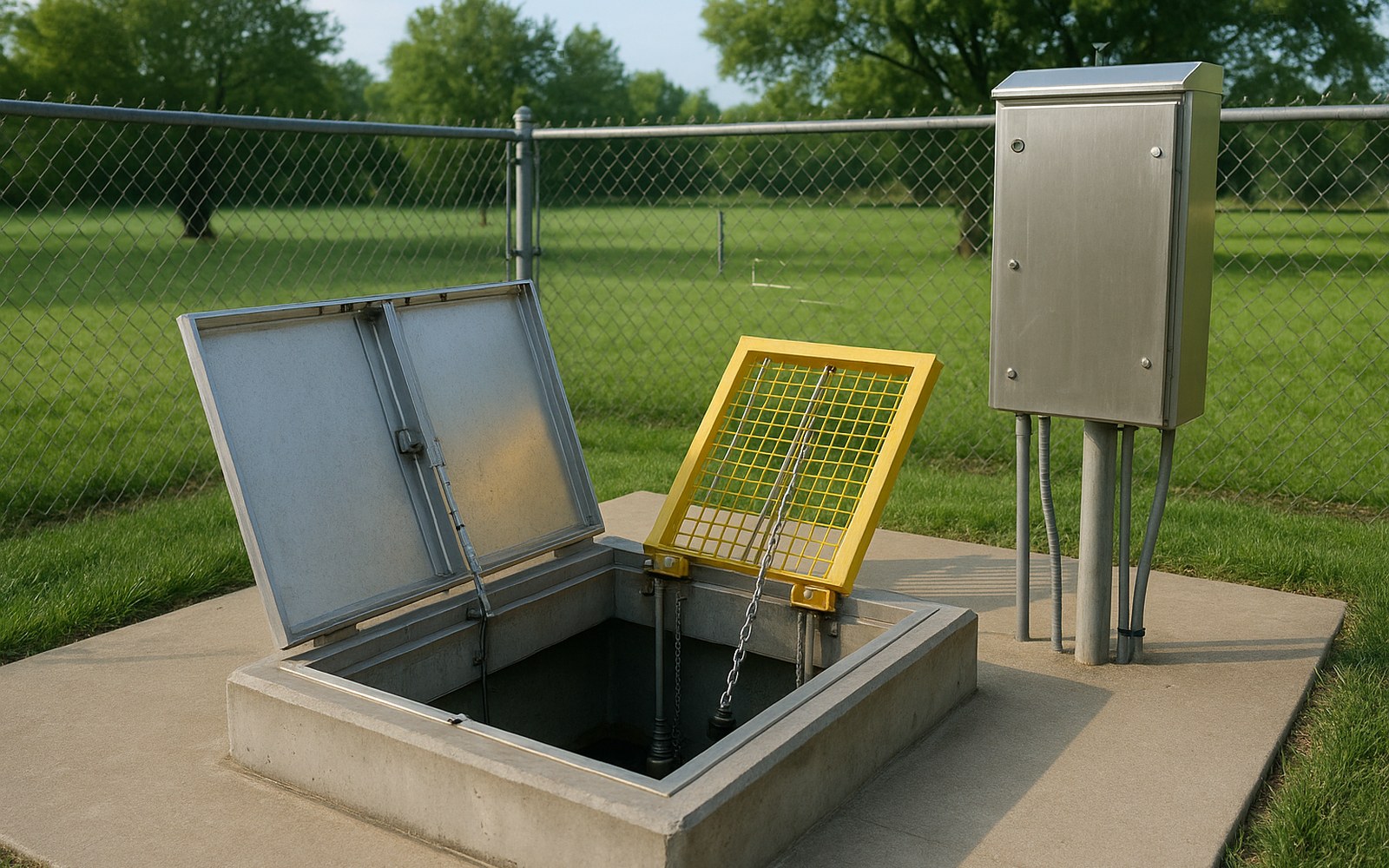
If you have quoted a packaged lift station against a city or county standard, you know that picking the pumps is the quick part. The slow part is everything else in the lift station specifications that the owner has written around those pumps.
Those other sentences decide who may build the control panel, how deep the wet well may go and which fuel the generator burns. They also decide how many days your service technician spends on site.
For this guide we read five public documents from end to end. We wrote down every requirement that changes what a manufacturer supplies or prices, with its page, so you can check each quote yourself.
The five owners disagree on nearly every item that carries real money. They name different pump makers, panel builders, enclosure metals and generator fuels, and their test runs range from 3 hours to 7 days.
Four of the five also contradict themselves somewhere. One bid package asks for a two-pump station and then tells you to test three pumps.
If you are new to water and wastewater spec books in general, start with our guide to quoting water and wastewater equipment from a spec book. This guide stays on the lift station itself.
In brief
- Check first whether your kind of station is allowed at all. Polk and Pasco accept only submersible stations, and Austin's draft rule would do the same.
- Read the pump maker list as a cost list. Polk's list is closed, and Santa Fe makes any maker other than Flygt pay for the redesign.
- Find out who may build the control panel before you price it. Pasco wants it from the pump supplier, while Polk allows only two named local shops.
- Price the field test in days. Houston asks for 7 days in full automatic without a failure.
The five documents we read
| Document | Owner | Date | Pages | What it is |
|---|---|---|---|---|
| Utilities Standards and Specifications Manual, Chapter 5 Wastewater | Polk County Utilities, Florida | File dated 03-04-2025; latest amendment effective December 21, 2024 | 250 | County standard for every station the county will own |
| Technical Manual for Design and Construction of Water, Wastewater, and Reclaimed Water Facilities | Pasco County Utilities, Florida | Revised February 10, 2021 | 216 | County standard with design criteria and specifications |
| Notice of Proposed Rule R161-26.02 | Austin Water, Texas | Posted August 24, 2026 | 25 | A marked-up draft of the city's design manual, adoption not confirmed |
| Lift station guide specifications, Divisions 13 and 16 | City of Houston, Texas | Revised May 2, 2023 | 206 | Electrical and controls only, a copy issued in TxDOT project CSJ 0028-01-067 |
| Project Manual, Abajo Lift Station Re-Direct | Santa Fe County, New Mexico | September 2025 | 421 | A real bid package for one new station |
Every page number in this guide is the page of the PDF file, so you can open the file and jump straight to it.
Austin's real equipment specification is not public. The draft says copies "are available and can be obtained from AW" (page 24).
The Houston copy points to "Specification 11311, Submersible Wastewater Pumps" (page 145), which is not in the file.
What five lift station specifications ask a manufacturer to price
| Item | Polk | Pasco | Austin (draft) | Houston | Santa Fe |
|---|---|---|---|---|---|
| Station type | Submersible only | Submersible pumps only | Submersible non-clog only | Not in this copy | Submersible, two pumps scheduled |
| Pump makers | Closed list of four | Six named, or approved equal | Spec not public | Not in this copy | Flygt, or Engineer reviewed equivalent |
| Panel builder | Curry Controls or Unitron only | Same supplier as the pumps | Not stated | Integrator within 100 miles | UL 508A shop with a certified technician |
| Panel enclosure | NEMA 4X painted 304 stainless | NEMA 4X aluminum | Not stated | NEMA 3 aluminum or 316 stainless | NEMA 4X painted steel or 316L stainless |
| Standby power | Diesel, 48 hours of fuel | Diesel when triggered | Natural gas first | Switch for the City's portable generator | No generator section listed |
| Field test | 24 hours on every pump | Maker's representative at start-up | Not stated | 7 days in full automatic | 3 hours at peak flow |
| Pump warranty | 5 years or 10,000 hours | 2 years, plus 5 on wear parts | Not stated | Not in this copy | 5 years, pro-rated |
A manufacturer who quotes all five owners from one standard package will be wrong somewhere in every column.
Step 1: check whether your kind of station is allowed at all
In a submersible station, the pumps sit under the sewage at the bottom of the wet well, the underground tank where sewage collects.
In an above-ground or self-priming station, the pumps sit above the wet well and pull the sewage up. In a dry pit station, they sit in a dry room beside it.
"All stations shall be submersible type stations."
Polk County Utilities, Chapter 5, page 41Pasco says "Pumps must be submersible-type" (page 101). If you sell above-ground or dry pit stations, neither county will take your standard product.
Polk adds a size floor: "No pumps with less than five horsepower motors will be acceptable" (page 45). A small duplex with 3 horsepower pumps fails before anyone looks at the price.
Austin's draft reverses the current rule
In Austin's marked-up copy, this current sentence is crossed out:
"For installation with a required rated horsepower motor greater than 25 BHP AW prefers wet/dry well type installation."
Austin Water, proposed rule R161-26.02, deleted text, page 8The draft's summary says "Submersible non-clog wastewater pumping facilities will be the only type of lift station allowed" (page 2).
The preferred design for a large Austin station under the current rule is the one design the draft would ban.
Find the sentences that set the station type and the minimum motor size before you price anything. In Austin, ask which version of the criteria manual the project was designed under, and name it in your quote.
Step 2: read the pump maker list as a cost list
Each owner names pump makers differently, and the wording decides what it costs to offer a brand that is not named.
Polk: a closed list and one brand's rails
Polk's Approved Materials Checklist names four pump makers: Hydromatic, Flygt, Wilo-EMU and ShinMaywa (page 219).
The checklist opens with "The use of the following items is mandatory". Anything else must be "approved in advance by the Utilities Code Committee" (page 191).
The pump slides down two guide rails onto a base elbow, a fitting bolted to the wet well floor, so nobody has to climb in to remove it. Polk ties that fitting to one brand:
"Pump rails and base elbows shall be capable of accepting a "Hydromatic" brand pump by sliding a pump down the rails and accomplish a positive seal to the base elbow with no adapters."
Polk County Utilities, Chapter 5, page 45Pasco: six names and "or approved equal"
Pasco names A.B.S., Barnes, Hydromatic, EBARA, Myers and Wilo, "or approved equal" (page 101). Flygt, one of Polk's four, is not on Pasco's list.
We cover how to judge those three words in or approved equal: when to bid and when to walk away.
Santa Fe: one design basis, and the redesign is yours
Santa Fe names Flygt, "Or Engineer reviewed equivalent" (page 413).
The design basis is the product the engineer laid the station out around, and the pump section says who pays to change it:
"All changes or alterations to facilities which are needed to accommodate another pump manufacturer shall be included as work under this specification."
Santa Fe County, Abajo Lift Station Re-Direct Project Manual, page 412The engineer considers substitutions "For a period of 30 days after the Preconstruction Conference" (page 23). So you learn whether your equivalent is accepted only after the contract is awarded.
The schedule calls for a "Flygt Model NP 3202 HT3" at 1,300 gpm and 79.4 feet of head, with a minimum hydraulic efficiency of 75.6% (page 420). An equivalent must match that efficiency too.
If your pump is not named, price the cost of fitting the owner's rails or layout as its own line.
Ask before the bid whether your brand is acceptable, and if the answer comes only after award, say in the quote that your price depends on it.
Step 3: find out who is allowed to build the control panel
Many packaged station makers build their own panels. Read the lift station specifications for this question before you assume you can, because these owners give four different answers.
Pasco wants one supplier for everything
"On projects where PCU is or will be the Owner, pumps, appurtenances, and controls must be supplied by the same supplier."
Pasco County Utilities, Technical Manual, page 46Pasco adds that the pumps, control center and access frame "must be warranted by the same supplier" (page 111). For a package maker this is the easy case.
Polk names two panel shops
Polk says the panel supplier "shall be one the following approved suppliers": Curry Controls Company or Unitron Controls (page 116).
The checklist heading adds that the panel builder "Must Be Within Polk County" (page 212).
In Polk, a pump package maker cannot supply its own panel. Your quote covers the mechanical package, and the panel comes from one of the two named shops.
Houston and Santa Fe set qualifications
Houston wants a system integrator, the company that builds and programs the panel, with "proven experience with the City's existing facilities". It must keep service facilities "within 100 miles of the City of Houston" (page 9).
SCADA is the utility's central system that watches every station by radio or cellular link.
Houston's SCADA software engineer must be approved "prior to the bidding of this work" and have an office in the city (page 32).
Santa Fe names no shop. It wants one authorized by a testing laboratory such as UL to label panels to UL 508A, the industrial control panel standard.
That shop must also employ "a field service representative who is currently certified as a Certified Control Systems Technician, Level 3" (page 374).
Settle the panel question before the price. If the owner names the panel shops, quote the station without a panel, say so in the first line of your scope, and offer to coordinate with the named shop.
Step 4: price the panel the owner will accept
NEMA ratings describe what an enclosure keeps out. A NEMA 3 box is made for outdoor rain and dust, and a NEMA 4X box also resists hose-directed water and corrosion.
| Owner | Enclosure, exact words | Page |
|---|---|---|
| Polk | "NEMA 4X white painted 304 Stainless Steel with a top mounted white painted solar shield" | page 118 |
| Pasco | "NEMA 4X with minimum dimensions of 30" X 36" X 8", aluminum, by Hoffman or approved equivalent" | page 107 |
| Houston | "NEMA 3 type 5052-H32 aluminum", in "14 gauge type 316 stainless steel or 0.125 inch thick type 5052-H32 aluminum" | pages 51 and 52 |
| Santa Fe | "steel with white polyester powder paint or 316L SS" | page 198 |
An aluminum panel that suits Pasco is not acceptable in Polk, and a painted steel panel that suits Santa Fe is acceptable in neither Florida county.
Four controller platforms
The PLC, or programmable logic controller, is the industrial computer inside the panel that runs the pumps. Each owner standardizes on its own:
- Polk lists a Schneider Electric Magelis operator screen and Square D breakers and starters (pages 212 to 217).
- Pasco requires telemetry from Data Flow Systems in "DFS TCU Cabinet Model DFS-00275-008-05", plus a radio survey by the same company (page 104).
- Houston specifies "Siemens Industry, S7-1214C" (page 10).
- Santa Fe gives "Basis of Design: Allen-Bradley CompactLogix 5069 L330ER Series" (page 370).
Extras that are easy to miss
Houston wants "at least 25% of each PLC module furnished as spare parts" and "4,000 GE iFIX Historian license" (page 14).
It also wants a concrete pole "for WiMAX antenna support and CCTV camera" (page 55, Section 13550, footer printed 13350-1).
Polk tests the panel twice before shipment. First it is "completely factory tested using the three phase line voltage source for which the panel is intended" (page 118).
Then it is tested "back to the County's central SCADA system over cellular interface" (page 137).
Compare the owner's enclosure, controller, telemetry, spares and factory tests with your standard panel before you price. A different enclosure metal or controller brand is a different panel, not an option.
Step 5: price the wet well, the hatch and the lifting gear
The wet well is usually a stack of precast concrete rings made in a factory. Its size sets the length of your rails and cables, the hatch size and the reach of any crane.
Size follows flow and horsepower
Polk's Table 512-1 sets 2 pumps below 1,000 gpm of peak flow, 3 from 1,000 to under 2,500 gpm, 4 from 2,500 to under 4,000 gpm and 5 at 4,000 gpm or more (pages 42 and 43).
A triplex needs "a minimum 12-foot inside diameter", and a duplex with "35 horsepower pumps or larger" needs 10 feet (page 47).
Pasco sorts stations by horsepower (page 105).
Type I runs "up to 14 hp" in a six-foot wet well, Type II "10- 47 hp" in an eight to ten foot wet well, and Type III "32 hp and greater".
Depth limits differ by more than double
Pasco says "Total wet well depths must not exceed 21 feet unless otherwise approved by the PCU Director or designee" (page 48). Austin's draft allows more than twice that:
"Submersible lift stations deeper than 45 feet, measured from the finished floor to the top of the wet well lid, will not be allowed."
Austin Water, proposed rule R161-26.02, new text, page 23Three linings for the same concrete
Sewage gas attacks bare concrete, so every owner wants the wet well protected. They disagree on the material and on who applies it:
- Polk wants a studded HDPE plastic liner. "Minimum thickness of liner is 80 mils", and "The liner shall be cast in place by the precast manufacturer" (page 51).
- Pasco wants a cement-like geopolymer lining "such as GeoKrete by Quadex, LLC of Houston, TX, or approved equal", at least one inch thick (page 110).
- Santa Fe schedules coating system C2, an epoxy or polyurethane lining of 100 to 250 mils, checked with a holiday test, which is a spark test for pinholes (pages 143 and 144).
Polk's liner is a factory item cast in at the precast plant, while Pasco's and Santa Fe's are applied after the concrete is made. That changes who quotes it.
Hatches, grates and rails
Polk wants its hatch "along with an integrated fall protection system", and "Doors shall be of aluminum diamond plate" (page 53).
Santa Fe asks for a "Hinged grated safety hatch located below doors" (page 418).
Pasco sets a minimum door of "36" X 54"" in a "TPS300, or equal" (page 109).
Polk wants "two Type 316 seamless tubular stainless steel guides" (page 79). Santa Fe accepts "Type 304 stainless steel Schedule 40 guide bars" (page 417).
Cranes and valve vaults
Austin's draft changes "an equipment-lifting device" to "All stations will be required to have a jib crane" (page 22). A jib crane is a small crane on a post that swings over the hatch.
Santa Fe asks for a motorized one-ton jib crane, load tested "at 125 percent of rated load" (page 410).
Pasco asks for hoists only "Where required in large installations" (page 102).
Pasco also says "No valve vaults are permitted" (page 110), while Santa Fe has a valve vault cover in the pump accessories (page 418).
List the wet well diameter, depth, lining, hatch, grate, rail material, crane and valve arrangement for each job. Then say in the quote which items you supply and which belong to the precaster or the contractor.
Step 6: settle the power question
Every owner wants the station to keep pumping when utility power fails. Each one buys that protection differently.
Polk and Pasco: diesel
Polk requires a permanent generator at larger stations, for example any station with "a 12 inch and larger force main" (page 49).
It must be a diesel "in a weatherproof sound attenuated enclosure", with fuel for "a minimum duration of 48-hour failure of the normal power supply" (page 90).
The approved makers are Caterpillar, Cummins/Onan and Kohler (page 225).
Stations without a generator get a manual transfer switch for a portable one (page 50). Its enclosure is "NEMA 3R powder coated galvanneal steel" (page 85).
Pasco says the generator "must be a diesel engine generator" from "Caterpillar, Onan, or approved equal" (page 104).
Austin's draft: natural gas first
"Natural gas shall be the primary fuel source on the lift station site to support refueling operations during adverse weather conditions. Diesel-fueled generators will only be considered acceptable on a case-by-case basis."
Austin Water, proposed rule R161-26.02, new text, page 23Under the draft, the diesel generator that Polk and Pasco require becomes the exception in Austin.
Houston: a switch for the City's own generator
Houston has no permanent generator. It asks for a manual transfer switch for an "owner supplied portable generator" (page 201), with a "Body and cover: Type 316 stainless steel" (page 203).
Starters and drives
A soft starter brings a motor up to speed gently. A variable frequency drive, or VFD, lets it run at any speed.
Polk wants a soft starter "for all motors 25HP and larger" and a VFD "for motors greater than 50 horsepower" (pages 121 and 122).
Austin's draft lowers its soft start threshold from 75 to "motors 50 hp and larger" (page 23).
Write the power arrangement you priced in one sentence: generator or not, fuel, hours of fuel, and transfer switch type and enclosure.
Step 7: price the tests in days on site
Tests cost time, travel and sometimes equipment. The run you price on site can be 3 hours, 24 hours per pump or 7 days.
"Operate the system continuously for a period of 7 days in full automatic, without failure, to qualify as acceptable."
City of Houston guide specifications, page 71Houston counts as a failure any high or low water level, motor alarm, communication failure, PLC failure or transducer failure (same page). The test uses fresh water, and "The existing station shall remain in service during this test."
Polk wants a 24-hour run on every pump "before final acceptance", running out of the water at full load (page 79).
At start-up, Polk also flow tests the pumps against "the manufacturer's pump curve", with no generator power allowed (page 189).
Santa Fe ramps the pumps to peak flow and says "Demonstrate this process for 3 consecutive hours" (page 110).
The contractor brings "a temporary 10,000 gallon storage tank (minimum)" (page 109).
The Santa Fe clock restarts on failure: "If equipment fails during shakedown, required shakedown scheduled period restarted" (page 106).
Factory tests and who must attend
Santa Fe lists five factory tests on every pump, including "A test of the pump motor (run dry for 5 minutes at full load)" (page 413).
Pasco says "Each pump must be tested in the manufacturer's shop" (page 112).
Polk wants "A factory representative" to supervise the formal start-up (page 188). Pasco says "the manufacturer's representative must be present at the job site" (page 113).
Price field service as days and trips, and state both in the quote with a rate for extra days.
A 7-day run that restarts after a communication failure can need a second trip, and the quote should say who pays for it.
Step 8: price the warranty, local service, spares and training
These items look small on the bid form, but they stay on your books for years.
Warranty
- Polk wants pumps warranted "for a period of five years from installation or 10,000 hours from installation, whichever comes first" (page 81).
- Pasco wants "a minimum of two years", plus wear parts "on a progressive schedule of cost for a period of five years" (page 111).
- Santa Fe wants "five (5) years from date of Substantial Completion", covering parts, labor and freight at 100 percent for months 1 to 18, 50 percent to month 39 and 25 percent to month 60 (page 413).
Polk's clock starts at installation and Santa Fe's at substantial completion, which can come months later.
Local service
"Warranty/Service Center shall be located in Orange, Lake, Hillsborough, Polk, or Osceola Counties and service response shall be within two hours during NORMAL WORKING HOURS"
Polk County Utilities, Chapter 5, page 77Santa Fe wants "a local representative located within 200 miles of the job site", appointed "three (3) years prior to bid date" and stocked with "a minimum of $100,000 inventory of manufacturer's repair parts" (page 413).
Spares, training and manuals
Santa Fe wants "Lubricant for all equipment and facilities sufficient for three months normal usage" (page 102).
Polk says "No tools or spare parts shall be required" (page 81).
Santa Fe asks the pump maker for "4 hours of training", recorded on video (page 420).
Houston's controls training is "PLC basic/advanced programming/maintenance (5 days): Four people", with airfare and hotels paid if held outside Houston (page 23).
Pasco wants three parts manuals, three pump O&M manuals and three sets of schematics at start-up (page 113).
Put warranty, service, spares, training and manuals on their own lines in the quote. If a local service rule rules you out, say so before the bid.
Where the documents contradict themselves
Most of these documents were edited from older versions. The sentences that survived an edit are where two careful bidders end up pricing different stations.
Santa Fe: two pumps or three?
The schedule says "Quantity: Two (2) pump assemblies (1 duty, 1 standby)" (page 421). The shakedown test says otherwise:
"Pump 3 Standard Operation: Switch lead pump to Pump 3." ... "Disable all three pumps and verify that the high water level alarm functions."
Santa Fe County, Abajo Lift Station Re-Direct Project Manual, page 110The drawings are not in the public spec book. Until the engineer settles it, a bidder who prices two pumps and one who prices three are both reading honestly.
Santa Fe: an unclassified area with an explosion-proof motor
NFPA 820 is the fire code that marks where explosive gas may collect in a wastewater facility. The schedule says "NFPA 820 Area Classification: Unclassified" (page 420).
Yet the motor is "FM-explosion proof rated" (page 421). An explosion-proof motor costs more, so ask which applies.
Pasco: three conflicts in one manual
- The approved pipe list says "Sewage Pressure Pipe and Fittings" in "Grade 316 stainless steel" (page 102), but "All above-ground pipe and fittings must be ductile iron" (page 110).
- Gauge connections go "inside the valve vault ahead of the check valve" (page 103), but "No valve vaults are permitted" (page 110).
- Appendix B requires "a chain-link fence enclosure 50' X 50' (minimum)" (page 50), but Appendix E says "Site fencing must be provided when specifically requested by PCU" (page 102).
Pasco's station types also overlap. A 12 horsepower station fits Type I and Type II, which have different wet well sizes.
Polk and Houston
Polk asks for "a cable cap as part of the spare parts for each pump" (page 80), and one page later says "No tools or spare parts shall be required" (page 81).
Houston's outdoor cabinets are "NEMA 3" (page 51), yet the next page says "NEMA 4X enclosures shall have all bolt holes gasketed" (page 52).
Send each conflict to the engineer as a written question before the bid closes, quoting both sentences and their pages. If no answer comes back, price one reading and put it in the quote as a clarification.
What to put in your quote
Reading lift station specifications this closely only pays off if what you found reaches the quote. A quote against documents like these should have these parts:
- Name what you priced. Give the document title and its date or revision. The Polk manual alone lists thirteen numbered amendments since 2012.
- List the station by item. Show the pumps, rails, hatch, grate, lining, valves, panel and crane, each with the model or rating you priced.
- State the scope split. Say what you supply, what the precaster or a named panel shop supplies, and what the contractor installs.
- Give the services in days. State factory tests, start-up visits, test run days and training hours, with a rate for extra days.
- Give the warranty in the owner's terms. Say when the clock starts and what it covers.
- List the exceptions. An exception is a requirement you will not meet, such as a local service center you do not have.
- List the clarifications. A clarification is a conflict with the reading you priced, such as two pumps rather than three.
Questions to ask before the bid closes
- Is my pump brand acceptable, and who decides if it is not named?
- May I supply the control panel, or must it come from a named shop?
- Which enclosure material and NEMA rating apply?
- Is a permanent generator required, and which fuel?
- How many pumps are there, and is the wet well a hazardous area?
- How long is the acceptance run, and what restarts it?
Our free specification compliance matrix template keeps each requirement, its page and your answer in one sheet.
Writing each risk down before the price is set is covered in pre-bid risk assessment, and the rest of a bid package in reading bid packages.
If you keep one habit from this guide, keep this one: every conflict you find goes into the quote, together with the reading you priced.
Where Mavlon fits
We read these five documents by hand for this guide. Mavlon's AI Quoting Engine does that reading on the specification and drawings your customer sends you.
It lists every requirement that changes the price, with the page it came from.
It shows where the documents disagree with each other or with themselves, such as a pump schedule and a test procedure that count different pumps.
It then drafts a first quote from your own pricing for your estimator to check. It does not decide whether you comply with a requirement, and it does not set the price. Those decisions stay with your team.
More on our page about AI quoting for water and wastewater equipment manufacturers.
Sources
- Polk County Utilities, Florida, Utilities Standards and Specifications Manual, Chapter 5 Wastewater, file dated 03-04-2025, latest listed amendment effective December 21, 2024.
- Pasco County Utilities, Florida, Technical Manual for Design and Construction of Water, Wastewater, and Reclaimed Water Facilities, revised February 10, 2021.
- Austin Water, City of Austin, Texas, Notice of Proposed Rule R161-26.02, posted August 24, 2026. This is a proposed rule, and we could not confirm that it has been adopted.
- City of Houston, Texas, Lift station guide specifications, Divisions 13 and 16, electrical and instrumentation, revised May 2, 2023. This is a copy issued in TxDOT project CSJ 0028-01-067, hosted on TxDOT's server.
- Santa Fe County, New Mexico, Project Manual, Abajo Lift Station Re-Direct, September 2025, prepared by Molzen Corbin.
Found a mistake? Write to atishay@mavlon.co and we will fix it.
Bring a lift station specification you have already quoted
If your team quotes packaged lift stations, pumps or control panels against city and county specifications, bring one you have already quoted to a demo. We will read it with you and show every requirement that changes the price, tied to its page, and every place where the document disagrees with itself.
Or read what Mavlon does for this industry on one page: AI quoting for water and wastewater equipment manufacturers.
Book a demo