Quoting Water and Wastewater Equipment from a Spec Book
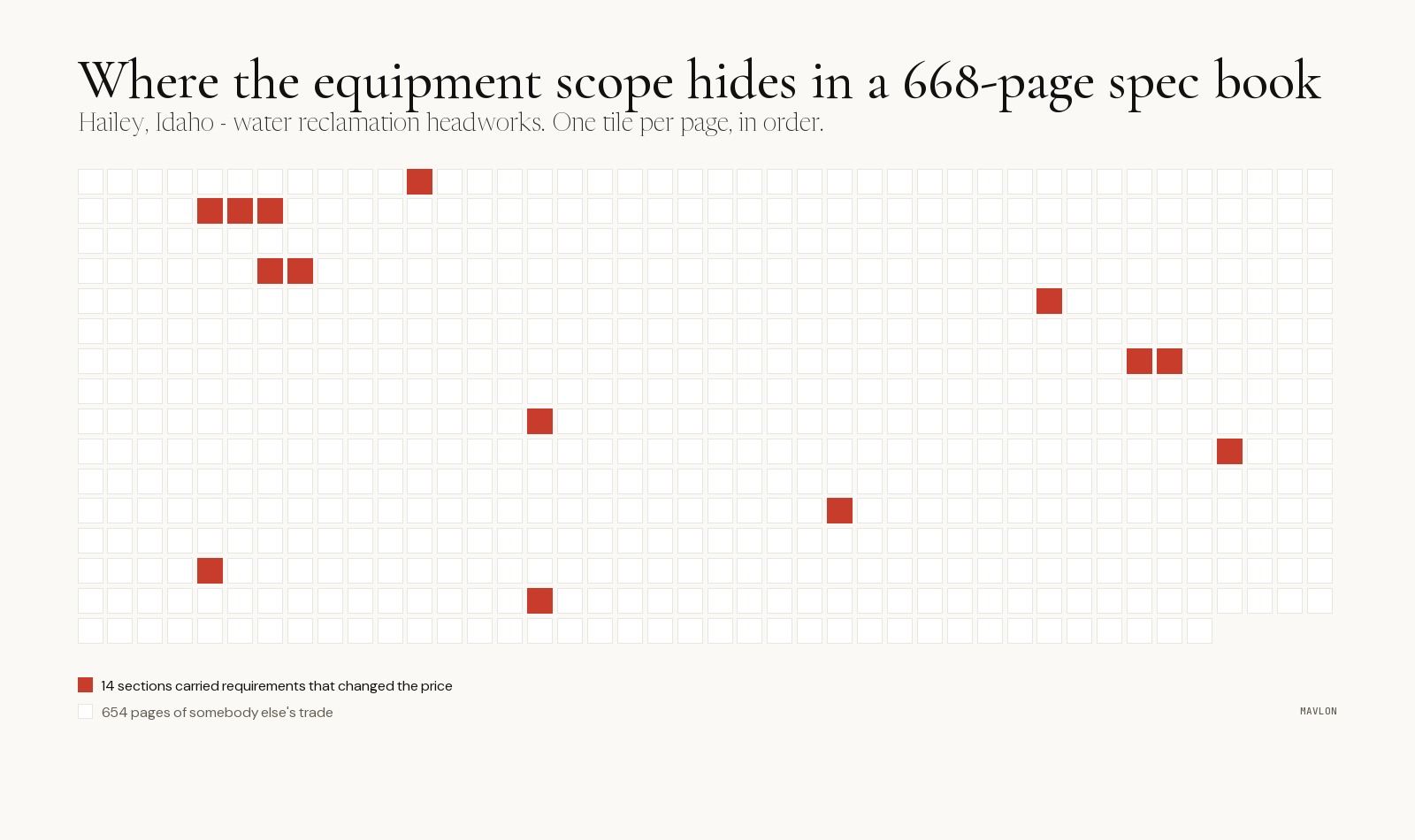
I watched an engineer open a 668-page specification book for a water reclamation facility headworks in Hailey, Idaho, scroll for a while, and say: "somewhere in here is about thirty pages that are actually mine."
He was right, and he was being generous. When we later ran that same public package through our own software, the number of separate sections carrying requirements that changed the equipment price was fourteen.
Quoting water and wastewater equipment is mostly the job of finding those fourteen sections in six hundred and sixty eight pages, and only then the job of pricing anything.
This guide is for the person at a screen manufacturer, a pump packager, a clarifier builder or a headworks supplier who receives a municipal bid package and has to turn it into a number.
It is not about takeoff software and it is not about CPQ. It is about the specific ways these packages hide money, and what to check before you send a price.
If your work is marine rather than municipal, the companion piece on quoting custom gangways and docks covers the same ground for floating structures.
The underlying problem is identical: somebody else wrote the documents, and they did not write them for you.
What you are actually being sent
A municipal equipment package is not a drawing and a part number. It is a construction bid package assembled by a consulting engineer for a general contractor, and your equipment is a component inside a much larger job.
That has three consequences that catch people out.
The document is mostly not about you
The Hailey headworks book runs 668 pages covering sitework, concrete, structural steel, electrical, instrumentation, painting, and every other trade on the project. The equipment being quoted occupied fourteen sections.
The other six-hundred-odd pages are someone else's problem, except where they are quietly yours, which is the whole difficulty.
You are quoting to a contractor, not to the owner
The specification is written to bind the general contractor. Your quote sits behind theirs.
Anything the specification requires of "the Contractor" that touches your equipment tends to arrive on your desk during submittals, whether or not you priced it.
The requirements are deliberately distributed
Construction specifications are organised by trade and by system, not by supplier. A single bar screen picks up requirements from all of these places:
- The screen's own technical section
- The general mechanical requirements
- The electrical section covering its motor and local control panel
- The coatings section
- The testing and start-up section
- The front-end documents covering bonds, warranty and liquidated damages
None of those sections mentions the others.
What the division number can and cannot tell you
The industry shorthand for this filing system is CSI MasterFormat, a numbering scheme where each trade gets a division number. Equipment usually lands in Division 11 or Division 43 depending on the vintage of the spec.
Knowing the number helps you search. It does not help you find the requirements that live outside it, which are the ones that cost money.
The seven decisions the package does not make for you
Every package leaves gaps. The skill is knowing which gaps cost money and which do not.
These are the seven that show up most often when quoting water and wastewater equipment.
1. Whether a substitution is genuinely available
The phrase "or approved equal" appears in almost every municipal specification. It does not mean what a first-time reader assumes. It means a substitution may be considered.
Whether one will actually be accepted is governed by a different clause entirely, usually in the front-end documents. That clause typically carries a deadline, a required submittal package and a reviewing engineer with no obligation to say yes.
Sometimes it is settled outright. On a four-page package for a mechanically cleaned bar screen in Odessa, Missouri, the sentence that ends the exercise is on page two: substitute materials or work shall not be permitted.
That is four pages, and the substitution question is closed before it is asked.
We wrote about this decision in more depth in or approved equal: when to bid and when to walk away, because getting it wrong in either direction is expensive:
- Price the alternate when the spec forbids it and you have wasted the bid.
- Assume the named brand when a substitution was genuinely open and you may have bid yourself out of the job.
2. What the motor and controls scope actually includes
The equipment section describes the machine. The electrical section describes what has to be done to power and control it, and the boundary between the two is where arguments happen.
That boundary raises questions like these:
- Is the local control panel yours or the electrical contractor's?
- Is the motor starter in your scope, in the motor control centre, or both by accident?
- Does the specification require a particular manufacturer of drive, and if so does that manufacturer's lead time fit the schedule?
This single boundary is the most common source of a quote that looked competitive and then lost money.
Read the electrical section for your equipment tag every single time, even when the equipment section appears complete.
3. The coating system
Submerged and splash-zone equipment in a treatment plant is a coatings problem as much as a mechanical one.
The coatings section will specify several things:
- It names a system, by generic type or by product.
- It sets a dry film thickness.
- It sets a surface preparation standard.
- It often sets a shop-versus-field split.
None of that appears in the equipment section. A stainless assembly that you assumed needed no coating may still be caught by a specification that asks for passivation and a particular surface finish.
4. What testing and start-up you owe
Shop testing, factory witness testing, field performance testing, and manufacturer's start-up and training services are usually specified in their own section, in days or in visits.
A requirement for a factory witness test with the owner's engineer present, or for five days of on-site start-up plus operator training, is real money and real scheduling.
It is also routinely missed because it does not sit near the equipment description.
5. Anchorage and what is by others
Anchor bolts, embedded plates, grout, and the structural interface between your equipment and the concrete are sometimes yours, sometimes the contractor's, and sometimes not addressed at all.
Seismic anchorage calculations, where required, may need a professional engineer's seal in the project's state, which is a cost and a lead time.
6. The warranty period and what starts it
A one-year warranty is standard, and a two-year warranty is common.
The more important question is when it starts: at delivery, at substantial completion, or at final acceptance.
On a plant with a long commissioning period the difference between delivery and final acceptance can be a year of exposure you did not price.
7. Whether the schedule is real
Municipal projects run on funding cycles and regulatory deadlines. Some schedules are genuinely generous and some are driven by a consent decree with penalties attached.
Liquidated damages, where specified, tell you which kind you are looking at.
Where liquidated damages are not mentioned anywhere in the sections you read, confirm that rather than assuming it, because silence is not the same as absence.
Where the hours actually go
Ask an estimator in this lane how long a package takes and the answers cluster between four hours and three days.
Ask what they were doing for those hours and the answer is almost never "pricing".
| Task | Share of the time | Can it be mechanised? |
|---|---|---|
| Finding which sections concern your equipment | Large | Yes, this is a search and retrieval problem |
| Pulling requirements out of those sections | Large | Yes, provided every extraction keeps its page reference |
| Reconciling the specification against the drawings | Moderate | Partly: conflicts can be surfaced, but not resolved |
| Deciding what is in scope and what is by others | Moderate | Partly: the question can be raised, the call is yours |
| Arithmetic against your own rates | Small | Yes, and it is the part least likely to be wrong |
| Deciding margin and whether to bid | Small in time, large in consequence | No |
What the table says about software
The shape of that table is the argument for software in this lane, and also the limit of it.
The two largest rows are reading problems. The row that decides whether the job makes money is judgment, and judgment does not automate.
What a machine can and cannot take off your desk
We publish what our own engine did on three public packages in this lane, including the ones where the honest answer is that software was unnecessary.
| Package | Pages | Result | Time |
|---|---|---|---|
| Hailey, Idaho. Water reclamation facility headworks | 668 | Found the 14 sections relevant to the equipment being quoted without being told where to look, and pulled their requirements with page references | 102 seconds |
| Grosse Ile, Michigan. Bar screen replacement | 2 | Named the equipment and the demolition scope hiding in the same two pages. Honestly, a document this short does not need software | Seconds |
| Odessa, Missouri. Mechanically cleaned bar screen | 4 | Surfaced the sentence on page two that ends the exercise: substitute materials or work shall not be permitted | Seconds |
Two of the three did not need software
Two of those three are cases where a careful estimator with ten minutes would have done the same thing. That is the honest picture.
The value is not in the four-page package. It is in the 668-page package, where the cost of missing one of fourteen sections is real and the cost of reading all 668 pages properly is most of a day.
Where the engine stops
What it does not do is decide anything:
- It does not choose whether to bid.
- It does not set margin.
- When the documents genuinely conflict, it raises the conflict rather than resolving it.
We wrote the general version of this argument in why quoting is hard to automate, and the specific limits in using ChatGPT to read bid packages: what actually breaks.
A checklist for quoting water and wastewater equipment
Whether you use software or not, these are the checks that catch the expensive misses in this lane. None of them require a tool.
They are worth running on every package:
- Find the substitution clause before anything else. That does not mean the phrase "or approved equal" in the equipment section. It means the actual procedure in the front-end documents, with its deadline.
- Read the electrical section for your equipment tag. Do this every time, even when the equipment section looks complete.
- Find the coatings section and check whether it catches your materials. That includes stainless.
- Find the testing and start-up section and count the days. That means factory witness tests, field testing, start-up visits and operator training.
- Establish the anchorage boundary. Find out who supplies anchor bolts, who grouts, and whether seismic calculations with a seal are required.
- Find when the warranty starts. The answer will be delivery, substantial completion, or final acceptance.
- Search for liquidated damages. If the phrase does not appear anywhere in the sections you read, note that as unconfirmed rather than absent.
- List what you could not find. The gaps are the questions for your reply email, and a package that cannot answer them is a package that cannot be priced without a bracket.
The thing that makes this lane different
Quoting in this market is not a configuration problem.
A configurator assumes the option tree is known before the document arrives: pick a size, a material, a drive, and a price comes out.
That model fits products sold from a catalogue. It does not fit equipment sold into a construction project, because the configuration is not decided until somebody has read a specification that somebody else wrote for a different purpose.
Why teams end up back in a spreadsheet
This is why teams in this lane tend to bounce off CPQ software and end up back in a spreadsheet with the one experienced estimator who remembers what things cost.
We wrote honest guides on the two most common tools, Tacton and Epicor CPQ, that include the cases where staying put is the right answer.
Neither is a bad product. They solve a different problem.
The part a machine can take
The problem here is reading. It is unglamorous, it is where the hours go, and it is the part a machine can genuinely take.
That is true provided every value it extracts carries the page it came from, so an estimator can check it rather than trust it.
How the package reaches you, and why that matters
Nobody sends you a bid package because they chose you.
It arrives through one of three routes, and the route tells you how much of the document you can trust to be relevant.
From a general contractor bidding the project
This is the most common route. A GC is assembling their own bid and needs a number for your equipment.
They will often forward the entire project manual, because filtering it is work and it is cheaper for them to push that work to you.
Several GCs on the same project will send you the same package separately, sometimes with different addenda attached. That is its own hazard: quoting from a superseded addendum is a real and common way to lose money.
From a bid listing service
These are platforms that aggregate public solicitations. Here you get the package with no relationship attached and no indication of whether anyone intends to use your number.
The hit rate is low and the reading cost is identical, which is exactly the economics that make automated reading worth something.
From the owner or their engineer, directly
This route is rarer, and it is usually a sign that your equipment was named in the specification or that you did the basis-of-design work.
This is the best case and it changes the substitution question entirely. If you are the named basis of design, the competitive dynamic is other people trying to substitute against you.
What the route tells you
Knowing the route before you start reading is worth five minutes, because of what it tells you:
- It tells you whether to check for addenda you have not been sent.
- It tells you whether a competitor is the basis of design.
- It tells you how much of your time this package deserves.
What changes by equipment type
The seven decisions above apply across the lane, but their weight shifts depending on what you build. These are the patterns worth knowing.
| Equipment | Where the risk concentrates |
|---|---|
| Screens and screenings handling | The interface with the channel. Channel width, depth and invert elevations come off the drawings rather than the specification, and a screen is dimensionally constrained by concrete somebody else is pouring. Screenings washing and compaction are often specified separately and assumed to be included. |
| Pumps and pump packages | The duty point, and whether it was calculated for the installed system or copied from a catalogue. Also the control scope: variable frequency drives are frequently specified in the electrical section with a named manufacturer, which can override whatever your standard package includes. |
| Clarifiers and sedimentation equipment | Anchorage and the concrete interface again, plus the drive torque rating, which specifications sometimes state as a continuous rating and sometimes as a momentary one. Reading it wrong changes the drive and the price materially. |
| Blowers and aeration | Noise limits and enclosure requirements, which live in a general section rather than the equipment section, and site conditions such as elevation and ambient temperature that change the machine selection. |
| Tanks and fabricated vessels | Coatings and linings, and whether a code stamp is required. Where the specification invokes a design code, the calculations and the stamp are cost and lead time. |
What every row has in common
The common thread is that in every row, the risk sits outside the equipment's own specification section.
That is not an accident of any one project. It is how construction specifications are structured, and it is the single most useful thing to understand about this lane.
Reading order that saves time
Most people read these packages front to back, or search for their equipment name and start there. Both are slower than necessary.
Here is a more efficient order, whether you are reading or configuring a tool to read:
- Read the bid form first. It tells you what is actually being priced and how it is broken out. If your equipment is a line on the bid form, the scope boundary is partly defined for you.
- Read the substitution clause second. It decides whether you are quoting your product or somebody else's, which changes everything downstream.
- Read the table of contents third. Use it to build a list of candidate sections. Every mechanical, electrical, coatings, testing and general-requirements section is a candidate regardless of whether it names your equipment.
- Read your equipment's technical section fourth. By now you can read it knowing what else might override it.
- Read the drawings fifth. Read them specifically to find dimensions and elevations the specification does not state, and to catch places where the drawing and the specification disagree.
- Read the addenda last, and again at the end. Addenda routinely change quantities and occasionally change the equipment entirely. They are also the thing most often missed when a package arrives through several GCs at different times.
Why the drawings come fifth
The reason the drawings come fifth rather than first is that a dimension only matters once you know which dimension governs, and the specification usually decides that.
Reading the drawings cold means measuring things that turn out to be irrelevant.
The reply email is part of the quote
Every package leaves questions. The instinct is to resolve them internally with an assumption and price it, because asking feels like admitting you did not understand the documents.
That instinct costs money twice: once when the assumption is wrong, and again when a competitor asked and got a written answer that you did not see.
The gaps you could not close are not a weakness in your quote. They are the most valuable thing you learned while reading, and they belong in writing.
A useful reply does three things.
It states what you priced
That means not just the number, but the reading you took where the documents were open.
"Priced with the screen drive rated for continuous torque per section 11 xx, not momentary" is one sentence. It means that if the engineer intended otherwise, they will tell you now rather than during submittals.
It lists what you excluded, plainly
That covers anchor bolts, field painting, unloading, electrical beyond the terminal strip, whatever it is.
Exclusions buried in a boilerplate paragraph at the foot of a quotation are worth very little in an argument. Exclusions stated as a short list in the covering email are worth a great deal.
It asks the questions the package cannot answer
The questions are about gaps like these:
- The channel dimensions are not on the drawings.
- The duty point looks copied.
- The warranty start is not defined.
- The coating system may or may not catch your stainless.
Each one is a sentence, and most will be answered. The ones that are not tell you something about how this project will run.
The commercial reason to do this
There is a commercial argument for this beyond accuracy. A contractor collecting four quotes for the same equipment gets four numbers and usually no explanation.
The one that arrives with a clear scope statement and three intelligent questions reads as the supplier who actually opened the documents.
That is worth something on the close, and it is worth more on the second project.
Keep the list as you read rather than reconstructing it afterwards. By the time the arithmetic is done you will have forgotten two of them, and the two you forget are usually the ones that mattered, because you noticed them early while the document was still unfamiliar.
How to test any vendor, including us
The demo will work, because that is what demos are for. The vendor picked the document and has driven that path a hundred times.
The test that means something
The test that means something is a blind one. Take packages you have already quoted, hold back your filed numbers, and let the system price them cold.
Then do these three things:
- Agree the pass bar in writing before anyone sees a score.
- Count a package that fails to process as a miss rather than an exemption.
- Score reading accuracy and pricing accuracy separately, because a system can be excellent at one and useless at the other.
Our own protocol is public
We publish our own protocol in full, including the pass bar we agree in advance and the forty-four classes of mistake our engine has made, at mavlon.co/pilot.
If a vendor will not publish theirs, that is information too.
Mavlon builds the reading engine described here for manufacturers whose RFQs arrive as somebody else's bid package.
If that is your desk, the pilot protocol above is the honest place to start, and it costs nothing to read.