Overhead Bridge Crane Specifications: A 100-Ton Example
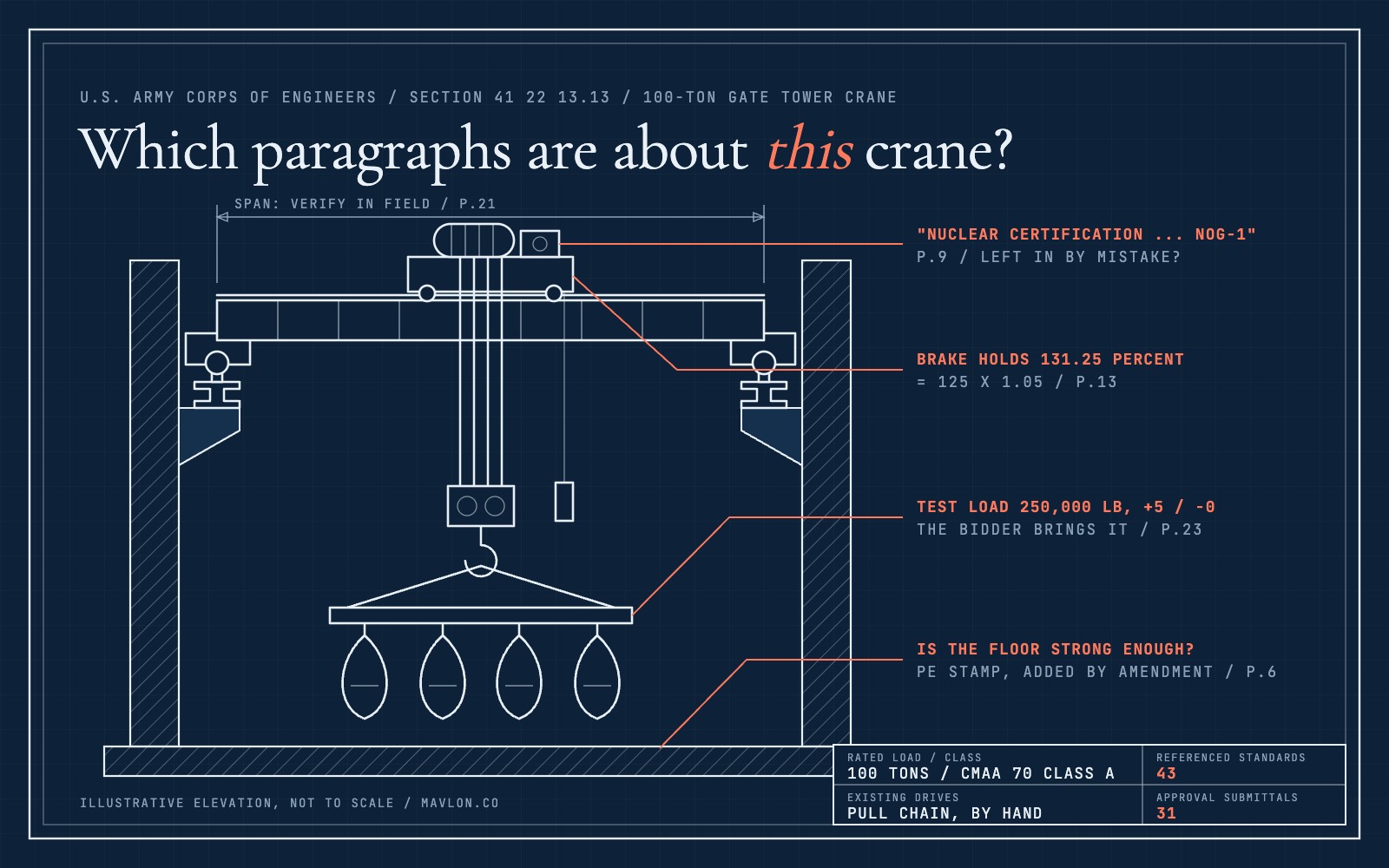
I read a bridge crane specification twice. The first time through, it looked like what it claims to be: twenty seven tidy pages describing a 100 ton crane. The second time I read it the way the person pricing it has to, asking of every paragraph whether it applies to this crane or was left over from some other one. Overhead bridge crane specifications reward that second reading more than any document I have worked through so far, because a large share of what is on the page was never written for the job in front of you.
The crane in question lives in the gate tower of a flood control dam. It can lift 100 tons. Today its hoist moves at just over one foot per minute, and the trolley and bridge are moved by men pulling chains. The government wants it motorised. That is most of the job, and it takes 27 pages, 43 referenced standards and 31 approval submittals to say so.
This is the third piece in a series. We have looked at a switchgear bid package with one blank for the price, and at a fire truck RFP with a yes or no beside every paragraph. Cranes fail in a different way. The document is not too strict. It is too general, and sorting out which parts are real is left to the bidder.
In brief
- A federal bridge crane specification for a 100 ton dam crane runs 27 pages, cites 43 standards and requires 31 government approved submittals.
- It was edited from a guide specification and the editing stopped part way: it asks for a cab on a pendant crane, a second crane on a one crane runway and a wind alarm indoors.
- One sentence requires nuclear certification to ASME NOG-1. It is almost certainly a leftover, and it says shall.
- An amendment changed the drives to two speed control and left the transformers, brakes and shielding written for the old drives.
- The crane load test needs 250,000 pounds of test weight, which the bidder supplies, and the hoist brake must hold 131.25 percent.
The documents: one bridge crane spec section and one full solicitation
The main document is a U.S. Army Corps of Engineers specification: Section 41 22 13.13, Bridge Cranes, for the gate tower crane at Clearwater Dam on the Black River in Missouri, a project of the Little Rock District. The copy I read is dated June 2018, carries the internal reference CDS18006, and includes the changes made by Amendment 0001, which are marked in the text as (AM001). It is public. I have only the crane section, not the rest of the solicitation, and I will say so wherever that limits what I can conclude.
For comparison I used a second federal package that I do have in full: Bureau of Reclamation Solicitation No. 140R1021B0004, the Third Power Plant Crane Controls Modifications at Grand Coulee Dam. It runs to 452 pages and covers the modernisation of a 70 ton draft tube gantry crane.
Some vocabulary for anyone outside the trade. A bridge crane is a beam, the bridge, that spans a building and rolls along rails fixed high on the two side walls, called the runway. A trolley runs back and forth along the bridge, and the hoist on the trolley raises and lowers the hook. Three motions, and between them the hook can reach any point on the floor. A pendant is the hand-held button box that hangs down for the operator. CMAA is the Crane Manufacturers Association of America, whose Specification 70 sorts cranes into service classes from A, for a crane that sits idle most of its life, to F, for one that works continuously in a steel mill.
The Clearwater crane is Class A. It exists to lift the gates and bulkheads of the dam's intake structure, which might happen a few times in a decade. When it is needed, it is needed badly, and it has to lift 100 tons.
What is actually being bought
The scope is never stated in one place. You assemble it from a speeds table on page 5:
| Motion | Minimum, feet per minute | Maximum | Existing |
|---|---|---|---|
| Main hoist | 1.1 | 3 | 1.1 |
| Trolley | 10 | 20 | Manual |
| Gantry | 10 | 20 | Manual |
Below the table: the speeds are approximate and adjustable, and trolley and bridge travel speeds are estimates due to existing being pull chain drives.
So this is a rehabilitation. The structure stays. Page 9 asks for a rehabilitation procedure. Page 13 says the new hoist rope shall be the same size as the existing diameter. Page 21 says to paint only where work is being performed. The contractor is adding motors, drives, brakes, controls, wiring and a pendant to a crane somebody else built a long time ago.
Yet page 8 requires the crane to be designed and manufactured by a company with at least ten years of specialised experience in this type of crane, and page 10 requires materials and equipment that are standard products. Page 4 even defines the term: a Standard Commercial Cataloged Product is one sold in substantial quantities to the general public, industry or Government, appearing on the manufacturer's published data sheets, published before the solicitation was issued.
There is no catalogue page for motorising a hand-chained 100 ton gate tower crane. The definition belongs to a different job. It is the first sign of what this document is.
A form letter with the blanks half filled
The section number and much of the text follow the Unified Facilities Guide Specifications, the master text that Corps and military designers edit for each project. A guide specification is a form letter. It contains every paragraph that any bridge crane might need, with choices in brackets: indoor or outdoor, cab or pendant, one crane or two, AC or DC. The designer's job is to delete what does not apply and choose inside the brackets.
Here the editing stopped part way. Page 5 shows a bracket that was never resolved, only closed up:
Systemelectric is two options run together. Once I knew to look, the rest of the unedited form was easy to see:
| Page | What the section says | What this job is |
|---|---|---|
| 5 | Number of cranes: one | |
| 11 | Identification plates "such as BC-1, BC-2, for each bridge crane" | One crane |
| 12 | "When two bridge cranes are on the same runway", bumper arrangements for each | One crane |
| 19 | Provide a receptacle "in the cab" | Pages 16 and 17: the crane is run from a pendant. There is no cab |
| 18, 19 | Requirements "for outside cranes" and "outdoor crane bridge festoon system hardware" | Page 5: indoor wet environment |
| 23 | Check the "accuracy of wind indicating device and alarm" | Indoors |
| 16 | A quadraplex controller "for 4-motor bridge drives on ac central cranes" | A slow Class A crane whose bridge is currently pulled by hand |
| 8 | Craftsmen must have worked on "monorail cranes of similar size and capacity" for at least five years | A monorail is a hoist on a single beam. I am not aware of any that lift 100 tons |
None of these is hard to spot on its own. The trouble is what they do to the reader's trust in every other paragraph. If the cab and the wind alarm and the second crane are leftovers, then what else is? That question has a price attached, because some of the leftovers are expensive.
The most expensive sentence on page 9
Here it is, in the middle of a routine safety paragraph:
ASME NOG-1 is the standard written for cranes in nuclear facilities. It sits in the reference list on page 1 with the everyday documents. It is not an everyday document. Design factors, material traceability, seismic analysis, quality assurance records: a crane built to it is a different and far more expensive machine than a Class A crane built to CMAA 70, and the engineering hours alone are a different order of cost.
This is a gate tower on a flood control dam in Missouri. I am fairly sure the sentence is a guide specification option that nobody deleted, sitting beside a reference to the lock-out and tag-out regulation that has nothing to do with nuclear anything. But I am fairly sure, and the bidder has to be certain. The sentence says shall. If one bidder prices it as written and another ignores it as boilerplate, the two numbers will be nowhere near each other, and the low bidder has signed a contract that says NOG-1.
There is only one professional answer, which is a written question to the contracting officer before bids are due. The hard part is not knowing what to do. It is finding the sentence in the first place, on page 9, in a paragraph that looks exactly like every other safety paragraph in every other federal specification.
The amendment that changed the drives and left the rest
The (AM001) marks show what Amendment 0001 changed. On page 14 the drive control paragraph now reads: provide (AM001) 2-speed controllers for the trolley and bridge drives. Provide (AM001) load brake. On page 16: (AM001) provide bridge and trolley main control systems with two speeds in each direction.
My reading is that the original text asked for electronic variable speed drives, and the amendment swapped in the simpler and older arrangement: two-speed motors switched by contactors. That is a reasonable choice for a crane that works a few days a decade. The problem is that the amendment changed three sentences, and the paragraphs written around the old choice are still there.
- Page 14 still says drive motors shall be energised at a frequency not exceeding 60 Hz. That sentence only means something if a drive is varying the frequency. A contactor cannot.
- Page 15 requires two-speed, two-winding motors for the bridge and trolley, a few lines after saying that two-speed, two-winding motors with a solid-state control are not allowed for creep-speed use.
- Page 16, in a single paragraph, asks for a full-magnetic, across-the-line reversing starter and for reduced voltage starting for all speed points. Across-the-line means full voltage. It is one or the other.
- Page 17 requires an isolation transformer of the SCR drive type, sized from the hoist, trolley and bridge motor ratings, with three surge suppressors on the line side of each SCR drive transformer. An SCR drive is solid-state DC control. Nothing else in the amended section has one.
- Pages 15 and 16 call for DC shunt magnet brakes and describe what to do when DC magnetic control is required.
- Pages 19 and 20 require electronics enclosures shielded against radio interference to better than 100 decibels, for installations where, in the specification's words, electromagnetic compatibility or system security is required.
- Page 26 requires the control supplier to train staff on the 2-speed drives and associated electronic equipment.
Put yourself in the estimator's chair. Do you price the isolation transformer? It is a real piece of equipment with a real cost and the specification says provide. It serves a drive that the amendment appears to have removed. Do you price the shielded enclosures? If you leave them out and the government's inspector reads page 20 during submittals, you will be supplying them at your own expense.
This is the pattern we described in quoting custom equipment before the design exists: the parts of a package disagree, and reconciling them is the bidder's job. Amendments make it worse, not better, because an amendment is a patch applied by someone in a hurry to a document they did not write.
Numbers that are arithmetic, and numbers that are mistakes
Two sets of odd numbers appear in this section. One set is right and worth understanding. The other I believe is wrong, and it is wrong in a way that matters to anyone quoting motors.
The right one first. Page 13 requires a hoist brake capable of stopping and holding a 131.25 percent test load, and page 14 sizes the controllers to start the crane with 131.25 percent of rated load on the hook. Nobody picks 131.25 out of the air. Page 9 says the crane is load tested at 125 percent of rated load, with a tolerance of plus 5 percent and minus nothing. 125 times 1.05 is 131.25. The brake has to hold the heaviest weight that a legitimate test might hang on the hook. It is a neat piece of reasoning, and it tells you the brake and the drive are sized by the test, not by the working load.
Now the other set. Page 14, on transformers: carry full load continuously without exceeding an average temperature rise of 239 degrees F above an ambient temperature of 104 degrees F. Page 15, on motors: insulation based on 220 degrees F motor temperature rise above 103 degrees F ambient.
Those are strange numbers until you convert them. 104 F is 40 C, the standard design ambient. 239 F is exactly 115 C, and 221 F is 105 C, both familiar temperature rise ratings in the metric world. But a rise is a difference, and you cannot convert a difference the way you convert a thermometer reading. A rise of 115 C is a rise of 207 F, not 239. A rise of 105 C is 189 F, not 220. Somebody, or some software, added the 32.
| Item | As printed | What I think was meant | Correct conversion |
|---|---|---|---|
| Transformer temperature rise | 239 F rise over 104 F | 115 C rise over 40 C | 207 F rise |
| Motor temperature rise | 220 F rise over 103 F | 105 C rise over 40 C | 189 F rise |
Does it matter? Read literally, the printed motor figures allow a winding at 323 F, which is about 162 C. The same sentence offers Class F insulation, whose limit is 155 C. The specification, taken at its word, permits a motor to run hotter than the insulation it permits. No motor supplier will be confused by this for long, because they think in Celsius and will recognise 105. But a compliance reviewer comparing a data sheet with the printed numbers may well be, and that is a submittal rejected and three weeks lost over a unit conversion.
I include this because it is a good example of what close reading of overhead crane specifications actually finds. Not a philosophical ambiguity. A number with 32 added to it.
The overhead crane load test procedure: 125 tons of something
The crane itself is not the hardest thing to price in this section. The test is.
Page 23: test weights required are 200,000 and 250,000 pounds. The contractor provides all personnel necessary, including crane operators, riggers, rigging gear and test weights. The loads must be within minus nothing and plus 5 percent, verified before testing. Page 10 requires a test weight plan, approved in advance, stating the type of weight (water bags, concrete, steel), the handling procedure, scale drawings of the test configuration showing the crane and the structure around it, and calibration certificates for the measuring devices no more than two years old.
Then a sentence that tells you where this is happening: if water bags are used, provide means of pumping water into the bags from the deck, and the bags shall be non-contained in order to dump water back into the river.
So somewhere in the estimate there has to be a line for getting 125 tons of calibrated weight into the gate tower of a dam, hanging it, proving what it weighs, and getting rid of it. Steel weights mean trucking and a second crane to handle them. Water bags mean pumps, hoses, a flow meter with a certificate, and a rental that runs for as long as the testing does. And page 27 says the testing may be re-run as many times as necessary.
The sequence around the test is its own cost. Count the gates on pages 22, 23 and 27:
- Inspection and test procedures submitted at least 90 days before any test.
- The contractor runs the full inspection and operational test once for itself, corrects what it finds, and submits a report for approval.
- 30 days notice to the contracting officer before acceptance testing, 14 days before inspections.
- The government will not attend until the procedures, the test weight plan and the contractor's own test report have all been approved.
- Then the whole thing is done again with government witnesses.
Every one of those is calendar time during which a crew, a field service engineer and rented test weights are either on site or on hold. None of it is in the bill of materials. We made the same point about water and wastewater equipment: the machine is in one section, and the start-up, testing and training that surround it are somewhere else, and they are routinely the difference between a job that makes margin and one that does not.
Amendment 0001 also made the crane bidder a structural engineer
The longest insertion marked (AM001) is on page 6, in the list of design calculations the contractor must submit:
Read it slowly. Before hanging 125 tons from this crane, or setting test weights down on the gate tower floor, the crane contractor must prove that the concrete structure of the dam's intake tower can take it. With calculations. Stamped by a licensed professional engineer. Using design information the amendment itself describes as partial.
A crane company employs mechanical and electrical engineers. It does not normally employ someone who will put a stamp on the load capacity of a decades-old reinforced concrete slab built by the government. That is a specialist structural subconsultant, site investigation, possibly a load test of the floor itself, and professional liability that a crane builder's insurance may not contemplate. It arrived in an amendment, inside a parenthesis, in a list of submittals.
I would put this near the top of any bid review. It is the single item in the section most likely to be missed by a bidder working from the original issue and a quick skim of the amendment.
What "or equal" looks like in wire rope
Page 13 is a useful miniature of how much a short paragraph can carry. The hoist rope shall be the same size as the existing diameter, which means nobody knows the size until somebody goes and measures. It shall be the product of a domestic manufacturer. It shall conform to a federal specification, RR-W-410, Type I, Class 3, 6 x 37. It shall be pre-stretched. A sample shall be pulled to failure on suitable tension testing equipment, with qualified personnel, both furnished by the contractor. It shall be coated on site with a named lubricant, or equal. And a single broken wire in a valley between two strands is cause for rejection.
Seven requirements in nine lines. The rope for a 100 ton hoist is not a small purchase, a destructive test needs a laboratory, and domestic manufacture narrows the supplier list. An estimator who writes wire rope, 1 lot against that paragraph has not priced it.
Thirty one approvals and forty three standards
I counted the submittals that carry a G, meaning the government must approve them before the work they describe can proceed. There are 31, from the rehabilitation procedure and test weight plan through shop drawings, wiring diagrams, product data for a dozen components, test reports, certificates for inspectors, craftsmen and electricians, and the manuals. Page 5 adds that all submissions for a component shall be submitted in one package, and page 9 that shop drawing quality shall be equivalent to the contract drawings.
The qualification paragraphs are unusually specific. Crane inspectors must hold certificates from an established training institution, and page 8 names two, with their telephone numbers. Certificates issued by the contractor do not count. Inspectors must have spent the last two years employed by a firm specialising in crane inspection. If your inspector is excellent and works for you, that is a NO.
And the reference list on the first three pages names 43 separate publications: gear ratings, welding codes, six ASME crane and hoist standards, twelve ASTM material standards, six NEMA documents, five from UL, four federal regulations. Each is cited by edition. CMAA Specification 70 is cited as the 2010 edition, in a document dated 2018, three years after the 2015 edition was published. Which edition governs when they differ is another question nobody will answer unless somebody asks.
It is worth comparing with how little the owner will see at the end. Six hours of training, two copies of a video tape of the training session (page 26 really does say video tape), three sets of manuals, and a crane that moves when you press a button.
How the bigger package handles the same problems
The Grand Coulee package is a useful contrast, because it is the same kind of work, modernising an existing dam crane, specified with far more care. It is also 452 pages long.
Its price schedule on page B-1 has four lines rather than one:
| Line | Item | How it is priced |
|---|---|---|
| 1 | Mobilization and preparatory work | Lump sum |
| 2 | Contract document management system | Lump sum |
| 3 | As-built and final drawings, operation and maintenance manuals | "For the lump sum equal to 1.65% of CLIN 4" |
| 4 | 70T Draft Tube Gantry Crane | Lump sum |
Line 3 is the interesting one. The government has decided in advance what the final documentation is worth: 1.65 percent of the crane line, no more and no less. The bidder does not get to price it. I assume this exists because contractors otherwise price documentation at nearly nothing, deliver the crane, get paid, and lose interest in the manuals. Whatever the reason, it means that if your real cost of as-built drawings is 4 percent, the other 2.35 has to be hidden in line 4, which in turn raises line 3. Somebody at every bidder has to do that algebra.
The package also contains a requirement I have not seen anywhere else. The draft tube gantry crane is how the plant installs and removes the stop logs on the draft tube tail bay. While the contractor has it in pieces, the plant still needs that ability. So Section 01 14 30 says the contractor shall provide two identical mobile cranes, rated to 100 tons, to be on site for the duration of the crane outage, for use by government operators. Two 100 ton mobile cranes, standing by for the whole outage, is a very large number, and it has nothing to do with controls modifications. It lives in a Division 01 section titled Interruption of Service. Only one outage window is allowed.
The same package has four sections on removing asbestos and coatings containing heavy metals, because old cranes tend to be painted with lead. Buy American clauses apply. And the warranty has teeth: the contract price will be adjusted under a clause titled Failure to Meet Performance Warranties.
Clearwater has a gentler version of one good idea. On page 20 the load block and lifting beam are to be taken apart, inspected, and reported on, with non-destructive testing procedures reviewed by an independent Level III examiner. Then: any repairs will be paid for using the miscellaneous CLINs. That is the honest way to buy an unknown. Nobody can price the repair of a hook nobody has opened, so the owner pays for the looking and carries a separate line for the fixing. I cannot tell you how those lines were sized, because the bid schedule is in the part of the solicitation I do not have.
Overhead bridge crane specifications: what to check before you price
The order I would work in, which again is not the order of the document:
- Work out what the job is. New crane, replacement, or rehabilitation. Here the answer was in a speeds table and the words pull chain, not in any summary.
- Read every amendment against the full text, not on its own. Find the three sentences it changed, then find the thirty it should have changed and did not.
- Hunt the single expensive words. NOG-1. Nuclear. Seismic. Explosion proof. Single failure proof. Domestic. Any one of them, left in by accident, can double a number. Ask in writing.
- Mark every leftover. Cab, outdoor, second crane, wind alarm. For each, decide whether it is harmless or whether it implies equipment, and write down what you assumed.
- Price the test before the crane. Test weights, their delivery and removal, calibration, the rehearsal test, the witnessed test, the notice periods, the chance of doing it twice.
- Find the work that is not crane work. Structural calculations with a PE stamp. Lead paint and asbestos. Temporary cranes during the outage. Whoever wrote the section put them wherever was convenient.
- Count the approvals and put them on a calendar. 31 submittals, a 90 day lead on test procedures, a rule that work cannot start until the procedure is approved. The schedule is a cost.
- Check the people, not just the product. Named training institutions, years of employment with a specialist firm, a licensed electrician on site. These fail bids as surely as a wrong motor.
- Convert the odd numbers. If a figure looks strange, it may be a unit conversion, and it may be wrong. 131.25 was arithmetic. 239 was a mistake.
The same document in other clothes
Set this beside the other packages in this series and a pattern is hard to miss. The switchgear package was written by a consulting engineer and was careful, and its trap was a bid form with one line. The fire truck specification was written largely by a truck builder's catalogue, and its trap was three hundred boxes with most of the exits closed. This crane section was written by a guide specification that nobody finished editing, and its trap is that a third of the page may not apply and nothing tells you which third.
That is what reading overhead bridge crane specifications comes down to. In all three cases, the bidder is being asked to do the last stage of the owner's engineering: decide what the document means, for free, against a deadline, with their own money at risk if they decide wrong. The people who are good at this are rare and expensive, and they spend most of their time reading. We wrote about why that is so hard to systematise in why quoting is hard to automate.
What software changes, and what it does not
We build software that reads packages like these, so here is the honest account of what it is good for on a document like Clearwater.
It reads all 27 pages, and all 452 of the other one, without getting bored on page 9. It lists every requirement with its page. It can be taught the things I did by hand here: flag any paragraph that refers to equipment the job does not have, such as a cab on a pendant crane or a second crane on a one-crane runway. Flag any standard that belongs to a different industry. Compare the amended sentences with the paragraphs around them and show where they no longer agree. Pull every notice period and approval gate onto one timeline. Check unit conversions, which is exactly the kind of tireless arithmetic machines are for. And put the three sentences that could double the price at the top of the first page, instead of leaving them on page 9, page 6 and page 23.
It does not decide whether NOG-1 is a mistake. It does not decide whether to bid. It does not know that the last time you worked at a Corps dam the test weights sat on a barge for a month waiting for a witness. Your estimator knows that, and the point of the software is to hand them a sorted list on day one so that their three weeks go on judgement and not on finding things.
Talk to us about your packages
If your team prices cranes, hoists or lifting systems against specifications like these, the fastest way to find out whether we are useful is a conversation with the person who built the thing. No forms to fill in, no data to send, no procurement process to start. Just a call.
Book a demo