UL 891 vs UL 1558: What Changes in the Quote
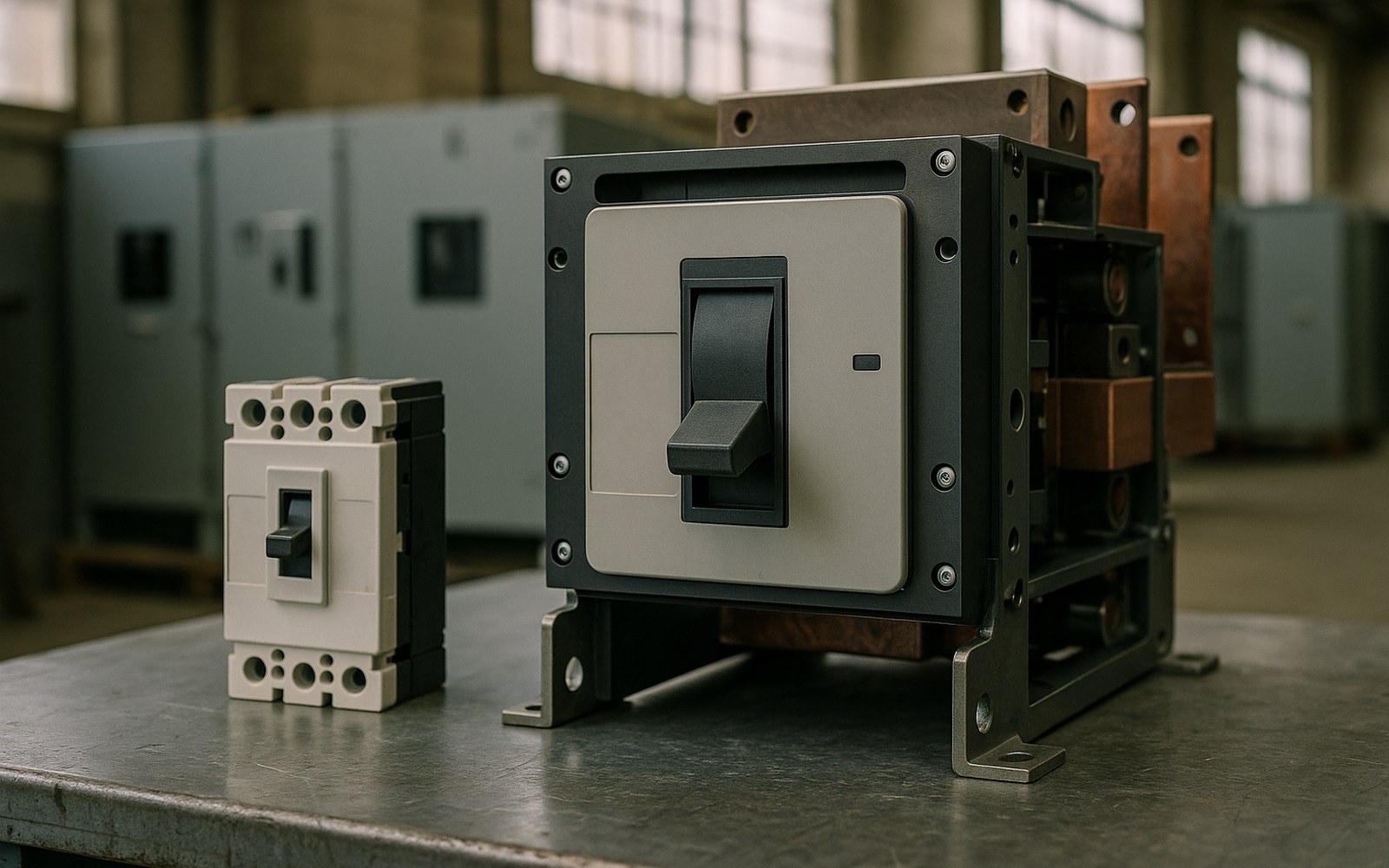
If you have quoted low voltage distribution equipment, you have met the two numbers that sit on the first page of the specification. UL 891 is the standard for a switchboard, and UL 1558 is the standard for switchgear.
UL 891 vs UL 1558 reads like a question about standards. At the estimating desk it is a question about money.
The same one-line diagram, which is the drawing of how power flows through the system, can be built either way, and the two prices are far apart.
I spent two days reading how eight large owners answer that question in writing. They are two federal agencies and six universities that publish the electrical rules their designers must follow.
They do not agree with each other. One draws the line at 1,000 amps, one at 1,200, one at 1,600 and one at 2,000.
Two of them ask for something that is neither product as most people picture it. It is a switchboard, listed to UL 891, that carries a rating and a breaker borrowed from switchgear.
This article is for the person who has to turn that first page into a number. It covers four things:
- It explains the differences between the two products that reach the price.
- It shows where each owner draws the line.
- It describes the hybrid that sits between the two products.
- It lists the seven sentences in a specification that tell you which one you are pricing.
Like our guide on how to quote switchgear, it starts from the documents themselves. Most of the documents here are ones that guide did not use.
In brief
- A switchboard to UL 891 and switchgear to UL 1558 can serve the same one-line diagram. The difference is in the breakers, the way they are mounted, how long the assembly can carry a fault, and how much steel separates one part from the next.
- The line that matters most is the short-time rating. Switchgear is tested to carry a fault for 30 or 60 cycles so that a breaker downstream can clear it first. A switchboard is tested for three cycles.
- Owners draw the line in different places. The Department of Defense starts switchgear at 1,200 amps with large feeders. The Department of Veterans Affairs prefers power circuit breakers from 1,600 amps. Dartmouth wants drawout devices from 1,000 amps.
- Some owners ask for a hybrid. It is a UL 891 switchboard with drawout mains built to the power circuit breaker standard and, in one case, a 30 cycle rating. That is a third product, and it has its own price.
- Seven sentences in the specification settle which one you are quoting. The title of the section is not one of them.
- The choice moves more than the lineup price. It moves the room, the bus, the spare spaces, the lifting gear and the safety options.
UL 891 vs UL 1558: the differences that reach the price
The clearest public comparison I found was written by two electrical engineers at CDM Smith, William McGugan and Tyler Roschen. They wrote it for Consulting-Specifying Engineer in September 2022.
The first three columns of the table below follow their description of the two standards. The last column is mine, and it shows where each difference lands in a quote.
| Topic | Switchboard, UL 891 | Switchgear, UL 1558 | Where it shows in the quote |
|---|---|---|---|
| Companion standard | NEMA PB 2 | IEEE C37.20.1 | The product family, and with it the price range |
| Breakers | Molded case and insulated case breakers, UL 489. Power circuit breakers, UL 1066, are possible. Fused switches too. | Power circuit breakers, UL 1066, and nothing else | The largest difference in cost per circuit |
| Mounting | Usually fixed, with several devices grouped in one section | Drawout, each breaker in its own compartment | Cradles, racking parts, shutters, steel |
| Fault withstand | Three cycles. No short-time rating. | Four cycles, plus a short-time rating of 30 or 60 cycles | Bus bracing and structure |
| Instantaneous trip | UL 489 breakers always have it | UL 1066 breakers can have it switched off | Whether the coordination the engineer asked for can be met |
| Separation | Devices in a section are not isolated from each other | A metal barrier isolates each vertical section from the next | Barriers, and more sections for the same circuits |
| Size and access | 24 to 60 inches deep, 36 common. Front access is common. | 60 inches deep or more, 72 and 90 not unusual. Front and rear access. | Floor space, shipping splits, the room itself |
| What can share the lineup | Panelboards, transfer switches, breakers from 20 amps up | Protective relays and programmed transfer schemes | Engineering hours and control wiring |
What the comparison says about cost
Their summary of cost is careful, and it is worth repeating in the same spirit. The two products can be configured in so many ways that a like-for-like comparison only works for designs of similar size and purpose.
Even so, the extra material in compartmented switchgear makes the switchboard the significantly cheaper option in general. They give no ratio, and I will not invent one. Your own price book is the only place that number lives.
Two rows in that table do most of the work at the estimating desk, so they get a closer look. They are the breaker row and the fault withstand row.
UL 1066 vs UL 489, in plain words
A molded case breaker, the UL 489 kind, is a sealed unit. All of its parts sit inside one housing of insulating material. If it fails, it is usually replaced whole.
An insulated case breaker is a larger member of the same family with a stored-energy mechanism, which is a spring that is charged ahead of time and then closes the breaker.
That mechanism makes it behave more like a power breaker while it keeps the sealed construction.
What a power circuit breaker is
A low voltage power circuit breaker, the UL 1066 kind, is built to be maintained. It is almost always drawout, which means it sits on rails in its own compartment, called a cell, and can be rolled out.
It is not sealed, and its parts can be replaced one at a time. It costs more, it is larger, and it needs a cell to live in.
When a specification names UL 1066 or its companion, IEEE C37.13, for any breaker in the lineup, that breaker is the expensive kind, whatever the section is called.
The difference between switchboard and switchgear that matters most
The difference between switchboard and switchgear that moves the most money is a rating most quotes never state. It is how long the assembly can carry a fault before something has to open.
How long each one is tested to carry a fault
A cycle is one sixtieth of a second on a 60 hertz system.
A switchboard to UL 891 is tested to withstand its short-circuit current for three cycles, which is a twentieth of a second. It has no short-time rating beyond that.
Switchgear to UL 1558 is tested for four cycles and then carries a short-time rating of 30 or 60 cycles, which is half a second or a full second.
The CDM Smith authors give an example of what that looks like on a breaker. The breaker is able to interrupt a 100 kA fault within four cycles, and it is able to sit through 65 kA for 30 cycles. A kA is a thousand amps.
Why a breaker would wait during a fault
Why would anyone want a breaker to sit through a fault? The reason is the way a well-designed system clears one.
When a fault happens on a feeder, which is one of the outgoing circuits, the breaker nearest the fault should open and everything upstream should stay closed. That way, one bad circuit does not black out the building. Engineers call this selective coordination.
It only works if the main breaker waits a moment to see whether the feeder breaker clears the problem.
While it waits, the main breaker and the bus behind it carry the full fault current. The bus is the set of metal bars that carry power through the lineup.
A switchboard is not built to do the waiting
Switchgear is built to do that waiting, and a switchboard is not. A switchboard has to be protected by a breaker that opens at once on a large fault. That is why the instantaneous trip row in the table matters.
An instantaneous trip opens the breaker with no deliberate delay. A UL 489 breaker always has an instantaneous trip. A UL 1066 breaker may have one that can be switched off.
The same authors warn about the combination that results when a UL 1066 breaker with its instantaneous trip switched off protects a UL 891 switchboard. A fault that lasts longer than three cycles can exceed what the switchboard was tested for.
What to look for in the specification
For the estimator, this turns an abstract standard into a reading task.
If the specification asks for a short-time delay on the main with the instantaneous trip switched off, or says the instantaneous function must be defeatable, meaning it can be switched off, it is describing switchgear behaviour. A standard switchboard does not meet it no matter what the section title says.
Look for the sentences about coordination and trip settings.
Where eight owners draw the line
Large owners write their preferences down so that every design firm they hire gives them the same thing. Those documents are public, and they are the closest thing there is to a survey of how buyers settle UL 891 vs UL 1558.
I read eight of them. The table gives each rule as closely as a short cell allows, with the paragraph it comes from.
| Owner and document | The rule | Paragraph |
|---|---|---|
| U.S. Department of Defense, UFC 3-520-01, Interior Electrical Systems (January 2025) | Switchgear when the equipment is 1,200 A or larger and the feeders are above 400 A, or when any feeder is larger than 800 A. Switchboards when the equipment feeds breakers of 800 A or larger. | 3-2.2 |
| Department of Veterans Affairs, Electrical Design Manual (March 2025) | As a guideline, power circuit breakers at 1,600 A and above, molded case breakers below. | 5.3.4(b) |
| Dartmouth College, Design and Construction Guidelines (January 2023) | Drawout devices at 1,000 A and above, in switchgear and in switchboards. Breakers of 1,200 A and above individually mounted and drawout. 400 A and above individually mounted. | 1.2.D.2 and 2.1.C |
| Northwestern University, Sections 26 2413 and 26 2300 (issued March 2017) | Switchboards to UL 891 up to a 2,000 A main bus, with drawout mains from 1,600 to 2,000 A. Switchgear to UL 1558 with mains and ties on a frame of at least 3,200 A. | 26 2413: 2.1.E and 2.4. 26 2300: 2.3.A and 2.5.C |
| University of Pennsylvania, Design Standards 26 10 00 (July 2019) | Every main and tie is a drawout power circuit breaker. Feeders are drawout or group mounted, as the university's engineering department directs for each building. | 9.0.A and 9.0.B |
| University of Michigan, Design Guideline 26 11 00 (February 2023) | In unit substations, every main, tie and feeder is an individually mounted drawout breaker. Feeder frames are 800 A at least. | Secondary switchgear requirements, pages 2 and 3 |
| University of Houston, Master Specification 26 24 14 (August 2020) | Drawout power circuit breakers. Insulated case breakers only with the owner's approval. Arc resistant construction and remote racking unless the owner approves otherwise. | 2.2.A |
| Yale University, Design Standards, Subdivision 16300 (Revision 3, April 2009) | Mains and ties are true drawout, and may be insulated case. In utility plants, power circuit breakers for the whole substation. | Secondary unit substations, system design |
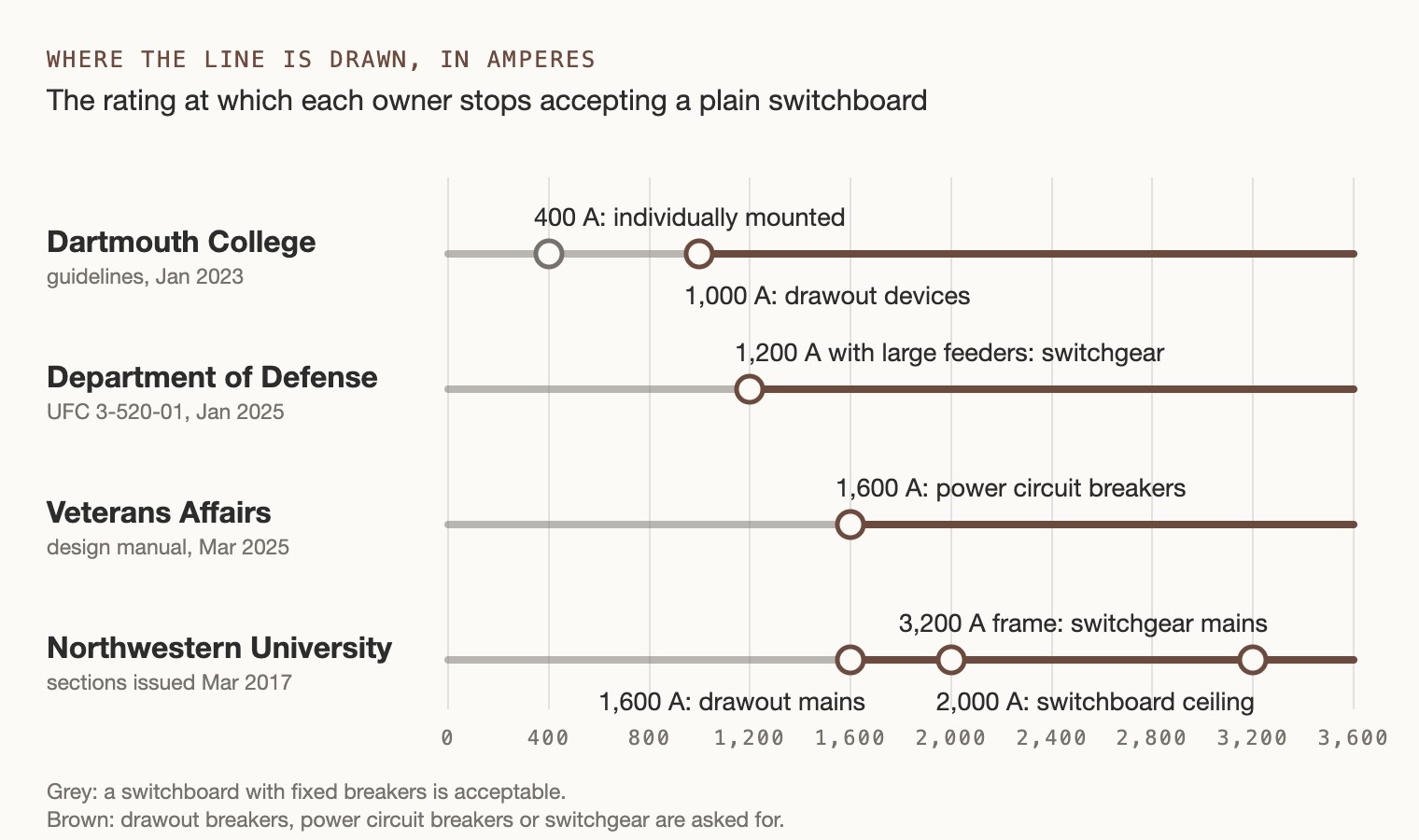
Three patterns come out of those eight documents.
Some owners decide by size
The Department of Defense, the Department of Veterans Affairs, Dartmouth and Northwestern each name an ampere rating. They name four different ones.
Take a 2,000 amp, 480 volt service as an example. The four owners give it four different answers:
- On a military base, it is switchgear if it has large feeders.
- At a veterans hospital, it gets power circuit breakers by guideline.
- At Northwestern, it is a switchboard with a drawout main.
- At Dartmouth, it is drawout throughout.
What your last customer wanted is not evidence about this one.
Some decide by the job each breaker does
Pennsylvania and Yale both treat the mains and ties as the breakers that must be drawout and maintainable, and they are more relaxed about the feeders. The mains are the incoming breakers, and the ties are the breakers that link two halves of a lineup.
Pennsylvania goes further and keeps the feeder decision for itself. Its engineering department tells the design firm, building by building, whether the distribution breakers are group mounted or drawout. Group mounted means several breakers are mounted together on one panel, instead of each one sitting in its own compartment.
If you are quoting a Penn job before that direction has been given, the honest quote prices one arrangement and says which one it priced.
Some decide by what the building does
Yale wants power circuit breakers for the entire substation in a utility plant. Houston wants them everywhere unless it approves otherwise.
Michigan wants every breaker in a unit substation individually mounted and drawout. The Department of Veterans Affairs sorts its facilities into critical, essential and ancillary, and sets different rules for each class.
The owner's standard is not the project specification
None of these documents is the specification you will be handed. A design firm edits the owner's standard into a project section, and edits leave gaps.
When a project section is silent, or says two things, the owner's standard is the first place to look for what was meant. It is usually one search away.
The hybrid: a UL 891 switchboard asked to behave like switchgear
The most interesting of the eight is Northwestern's switchboard section, because it asks for a product that sits between the two columns of the first table.
What Northwestern's switchboard section asks for
Section 26 2413 is titled Switchboards and requires compliance with UL 891. So far, it describes a switchboard.
Then the section goes on in three more paragraphs:
- Paragraph 2.1.F asks for a factory certified 30 cycle rating, which is the short-time rating that defines switchgear.
- Paragraph 2.3.B covers molded case breakers up to 1,600 amps to UL 489 and prohibits series rated equipment. Series rated means a breaker relies on another breaker upstream to help clear a fault larger than its own rating.
- Paragraph 2.4 covers main devices from 1,600 to 2,000 amps. They must comply with IEEE C37.13 and UL 1066, the power circuit breaker standards, and be a drawout insulated case power circuit breaker from a named product line or an equal.
What that adds up to as a bill of material
Read as a bill of material, that section describes four parts:
- The enclosure is a switchboard enclosure.
- The feeder breakers are the ordinary sealed kind.
- The main is a drawout breaker of the switchgear kind.
- The structure is rated to carry a fault for half a second.
Northwestern caps it at 2,000 amps. Above that, its separate switchgear section takes over, with UL 1558, mains and ties on a 3,200 amp frame at least, and a different named breaker line.
Other owners ask for the same mix
Northwestern is not alone. Dartmouth asks for drawout devices from 1,000 amps in switchgear and in switchboards alike. Pennsylvania allows group mounted feeders behind drawout mains.
The CDM Smith article also notes that some switchboards are built with drawout UL 1066 breakers. These have to be laid out with the same clearances for withdrawing a breaker as switchgear.
The three products you can be asked to quote
So UL 891 vs UL 1558 is not a choice between two products. It is a choice among at least three:
- A switchboard is listed to UL 891, has fixed breakers to UL 489, and has a three cycle withstand.
- A hybrid is listed to UL 891, with drawout mains or ties to UL 1066 and, where the owner asks, a short-time rating on the assembly.
- Switchgear is listed to UL 1558, with drawout breakers to UL 1066 throughout, each in its own compartment, and it has a short-time rating by definition.
Check whether your product line includes the hybrid
Whether your product line includes the middle one, and up to what rating, is a catalogue question. It decides whether you can bid a section like Northwestern's at all without taking an exception. An exception is a written statement that your offer departs from the specification.
If you cannot bid a section like Northwestern's without an exception, the place to say so is a line in the compliance matrix, with the paragraph number and what you offer instead, not a hope that nobody checks.
Switchboard vs switchgear UL listing: seven sentences that decide which one you price
The title of the section is the least reliable sentence in it. A section called Switchboards can describe a hybrid, and a section called Switchgear can be met by something simpler than the title suggests.
These seven sentences are the ones that settle the switchboard vs switchgear UL listing question. For each one, I give a place where it appears in the eight documents.
The seven sentences, and where each one appears
- The first is the standard named for the assembly. It is UL 891 and NEMA PB 2, or UL 1558 and IEEE C37.20.1. The Defense criteria put this in two adjacent paragraphs, 3-2.3 for switchgear and 3-2.4 for switchboards, and there is no doubt which is which.
- The second is the standard named for the breakers, which is UL 489 or UL 1066. Northwestern's switchboard section names both, in paragraphs 2.3.B and 2.4.A, for different breakers in the same lineup. Check every breaker class separately.
- The third is the word drawout, and the rating it starts at. Dartmouth starts it at 1,000 amps in paragraph 1.2.D.2 and repeats a 1,200 amp rule in 2.1.C. A threshold like that changes how many cells you need.
- The fourth is a short-time rating on the assembly. One example is Northwestern's 30 cycle rating in a switchboard section. Another is its switchgear rule in 26 2300 paragraph 2.2.C that the short-time and short-circuit ratings match the highest rated breaker in the lineup.
- The fifth is whether the breakers are individually mounted or group mounted. Dartmouth requires individual mounting from 400 amps. Pennsylvania allows group mounting for feeders. Individual mounting means more sections for the same number of circuits.
- The sixth is what the section says about barriers and compartments. The Defense criteria ask for switchboard sections completely isolated from each other by vertical steel barriers, and for hinged fronts. Northwestern's switchgear section asks for barriers between main and tie compartments carried to the rear of the section, and for the line bus isolated from the load bus at each main and tie.
- The seventh is whether the instantaneous trip can be switched off. Michigan requires the instantaneous function on mains and ties to be defeatable. That one word says the assembly behind those breakers must be able to carry a fault while they wait.
Go through a section with those seven in hand, and you will know which of the three products it describes.
You will also know whether it describes one product consistently, which is the subject of the next section.
When the page says one thing and describes another
Specifications are assembled from older specifications. Words travel with the paragraphs they came in, and the result does not always describe a single product.
The owner standards show the same wear that project documents do.
Houston calls low voltage switchgear metal-clad
Houston's master specification is titled Low Voltage Switchgear and cites IEEE C37.20.1 and UL 1558. Then it says in paragraph 2.2.A that the switchgear shall be metal-clad.
Metal-clad is the term the standards use for medium voltage gear with drawout breakers and insulated bus. The low voltage product is metal-enclosed. Michigan's guideline uses the same word for its low voltage breakers.
Nobody will be confused by this in practice, but it tells you that the sentence was not written while looking at the standard it cites.
Yale names a standard and a breaker that do not go together
Yale's standard is a sharper case. It references UL 1558 for the secondary unit substation, and it describes the main and tie breakers as true drawout, insulated case breakers.
On the description in the first table, those two do not go together. Insulated case breakers belong to the UL 489 family, and UL 1558 switchgear takes UL 1066 breakers only.
A manufacturer reading that paragraph has to ask which one governs, the standard cited or the breaker described, because they lead to different cells and different prices.
The Defense criteria ask for more than the base switchboard
The Defense criteria describe a switchboard with more separation than the base product has. They ask for sections fully isolated by steel barriers, and for hinged fronts.
Those are options on most product lines, and they cost money. A quote that prices the base switchboard against paragraph 3-2.4 is short by those options.
The same mismatch in an issued project document
We found the same kind of mismatch in an issued project document. It is a 15 kV specification that describes fused switches under one standard and then asks for breaker tests under another.
It is written up in the switchgear guide linked at the top.
How to answer a mismatch
The response is the same every time:
- Ask the question early, in writing, with both readings stated.
- Price one reading, and choose it on purpose.
- Write the reading you priced into the quote, with the paragraph number.
A question that names two paragraphs and two prices gets answered. A quote that silently picks the cheaper reading gets a rejected submittal three months later, after the price is fixed.
A submittal is the package of drawings and data that the buyer approves before you build.
What the choice does to the rest of the quote
The lineup price is the obvious difference. The same documents show five quieter ones.
The room and the route
Switchgear is deeper and usually needs working space behind it as well as in front.
The CDM Smith authors work an example under the electrical code's working space rules. A front and rear access lineup can need about twelve and a half feet of total depth, where a front access switchboard against a wall needs about seven feet.
Michigan requires rear access to every unit substation and working space sized for it. Pennsylvania requires the design firm to document how the equipment will be moved into the building, and requires shipping sections sized to make the move.
If your quote assumes standard shipping splits, meaning the usual places where the lineup is divided into pieces for shipping, it should say so. The route is the buyer's, and the split sizes are yours.
The bus
The Department of Veterans Affairs asks that the horizontal bus be fully rated for the length of the lineup.
Michigan asks that the vertical bus in each feeder section be rated for the breaker cell frame sizes, including spares and spaces, not for the breakers actually installed.
Both rules add copper that a breaker list will not show you. Our busbar calculator turns a rating and a lineup into pounds of bar if you want to see how much.
The spare space that is not empty
The Defense criteria require 15 percent empty space and 15 percent spare capacity in all switchgear and switchboards. The Department of Veterans Affairs asks for 25 percent space for additional devices.
Michigan goes further. Blank compartments are not permitted, and every space must meet three conditions:
- It must be fully bused.
- It must be fitted with neutral current sensors that match the breaker frame.
- It must be ready to accept a breaker.
A space at Michigan is most of a cell with no breaker in it. It has a price, and the price is not zero.
Lifting, racking and safety options
Drawout breakers have to be lifted out. Dartmouth requires a lift trolley for drawout breakers of 800 amp frame and larger. Yale requires a trolley lifting mechanism on each substation.
The Defense criteria ask the designer to evaluate arc resistant construction, infrared viewing windows, a remote racking mechanism that lets the operator stand at least 20 feet away, and shutters in the drawout compartments.
Houston requires remote racking and arc resistant construction unless it approves otherwise.
Each of these is a line on the quote, and each is easy to leave off when the breaker schedule is the only thing being read.
Read the owner's lifting, racking and safety options as well as the breaker schedule, and give each one its own line on the quote.
One manufacturer
The Defense criteria require the switchgear and its circuit breakers to be the product of the same manufacturer.
If you build assemblies around another maker's breakers, that sentence decides whether you can bid without an exception.
How to quote when the specification does not say
Sometimes the section really is silent. It gives a one-line diagram, a bus rating and a breaker schedule, and never names a standard for the assembly.
When that happens, take these five steps, in this order:
- Find the owner's standard. Universities, federal agencies, transit agencies and many cities publish theirs. A short search often answers the question the project section left open.
- Read the breaker descriptions. Drawout, stored energy, UL 1066, C37.13 and 100 percent rated are switchgear words. Molded case, group mounted and UL 489 are switchboard words. A mix of the two is the hybrid.
- Read the coordination requirement. A study that needs short-time delays on the mains needs equipment that can carry a fault for that long.
- Check the room on the drawings. A room with seven feet of depth was not drawn for rear access switchgear, whatever the section says.
- Price one product, name it, and send the question. State the standard the assembly is listed to and the standard each breaker class is listed to, in the first lines of the quote.
Why naming the product matters
That last step sounds too simple to matter. It matters because two honest manufacturers reading a silent section can price different products and both believe they complied.
The buyer then compares a switchboard price with a switchgear price and awards the lower one. Whether that is your quote or your competitor's, somebody finds out at the submittal.
We wrote about that judgement, and when the equal is worth arguing for, in or approved equal: when to bid and when to walk away.
When the lineup has two mains and a tie
If the lineup is double ended, with two mains and a tie, the same reading has a second half. That second half is how the two sources are transferred and kept apart.
That is covered in the companion article on main-tie-main switchgear.
Why a quoting company wrote this
Mavlon builds software that reads a customer's specification and drawings when the request for quote arrives. It does three things:
- It lists every requirement that changes the price.
- It ties each one to its page.
- It flags the ones that disagree with each other, such as a section that cites one standard and describes the breakers of another.
Your estimator decides what to do about each flag, and the quote is drafted in your own pricing rules. The seven sentences in this article are the kind of thing it is built to find.
If your team quotes switchboards or switchgear from specifications, the documents in this article are a fair test of any tool, including ours.
Sources
- U.S. Department of Defense, UFC 3-520-01, Interior Electrical Systems, 16 January 2025, paragraphs 3-2.1 to 3-2.4.
- Department of Veterans Affairs, Electrical Design Manual, PG 18-10, 1 March 2025, paragraph 5.3.4.
- University of Pennsylvania, Design Standards 26 10 00, Power Distribution System and Equipment, revision July 2019.
- Northwestern University, Section 26 2413, Switchboards, and Section 26 2300, Low-Voltage Switchgear, issued 29 March 2017.
- University of Michigan, Design Guideline 26 11 00, Unit Substations, February 2023.
- University of Houston, Master Specification 26 24 14, Low Voltage Switchgear, August 2020.
- Dartmouth College, Design and Construction Guidelines 26 24 13, January 2023.
- Yale University, Design Standards, Subdivision 16300, Transmission and Distribution, revision 3, April 2009.
- William McGugan and Tyler Roschen, CDM Smith, Comparing low-voltage switchgear and switchboards, Consulting-Specifying Engineer, 28 September 2022.
Found a mistake? Write to atishay@mavlon.co and we will fix it.
Talk to us about your specifications
If your team quotes switchboards or switchgear from customer specifications, bring one. We will read it with you and show every sentence that decides the product, tied to its page.
Or read what Mavlon does for switchgear and switchboard builders, on one page: AI quoting for switchgear and switchboard manufacturers.
Book a demo