How to Quote Switchgear: What 12 Real Specifications Demand
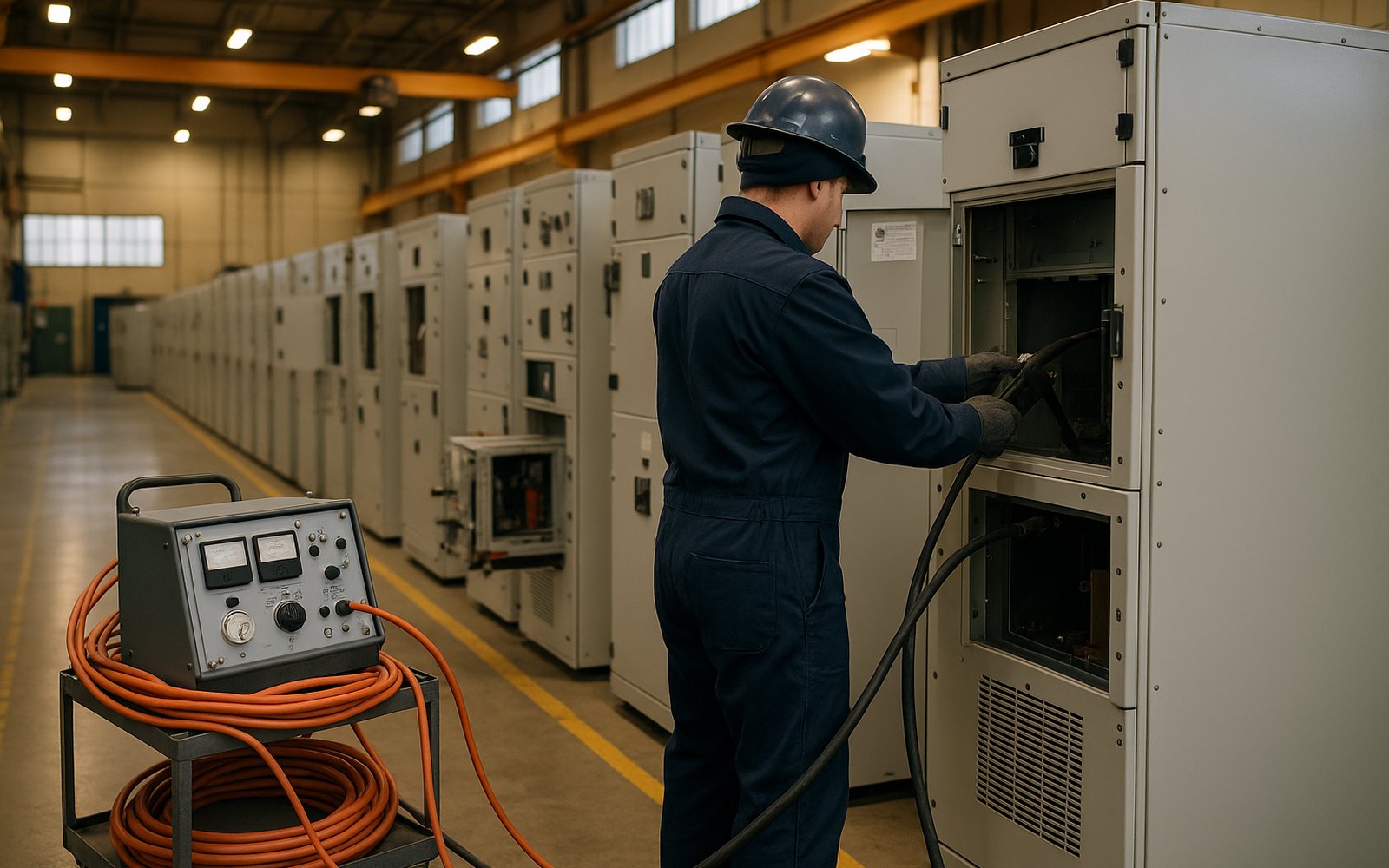
I spent a week reading twelve switchgear specifications the way a switchgear quotation specialist has to read them: with a pencil and a list of questions, not a highlighter.
Two were issued for real projects. One is a switchgear replacement inside a U.S. Army Corps of Engineers hydroelectric powerhouse, and the other is an outdoor lineup for a new veterans' home in Quincy, Illinois. The other ten are the standard specifications that large owners hand their engineers as a starting point.
If you are learning how to quote switchgear, the ratings are the part you already know. The money sits in everything around them.
Here is a taste of what those documents hold:
- One asks for a complete spare circuit breaker.
- Another asks for a quarter of the breakers again as spares.
- One was written from a single manufacturer's quotation, and it still says so on page 12.
- One carries the author's own note, "remove??", above a whole battery system.
- One lists a momentary rating of 135 kA next to a short-time rating of 25 kA. Those two numbers cannot describe the same lineup.
None of this is in a price book, and all of it changes the number.
This guide walks through how to quote switchgear from the specification, step by step, using those twelve documents as evidence. Every requirement below is quoted from a public document, with the page or paragraph where you can check it.
The commercial side of a utility package is a separate subject. By that I mean the bid form, the deviations clause and a price that must hold for sixty days. It is covered in what a switchgear bid package actually asks you to price. This piece is about the technical specification itself, and the sentences in it that a price book cannot see.
In brief
- A switchgear specification is usually addressed to the contractor, not to the manufacturer. The first job is sorting which sentences are yours to price, which belong to the installer, and which the owner has kept for itself.
- Check the ratings against each other before you check them against your catalogue. In one of the twelve documents, the momentary rating on page 9 belongs to a lineup roughly twice as strong as the one the breaker table on page 10 describes.
- Find whose quotation the specification was written from. The Illinois document names four acceptable manufacturers on page 4, then describes every bay in one manufacturer's product names.
- Count the bays and breakers yourself. Numbering that survived an edit is not a count.
- Services are priced in days, and the days vary by owner. One owner asks for one four-hour training session. Another asks for a recorded eight-hour class that includes tearing down a breaker.
- Spares vary more than anything else, from two fuses of each type to 25 percent spare breakers.
The twelve documents
The two project documents are the ones to learn from. An engineer edited them for a real job, and edits leave marks.
The ten owner standards show what large buyers ask for before any editing happens.
Most of the twelve follow the same numbering system:
- 26 13 is medium voltage switchgear.
- 26 23 00 is low voltage switchgear.
- 26 24 13 is switchboards.
| Document | Owner | What it covers | Pages |
|---|---|---|---|
| Section 26 13 26.00 26, Metal-Clad Switchgear, Amendment 0002 | U.S. Army Corps of Engineers, hydroelectric powerhouse | 5 kV metal-clad lineup, issued for bid | 35 |
| Section 26 13 00, Medium Voltage Switchgear, Amendment 3 | Illinois Capital Development Board, Quincy Veterans' Home, project 040-010-115 | 15 kV class outdoor fused switch lineup, issued for bid | 19 |
| VA 26 13 13, 26 23 00 and 26 24 13 | Department of Veterans Affairs | Medium voltage switchgear, low voltage switchgear, switchboards | 21, 18, 15 |
| UFGS 26 23 00 and 26 24 13 | Department of Defense unified guide specifications | Low voltage switchgear, switchboards | 40, 36 |
| 26 23 00 Low Voltage Switchgear, September 2025 | Metrolinx, the Ontario transit agency | Low voltage switchgear | 25 |
| 26 13 13 and 26 24 13 | University of Houston | Medium voltage switchgear, low voltage switchboards | 6, 8 |
| 26 24 13, January 2023 | Dartmouth College | Switchgear, switchboards, panelboards and breakers | 6 |
| 26 24 13, 2024 | Ohio Facilities Construction Commission | Switchboards for school buildings | 2 |
The page references below use each document's own page numbers. The owner standards are templates rather than issued documents, so for those I cite the paragraph number instead. The paragraph number is what survives into the project copies an engineer makes from them.
Switchgear or switchboard: know which standard you are quoting
Before anything else, settle what kind of equipment the section is asking for. The product family sets the price range before a single option is added.
The words get used loosely in conversation, but the standards behind them are specific. The section number and the standards it cites are the quickest way to tell.
At low voltage: a switchboard or switchgear
- A low voltage switchboard is built to UL 891. It usually carries molded case or insulated case breakers, often fixed in place rather than drawn out. It is the less expensive way to distribute power inside a building.
- Low voltage switchgear is built to UL 1558 and IEEE C37.20.1. It carries low voltage power circuit breakers that roll out on rails, each in its own compartment. They are rated to hold a fault for a short time, so that a breaker further downstream can clear it first.
That short-time capability is a large part of why switchgear costs more, takes more floor space and weighs more.
At medium voltage: metal-clad or metal-enclosed
Medium voltage means roughly 5 kV to 38 kV. Two families matter here:
- Metal-clad switchgear, IEEE C37.20.2, has drawout circuit breakers. It puts each major live part in its own grounded steel compartment, with insulated bus.
- Metal-enclosed interrupter switchgear, IEEE C37.20.3, uses stationary load-break switches with fuses instead of breakers. It is simpler, and generally a good deal less expensive.
What happens when one document mixes the two
The Illinois document shows why this matters. Its summary on page 1 and its construction paragraph on page 5 describe metal-enclosed interrupter switchgear built to C37.20.3. That means fused switches and no breakers.
Then the same document asks for things that only make sense for breakers:
- Page 15 asks for "production tests on circuit breakers according to ANSI C37.09".
- Page 15 also asks for tests on the completed assembly "according to IEEE C37.20.2", which is the metal-clad standard.
- Page 15 defines "space" as "fully provisioned space ready for inserting a circuit breaker at a future date".
- Page 4 asks for a "remote operated, motor driven, racking device", which is a tool for racking breakers in and out.
The lineup described in the bays has no breakers to test, to leave space for or to rack. The seismic paragraph on page 1 even begins "Switchboards shall withstand" in a switchgear section.
None of these sentences was written for this project. They came along with the template.
Ask the engineer one simple question, in writing: which of these sentences apply to the equipment you want, and may I exclude the rest?
Step 1: sort the sentences before you price them
A Division 26 section is addressed to the contractor. The switchgear manufacturer usually quotes the electrical contractor, who quotes the general contractor or the owner.
So the first read is not about price at all. It is a sort into four piles: yours, the installer's, the owner's, and the ones nobody has claimed. The powerhouse document makes the sort easy to see.
Sentences that belong to the installer
- Equipment must be stored "in completely enclosed containers and in a humidity-controlled environment" (page 7).
- A contractor representative must be on site "during all deliveries" (page 7).
- Cable entry holes are drilled in the field (page 16).
- The foundations are steel channel (page 17).
- A weekly work plan is needed for outages, in a plant where "the operation of existing 13.8kV equipment is critical to operation of the plant and shall not be interrupted" (page 32).
Sentences that take cost out
"Protective relays shown in the drawings will be furnished, installed, tested, and commissioned by the government."
Powerhouse specification, page 26The relays are often among the more expensive devices in a metal-clad lineup, and here they are not yours.
Three things in the same paragraph, and in the one after it, are still yours:
- You terminate the relay cables.
- You supply test switches for every voltage, current and trip signal into those relays, "equivalent to ABB FT-1 and FT-14 test switches".
- The contractor must submit a CT burden analysis (page 26). That is a calculation showing that the current transformers can drive the new relays without saturating.
Somebody has to run that calculation. Decide whether it is you, and say so in the quote.
Sentences that are clearly yours
Some items are yours without any doubt: a spare breaker, a remote racking device, infrared windows, a test cabinet, a field service engineer and a training engineer. We come back to each of those below.
Sentences that are shared without saying so
Page 7 asks the contractor to coordinate "between manufacturers of the new switchgear, installation subcontractors, and the COR". The aim is that the switchgear "can be transported and installed within the physical access constraints of the powerhouse without disassembly of the delivered equipment."
The shipping section sizes are yours. The route through the powerhouse is theirs. If a section does not fit through a door, the document does not say whose problem that is.
State your shipping section dimensions and weights in the quote. Also state that you chose them without a survey of the access route.
The sentence that decides where test costs go
"The costs of performing all tests shall be borne by the Contractor and shall be included in the prices bid for the items of equipment in the Schedules."
Powerhouse specification, page 4There is no separate line for testing. Whatever the witnessing and reporting cost you, it rides inside the equipment price.
Step 2: check the ratings against each other
Every estimator checks the ratings against the catalogue. Fewer check the ratings against each other, and that is where the powerhouse document hides its first question.
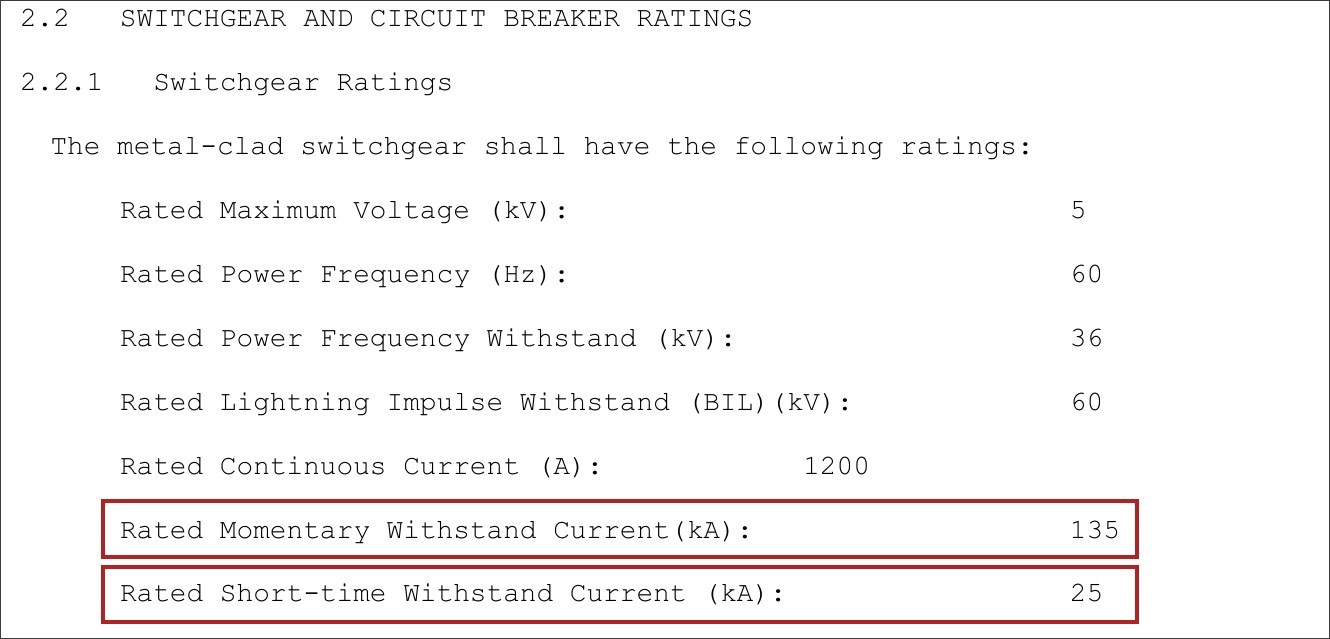
What pages 9 and 10 say
Page 9 lists the switchgear ratings:
- The maximum voltage is 5 kV.
- The continuous current is 1,200 amps.
- The momentary withstand is 135 kA.
- The short-time withstand is 25 kA.
A kA is a thousand amps. The short-time rating is the fault current the gear can carry for a set time. The momentary rating is the peak it can survive in the first instant of a fault.
Page 10 then lists the breaker ratings: 25 kA short-circuit current, and a closing and latching capability of 65 kA peak.
Why the two pages cannot both be right
Under the current IEEE rating structure, the peak goes with the short-time rating at a fixed ratio of 2.6. Twenty-five times 2.6 is 65, which matches page 10 exactly.
A momentary rating of 135 kA belongs to a lineup built for roughly twice the fault current. So which one do you price?
The bus bracing, the breaker frame and the test reports you will be asked to certify all follow from that choice. The cheap reading and the safe reading are different. Only one person can tell you which is right, and that is the engineer who wrote it.
Send a request for information early, and state both readings in it.
A quieter version of the same problem
The Illinois document has a subtler version. Page 5 gives three figures:
- It rates the equipment "13.8 kV Nominal, 95 kV BIL".
- It gives the system voltage as "12.47 kV nominal; 15 kV maximum".
- It rates the main bus at "600MVA Short Circuit".
Fault levels in megavolt-amperes have to be converted to amps, and the conversion depends on the voltage you divide by:
- At 13.8 kV, 600 MVA is about 25.1 kA.
- At 12.47 kV, 600 MVA is about 27.8 kA.
On the same page, the switches are rated for fault closing at "40,000 asymmetrical A". At the usual 1.6 ratio, that is 25 kA symmetrical. One reading of the document fits the switch rating. The other does not.
Neither document is badly written. Both are ordinary, and that is the point. Ratings are typed by people, copied between templates and edited under deadline. The only defence is to read them as a set and ask about the ones that disagree.
Step 3: find whose quotation the specification was written from
Engineers rarely write a switchgear specification from nothing. They start from an owner standard, a manufacturer's guide specification, or a budget quotation that a manufacturer sent them during design.
The Illinois document shows the third route more plainly than anything I have seen.
Four names on page 4, one company's products on pages 7 to 12
Page 4 lists the "Available Manufacturers": S&C custom metal-enclosed switchgear, Eaton "MVS, or equal", Square D and General Electric. That is four names, and it looks like an open field.
Then pages 7 to 12 describe each bay, and the descriptions are written in one company's product names:
- Mini-Rupter switches
- SM-5S fuses
- MS-2 and MS-10 switch operators
- Micro-AT source-transfer control
Those are S&C products. At the bottom of page 12 the document stops pretending.
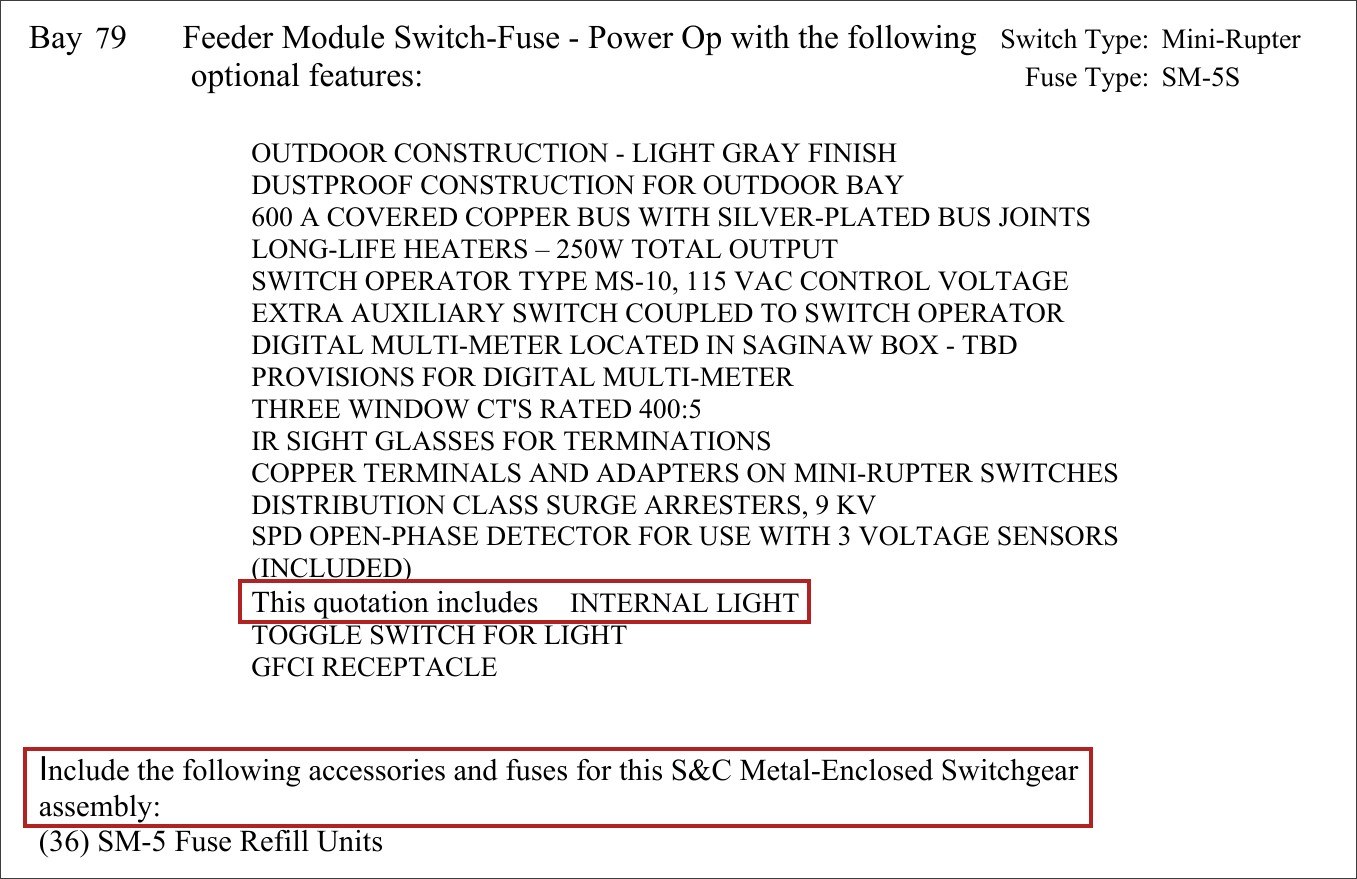
The words "This quotation includes" sit in the middle of a bay description. The last line asks for "accessories and fuses for this S&C Metal-Enclosed Switchgear assembly: (36) SM-5 Fuse Refill Units".
A manufacturer's quotation was pasted into the specification, and the paste is still visible.
If the quotation was yours
Much of your answer is already written, but not all of it. Page 12 still shows tracked-change marks on lines added later, including "DIGITAL MULTI-METER LOCATED IN SAGINAW BOX - TBD" and "THREE WINDOW CT'S RATED 400:5".
Compare the specification with the quote you sent, line by line, and price the differences.
If the quotation was a competitor's
You are quoting against a bill of material written in a competitor's part names. Two jobs follow from that:
- Translate every line into your equivalent.
- List the lines where no direct equivalent exists as clarifications.
A source-transfer control scheme is a good example of a line with no direct equivalent, because two manufacturers' schemes rarely do exactly the same thing in the same order.
The engineer who wrote the list will judge whether your offer is equal, and they will judge it against the product they described. We wrote about that judgement, and when it is worth fighting, in or approved equal: when to bid and when to walk away.
The sentence above the manufacturer list
"All products supplied for this project must comply with the Illinois Procurement of Domestic Products Act (30 ILCS 517)."
Illinois specification, page 4Where your enclosures, bus and breakers are made is now part of the bid. Settle it before you price, not after award.
Named lists get old
Named lists also age faster than the templates that carry them:
- The University of Houston's medium voltage standard, paragraph 1.4.A, names General Electric, Square D and Westinghouse. Westinghouse sold its electrical distribution business to Eaton in 1994.
- The Illinois document, dated November 2019, names "General Electric Company; GE Consumer & Industrial - Electrical Distribution". ABB had bought that business in 2018.
- Dartmouth's standard is more direct. Paragraph 2.1.A names Square D as the basis of design and accepts other brands only to match existing equipment in a building.
When a list names a company that no longer makes the product, ask who counts as the named manufacturer now, and get the answer in writing.
Step 4: count the units yourself
Switchgear is priced by the unit: the bay, the section, the breaker. So the count is the price.
The count has to come from the drawings and be confirmed against the text. It should never come from the text alone.
Ten bay headings that do not count to ten
The Illinois document has ten bay headings. In order, they are numbered 1, 2, 3, 4, 5, 46, 5, 67, 8 and 79.
- Bay 5 appears twice, once as an entrance module and once as a feeder.
- The numbers 46, 67 and 79 look like old and new numbers fused together when tracked changes were accepted.
How many bays are there? The text cannot tell you. The single-line diagram can, and the section names it on page 1: sheet S-E102.
Three fuse counts that disagree
The fuses give a second count that disagrees with the first:
- Page 6 asks for "three fuses in use and three spare fuses in storage clips in each switch". That is six per switch.
- The accessory line on page 12 asks for 36 fuse refill units, which would mean six fused switches.
- The bay list names SM-5S fuses on seven bays. An eighth, Bay 1, reads "Fuse Type: SM-5SNone".
That gives three counts and three different answers.
Price the count the drawing supports. State that count in the quote, so the buyer can see which reading you took.
Counts hidden in other places
The powerhouse document hides its counts in different places:
- A capacitor trip device is required on exactly one breaker: "only required for circuit breaker 3AG2" (page 24). This device stores enough energy to trip a breaker if the control battery fails.
- A test cabinet is required for each type of breaker. Another one is required for "any breaker or set of breakers that are located over 200 ft. from a test cabinet" (page 27).
You cannot count either one without the drawings and the layout.
Step 5: treat the leftovers as questions, not noise
Every issued specification contains sentences that nobody meant to leave in. The temptation is to ignore them as noise.
Priced honestly, each one is either a cost you carry or a question you ask. The question is cheaper.
The battery system that may not be in the job
The clearest example in the twelve documents is on page 14 of the Illinois section. The heading reads:
"2.6 CONTROL BATTERY SYSTEM (remove??)"
Illinois specification, page 14Below the author's note sits a complete battery specification, with a rack, accessories and a charger with a named source: "Provide products by La Marche."
Is the battery in the scope or not? Both answers are defensible, and the price difference is real. A bidder who includes it and a bidder who leaves it out will not be comparing like with like.
Ask the engineer. If there is no time to ask, price the battery as a separate line, so that it can be added or taken away.
Two paint finishes in one document
The same document asks for two finishes:
- Page 6 says "Manufacturer's standard gray finish", and every bay description says "LIGHT GRAY FINISH".
- Page 16 says "Manufacturer's standard olive green finish applied to equipment before shipping."
Paint colour sounds trivial until a lineup arrives in the wrong one.
Unfinished lines, and lines that only look unfinished
Some leftovers are simply unfinished. The digital meter location on page 10 is "TBD".
Some requirements look like leftovers and are not. Page 5 asks for switch position flags with the words "Open" and "Closed" in French, Spanish and English. That is a real requirement, and a standard product may not carry it.
Two facts that change how to read this document
First, its footer calls it "Bridging Documents". In design-build work, bridging documents are the owner's partial design, handed to a design-build team that finishes it. So gaps are expected, and the team that fills them takes on part of the price risk.
Second, it is Amendment 3, but only page 1 carries the amendment's revision date, "Revised 01/13/2020". The other pages keep the original date of 11/11/2019, while page 12 still shows change marks. The footer does not tell you which lines changed.
If you priced an earlier version, compare the two versions line by line before you resubmit.
Step 6: price the services in days, because they are days
Services are where two honest quotations for the same equipment drift furthest apart. The specification describes the service and leaves the days for you to estimate.
One line in a quote that says "field service included" means nothing. Here is what the documents actually ask for.
Factory witness testing
- In the powerhouse document, the government's quality representative "will witness all tests required herein unless waived in writing", with 21 calendar days' notice (page 29).
- Metrolinx says "All standard factory testing shall be witnessed by Metrolinx", with two weeks' notice (paragraph 3.1.1). It adds that all final site testing will be witnessed too (3.3.7).
- The Department of Defense template only reserves the right: "The Government reserves the right to witness tests" (2.5.1).
Witnessed testing means test bay time held for visitors, someone to host them, and a real chance of rescheduling when their travel changes.
Design tests
The powerhouse document asks for certified design test reports for switchgear and breakers "identical to those furnished". If such tests have not been performed, "they shall be performed as a part of this contract", and any equipment degraded by testing must be replaced (pages 28 and 29).
For a standard design with existing reports, that costs nothing. For a modified design, it can be the most expensive sentence in the section.
Check whether your existing reports cover the exact configuration you are offering.
Field service
- The powerhouse document asks for a field service engineer with at least two years' experience on the manufacturer's equipment, and a resume submitted for approval. That engineer "shall be present during both the Contractor's commissioning of equipment and for the Government's commissioning of the system" (page 34). That is two separate commissioning periods, possibly weeks apart.
- The VA's medium voltage standard has the manufacturer's representative "technically supervise and participate during all of the field adjustments and tests" (3.2).
- The Illinois document asks for a factory-authorized representative to inspect the installation, assist with field testing and report in writing (page 17).
Training
This is where the range is widest.
| Document | Training asked for | Where |
|---|---|---|
| VA medium voltage switchgear | One 4-hour session by a factory-trained technician, "on the dates requested" | 26 13 13, 3.8 |
| VA low voltage switchgear | Two 4-hour sessions | 26 23 00, 3.8 |
| VA switchboards | One 4-hour session | 26 24 13, 3.7 |
| Metrolinx low voltage switchgear | A minimum of two separate sessions by a manufacturer's qualified representative | 1.6.2 to 1.6.3 |
| Corps of Engineers powerhouse | One recorded 8-hour class for about 15 people, within 30 days of the first switchgear going into service, including "complete maintenance tear down and rebuild of a breaker during the class" | Page 34 |
| Illinois veterans' home | A factory-authorized representative trains maintenance staff; no hours stated | Page 18 |
Two phrases in that table deserve a second read:
- The VA's "on the dates requested" means the date is theirs, not yours. So the training trip may not line up with the commissioning trip.
- The powerhouse document goes further: "Government may require that the training be given on different days and in different weeks" (page 34).
Price the trips, not just the hours.
Return visits
The Illinois document asks for an infrared scan of each lineup after substantial completion and within 60 days of final acceptance, with front and rear panels removed (page 18).
It is written to the contractor. If the contractor passes it to you, it is another trip, months after the first ones.
State three things in the quote: the days on site, the number of trips, and the rate for any day beyond them. That turns a vague service line into something a buyer can compare, and it protects you when the dates move.
Step 7: spares, accessories and safety features vary by owner
If services are where quotes drift, spares are where they jump. The same category of equipment, bought by different owners, comes with very different expectations of what goes in the crate.
| Item | What the documents ask for |
|---|---|
| Spare breakers | Metrolinx: "25% spare breakers inside the switchgear circuit breaker compartment", and at least one spare matching the main breaker's frame and trip ratings (1.5.3). Corps of Engineers powerhouse: one complete 5 kV vacuum breaker identical to those supplied, plus spare CTs, VTs, coils and charging assemblies (page 28). Dartmouth: one spare feeder breaker for each frame size, and spare space of 20 percent or two of the largest frame, whichever is greater (F). |
| Other spares | Defense template: two fuses of each type and size, in a paragraph marked "Do not use this paragraph for Navy projects" (1.6.3). VA: a replacement and spare parts list in the manual, not the parts themselves. |
| Arc-resistant construction | Metrolinx: "The switchgear assembly shall be arc-resistant" (2.1.3). Defense template: the designer chooses, with a note explaining the type 1 and type 2 options (2.2.2). Dartmouth: arc-resistant gear or an active arc-quenching device "shall be evaluated" (G.6). Neither project document asks for it. |
| Arc energy reduction | Defense template: follows the electrical code threshold of 1,200 amps (2.2.5). Dartmouth: an energy reduction maintenance switch on switchgear and switchboards with main devices above 800 amps, or above 40 cal/cm² of arc flash energy (G.1). |
| Remote racking | Corps of Engineers powerhouse: provisions in every breaker cubicle, plus an electrically operated device on wheels with a 25-foot pendant, so the operator stands at least 20 feet away (pages 10, 12 and 27). Illinois: a motor-driven racking device, in a lineup with no breakers (page 4). |
| Infrared windows | Corps of Engineers powerhouse: at every main and tie breaker connection, and every feeder unless impractical, with 4-inch crystal sight glasses (page 12). Metrolinx: a view of all bus bar, cable and breaker connections (2.2.16). |
| Warranty | Metrolinx: at least two years after acceptance by Metrolinx (1.7.1), which starts later than most standard warranties. |
Read the first row again. At one owner, spares are a list in a binder. At another, they are a quarter of the breakers again.
If your quote template carries a standard spares allowance, it is right for at most one of these owners.
The switchgear submittal is part of the price too
Everything a manufacturer draws, calculates and certifies after award has to be delivered on the specification's schedule, and it all costs engineering hours.
A switchgear submittal is the package of drawings, data and certificates that the buyer approves before you build. It is quoted in the same number as the steel, so it has to be estimated like the steel.
The deadlines in the powerhouse document
- A work plan and foundation details are due within 45 days after notice to proceed.
- Seismic certification and field service engineer qualifications are due within 60 days.
- The factory test procedure is due 30 days before the tests, and the test reports are due within 10 days after them.
- Operation and maintenance manuals are due 30 days before completion. That means three draft hard copies for approval and then five final copies, each with a CD (page 35).
- As-built drawings are due within 30 days after completion, and they must be approved before training can start (page 35).
Where the drafting hours go
- Wiring diagrams must be point to point, and "the use of ladder logic type diagrams to indicate wiring connections is not acceptable" (page 6).
- Terminal marking strips must carry both the manufacturer's wire number and the government's, and "hand-written marking strips will not be accepted" (page 15).
- Every device needs an engraved nameplate of a specified material, size and letter height (page 17).
An approver from outside the project
The Illinois document adds one. Its shop drawings must show the utility's metering provisions "with indication of approval by utility company" (page 2). Page 15 requires the utility's approval of the metering cubicle arrangement "prior to fabrication of the switchgear".
That is a third review loop on the critical path, run by an organization that does not work for the buyer. Count the approval cycles as well as the drawings.
Step 8: write the switchgear quotation so it can be compared
The reading is only worth something if it reaches the quote. A switchgear quotation that answers a specification like these two should carry at least these seven parts:
- Say what you priced. Name the section, the amendment number and the drawing sheets you read. Amendments change things, and the footer does not tell you what.
- List the equipment by unit. Show every bay or breaker with the ratings you actually priced. If you priced 25 kA because the breaker table said so, write 25 kA.
- List the owner-specific items. Show the spares, accessories, remote racking and infrared windows one by one, so the buyer can see what is in the crate.
- Give the services in days. State the days on site, the number of trips, the witness testing arrangements and the rate for extra days.
- List the exclusions. These include owner-furnished items such as the relays in the powerhouse job, customer-supplied transformers such as the utility metering CTs and VTs in the Illinois tie bay, and installer work.
- List the clarifications. Write down every conflict you found, each with the reading you priced. Here that means the 135 kA line, the battery system, the finish colour and the bay count.
- State the commercial terms. Say how long the price holds, and count delivery from the order date rather than the bid date. How long to hold a price on equipment with long lead times is its own question, covered in how long should a quote be valid for.
Why the clarifications list matters most
The clarifications list does more work than it looks:
- It turns a lower price that rests on a cheap reading into a price the buyer can see is conditional.
- It gives the engineer a reason to answer the question for every bidder.
If you only take one habit from this guide, take that one: every conflict you find goes into the quote with the reading you priced.
What reading twelve of them taught me about how to quote switchgear
The standard parts of these documents are standard. The ratings tables, the test lists and the construction paragraphs repeat, nearly word for word, from one owner to the next.
What makes each job its own job is in three places:
- The first is the edits an engineer made for this project.
- The second is the leftovers they forgot to remove.
- The third is the services and spares their owner is used to getting.
None of that is in a price book, and none of it can be found by skimming for the ratings. It is found by reading the document as a set of promises you are about to make, asking which ones you can keep at what cost, and writing down the ones you cannot answer.
Two careful estimators can read the same section, resolve its leftovers differently, and both be honest. The difference only becomes a problem when neither of them writes down what they assumed.
We have written about turning those assumptions into a list before the price is set in pre-bid risk assessment, and about where the time goes in quote turnaround time.
Why we read these
I read specifications like these because Mavlon exists to read them.
The software takes the document set your customer sent and does three things:
- It finds every requirement that changes the price.
- It cites each one to its page.
- It puts conflicts like the 135 kA line or the "(remove??)" battery in front of your estimator instead of averaging them away.
The estimator still decides what to price and at what margin.
If you are wondering how long it would take to set up for your own switchgear quotes, the honest answer is that it depends on your bid packages, and we can only give a real number after looking at an actual one with you.
Talk to us about your packages
If your team prices switchgear from documents like these, the fastest way to find out whether we are useful is a conversation with the person who built the thing. No forms to fill in, no data to send. Just a call.
Or read what Mavlon does for switchgear and switchboard builders, on one page: AI quoting for switchgear and switchboard manufacturers.
Book a demo