Paralleling Switchgear: What the Specification Asks You to Price
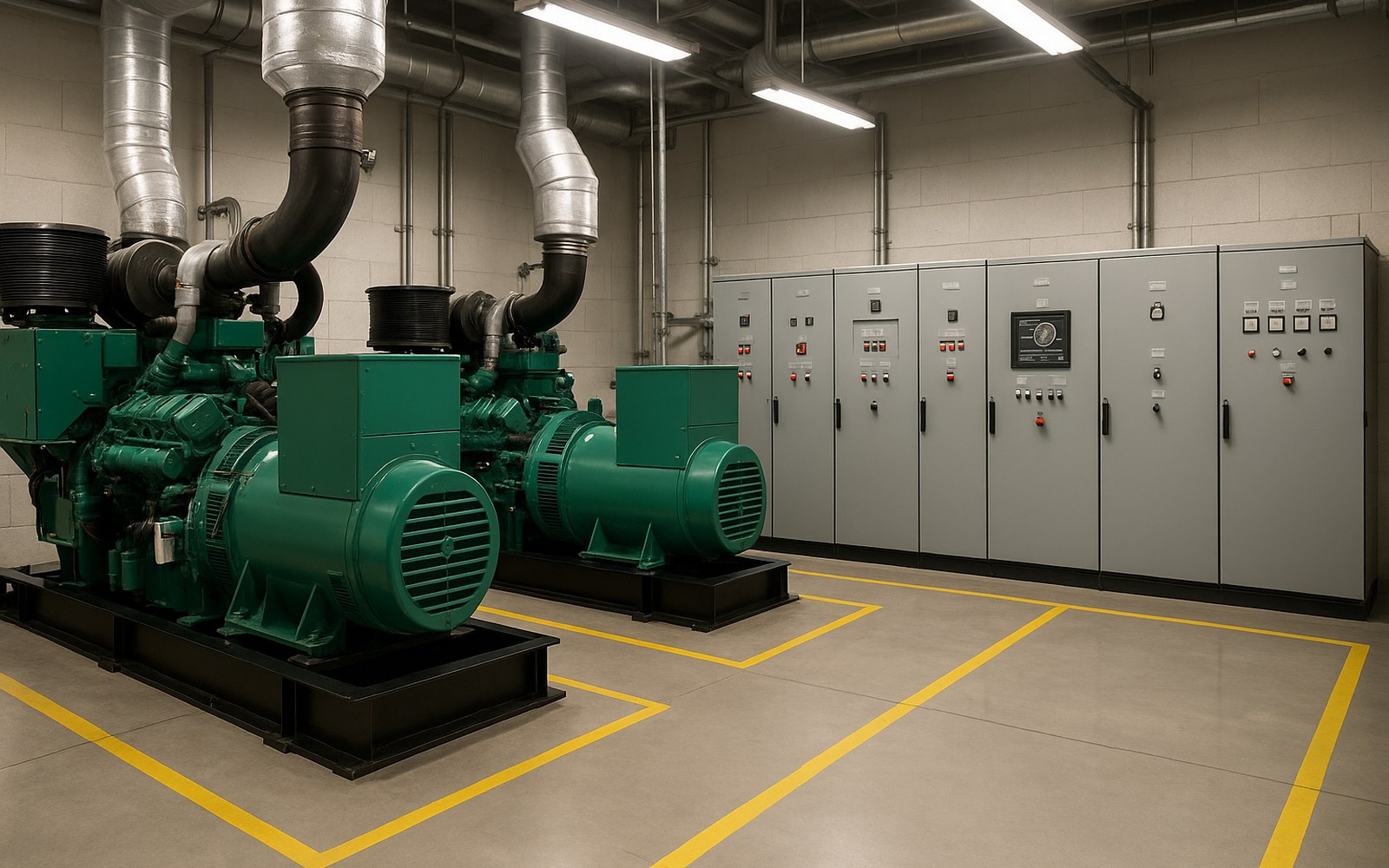
If you have quoted generator paralleling switchgear for a hospital, a water plant or a government site, you know the one-line diagram is the easy part. It shows the generators, their breakers, the bus and a main breaker.
It does not show who writes the control program, what must keep working when the master controller fails, or how many days your engineer spends on site. Those answers are in the specification.
So for this guide we read five public specifications all the way through, with the price in mind.
They come from the Department of Veterans Affairs, the University of Maryland, Baltimore, the Fayetteville Public Works Commission in North Carolina, the U.S. military and the City of San Diego.
They agree on what the gear must do, and they disagree on most of what sets the price. Here is a sample of what they hold:
- One owner lets the paralleling controls sit in the switchgear, in a separate cabinet or inside each generator, and says the functional requirements are the same for all three.
- Another makes the generator dealer responsible for the whole switchgear package, and also asks for controls that are not tied to any one generator maker.
- One university says shed loads come back only when an operator resets them at the touchscreen. A city guideline says they come back on their own, in reverse order.
- One document sets the synchronizing window at 20 electrical degrees, and another lets you adjust it only between 5 and 15.
- One asks for "two 4-hour periods" of training, and another asks for at least five days.
Every requirement below is quoted from the document, with the page where you can check it. The documents are linked at the end.
In brief
- The first pricing question is who supplies the paralleling controls, and the five documents give five different answers.
- Read the failure clauses early, because two of the five require the system to keep working after the master controller or its PLC has failed.
- Count the load blocks on the drawings, because that is where the VA puts its load priority table.
- Utility paralleling is a bigger job than paralleling generators with each other, and only one of the five makes closed transition with soft loading part of the base scope.
- Witness tests, batteries and training vary so much between owners that none of them can come from a standard price.
- Four of the five documents contradict themselves, and each conflict belongs in the quote with the reading you priced.
The five documents
The five differ in age and in purpose. That matters when you decide how much weight to give each one.
| Document | Owner | Date | Pages |
|---|---|---|---|
| Section 26 23 13, Generator Paralleling Controls, and the paralleling paragraphs of Section 26 23 00, Low-Voltage Switchgear | U.S. Department of Veterans Affairs | 11-01-22 | 10 and 18 |
| Section 262313, Paralleling Low-Voltage Switchgear | University of Maryland, Baltimore | "Latest Update 5-6-2017" | 35 |
| Request for Proposal for Standby Power System Upgrades, Cross Creek Water Reclamation Facility, with Sections 26 23 00 and 26 32 13 | Public Works Commission of Fayetteville, North Carolina | September 2022 | 92 |
| UFGS 26 32 15, Engine-Generator Set Stationary 15-2500 kW, with Auxiliaries | USACE, NAVFAC and AFCEC | February 2026 | 123 |
| Section 16355, Generator Switchgear, CWP Guidelines | City of San Diego | February 1992 | 16 |
Read each one for what it is
- The VA section is a guide specification for hospitals. Text between double slashes, like //this//, is optional, and the engineer keeps or deletes it for each project.
- The VA puts the switchgear itself in other sections, so we also read the paragraphs of its Section 26 23 00 that deal with paralleling.
- The Maryland standard still carries the page header of a 2011 project, a renovation of the Bressler Research Building, while its text says "Latest Update 5-6-2017".
- UFGS 26 32 15 is a generator guide specification, not a switchgear specification. It still holds the synchronizing panel, the automatic paralleling sequence and the parallel operation tests.
- San Diego 16355 is dated February 1992 in its own footer. We use it for its control logic and its relay list, which are clear and complete, but not for brand names.
- Fayetteville is the only one of the five issued for a real job, a wastewater plant, so it shows what an engineer actually kept and added.
How the page numbers work
In the VA, Maryland, UFGS and San Diego documents, the printed page and the PDF page are the same, so one number is enough.
Fayetteville is one 92-page PDF that holds the request for proposal and several specification sections. Its first 16 pages carry no printed number, so for those I give the PDF page.
Inside its Section 26 23 00, printed page N is PDF page N + 36. Inside Section 26 32 13, printed page N is PDF page N + 67.
I give both numbers, for example "26 23 00, page 17 (PDF page 53)".
What the gear has to do, in plain words
A paralleling lineup does a handful of jobs. It helps to name them in plain words first, because each document prices them a little differently.
Paralleling and synchronizing
Paralleling means connecting two or more power sources so they run together on one bus. Here the sources are generators, and sometimes the utility as well.
A generator can join a live bus only when its voltage, frequency and phase angle match the bus. Matching them is called synchronizing.
A device called a synchronizer adjusts the engine speed until they match, and then closes the generator breaker.
The first generator onto a dead bus
When the utility fails, all the generators start at once and the bus is dead, so there is nothing to synchronize to yet. The first generator that is ready closes onto the bus, and the others then synchronize to that one.
"The first engine generator to achieve 90% of nominal voltage and frequency shall be connected to the bus."
U.S. Department of Veterans Affairs, Section 26 23 13, page 6Only one generator may close onto a dead bus. San Diego asks for a device that will "positively prevent more than one set from being simultaneously connected to a dead bus" (page 8).
Load sharing, load add, load shed and load demand
- Load sharing means each running generator carries its fair share of the load. The UFGS wants each set loaded "to within 5 percent of its fair share" (page 42).
- Load add means connecting loads in priority order as generators come on line, so the bus is never asked to carry more than it can.
- Load shed means dropping the lowest-priority loads when there is not enough generation, for example after a generator trips.
- Load demand means starting and stopping generators to match the load, so that a light load does not keep every engine running.
Closed transition and soft load
When the generators work with the utility, two more terms appear. Closed transition means make before break: the generators synchronize to the utility and run in parallel with it for a moment, so the load moves without an outage.
Soft load means the controls move the load across gradually rather than all at once. Peak shaving means running the generators alongside the utility for longer periods to cut the power bought from it.
Device numbers
Protective relays go by standard device numbers, so a specification can call for a function in two digits. The two that matter most here are 25 and 32.
- Device 25 is the synchronism check relay. San Diego describes a relay "designed to permit circuit breaker closure after specified phase angle conditions have been verified and condition satisfied for a specified period of time" (page 6).
- Device 32 is the directional power relay, which catches a generator that draws power instead of making it. San Diego says "Generator motoring or reverse power shall be detected by means of a solid state directional power relay" (page 6).
The other device numbers in these documents are explained in the section on protective relays below.
Paralleling switchgear: who supplies the controls
This is the first question to settle, because it decides whose hardware and whose software you are pricing. Each of the five documents answers it differently.
The VA leaves the choice open
"Generator paralleling controls shall be integral to the switchgear, or housed in a separate cubicle, or be integrated into the controls on each paralleled engine generator."
U.S. Department of Veterans Affairs, Section 26 23 13, page 4The next sentence reads, "The functional requirements are identical for all system topologies." So the VA will accept any of the three, as long as they do the same things.
That freedom is a pricing risk. Two bidders can quote very different designs, and the buyer may compare them as if they were the same thing.
Maryland names a generator maker's platform
Maryland lists five acceptable makers of the paralleling control system on pages 5 and 6: Caterpillar, ASCO, GE Zenith, Onan and Cummins, and Russelectric. Then it sets a basis of design.
"Basis of Design is Cummins Power Command"
University of Maryland, Baltimore, Section 262313, page 6Page 7 names an operator panel, the "User Interface MCM 3320". It adds that "Key Actions will meet or exceed actions defined by Cummins Power Command user interface."
Page 8 names two load add and shed modules, AUX-101 and AUX-102, that talk to that panel. Page 17 then puts the master control equipment in "a separate enclosure."
A bidder quoting another platform has to show how its screens and buttons compare with the named one.
Fayetteville gives the package to the generator dealer
"The switchgear shall be provided by the engine-generator set manufacturer and/or dealer specified in 26 32 13, Engine Generators, in order to provide a complete, coordinated power generation system."
Public Works Commission of Fayetteville, Section 26 23 00, page 1 (PDF page 37)The acceptable generator makers are Power Secure, Cummins and Caterpillar (26 32 13, page 9, PDF page 76). So a switchgear builder reaches this job only through one of them or their dealers.
Yet the same request says "Generator and transfer controls shall be non-proprietary," and wants them "compatible with Woodward control products" (26 23 00, page 17, PDF page 53).
It also puts paralleling controls in two places. They go inside the switchgear enclosure (26 23 00, page 16, PDF page 52). Each generator panel also needs "integral paralleling and load sharing controls" (26 32 13, page 11, PDF page 78).
Read together, the dealer answers for everything, the controls must not lock the owner to that dealer, and some paralleling functions sit on both sides of the cable.
San Diego splits the parts between two suppliers
The 1992 San Diego guideline has a master control section in the switchgear (page 10). But some of the parts that make paralleling work come from the generator maker.
"The following components are supplied by the engine-generator manufacturer under Section 16350 and are shipped loose for installation under this section"
City of San Diego, Section 16355, page 9The list includes "load-sharing modules, electronic governor controls" and a "VAR/Power Factor Controller." The switchgear builder mounts and wires parts it did not buy, and still has to make them work.
The UFGS keeps it in the generator specification
The UFGS puts the synchronizing panel inside the generator specification (page 82). It asks for an automatic synchronizer, manual synchronizing controls, synchronizing lights and a synchroscope.
A synchroscope is a dial that shows how far, and in which direction, the generator is out of phase with the bus.
| Document | Where the paralleling controls sit | Who answers for them |
|---|---|---|
| VA 26 23 13 | Switchgear, separate cubicle or each generator (page 4) | The bidder chooses |
| Maryland | A separate master enclosure (page 17) | The switchgear section, measured against Cummins Power Command (page 6) |
| Fayetteville | The switchgear enclosure and each generator panel (26 23 00, page 16; 26 32 13, page 11) | The generator maker or dealer (26 23 00, page 1; 26 32 13, page 9) |
| UFGS | A synchronizing panel in the generator specification (page 82) | The generator supplier |
| San Diego | A master section in the switchgear, with governor and load share parts from the generator maker (pages 9 and 10) | Split between two suppliers |
State in the quote which control design you priced and where each function lives.
Name every part you expect someone else to supply, such as governor or load share modules. If the document names a basis of design that is not yours, say plainly that you are quoting an equal and where your screens differ.
What happens when the master controller fails
The master controller is the brain that decides which generator closes first, when to add load and when to start the next engine. Two of the five documents require the system to keep working without it.
The VA spreads the logic out
"The control logic shall be distributed between the generator paralleling controls and each engine generator such that each engine generator is capable of starting and paralleling to the bus"
U.S. Department of Veterans Affairs, Section 26 23 13, page 4The sentence ends "in the event of failure of the generator paralleling controls". So each generator needs enough logic of its own to close onto a dead bus or to synchronize to a live one.
The same page adds that "the master controls will continue to function in the event of a master control and display panel failure." The touchscreen cannot be the only way to run the system.
The VA then tests this on site. Page 9 asks you to "Verify undisrupted operation of the system under conditions of loss of the generator paralleling controls."
A design that works only through one master processor will fail that test, so price the design that passes it.
Fayetteville wants hard switches as well as a screen
Fayetteville names the master PLC, the programmable logic controller that runs the sequence. It must be a "Modicon Momentum, Allen-Bradley Compact Logix, or GE VersaMax" (26 23 00, page 17, PDF page 53).
The document then makes sure the plant can run without it:
- Transfers to and from the utility must work "whether the Master Generator Switchgear PLC (PLC-GEN) is operational or not" (26 23 00, pages 20 and 21, PDF pages 56 and 57).
- Operators can synchronize each generator by hand, using selector switches that share "a single, removal T-handle", so that only one manual circuit can be live at a time (26 23 00, page 19, PDF page 55).
- A list of controls must be "physical devices (not soft devices simulated via the touch screen)" (26 23 00, page 20, PDF page 56).
- That list includes "An analog synchroscope with 360 degree movement (not a digital display)" for each generator, on a swing-out panel.
That is a second, hard-wired control system beside the PLC. It takes panel space, wiring and test time that a screen-only design would not.
Maryland and San Diego say less
Maryland asks the system to recognize a failed "first-to-close" generator and carry on (page 10), and it shows a "Controller malfunction" alarm (page 20). It does not say what must happen while the controller is down.
San Diego asks the load management controller to bring the next unit on line before it shuts down a unit with a "preliminary fault" (page 11). It does not deal with the controller itself failing.
Find the failure clause before you choose the control design.
If the document asks for operation without the master, describe in the quote what still works when the master is lost and how you will show it in the field test. If the document is silent, say what your design does, so the buyer can compare bids fairly.
Screens, networks and the plant's SCADA
What the operator screen must show
- The VA asks the master panel to "indicate and trend" its metering on a per-phase and summary basis (page 5). Trending means storing values over time and drawing them as charts.
- Maryland asks for a touchscreen "with minimum viewing area of sixty (60) square inches" (page 17). It lists ten screens, from a main menu and a one-line diagram to an alarm summary that holds at least 32 alarms (pages 18 to 20).
- Maryland also wants a historical trend chart "with intervals no shorter than five (5) minutes and a minimum duration of four (4) hours" (page 18).
- Fayetteville asks for "a minimum 19 inch (diagonal), color TFT industrial display" with at least 1920 by 1080 pixels (26 23 00, page 17, PDF page 53).
Someone has to draw and test each of those screens. Count the screens, not just the display.
Network and protocol
The VA connects the controls, switchgear, generators, transfer switches and annunciators over a "dedicated //fiber optic network// //dedicated CAT5E network//" (pages 5 and 6). The double slashes mean the engineer picks one.
"All equipment shall share a non-proprietary and open topology and communications protocol."
U.S. Department of Veterans Affairs, Section 26 23 13, page 6The VA also puts the cabling in this section: "Provide all necessary fiber optic and copper media, raceways, hardware, software, and programming" (page 6). A raceway is the conduit or tray the cable runs in.
If you quote only the gear, exclude the field cabling in writing.
Fayetteville asks each generator panel for a port that sends all its data to the switchgear "via either Ethernet/IP or Modbus RTU protocol" (26 32 13, page 13, PDF page 80).
How much of the SCADA work is yours
SCADA is the plant's central monitoring and control system. Fayetteville asks the bidder to "Provide a register of all available data points, and the Commission will select up to 300 points to be transmitted" (26 23 00, page 21, PDF page 57).
Starting and stopping the generators and opening and closing the breakers from SCADA are also in the bidder's scope, over the same fiber link.
The owner keeps the other end: "Materialman is not responsible for any work on the Commission’s SCADA system" (PDF page 3). Materialman is this request's word for the design-build bidder.
Maryland wires the generator alarm and run status as dry contacts to a named meter, "the ION 7650 meter" (page 11). It also asks the field testing agency to check "Remote communications to campus utility management and automation servers" (page 34).
Count the screens and the SCADA points, and price the programming hours from those counts. State which protocol you provide at your terminals and exactly where your scope ends.
Load add, load shed and when to start the next generator
This is where the documents disagree most on numbers. It is also where the drawings carry part of the requirement.
The load table lives on the drawings
"A/E shall show on the drawings the arrangement and priority of all Essential, Standby, and Normal Electrical System loads"
U.S. Department of Veterans Affairs, Section 26 23 13, page 4, a note to the specification writerThe master panel must then manage loads "including prioritization of Essential and Normal Electrical System loads and groups of loads as shown on the drawings" (page 5).
The controls must also "prevent the automatic transfer of loads to the bus until there is sufficient capacity to carry these loads" (page 6).
Each load block on the drawings is an output, a wire and a test step. If you price from the specification alone, you will not know how many there are.
Maryland's named modules handle "up to six (6) load feed breakers or ATS'" (page 8), where ATS means automatic transfer switch. A seventh load block means another module.
When to start and stop generators
| Document | Start another generator | Stop a generator |
|---|---|---|
| VA, page 7 | Keep the reserve on line at no less than 10% of one generator | Keep the reserve at no more than 110% of one generator |
| Maryland, pages 19 and 21 | Pickup set point adjustable from 90% to 40% | Dropout adjustable from 20% to 70%, with the load below the limit for 15 minutes |
| UFGS, page 85 | Load above a set point of 50% to 100% for about 10 seconds | Load below the set point for a time the designer fills in |
| Fayetteville 26 23 00, page 27 (PDF page 63) | All available generators start if the program is disabled or a critical alarm occurs | Below 25% (adjustable) for 15 minutes, stopping the unit with the highest run hours, then a second unit below 30% |
| San Diego, page 11 | Load above a preset value | Load below a preset value, with a delay to ignore short swings |
Look closely at the Maryland ranges. The pickup can be set as low as 40% and the dropout as high as 70%.
Set that way, the controller could start and stop the same generator over and over, which is worth a clarification.
What triggers load shedding
- The VA sheds on frequency. If the load is too much for the bus and the result is "a decrease in system frequency to 58 Hz or less, load dumping will be initiated" (page 7).
- San Diego sheds on capacity. If load rises faster than another unit can come on line, or a unit trips, the controller sheds "sufficient load to bring demand down to the available generating capacity" (page 12).
- Maryland sheds on bus overload, and "additional load continues to be shed until bus returns to normal frequency" (page 21).
How shed loads come back
| Document | What happens after a shed |
|---|---|
| VA, page 7 | Automatic. When the next generator parallels, "the load dump signal will be automatically cancelled." |
| Maryland, page 21 | Manual. "Loads shed can be reconnected to bus only by manual reset at HMI." |
| San Diego, page 12 | Automatic, in order. "the loads shall then be reconnected in the reverse order in which they were shed" |
HMI stands for human machine interface, which here means the touchscreen. Manual restore and automatic restore are different programs and different tests, so ask which one is wanted if the document is silent.
Both the VA (page 6) and Maryland (page 21) also want an operator override, so that a low-priority load can be added by hand while someone watches the bus.
Take the load count from the drawings and write it into the quote, for example "priced for eight load add and shed blocks".
State the start and stop set points you will commission, what triggers a shed, and whether restore is manual or automatic.
Synchronizing and the protective relays
The synchronizing window
The synchronizer closes the breaker only when the generator is close enough to the bus. How close is written into the documents, and they do not agree.
- Maryland wants the voltage within 1% and the "phase angle within twenty (20) electrical degrees of paralleling bus for 0.5 seconds before circuit-breaker closing" (page 10, repeated on page 15).
- San Diego says "The phase angle acceptance band shall be continuously adjustable between plus or minus 5 electrical degrees and plus or minus 15 electrical degrees" (page 8).
Maryland's 20 degrees falls outside San Diego's whole adjustable range. A synchronizer chosen to meet one of them may not meet the other, so check the range of the device you price.
How long to try before giving up
If a generator cannot be synchronized, the controls must stop trying and raise an alarm. Maryland asks for a "fail-to-synchronize time delay" adjustable from 10 to 120 seconds (page 10). San Diego asks for an adjustable period "ranging from 0 to 3 minutes" (page 9).
Fayetteville adds a case for the utility. If the generators cannot synchronize back to the utility, the controls send a fail-to-synchronize signal to the plant control system and keep running the plant on the generators (26 23 00, page 21, PDF page 57).
Relays by device number
Only San Diego lists the switchgear's own relays by device number. Each generator section gets the following (page 9):
- Device 51V is overcurrent protection with voltage restraint, and 51G is neutral overcurrent protection.
- Device 32 is the directional power relay that catches reverse power.
- Device 47 or device 46 detects unbalance or a reversed phase sequence.
- Device 25 checks synchronism, and device 86 is a lockout relay that holds the breaker open until someone resets it by hand.
- Device 27/59 covers under and over voltage, and 81 covers under and over frequency.
- Device 87 is generator differential protection, which takes its inputs from current transformers.
The master section adds its own 81, 27/59, 25, 32 and 86 (page 10). San Diego also wants relays "of the type acceptable to the electric utility" and says "Settings shall be confirmed with utility" (page 5).
Maryland and the VA describe functions instead of numbers. Maryland trips the generator breaker "when reverse power condition exceeds 10 percent of generator sets kilowatt for three seconds" (page 10), which is a device 32 job without the number.
The VA mentions relays only in its status display list, "including protective relays if applicable" (page 4).
Fayetteville names its utility tie relays by model: "The relays associated with each recloser shall be SEL model 651R, no exceptions" (PDF page 12). Functions 25, 27/59, 47, 67, 81O/U and 32 must be enabled (PDF pages 12 and 13).
Build a relay list for every breaker from the document, by device number or by function. Where the document gives a function without a number, write down the number you priced.
Where it gives a setting range, check that the device you priced covers that range.
Paralleling with the utility
Running generators in parallel with each other on their own bus is one job. Running them in parallel with the utility is a bigger one, because the utility then has a say in the protection.
Fayetteville makes it the base scope
"Controls shall be installed to allow parallel operation and closed transition power transfer in both directions between the standby power generators and the utility sources."
Public Works Commission of Fayetteville, Section 26 23 00, page 16 (PDF page 52)Once in parallel, the controls must "softly load/unload the generators" (26 23 00, page 17, PDF page 53).
On the way back to the utility, they open the main breaker "when only 100kW (adjustable) of the plant load is being served by the generators" (26 23 00, page 23, PDF page 59).
There is also an extended parallel mode, where the generators carry the plant while the utility stays connected. The utility must keep supplying at least 100 kW.
If the import drops below that, "the main circuit breaker shall open immediately" (26 23 00, page 25, PDF page 61). If power ever flows back into the grid, the recloser on that line opens at once.
In the base bid this mode is set up "for use with the future generator only". The alternate bid sets it up for all the generators (26 23 00, page 25, PDF page 61).
The utility side has named hardware of its own. The reclosers, which are breakers mounted on utility poles, must be "the Viper Series by G&W, no exceptions," with "a closing speed of no more than 60ms" (PDF page 12). The bidder also supplies the wooden poles (PDF pages 11 and 12).
The other four treat it as an option or a warning
- The VA offers a "Utility Peak Demand Reduction Mode" between double slashes, so the engineer may keep or delete it (pages 7 and 8). If a normal source fails while it runs, "the peak demand reduction operation shall be terminated" (page 8).
- San Diego includes peak shaving in its load management system. When utility demand passes a set level, "a signal shall initiate peak shaving mode of operation" (page 12).
- Maryland says the "Existing building management system will initiate Demand Response Mode start and stop" (pages 12 and 17).
- The UFGS warns that utility paralleling "requires a 2/3 pitch generator winding" (page 42). It adds, "Do not specify this option without also providing a design for the protective device coordination which has been approved by the utility involved."
The UFGS goes further in its first note. When generators will run in parallel with the utility or with each other, it tells the designer to "contact the responsible Facilities Engineering Command (FEC) for determination as to which specification or sample specification is to be used" (page 6).
So on a military job, the generator specification in your hand may not be the document that governs the paralleling gear.
Closed transition between two utility feeders, rather than between generators and the utility, is a separate subject. We covered it in main-tie-main switchgear.
Before pricing utility paralleling, ask for the utility's interconnection requirements and ask who gets the relay settings approved.
If the mode is optional or only "provisions for future", state exactly which hardware and which programming you included now.
Breakers, bus and the short-circuit rating
Drawout power breakers or molded case breakers
A drawout breaker sits on rails in its own compartment. It can be racked out to a test or disconnected position without unbolting any cables. Four of the five documents ask for drawout breakers:
- Fayetteville says "Switchgear shall be UL 1558 Listed" (26 23 00, page 5, PDF page 41) and wants every breaker "drawout type and enclosed in a separate metal compartment" (26 23 00, page 9, PDF page 45).
- San Diego cites UL 1558 (page 1) and asks for "draw-out circuit breakers fused with current-limiting fuses as necessary" (page 4).
- Maryland wants compartments "equipped to house drawout-type circuit breakers" (page 26).
- The VA low voltage switchgear section asks for breakers that are "dead front, drawout, stored energy type" (26 23 00, page 10).
The UFGS is the odd one out. Its generator breaker "must comply with UL 489 requirements for molded case, adjustable thermal magnetic trip type circuit breaker" (page 78).
Its switchboards conform to "NEMA PB 2 and UL 891" (page 78). That is a different product family at a different price, and the difference is explained in UL 891 vs UL 1558.
Electrically operated breakers
The controls must open and close the breakers on their own, so the breakers need motor-charged mechanisms and close and trip coils. The VA says so directly.
"When used as generator paralleling switchgear, breakers shall be electrically operated."
U.S. Department of Veterans Affairs, Section 26 23 00, page 11The same page says that, unless shown otherwise, breakers of 1600 amperes and smaller are manually operated. In paralleling gear the sentence above overrides that, so every breaker needs an electrical operator.
The rating nobody states
None of the five documents gives a short-circuit rating in kA. That rating is the fault current the bus and breakers must survive, and it drives the breaker frames and the bus bracing.
- San Diego offers four bracing levels to choose from, "[50,000][100,000][150,000][200,000] amps RMS symmetrical" (pages 3 and 4).
- Maryland ties the rating to the biggest breaker, telling the engineer to "Match rating of highest-rated circuit breaker in switchgear assembly" (page 25).
- Fayetteville hands it to the bidder's own work: "Short circuit conditions shall be defined by the power systems studies included in the RFP" (26 23 00, page 6, PDF page 42).
The Fayetteville bidder also pays for those studies. They must be signed by a North Carolina engineer with at least 15 years of experience (PDF page 13).
They must be run in SKM PTW version 9.0 or newer, or ETAP version 20, because "No other software analysis packages are acceptable" (PDF page 15).
Fayetteville also asks for a 30-cycle short circuit withstand rating (26 23 00, page 6, PDF page 42). That means the bus must hold a fault for 30 cycles, which is half a second at 60 Hz, so that a breaker further downstream can clear it first.
Size the bus for a generator you are not selling
Fayetteville wants "a spare circuit breaker for a future engine-generator set" (26 23 00, page 1, PDF page 37). It wants a bus sized for "the entire generator system, including future generator capacity as identified herein" (26 23 00, page 8, PDF page 44).
The controls must then accept that future unit "without having to add any additional paralleling and load sharing hardware" (26 23 00, page 21, PDF page 57).
You are pricing hardware and programming for a generator that is not in the contract.
Write the kA rating, the bus rating and the breaker type you priced into the quote, with the source of each.
If the rating depends on a study you have not run yet, say the price assumes the rating you chose and will change if the study gives a higher one.
The station battery
The station battery is the DC battery that closes and trips the breakers and keeps the relays and controls alive when there is no AC power. On a paralleling lineup, that is exactly the moment it is needed.
The five documents ask for five different batteries.
| Document | Battery asked for | Sizing rule |
|---|---|---|
| VA 26 23 00, page 12 | "maintenance-free nickel-cadmium", 125 or 48 volts | Continuous loads for 8 hours, then the breaker duty, with a 50 percent safety margin |
| Fayetteville 26 23 00, pages 15 and 16 (PDF pages 51 and 52) | "sealed pocket plate nickel-cadmium type", 48 VDC | All breakers operating at once, plus 25% spare capacity |
| San Diego, pages 13 and 14 | Two batteries, "Nominal 125 VDC system, lead-acid Plante type" | A close and trip, then a close, open, close and trip, all within 15 minutes, with a recharge within 16 hours |
| Maryland, page 24 | "Lead-calcium type in sealed, clear plastic or glass containers" | Arranged to operate ungrounded, with no more than 3 cells per container |
| UFGS, page 86 | Lead-acid or nickel-cadmium, and "Valve-regulated lead-acid batteries are not acceptable." | Able to close and trip all breakers at once after the discharge period, with a 20-year rated life |
Two ask for nickel-cadmium, two ask for different kinds of lead-acid, and the UFGS allows either one except valve-regulated lead-acid. The voltages run from 48 to 125. No single standard battery answers all five.
San Diego wants two complete batteries with a selector between them. But it asks for "a filtered, dual-rate, charger for the station battery" in the singular (page 14), so ask whether that means one charger or two.
The UFGS adds a warranty for the battery alone, asking for "a rated life of 20 years and a manufacturer's 5-year, no cost replacement guarantee" (page 86).
Quote the chemistry and voltage the document names, and attach the sizing calculation. If the document leaves the voltage open, as the VA does with 125 or 48, state which one you priced and why.
Factory tests, witness tests and the test on site
Who may watch the factory test
| Document | Factory test | Witness |
|---|---|---|
| VA 26 23 13, page 2, and 26 23 00, page 2 | "Factory Tests shall be required." The switchgear is tested with the breakers in the connected position. | No witness wording |
| Maryland, pages 22, 25 and 31 | "Factory assembled and tested", with plant functional tests listed only for the medium voltage article | No witness wording |
| Fayetteville 26 23 00, page 29 (PDF page 65), and 26 32 13, page 22 (PDF page 89) | Certified shop tests, with notarized and certified copies of the reports | "Witnessed Shop Tests a. None required." |
| UFGS, page 87 | Factory tests of each generator set | "The Contracting Officer may provide one or more representatives to witness inspections and tests." |
| San Diego, pages 14 and 15 | A functional test at the plant, with dielectric tests at 2200 V and 1500 V | The owner and construction manager reserve "the right to witness factory tests", with two weeks' notice |
A witness test has to be planned around the visitors' dates, and the test bay and setup are held until they come.
Where the right to witness is only reserved, price the witness test as an option and say so.
The factory test may not use your gear
"When controls and switchgear are not provided as part of the generator set manufacturer's standard package, the actual controls and protective devices provided for the project are not required to be used during the factory test."
USACE, NAVFAC and AFCEC, UFGS 26 32 15, page 87So on a UFGS job the generator can pass its factory test on the maker's standard controls. Your paralleling gear may meet the generators for the first time on site.
None of the five documents asks for a combined factory test of the switchgear and the generators together.
The integrated test on site
- Fayetteville asks for "Three (3) closed transition transfers from the utility service to the generator and then back to the utility service at 2000kW of load" (26 32 13, page 24, PDF page 91). Three more follow at the plant's own load, and one transfer is made with a generator locked out.
- Fayetteville also wants the loads to stay on each source "for at least five (5) minutes in between transfers" (26 32 13, page 24, PDF page 91).
- If the plant cannot load the system enough, "the manufacturer shall connect a resistive load bank to a spare circuit breaker" (26 32 13, page 24, PDF page 91). A load bank is a rack of resistors that soaks up power for testing.
- Fayetteville wants "field verification of each and every part of the sequence of operations", with the owner's people watching (26 23 00, pages 29 and 30, PDF pages 65 and 66).
- The UFGS tests each set in parallel with the others "individually and in all combinations" (page 110). The test runs at "a power factor other than unity to verify proportional reactive power sharing" (page 109), so the load bank must draw reactive power, not only resistive power.
- The UFGS also parallels each set with the utility for 15 minutes, and asks for "a minimum of two successive, successful tests" of the automatic sequence (page 111).
- The VA tests the loss of the paralleling controls (page 9), as described above.
- San Diego's performance test covers five operations, including automatic and manual synchronization and "The correct operation of key interlocks" (page 16).
The number of combinations grows quickly. With four generators there are already six pairs to test before you count the groups of three.
Count the combinations before you count the test days.
Price the integrated site test as its own line, with the days, the load bank and who pays for the fuel.
Fayetteville puts the fuel on the bidder: "All fuel, lubricants, and other fluids required to complete all field tests shall be paid for by the Materialman" (26 32 13, page 24, PDF page 91). It also requires "a test plan" approved by the owner before functional testing starts (26 23 00, page 30, PDF page 66).
Training, field service, spares and warranty
Training hours
| Document | Training asked for |
|---|---|
| VA 26 23 13, page 10 | "two 4-hour periods" by a factory-trained technician |
| Maryland, page 35 | "a minimum of one (1) eight hour session" |
| Fayetteville 26 23 00, page 30 (PDF page 66) | "two (2) sessions of eight (8) hours each" for the switchgear, plus two four-hour sessions for the generators (26 32 13, page 21, PDF page 88) |
| UFGS, page 119 | One 8-hour day for operating staff and one for maintenance staff, taught by the generator maker's own employees |
| San Diego, page 3 | "at least [5] days", with training materials for up to 7 people |
That runs from 8 hours to at least five days for the same kind of equipment. The square brackets around San Diego's number mean the engineer may change it, so check the issued copy.
Field service days
Fayetteville counts the switchgear manufacturer's visits one by one. It asks for two working days during installation, two for startup, five for functional testing, two for training, and one day two months before the warranty ends (26 23 00, page 31, PDF page 67).
It then adds, "Any additional time required to achieve successful installation and operation shall be at the expense of the Materialman." The listed days are a floor, not a cap.
The UFGS asks for a startup engineer "regularly employed by the engine-generator set manufacturer", who must be on site full-time during preliminary operations and acceptance tests (page 113).
The VA asks the controls manufacturer's representative to "technically supervise and participate during all of the field adjustments and tests" (page 9).
Spares
- Fayetteville asks for a "Spare PLC CPU programmed with the final as-built program version," a PLC power supply, one I/O module of each type and two sets of fuses (26 23 00, page 4, PDF page 40).
- Maryland asks for fuses at "10% of each type and rating used" and for 10% spare indicating lights (page 5).
- San Diego asks for a "Card extender for each type of protective relay," a full breaker test kit and test plugs (page 14).
Warranty
Fayetteville is the only one of the five with a switchgear warranty term in the section itself. The warranty "shall in no event be for a period of less than ten (10) years from date of delivery" and covers repair labor and travel (26 23 00, page 5, PDF page 41).
The generator warranty in the same request is "ten (10) years or two thousand (2000) hours of operation, whichever comes first" (26 32 13, page 7, PDF page 74).
Because the generator panels hold paralleling controls too, the same function can sit under two different warranty terms.
Maryland sends you to another section for its warranty (page 5). The VA, the UFGS and San Diego give no switchgear warranty term in these sections, apart from the UFGS battery guarantee.
Price training, field days and spares from the document's own numbers, and list them line by line in the quote. For a long warranty, state what it covers, the date it runs from, and what it leaves out.
When a document disagrees with itself
Four of the five documents contradict themselves somewhere, and some of it looks like template text that was never edited out.
A contradiction is not a reason to stop reading. It is a reason to write down which reading you priced.
Fayetteville: one maker, or two lists
"The Materialman shall obtain the switchgear from one manufacturer who shall also manufacture the structure and major equipment components, which includes, but is not limited to, assemblies of circuit breakers and auxiliary housings, drawout type air circuit breakers"
Public Works Commission of Fayetteville, Section 26 23 00, page 1 (PDF page 37)Page 5 then says, "The switchgear shall be manufactured by Power Secure, Russelectric, ASCO, Cummins Power Generation, or Caterpillar. Circuit breakers shall be manufactured by Eaton, Square D, Siemens, or ABB" (PDF page 41).
The two lists have no name in common. Read literally, no bidder can meet both sentences, because the switchgear maker would also have to be one of the breaker makers.
The VA: a slab and a section
The VA says "The slab shall be of adequate size to project at least 100 mm (8 inches) beyond the equipment" (26 23 13, page 9). One hundred millimetres is about 4 inches, not 8.
Maryland goes the other way. Its base may extend "no more than three (3) inches in all directions beyond the maximum dimensions of switchgear" (page 32). If the pad is in your scope, those two owners want different pads.
The VA's low voltage switchgear section opens with a warning: "This specification is not for general use. Use Section 26 24 13, DISTRIBUTION SWITCHBOARDS for most applications" (26 23 00, page 1).
Yet 26 23 13 sends low voltage paralleling gear to that very section (page 1), and 26 23 00 carries paragraphs written only for paralleling (pages 11 and 12).
Maryland: leftovers from the template
- Page 1 defines "ATS: Acceptance Testing Specifications." Page 8 then uses "ATS'" to mean automatic transfer switches.
- Page 1 describes "metal-clad" gear under a low voltage title. Page 25 heads its low voltage article "METAL-CLAD, CIRCUIT-BREAKER SWITCHGEAR (1000 V AND LESS)" and cites IEEE C37.20.1, which Fayetteville's own list calls the standard for metal-enclosed low voltage power circuit breaker switchgear (26 23 00, page 2, PDF page 38).
- The medium voltage article cites "IEEE C37.20.3" on page 29, but tests the finished assembly "according to IEEE C37.20.2" on page 31.
- Page 30 leaves in both "Control Power: 24-V dc for closing and tripping." and "Control Power: 120-V ac for closing and tripping."
- Page 28 leaves in two different undervoltage trip devices, one instantaneous and one with a time delay.
San Diego: two numbers for one generator section
San Diego calls the generator section "Section 11500 Engine Generator" on page 1 and again on page 11, but "Section 16350" on page 9.
It also lists device 46 and device 47 as required relay types (page 6), then lets each generator section have one or the other (page 9).
Keep a list of every contradiction as you read, with both page numbers. A specification compliance matrix is a good place to keep it.
Send the important ones as questions before the bid, and put the rest in the quote's clarifications with the reading you priced.
Questions to send before you price paralleling switchgear
Most of what changes the price can be settled with a short list of written questions. These come straight from the gaps and conflicts above.
- Where should the paralleling controls live, and who supplies the governor and load share hardware in each generator?
- What must keep working when the master controller or PLC fails, and how will that be tested?
- How many load add and shed blocks are there, and which drawing holds the priority table?
- Should shed loads come back automatically, or only when an operator resets them?
- Which start and stop set points, synchronizing window and fail-to-synchronize time should be commissioned?
- Will the gear run in parallel with the utility, and if so, which utility rules apply and who gets the relay settings approved?
- What is the short-circuit rating, and who runs the study that sets it?
- Which battery chemistry and voltage are wanted, and is it one charger or two?
- Is the factory witness test required, or is it only a right the owner keeps?
- Who supplies the load bank and the fuel for the integrated site test?
- How many SCADA points and which protocol are in scope, and where does the switchgear scope end?
- Which of the conflicting sentences apply, and may the rest be excluded?
Send them early, in writing, through whoever issued the document. An answer that goes to every bidder is the only kind that makes the prices comparable.
Writing the quote so it can be compared
The reading is only worth something if it reaches the quote. For a paralleling lineup, the quote should say these things plainly:
- It names the documents, sections, amendments and drawing sheets you priced from.
- It describes the control design, where each function lives, and what still works if the master fails.
- It lists the breakers by type, rating and operation, and gives the kA rating with its source.
- It counts the load blocks, screens, SCADA points and generator combinations you priced.
- It gives services in days and trips, with the rate for extra days.
- It lists exclusions, such as field cabling, the owner's SCADA work and parts the generator maker supplies.
- It lists clarifications, meaning every conflict you found, each with the reading you priced.
The general method for turning a switchgear specification into a quote, step by step, is in how to quote switchgear.
What happens after award, when the engineer checks your drawings against the same document, is in what engineers actually reject in a switchgear submittal.
Where Mavlon fits
We read these five documents ourselves for this guide, page by page, with a pencil and a list of questions.
Mavlon's AI Quoting Engine does that reading on the documents your customer sends. It reads the specification and the drawings, lists every requirement that changes the price with its page, and shows where the documents disagree with each other or with themselves.
It then drafts a first quote from your own pricing, for your estimator to check.
It does not decide whether you comply, and it does not set the price, because your applications engineer does both. There is more on how it handles specifications on the AI specification review page.
Sources
- U.S. Department of Veterans Affairs, Section 26 23 13, Generator Paralleling Controls, 11-01-22.
- U.S. Department of Veterans Affairs, Section 26 23 00, Low-Voltage Switchgear, 11-01-22.
- University of Maryland, Baltimore, Section 262313, Paralleling Low-Voltage Switchgear, latest update 5-6-2017, with a March 11, 2011 project header.
- Public Works Commission of Fayetteville, North Carolina, Request for Proposal for Standby Power System Upgrades, Cross Creek Water Reclamation Facility, September 2022.
- USACE, NAVFAC and AFCEC, UFGS 26 32 15, Engine-Generator Set Stationary 15-2500 kW, with Auxiliaries, February 2026.
- City of San Diego, Section 16355, Generator Switchgear, CWP Guidelines, February 1992.
Found a mistake? Write to atishay@mavlon.co and we will fix it.
Bring a specification you have already quoted
If your team quotes generator paralleling gear from owner specifications, bring one you have already priced to a demo. We will go through it with you and show the requirements that change the price, each tied to its page, and the places where the documents disagree.
Or read what Mavlon does for switchgear and switchboard builders, on one page: AI quoting for switchgear and switchboard manufacturers.
Book a demo