Single Line Diagram Benchmark
We tested how well the reading step of Mavlon's AI Quoting Engine reads single line diagrams, using ten public switchgear packages from 9 countries. On the 9 packages run so far, it matched 196 of 205 checks against answer keys written before the runs, in 6 languages.
Two switchgear buyers told us the same thing this autumn: the slow part of a quote is reading the single line diagram, especially when the drawings come from many countries. So we built a test that anyone can check. We took ten public packages from nine countries, wrote down what each single line diagram says, and then let the reading step of Mavlon's AI Quoting Engine read each package once.
This page shows every score, every miss, and the answer keys, so you can judge the result yourself. We have run nine of the ten packages so far, and we will update this page when the last one finishes.
Can AI read electrical drawings? What this test measures
A single line diagram, which is called a one-line diagram in the United States, shows a whole switchgear lineup on one sheet. One line stands for all three phases. The sheet shows every panel, breaker, transformer and relay, and how the power flows between them. For a switchgear maker, most of the price comes from this one drawing.
The test checks the reading that a proposal team does before anyone prices a job. For each drawing, the answer key holds 11 to 33 checks. For example, we check:
- how many panels or cells there are, and what each one is for;
- the switching device in each panel and its rating;
- the transformers, with their ratings, voltages and connections;
- the protection relays, meters, current transformers and cables;
- the notes on the drawing that change what gets built.
The test also asks where the drawing and the written documents disagree, because that is where a quote goes wrong. It does not measure pricing. Pricing is the step that comes after the reading, and it depends on each manufacturer's own rates and rules.
How the test was run
- We used the same setup for every package. The reading step of Mavlon's AI Quoting Engine read each package, with the same written task every time and the same tools: render a page, crop and zoom into it, and read its text layer if it has one.
- We did one run per package. There were no reruns to pick the best result, and we gave no hints about the drawing.
- We kept each run fenced in. Each run could open only its own package folder. A log of every step shows that no run tried to open a file outside its folder.
- We wrote the keys first and scored the runs after. We wrote the answer keys before any run by reading each drawing label by label. We scored each run against its key only after it had finished.
- We prepared the keys apart from the runs. The keys were prepared at Mavlon with AI help, by reading each drawing label by label, before any run started. A member of our engine team then spot-checked a sample of the keys against the drawings and found them correct. Where a run disagreed with a key, we went back to the drawing and settled it. Four times, the run caught something our key had missed or described too loosely.
The results so far
Across the nine packages we have run so far, the reading matched 196 of 205 checks. The table shows each package, what kind of drawing it is, and what the reading got wrong.
| Package | Drawing | Checks right | Time | What it missed or read differently |
|---|---|---|---|---|
| Ottawa, Canada (English) | Clean CAD drawing with no text layer; the specification is a scan | 27 of 27 | 36.5 min | Nothing. |
| Fère-Champenoise, France (French) | One A3 sheet with a text layer; key-lock symbols about 1 mm tall | 18 of 18 | 9.6 min | Nothing. |
| DTU Lyngby, Denmark (Danish) | Small pictures at about 100 pixels per inch inside a Word document | 10 of 11 | 15.2 min | It read one transformer feeder as a fuse-switch where the key says breaker. The drawing supports either reading, and the run marked it as unsure. |
| Bogotá, Colombia (Spanish) | Dense CAD export, with ratings drawn as graphics | 31 of 33 | 21.1 min | It did not mention that the equipment list skips E5 and E7, and it left out one 630 A busway rating. |
| Oberegg, Switzerland (German) | Vector drawing with the ratings as tiny outlined text | 12 of 12 | 9.7 min | Nothing. |
| San Antonio, United States (English) | CAD drawing saved as a 150 pixel per inch picture | 27 of 28 | 19.2 min | It recorded both feeder breakers as CB-1 but did not point out that the label is used twice. |
| Terni, Italy (Italian) | Clean CAD with the text turned into lines, inside a 332-page file | 22 of 23 | 27.3 min | It called two 1250 A switches on the generator board outputs. They sit where the generator cables come in, so they are incomers. |
| Leipzig, Germany (German) | Picture of a clean CAD print with no text layer, in a 28-file tender | 33 of 33 | 22.7 min | Nothing. It read all 28 files in German, and it listed 23 places where the documents disagree. |
| POWERGRID SS-19, India (English) | Paper scan with fold lines, red pen marks and an approval stamp | 16 of 20 | 32.4 min | On the scanned Champa sheet, it read the bay, the breaker, the current transformers, and every rating correctly. However, it missed the isolator type, the 120% rating on the current transformers, one of the three handwritten bay numbers, and the list of existing bays. |
| Rasra, India (English) | CAD drawing saved as a black and white picture, rotated | Not run yet |
Three of the packages are not requests for quotation. The French sheet comes from a permit file, the Danish document is a buyer's technical standard, and the Swiss drawing comes with a utility letter. We kept them because they still test the reading. The Danish and Swiss runs said in their first answer that the package was not a request for quotation, and the French run noted that the sheet looks like a permit drawing.
Where the reading was better than our keys
- In Ottawa, note 4 on the drawing asks for two weekend shutdowns while note N-3 plans one. Our key had only N-3.
- In Ottawa, the run read 15353 as the number of a spare Kirk key, which is what the sheet says. Our key had described it more loosely.
- In San Antonio, the run counted four taps on the bus where our key had counted three labels. The run is right.
- In Bogotá, it noticed that cell C13 is labelled for one building's metering while its meter tag points to another table.
Contradictions between the drawing and the documents
Every run also listed the places where the drawing and the written documents disagree. We checked 25 of them against the documents, page by page. Twenty-two hold up exactly as the run described them, and three are better described as questions than as contradictions.
Some of them change the price directly. In the San Antonio bid, every breaker on the one-line diagram is marked 95 kV BIL, while the specification says 60 kV. In the Terni hospital package, the bill of quantities prices two bus couplers as circuit breakers, while the drawing shows them as switch-disconnectors. We show six of these examples, and explain what each one does to the quote, on our AI bid review for switchgear page.
| Package | Contradictions listed | Checked | Hold up |
|---|---|---|---|
| Ottawa | 18, plus 7 inside the specification | 2 | 2 |
| Fère-Champenoise | 6 within the drawing | 0 | |
| DTU Lyngby | 11 | 5 | 4 |
| Bogotá | 25, plus 8 inside the documents | 5 | 4 |
| Oberegg | 9 | 4 | 4 |
| San Antonio | 27 | 3 | 3 |
| Terni | 19 | 3 | 2 |
| Leipzig | 23 | 2 | 2 |
| POWERGRID SS-19 | 13 | 1 | 1 |
What makes a single line diagram hard to read
The scores held up across six languages and across both IEC and North American symbols. What changed the effort was the quality of the drawing, not its size or its language.
- Some drawings have no text layer. Six of the nine drawings had no text that a computer can copy, so the tool had to read every label straight from the picture.
- Some drawings have tiny symbols and outlined text. On the French sheet, the key-lock symbols are about 1 mm tall, and on the Swiss sheet, the ratings are tiny outlined text. Both runs zoomed to 600 dots per inch to read them.
- Some drawings are low-resolution pictures. The Danish drawings are pictures at about 100 pixels per inch. Zooming past the picture's own resolution adds no detail, and the run wasted steps doing it. The San Antonio run checked the picture's resolution first and kept its zoom close to it, which is the right habit.
- Paper scans are the hardest. The POWERGRID sheet from India is a paper scan at 150 pixels per inch, and it has fold lines, red pen marks, and an approval stamp. The run read every device and rating that sets the price, and it only slipped on the handwritten notes.
- Some packages are very long. The Terni file has 332 pages, with the single line diagram on page 228. Finding the right drawing is part of the reading.
How to test any tool on your own drawings
A test on public drawings tells you how a tool reads in general. Before you buy a tool, you should test it on the drawings you actually receive.
- Pick eight to ten packages that your team has already quoted, from more than one country if you can.
- Include at least one scan and one drawing with tiny or outlined text.
- Write the answer key before anything runs: list the panel count, the devices, the ratings and the notes.
- Run each package once, with no reruns and no hints.
- Score each country separately, and check every claimed contradiction against the page it cites.
- Count the wrong contradictions as well as the missed ones, because sending a false contradiction to a customer costs trust.
Package by package
Each package below shows the drawing, where it comes from, what made it hard to read, what the answer key checked, the score with every miss, and the contradictions we confirmed against the pages.
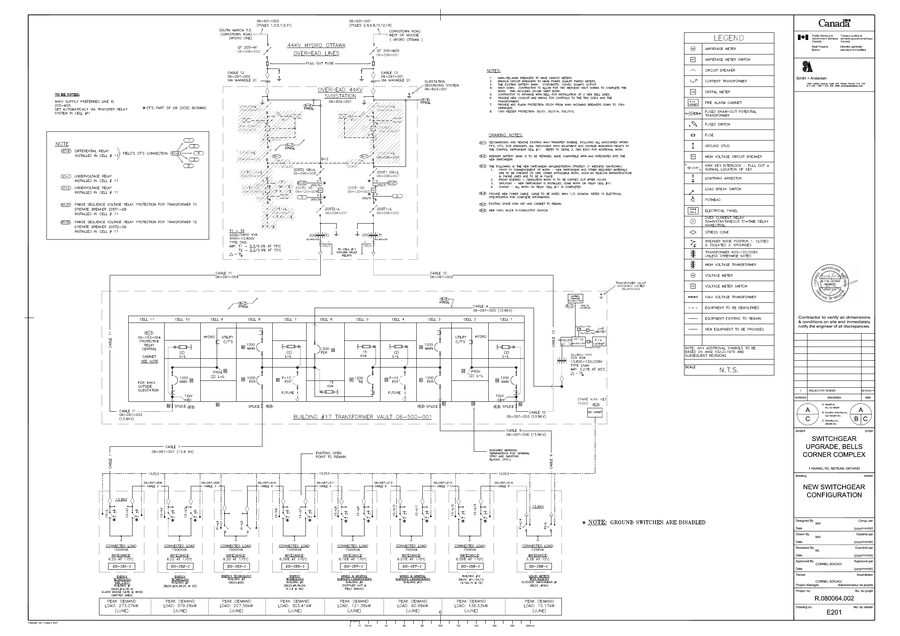
Ottawa, Canada
This package comes from Public Works and Government Services Canada for the KC01 Complex switchgear upgrade, under solicitation EP067-162617 (2016). The drawing shows an 11-cell, 13.8 kV main-tie-main lineup.
- What made it hard: drawing E201 has no text that a computer can copy, and the 79-page Division 26 specification is a scan, so the system had to read every page as a picture.
- What the key checked: the 11 cells and their breakers, the two 5000/5600 kVA transformers and their impedances, the meters and relays, the battery, the building loop and its loads, and the notes.
- Result: every check was right. The run also caught that note 4 asks for two weekend shutdowns while note N-3 plans one, which our key had missed.
- Confirmed contradictions: the specification asks for 90 kV BIL and 60 kV for one minute (section 26 13 13, 2.1), which no standard 15 kV lineup matches, and the two shutdown notes disagree. We checked 2, and both hold.
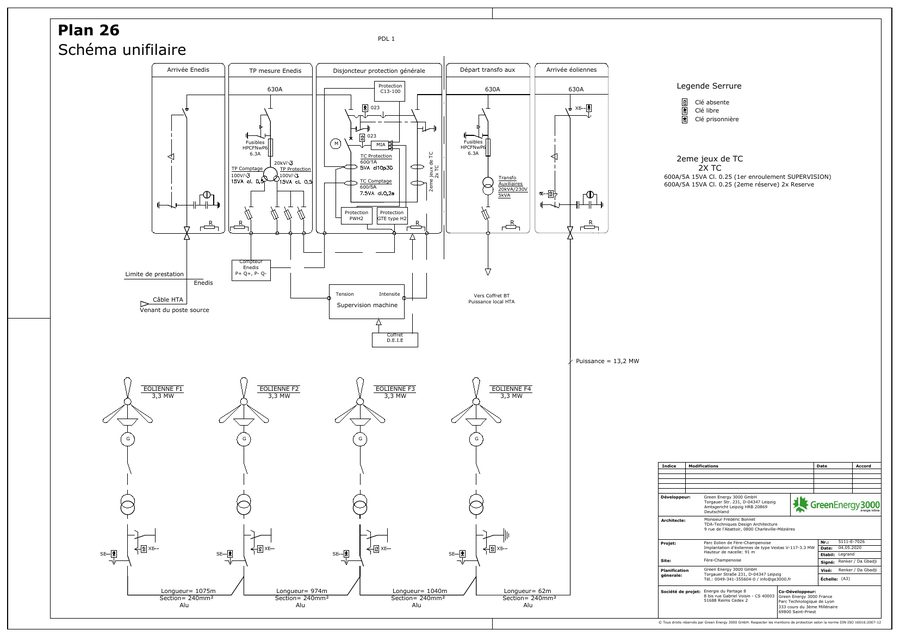
Fère-Champenoise, France
This package is for the Fère-Champenoise wind farm, delivery substation PDL 1, plan 5111-E-7026 (2020), from the public inquiry file of the Marne prefecture (2021). The drawing shows a 5-cell, 20 kV delivery switchboard with four turbines behind it.
- What made it hard: the key-lock symbols are about 1 mm tall on the sheet, so the run had to zoom in to 600 dots per inch to read their states.
- What the key checked: the five cells, the busbar, the voltage and current transformers with their classes, the relays, the auxiliary transformer, the key interlocks and the turbine cables.
- Result: every check was right. The package has no written documents, and the run noted that the sheet looks like a permit drawing.
- Contradictions: with no documents to compare, the run listed 6 places where the sheet seems to disagree with itself. We have not checked these yet.
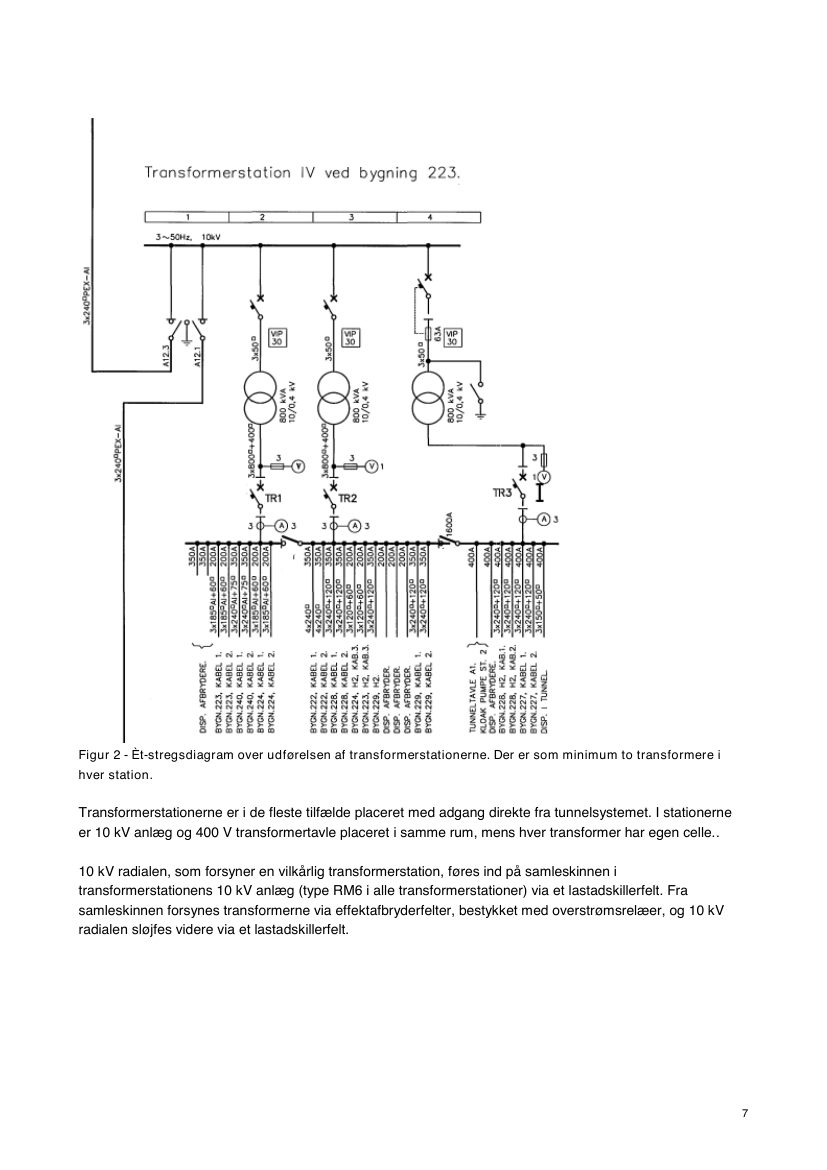
DTU Lyngby, Denmark
This document comes from the Technical University of Denmark, 450 El, Bilag 01, which is the buyer's standard for its campus electrical infrastructure (2018). It is not a request for quotation, and the run said so in its first answer.
- What made it hard: the drawings are small pictures, at about 100 pixels per inch, pasted into a Word document.
- What the key checked: transformer station IV, with its medium-voltage panels, transformers, low-voltage incomers, couplers, outgoing feeders and cables.
- Result: there was one difference. The run read the TR3 feeder as a fuse-switch where our key says breaker. The drawing supports either reading, and the run marked it as unsure.
- Confirmed contradictions: radial 13 on the campus diagram has no stations although the text says every radial carries four to five, the drawing shows 18 station symbols where the text counts 17, the text asks for five-conductor cables where four-wire cables are drawn, and no billing meters are drawn. We checked 5, and 4 hold.
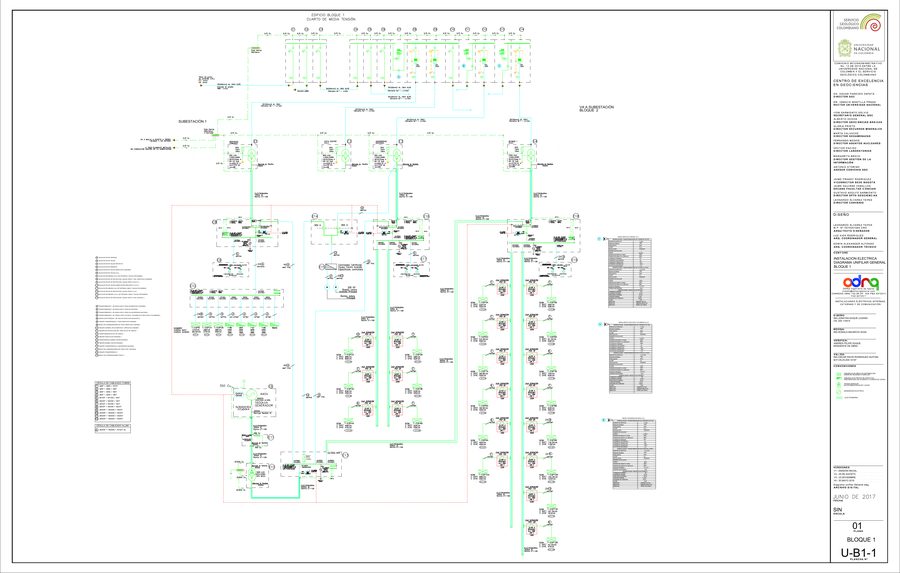
Bogotá, Colombia
These are the Bloque 1 design files (2018) from the Servicio Geológico Colombiano for the Centro de Excelencia en Geociencias. They include two drawings, a 67-page specification and a 73-page calculation report.
- What made it hard: the general diagram is a dense CAD export, and many of its ratings are drawn as graphics rather than text.
- What the key checked: all 14 medium-voltage cells, the metering and protection cells with their fuses, four transformers, the generators, the busways, the transfer boards and the capacitor banks.
- Result: there were two misses. The run did not mention that the equipment list skips E5 and E7, and it left out one 630 A busway rating.
- Confirmed contradictions: the calculation report sizes the transformer fuses roughly the other way round from the drawing (pages 56 to 60), the incoming cable is 3x240 mm² on the drawing and 3x120 mm² in the report, a feeder fused at 30 A in the report is drawn as a plain switch, and the report gives the fault level as both 12.5 kA and 300 MVA, which do not agree at 11.4 kV. We checked 5, and 4 hold.
Oberegg, Switzerland
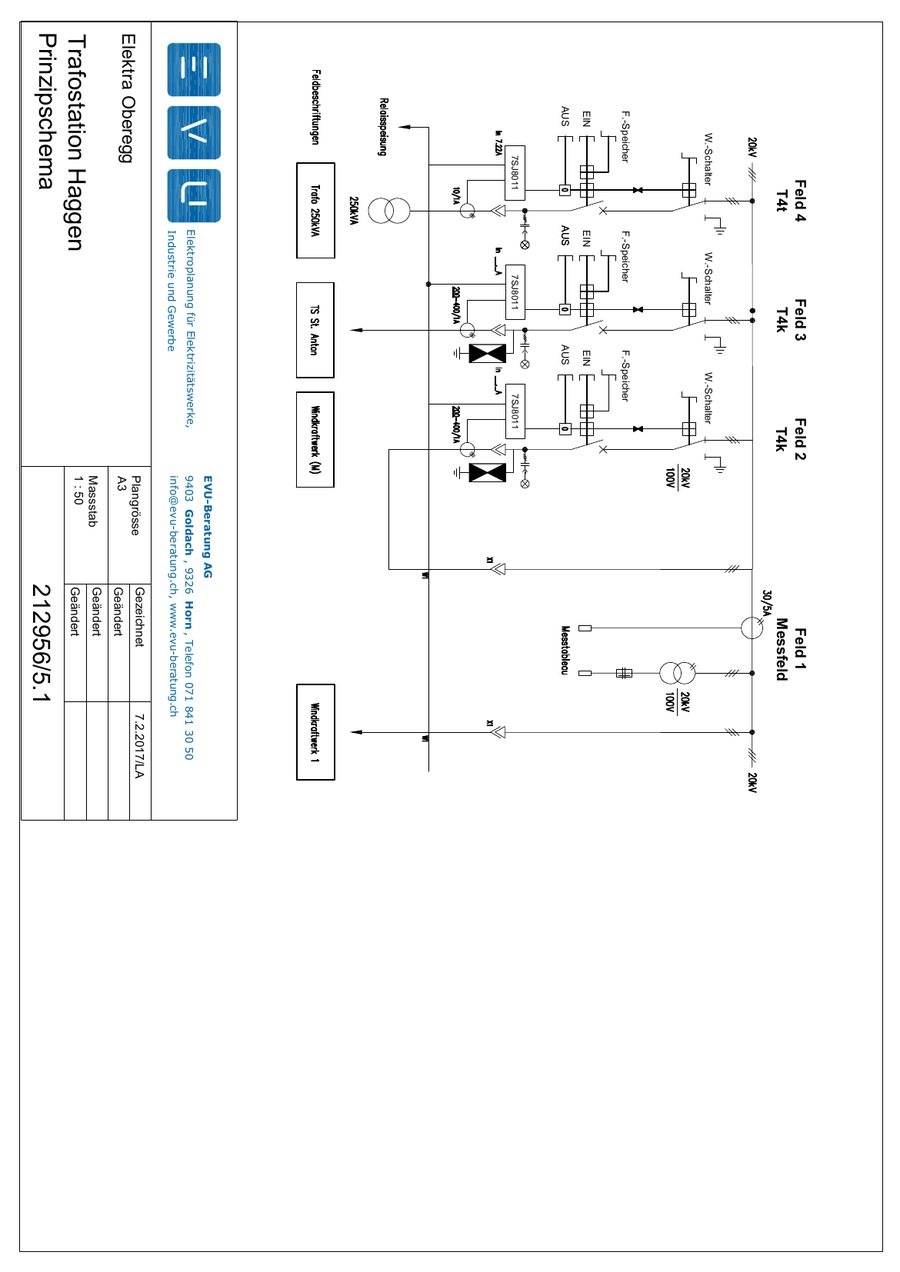
This package covers Elektra Oberegg, Trafostation Haggen, plan 212956/5.1 (2017), along with a utility letter from 2022, both from the Kanton Appenzell Innerrhoden public consultation (2024). It is not a request for quotation, and the run said so.
- What made it hard: the ratings are tiny outlined text, so the run went up from 300 to 600 dots per inch to read them.
- What the key checked: the four panels, the breakers, the relays, the current transformers, the surge arresters and the voltage indicators.
- Result: every check was right. The run also traced the wind feeder's cable through the metering panel.
- Confirmed contradictions: the drawing still shows 30/5 A metering current transformers, while the letter describes two 4.26 MVA turbines that draw about 246 A at 20 kV. Also, the letter says the 2017 request was replaced, but the drawing is dated 2017 and was never revised, and the letter calls for a feeder to MS Dorf and a control interface that the drawing does not show. We checked 4, and all 4 hold.
San Antonio, United States
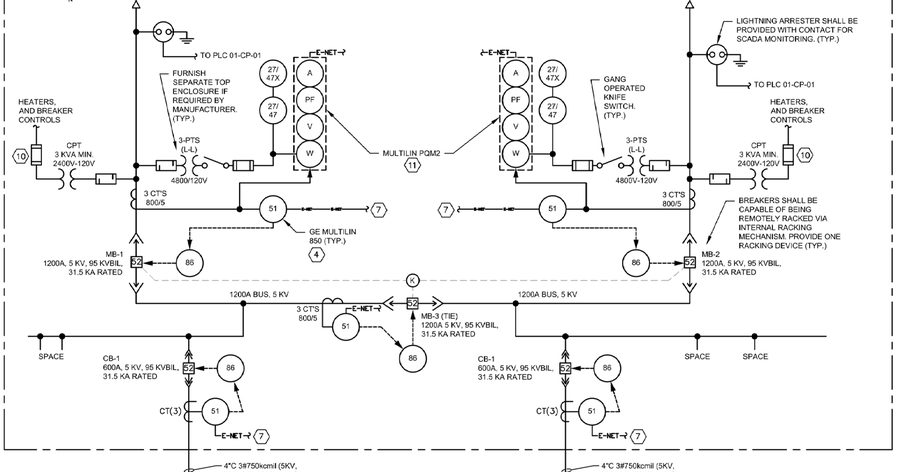
This package comes from the San Antonio Water System, IFB 18-18099, for medium voltage switchgear (2018). The drawing shows a 5 kV main-tie-main lineup with two feeders, inside a 108-page bid set with a 5-page addendum.
- What made it hard: the CAD drawing was saved as a picture at 150 pixels per inch, so none of its text can be copied.
- What the key checked: the lineup, the utility transformers, the mains, the tie and the feeders with their ratings, the relays, meters, current and potential transformers, the cables, the racking and the elevation.
- Result: there was one miss. The run recorded both feeder breakers as CB-1, but it did not point out that the label is used twice. It counted four bus taps where our key counted three labels, and it is right.
- Confirmed contradictions: every breaker on the one-line diagram is marked 95 kV BIL while section 16345, 2.2.A.2 says "BIL Rated: 60kV". In addition, the elevation shows bus potential transformers that the one-line diagram leaves out, and note 2 gives the relay settings to the contractor while section 16345, 3.3.B gives them to the manufacturer's representative. We checked 3, and all 3 hold.
Terni, Italy
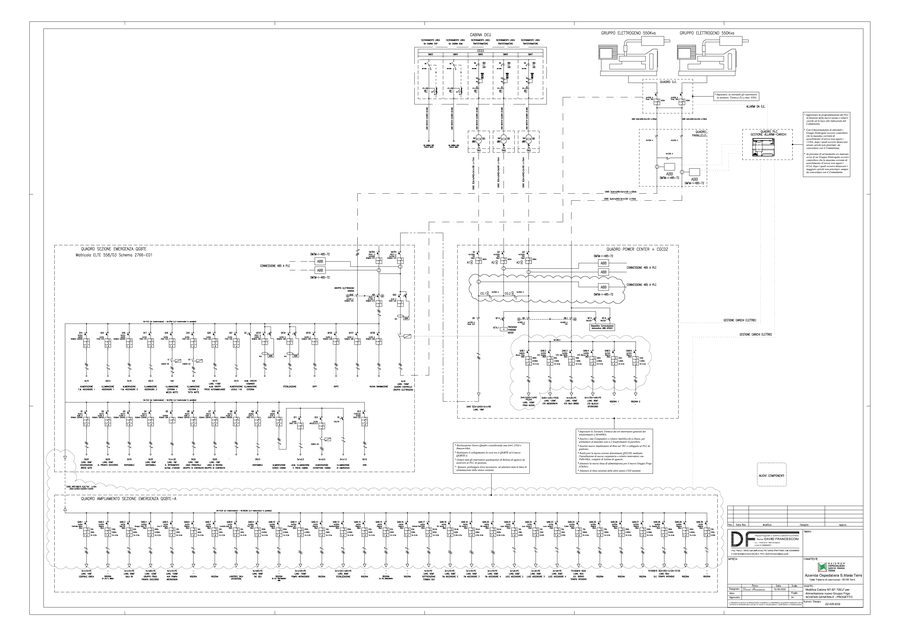
This file comes from the Azienda Ospedaliera Santa Maria di Terni, Delibera 375/2024. It covers an upgrade of the hospital's medium and low voltage substation to feed a new chiller. The single line diagram is on page 228.
- What made it hard: the drawing's text was turned into lines when it was exported, and the 332-page file mixes the board resolution, the specification, the priced bill of quantities and the reports.
- What the key checked: the medium voltage switchboard and its devices, three 630 kVA transformers, the generator and paralleling boards, the Power Center with its couplers, the automatic transfer and the new chiller feeder.
- Result: there was one miss. On the generator paralleling board, the run called two 1250 A switches outputs. They sit where the generator cables come in, so they are incomers.
- Confirmed contradictions: the drawing shows the two new 1600 A bus couplers as switch-disconnectors, while bill of quantities item 15.06.0060.026 prices them as 50 kA circuit breakers. Also, the new chiller breaker is 50 kA on the drawing, but it is 35 kA in item 15.06.0060.023 (page 105). We checked 3, and 2 hold.
Leipzig, Germany
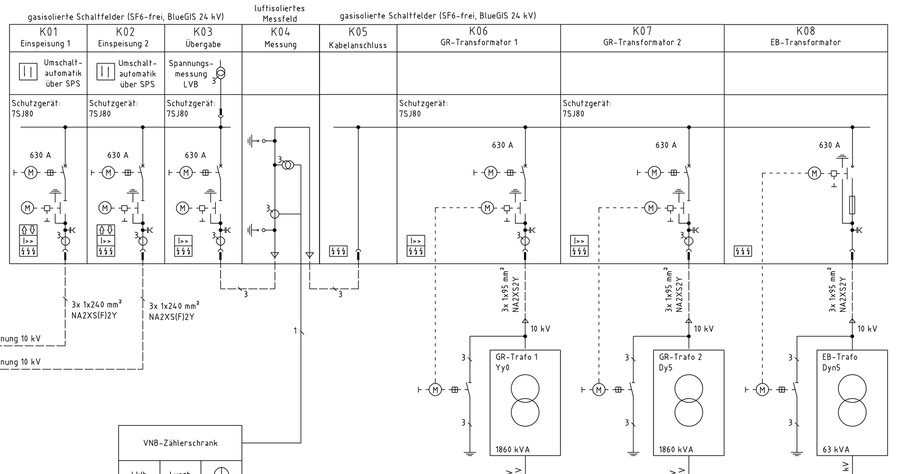
This package comes from Leipziger Verkehrsbetriebe, tender 2026-RL-27-02, lot VE 02. It covers converting the Mockau tram substation to 750 V, with eight medium voltage panels, two rectifiers and the DC switchgear for the tram lines.
- What made it hard: the single line diagram is a picture of a CAD print with no text layer, inside a 28-file German tender with a bill of quantities, a building description and three rounds of answers to bidders.
- What the key checked: all eight medium voltage panels with their devices, relays and cables, the four transformers, the 750 V DC system with its rectifiers, track feeders and ratings, and the auxiliary supplies.
- Result: every check was right. The written documents have a text layer, which is why the run was faster than Ottawa despite the size of the package.
- Confirmed contradictions: panel K08 is marked 630 A on the drawing, while the bill of quantities asks for a 200 A switch-disconnector (page 17), and the bill of quantities asks for a 12 kV breaker inside panels rated 24 kV (page 15). We checked 2, and both hold. The run recorded panel K03 as both a handover panel and a coupler without flagging the difference.
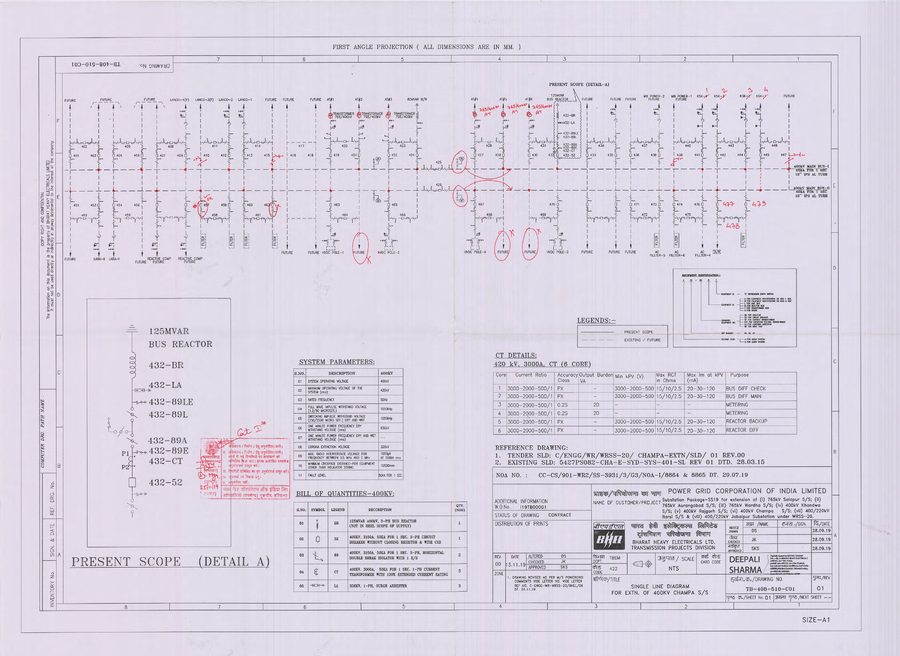
POWERGRID SS-19, India
This is BHEL specification TB-408-510-010 for POWERGRID substation package SS-19, which covers eight substations. The key covers the scanned Champa sheet, which is a 400 kV, 125 MVAR bus reactor bay.
- What made it hard: all 13 single line diagrams are paper scans at 150 to 200 pixels per inch, with fold lines, red pen markups and approval stamps.
- What the key checked: the bay and its equipment chain, the five bill of quantities lines, the system and insulation ratings, the current transformer cores, the existing bays, the handwritten markups, the stamp and the revision.
- Result: there were four misses. The run did not record the isolators' type or the current transformers' 120% extended rating on this sheet, it caught two of three handwritten bay numbers, and it did not list the existing bays. Every rating and device that sets the price was right, and the run noticed that this package buys relay panels and automation, not switchgear.
- Confirmed contradiction: Section I asks for a Wardha reactor bank of three 80 MVAR units, which is 240 MVAR in all (page 5), while the project table lists Wardha as 1 x 330 MVAR (page 31). We checked 1, and it holds.
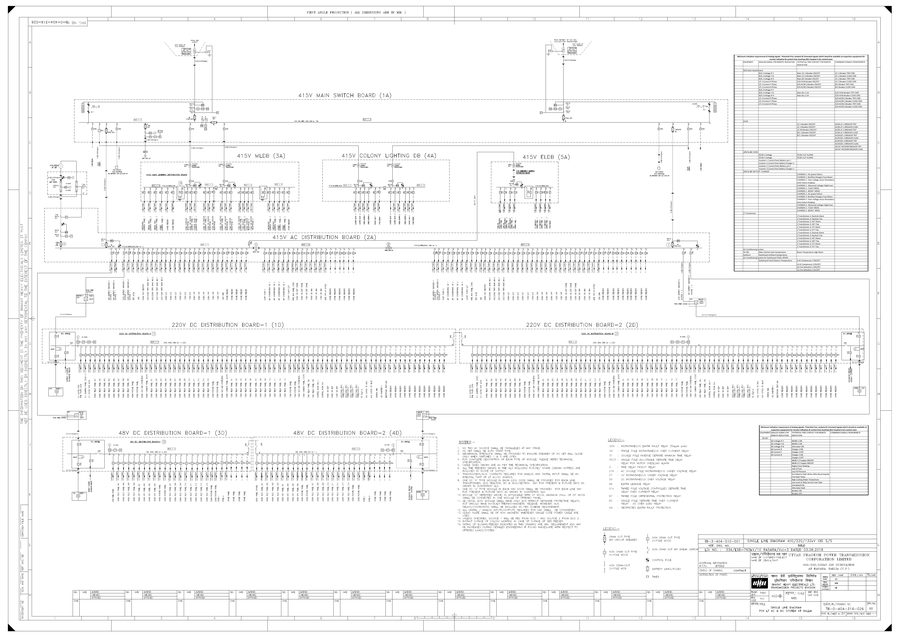
Rasra, India
This is BHEL specification TB-404-316-026, which covers the low voltage AC and DC distribution boards for the Rasra 400/220/132 kV substation. The drawing is a dense CAD sheet saved as a black and white picture and rotated on the page. Its key is ready, and we will add its result here.
Downloads
The answer keys and the scores are free to use under CC BY 4.0. Please cite this page if you use them.
To cite this page:
Changelog
Version 0.9, 17 November 2026. Nine of ten packages run and scored: Ottawa, Fère-Champenoise, DTU Lyngby, Bogotá, Oberegg, San Antonio, Terni, Leipzig and the POWERGRID SS-19 paper scan. Rasra has not been run yet. A sample of the answer keys was spot-checked against the drawings.
Reading the drawing is only the first step of a quote. The AI Quoting Engine then prices every line from your own rates, carries both readings where the documents disagree, and writes the questions for your customer. You can watch it do this on the San Antonio package in a 3-minute video, or see six priced contradictions on the AI bid review for switchgear page.
Book a demo