AI Drawing Intelligence for Manufacturing
AI agents for custom manufacturing.
The complete guide - what custom manufacturing is, why it bleeds time and money, what an AI agent is, why the two are made for each other, real cases, how the agent is built, and why it makes your people worth more.
01 - The ground
What is custom manufacturing?
Custom manufacturing - often called engineer-to-order, or ETO - builds products that are designed or heavily customized for each individual order. There is no catalog part and no standing inventory. Every job begins as a unique drawing set and a specification, and ends as a one-of-a-kind machine, assembly, or component.
It sits at the opposite end of the spectrum from mass production. A consumer-goods plant makes a million identical units and amortizes every cost across the run. A custom manufacturer makes one - a production line, a weldment, a special-steel profile, a machined housing - and has to get the price, the plan, and the part right the first time, with no second unit to learn from.
Who does it
Custom manufacturing is the quiet backbone of the industrial economy:
- Automotive tooling and automation builders - the firms that build the body-in-white lines and robotic cells that assemble every vehicle. A single line is a thirty-to-a-hundred-million-dollar, one-off machine.
- Special-steel and metal fabricators - rolling, cutting and welding profiles and assemblies to a customer’s exact section, often across multiple plants and countries.
- Precision-engineering and machinery groups - fabricating weldments, cast-and-machined parts, and complete process equipment for industries from food to energy.
- Aerospace and defense subcontractors - machining one-off and low-volume parts that must pass first-article inspection against the drawing, characteristic by characteristic.
What unites them is not the product. It is the starting point: a drawing and a spec that a human has to read and turn into a number before anything can be built. That single shared step is where the time goes, where the expertise is locked, and where this guide begins.
02 - The pain
Why custom manufacturing is slow and error-prone
To see exactly where custom manufacturing bleeds, follow one real company through one real quote. The details below come from a conversation with the operations leadership of a seventy-year-old North American automotive tooling builder, headquartered across the river from Detroit and single-sourced to one of the Big Three for its entire history. We’ll call it the builder; the facts are theirs.
What a single quote actually involves
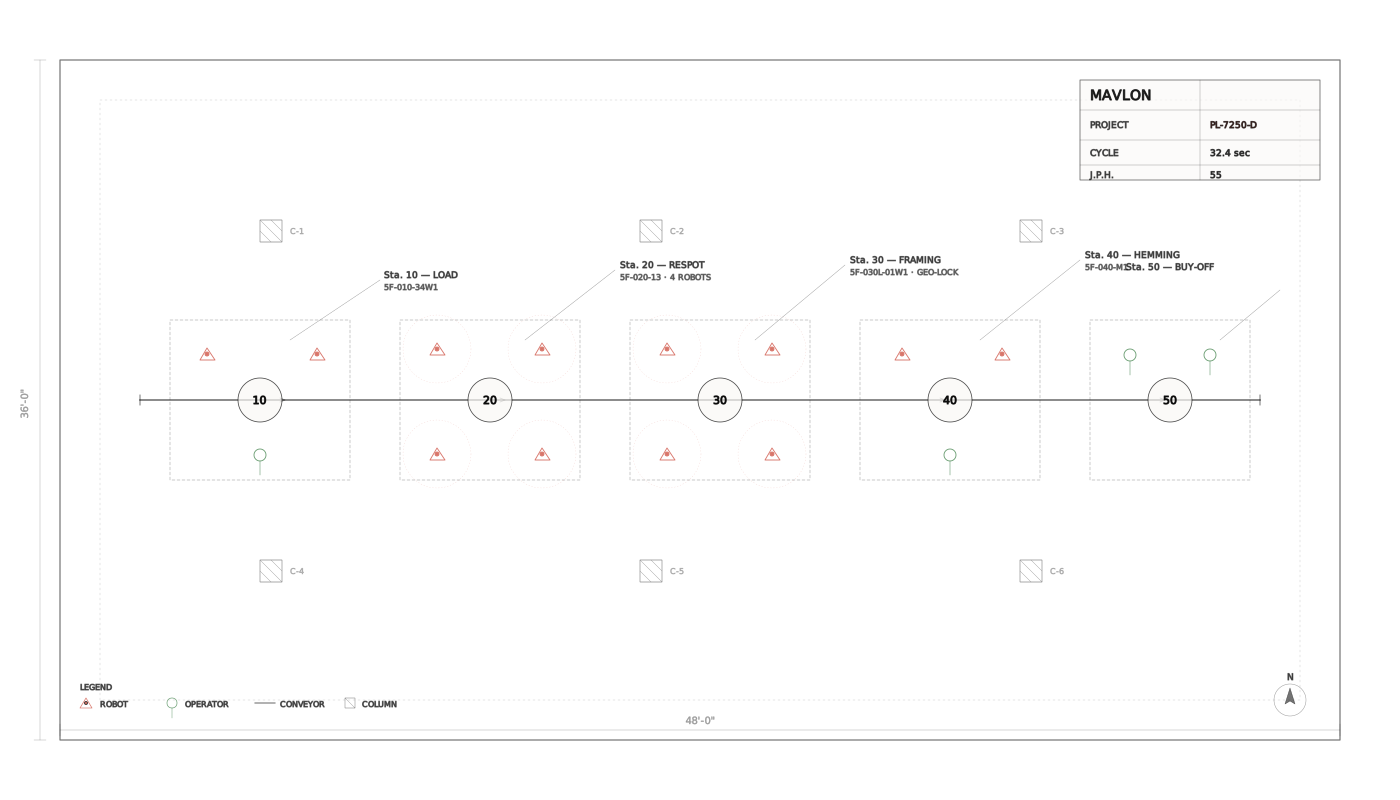
When the carmaker designs a new truck - say the next-generation F-250 - it does not ask the builder for a part. It hands over a plant layout and a fifty-page requirement document, and asks for a production line that can turn out two hundred vehicles a day. The builder has to work out the cells, the cycle time in each cell, the robots and conveyors, and a price. Its jobs run thirty, seventy, a hundred million dollars.
The way that quote gets built is revealing. Highly experienced engineers read the layout and the spec, then assemble a solution from the last job that looked like this one - because an F-250 door line and a half-ton door line are, in the end, mostly the same line; you might just change the gripper that grabs the part. They take three cells from previous jobs and, in their own word, “Frankenstein” them into a new modified layout. That layout becomes the content - twenty-six robots, seventeen conveyors, the X, Y and Z of the line. Estimating prices the material and the labor. The number goes back to the customer, and the negotiation begins. This cycle takes five to six weeks.
Problem one - it is far too slow
The whole quote is a month and a half of one scarce senior engineer’s time. As the builder’s leadership put it: the inputs are known and the outputs are known - so if you could get eighty percent of the outcome in an hour or a day, and let the professionals tweak it to where it needs to be, you could reach the same result in days instead of a month and a half. Feasibility alone is a stack of questions a human has to answer from memory: Have we built something like this before? What did it cost and how long did it take? What went wrong last time, and what did we learn? What’s the probability we can do it - and what alternative can we offer the customer?
Problem two - the correctness problem, and what it costs
Speed is the smaller problem. The larger one is correctness. In the builder’s own words: out of experience, we have made mistakes - we missed an entire cell in the quote on a big job.
“That’s a million-dollar mistake. We eat that million, because we gave Ford the quote and missed the cell - but they expected a functioning line, and we can’t hand them one that doesn’t work.”
- Operations lead, a North American automotive tooling builderAnd there is no slack in the price to absorb it. The margin is a razor: you quote fifty, the customer says it has to be forty-five, you say you can do forty-seven, you almost lose the job, you win it at forty-seven and execute at forty-three. A single misread is not a delay. It is the margin, or the job, or a seven-figure write-off discovered six weeks too late to reprice.
The inputs make it harder still. The layout the builder receives is a PDF built on assumptions that may be wrong. The spec is fifty pages of “thou shalt.” There is often no 3D model - only a 2D drawing and a document, and a human who has to read both correctly. The bottleneck in custom manufacturing is not the welding or the machining. It is the reading, interpreting, and reasoning that one expert must do before any of it can start.
The same problem, one sheet at a time
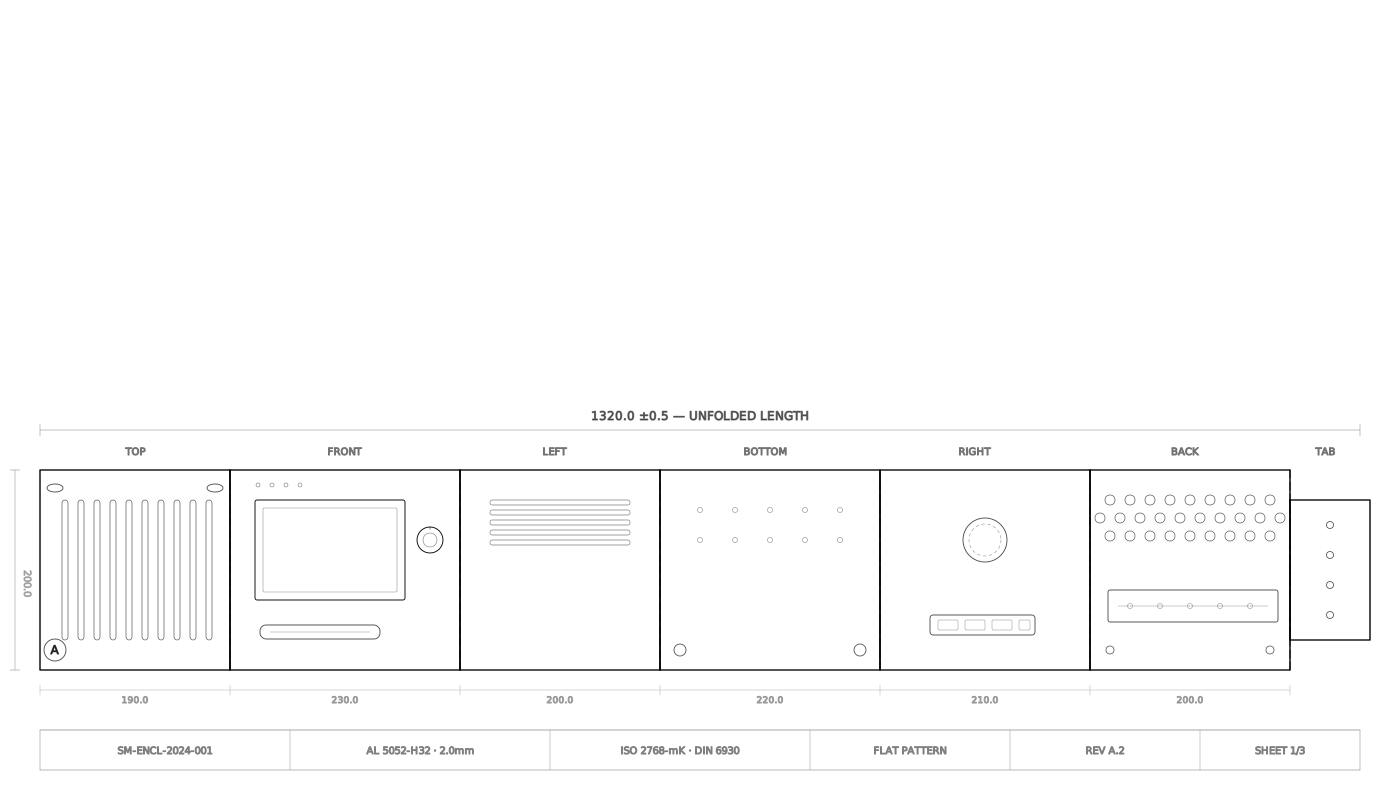
That problem isn’t only about plant layouts and fifty-page specs. On the shop floor it wears the face of a single dense drawing. A lifting-table weldment from a Swiss precision-engineering multinational puts a matrix of tolerance rules in its title block - forming, cutting, welding and machining each governed by a different ISO standard, chosen by material thickness - so that to tolerance one dimension you need three facts the drawing never prints beside the number. We pull that thread all the way in our guide to technical drawing interpretation. It is the same disease: the part can’t move until a scarce human has read something hard, correctly.
03 - The technology, plainly
What is an AI agent?
An AI agent is software that can take in a task, reason about it, draw on memory and tools, and carry out the steps to complete it with only light supervision. The difference from everything that came before is that it acts, not just answers.
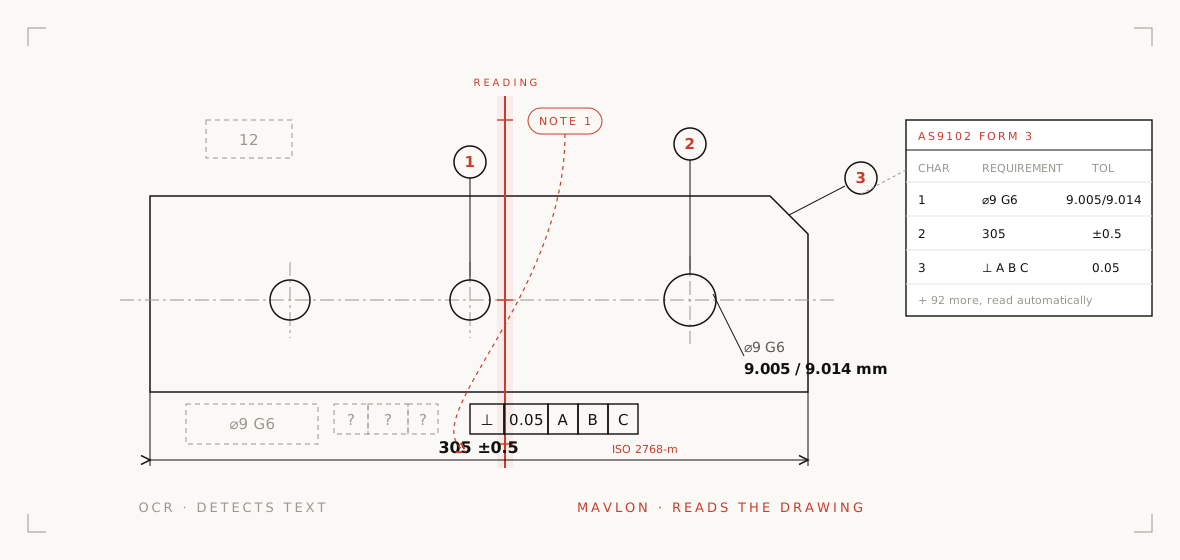
A chatbot responds to a message. OCR detects characters on a page. Robotic process automation runs a fixed script. An agent does something none of them can: it perceives a messy, unstructured input, decides what needs doing, takes the steps - looking things up, running calculations, drafting output - and checks its own work, looping until the job is done.
In a manufacturing setting, a drawing-reading agent behaves like a tireless junior engineer you can run in parallel: it reads the drawing, retrieves the closest past jobs, applies the right standards, drafts the quote or the inspection sheet, and - crucially - flags the parts it is unsure about for a human to decide.
04 - The thesis
Why AI agents and custom manufacturing are a match made in heaven
Custom manufacturing has spent decades unable to automate its first and most expensive step, because that step was judgment over unstructured drawings and specs. Agents are the first technology that can do judgment over unstructured drawings and specs. That is the whole match - and it holds up point by point.
05 - In the field
Real cases: how an AI agent actually helps
Not a demo. Two real companies, two different shapes of the same problem, and exactly where an agent fits.
Case one - the automotive tooling builder’s quote
Start where the builder itself said to start: with one market segment. Its leadership was explicit - the data on a hundred-million-dollar job is enormous, so for a pilot you don’t load everything; you pick one segment, say doors, and load the last three to five door jobs as the memory. From there, an agent does what the senior engineer does, in a day instead of six weeks:
- It strips and indexes the past RFQs into a vector database the company owns and hosts itself - its own decade of jobs becoming the bedrock the system reasons against.
- When a new layout and spec arrive, it matches the job to the closest past jobs and assembles a candidate layout - the “Frankenstein” step, automated - then generates the content: the robot and conveyor count, the cell breakdown.
- It drafts the estimate against the material and labor of comparable past jobs.
- And it runs the correctness check the builder needs most: comparing the new line against precedent to catch the missed cell before it reaches the customer.
Eighty percent of the quote in a day; the senior engineer tweaks the twenty percent that needs judgment; the cycle collapses from six weeks to days - and the seven-figure miss is caught while it’s still cheap to fix. The full breakdown is in our field brief on how AI catches missed cells in tooling RFQs; the product view is body-in-white & production-line quoting.
Case two - the dense drawing nobody wants to interpret
The second case is the shop-floor version. A drawing-interpretation agent takes the kind of bilingual weldment or legacy casting a Swiss precision-engineering group produces, applies the title-block rulebook by process and thickness, captures every GD&T frame and weld symbol whole, expands the fits to real limits, and produces a structured, reviewable result for quoting and inspection. The full dissection - two real drawings, every callout - is in our technical drawing interpretation guide.
The proof it already works
This is not theoretical. A Swiss special-steel multinational, live in production across three plants, now matches a new request for quote against a decade of its own profiles the moment it lands - at roughly eighty-five percent accuracy, and climbing as it learns. Its estimators never leave the inbox they already work in; the agent sits where the work already happens.
06 - Under the hood
How the agent is built: architecture, guardrails, ownership
An agent that quotes hundred-million-dollar jobs cannot be a black box that guesses. Here is the engineering that makes it trustworthy - and the principle underneath it: domain-specific, company-specific, and owned by the customer.
Read left to right, that diagram is the whole design philosophy:
- Narrow, domain-specific agents. Not one giant model guessing at everything - specialized agents that each read one thing well: the title block, a feature control frame, a past-job match. Smaller, testable, and far harder to fool.
- A layered pipeline with deterministic math. Vision finds where to look; a vision-language model interprets meaning; and anything that must be exact - expanding a fit, applying an ISO 2768 class, totalling an estimate - is done in deterministic code, not left to a probabilistic model. Tolerances are not a place to be approximately right.
- Evals that gate quality. Every agent is measured against the customer’s own accepted quotes and inspections before its output reaches a person. Quality is tracked, regressions are caught, and accuracy is a number you can watch climb - the way it climbed past eighty-five percent for the special-steel customer.
- Guardrails and a human in the loop. The agent surfaces its uncertainty instead of hiding it, and the engineer reviews and signs. The signature - and the accountability - stays human, which is exactly what regulated aerospace and defense work requires.
- Open models, fine-tuned on your drawings. The system learns your conventions, not a generic internet average, and you are not locked to one vendor’s closed model.
- Full-stack ownership and security. The enterprise owns its data and its stack; the customer’s past jobs live in a vector database on the customer’s own servers, on-premise where ITAR or defense rules demand it. The vendor provides the core algorithms and the platform - the customer keeps everything else.
- Domain-specific and company-specific. It is tuned to the domain (drawings, GD&T, the ISO standards) and to the company (their conventions, their history as the “bedrock” memory). You start with one market segment for the pilot - because the full data is too big to load at once - and expand from there.
07 - The boardroom case
This isn’t about cutting jobs. It’s about giving your people wings.
The reflex fear about AI in a factory is that it replaces people. In custom manufacturing, that reads the situation exactly backwards. The constraint here is not too many people - it is too few of the right ones. The engineers who can correctly interpret a dense weldment or scope a hundred-million-dollar line are scarce, expensive, and aging out, and you cannot hire your way out of that. An agent does not replace them. It multiplies them.
Read in the language a CFO actually uses, the case is about four numbers:
So the question a CFO should ask is not “how many people does this replace?” It is “how much more is each person worth?” The agent takes your scarcest, most expensive talent off the rote reading that consumes their week and puts them back on judgment, relationships, and winning work. For a custom manufacturer, that is the difference between bidding on the jobs you can staff and bidding on the jobs you want.
Don’t ask how many people it replaces. Ask how much more each person is worth.
Go deeper
AI drawing intelligence, by industry
One problem - reading the drawing - in every segment. Pick yours.
Body-in-white & production line quoting
Read a plant layout and a 50-page spec into a defensible quote - without missing a cell.
Technical drawing interpretation (ISO 2768)
Read the dense, multi-process weldment - apply the title-block rulebook by process and thickness.

AI quoting for special steel & metal fabrication
Match a new RFQ against a decade of your own profiles the moment it lands.
OCR vs AI for auto-ballooning
Why detecting characters and reading a drawing are not the same job.

FAI ballooning & AS9102 software
Every characteristic numbered and sourced for the Form 3, ready to review and sign.
GD&T on the AS9102 Form 3
Feature control frames captured whole - datums in order, inspection method set.
Frequently asked questions
Bring the drawing that scares you.
The fifty-page line. The dense weldment with the rulebook in the corner. Watch an agent read it.
Watch it read a drawing