First Article Inspection Software
First article inspection software
that reads the drawing.
Not just ballooning. It reads the tolerances, the general notes, the GD&T, and the flag notes the other tools make you look up and type by hand - then builds an AS9102 Form 3 you review and sign.
First drawing free · every characteristic numbered · every tolerance sourced.
What a FAIR really is
A First Article Inspection is a promise
that every requirement was met.
Not most of them. Every one. Every dimension, every tolerance, every GD&T callout, every note - found, measured, and recorded against the drawing. That is what your customer is buying when they ask for an AS9102 package, and it is what an auditor checks line by line.
Finding the dimensions is the easy part. The hours and the mistakes are in the interpretation - which general note governs an untoleranced size, what a flag note actually requires, how a fit class expands, what a datum-referenced frame really controls. That reading is the work, and it is the part Mavlon does for you.
What a Mavlon FAIR looks like
An example, not a template.
A real ballooned drawing beside its Form 3 - every characteristic numbered, every tolerance traced to its source. Not a blank you fill in. A finished review you walk through and sign.
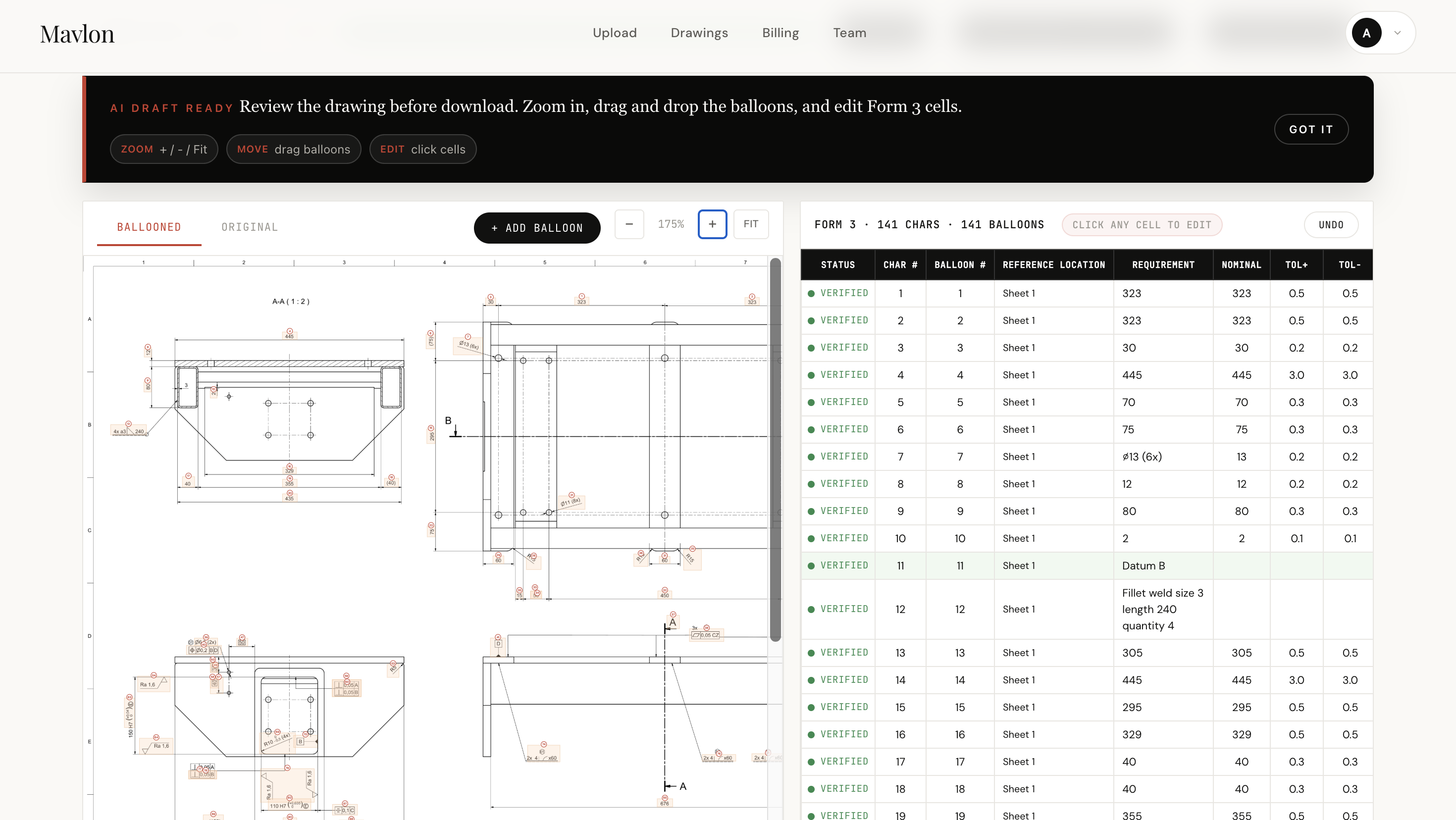
Ballooned drawing · AS9102 Form 3 · every characteristic sourced and reviewable
The three AS9102 forms - and where the work is.
A FAIR is three forms. Two are identification. One is the afternoon.
The long version
What a first article inspection report is, and why the Form 3 is the bottleneck.
A First Article Inspection, or FAI, is the documented proof that the first production part conforms to every requirement on the drawing. In aerospace it follows the AS9102 standard, and the deliverable - the FAIR - is recorded on three standardized forms.
Form 1 identifies the part: number, revision, the package itself. Form 2 records materials, special processes, and functional testing. Both matter, and both are mostly transcription of information you already have. Form 3 is different. It is the characteristic accountability sheet - every dimension, tolerance, GD&T callout, surface finish, and note on the drawing, each given a balloon number and an inspection result. On a real aerospace part that is dozens or hundreds of rows, and building it is the part of FAI that takes hours and carries the risk.
Why an example is worth more than a template
Searching for a first article inspection report example usually means one thing: you want to see a finished one, not a blank to fill. A template tells you the columns. An example tells you what good looks like - characteristics numbered cleanly, tolerances sourced to their notes, GD&T captured with datums, nothing missed. That is what Mavlon produces, from your own drawing, in minutes.
Detection is not interpretation
Most first article inspection software runs on OCR. It detects the characters on the drawing - it can put the text “12.5” in a balloon - and then leaves the thinking to you: which general note governs that dimension, what tolerance it carries, what the flag note requires. Mavlon reads the drawing the way your quality engineer does. It applies the ISO 2768 general note to the untoleranced size, expands a fit class to real limits, captures a feature control frame with its datums in full, and carries a note across sheets to the feature it governs. OCR vs reading a drawing →
What Mavlon does, and what stays yours
Mavlon reads the drawing and builds the Form 3, then hands the drawing back and walks you through it, section by section, so you confirm every characteristic before you sign. The package comes together around a Form 3 that is already interpreted, not just typed. The reading is done; the accountability stays yours. See how the ballooning works →
7-sheet bracket
Form 3 draft
and applied for you
Upload the drawing that scares you.
The dense multi-sheet bracket with the buried notes and the flag callouts. Watch it read every characteristic into an AS9102 Form 3, ready to review.
First one is free. No card, no setup.